
TL;DR:
- Cannabis marketing regulations are complex and vary significantly across jurisdictions, requiring thorough research and documentation.
- Build a compliance framework with claims-to-evidence matrices, SOPs, and regular audits to ensure ongoing adherence.
If you market cannabis products, you already know the rules are not straightforward. Knowing how to handle cannabis marketing regulations means understanding a patchwork of federal restrictions, state laws, platform policies, and local rules that can shift with little warning. Get it wrong and you risk fines, license suspension, or forced ad removal. Get it right and you build a brand that grows sustainably and earns consumer trust. This guide walks you through the foundational knowledge, preparation steps, execution controls, and ongoing monitoring practices that make compliant cannabis marketing possible in 2026.
| Point | Details |
|---|---|
| Know your jurisdiction’s rules | Cannabis advertising guidelines differ significantly by state and country, so always research the specific laws that apply to you. |
| Build a compliance framework first | Map every marketing claim to its legal basis before launching any campaign or content. |
| Treat age-gating as a system | Age verification must be documented with verifiable controls, not treated as a simple website toggle. |
| Platform policies are separate hurdles | Major ad platforms ban most cannabis ads regardless of legality, so organic and owned channels are your primary growth tools. |
| Ongoing audits protect your license | Regular compliance reviews catch issues before regulators do, reducing your exposure to penalties. |
Before you write a single ad or social post, you need a clear picture of the regulatory environment you are operating in. Cannabis marketing regulations are not uniform. They vary by state, country, and sometimes even by municipality.
Here are the most common regulatory themes you will encounter across U.S. states and Canada:
Canada operates on a different but equally strict framework. The Cannabis Act generally prohibits promotion except under narrow exceptions for informational and brand-preference content, and even those exceptions require strict access controls to prevent youth exposure.
Understanding cannabis advertising laws also means recognizing that delivery method matters. Canada’s Cannabis Act requires reasonable steps to prevent youth access when using telecommunications for promotional content. Many marketing teams miss this entirely, focusing only on ad content while ignoring how it gets delivered.
Pro Tip: Create a jurisdiction file for every market you operate in. List the specific regulations, required disclosures, and prohibited content types in one place. Update it quarterly, because laws in this space change fast.
Preparation is where most cannabis marketers lose before they even start. Reacting to regulations after you have already built a campaign is expensive and risky. Here is how to front-load the compliance work.
Conduct jurisdiction-specific legal research. Pull the actual regulatory text for each state or country you market in. Do not rely on summaries alone. Bookmark official sources like your state’s Office of Cannabis Management or Health Canada’s guidance pages.
Build a claims-to-evidence matrix. This is a document that links every marketing claim you plan to make to the legal rule that permits it and the evidence that supports it. For example, if you say “lab-tested,” you need documentation proving that claim meets your state’s standards. This matrix becomes your first line of defense during a regulatory inspection.
Map your distribution channels. Not all channels carry the same risk profile. Organic social content, email marketing to opted-in subscribers, and your own website operate differently than paid ads. Understand platform-specific restrictions before you allocate budget. Google Ads and Meta prohibit most cannabis product promotions regardless of whether your state has legalized cannabis.
Develop internal SOPs. Standard operating procedures for content creation, review, and approval protect you when staff changes happen. Your SOP should specify who reviews each asset, what checklist they use, and how approvals are documented.
Build a compliance checklist for each channel. A social post checklist looks different from a billboard checklist or an email checklist. Tailor your controls to the specific risks of each format.
Pro Tip: When you build your claims-to-evidence matrix, include a column for “regulatory risk level.” Rate each claim as low, medium, or high risk based on how likely it is to attract scrutiny. Review high-risk claims with a cannabis attorney before publishing.
With your framework in place, you can move into campaign execution. This is where operational discipline separates brands that stay compliant from those that get caught off guard.

Every piece of content should pass through at least two review stages before it goes live. The first is an internal marketing review for brand consistency and messaging accuracy. The second is a compliance review against your checklist and applicable regulations. For higher-stakes campaigns like broadcast or out-of-home advertising, adding a third legal review is worth the cost.
Here is the execution sequence that works:
When it comes to paid advertising, the honest truth is that your options are limited. Most paid placements on major platforms are not available to cannabis brands. This is why best practices for cannabis marketing consistently point toward organic content, local SEO, and owned media as your primary growth channels.
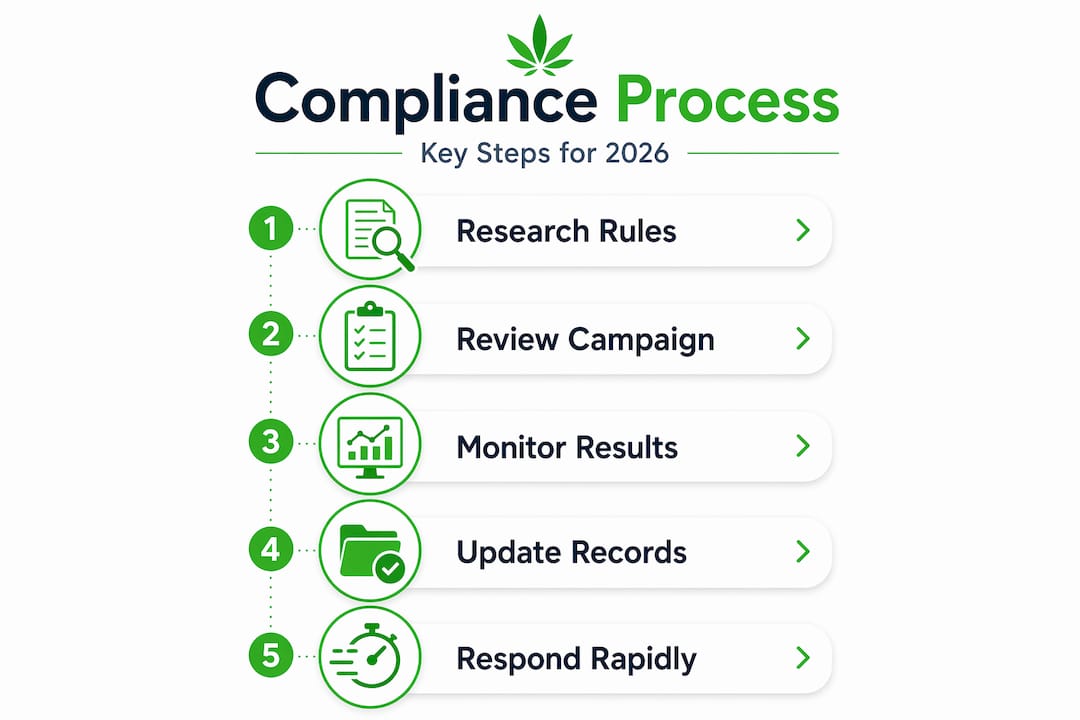
Compliance is not a one-time checkpoint. It is an ongoing operational process. The table below outlines the core monitoring activities every cannabis marketer should have in place.
| Activity | Frequency | Purpose |
|---|---|---|
| Campaign compliance audit | Monthly | Review active campaigns against current regulations |
| Audience composition check | Per campaign | Verify that ad audience demographics meet age requirements |
| Platform policy review | Quarterly | Check for changes to Google, Meta, and other platform rules |
| Regulatory update scan | Monthly | Monitor state and federal law changes affecting marketing |
| Records and approval log review | Quarterly | Confirm documentation is complete and audit-ready |
| Legal counsel check-in | Semi-annually | Validate that SOPs and checklists reflect current law |
Non-compliance can lead to fines, license suspension, and forced ad removal. Regulators have authority to require immediate discontinuation of non-compliant campaigns. Staying ahead of this through regular audits is far less costly than responding to an enforcement action.
When you receive a regulatory request or takedown notice, respond immediately. Designate one person internally who owns regulatory correspondence. A slow or disorganized response signals that you do not take compliance seriously, which often worsens outcomes.
Even well-intentioned marketing teams make avoidable mistakes. Here are the most common issues Dopeseo sees in cannabis marketing, along with specific ways to address them.
Pro Tip: Review your cannabis advertising guidelines checklist every time you enter a new market or launch a new product line. The rules you followed in one state often do not transfer directly to another.
I have worked with cannabis businesses long enough to see a clear pattern. The brands that treat compliance as a burden end up in one of two places: scrambling to fix problems after regulators come knocking, or pulling back from marketing altogether out of fear. Neither outcome builds a business.
What I have found actually works is treating compliance as an operational discipline, not a legal afterthought. The companies that do this well build their compliance framework into their content production process from day one. They do not review for compliance at the end. They build compliance into the beginning.
There is also an underrated benefit to thorough documentation. When your records are clean and organized, you build credibility with regulators over time. I have seen businesses with excellent documentation records receive more favorable treatment during audits simply because they came prepared. That kind of trust takes years to build and is genuinely valuable.
The other thing I push clients on is channel diversification. The cannabis digital advertising environment is restrictive by design. Instead of fighting against platform restrictions, put your energy into organic search, local SEO, and email. These channels give you sustainable reach without the constant threat of account suspension. Compliance and smart channel strategy are not in conflict. They reinforce each other.
— Max
Keeping up with cannabis marketing compliance while also growing your online presence is a real operational challenge. At Dopeseo, we specialize in helping cannabis businesses do both. We understand the regulations, platform restrictions, and local market dynamics that shape every marketing decision in this industry.
Our team helps dispensaries, cultivators, and manufacturers build compliant SEO strategies that drive organic traffic without triggering platform penalties or regulatory issues. From website compliance audits to content creation that meets jurisdiction-specific rules, we handle the details so you can focus on your business. If you are ready to grow your online presence within the rules, explore our cannabis advertising guidance and see how a specialized partner makes the difference.
Most jurisdictions require age-restricted audiences, prohibit unsubstantiated health claims, mandate specific warning language, and ban content that appeals to minors. Always check the specific rules for your state or country, as requirements vary significantly.
Conduct jurisdiction-specific legal research for each state and build a compliance checklist tailored to each market. Rules around audience composition, required disclosures, and prohibited content differ by location, so a one-size-fits-all approach creates real legal risk.
Yes, in practice. Google, Meta, and most major ad platforms prohibit cannabis product advertising regardless of state legality. Compliance in cannabis marketing means satisfying both legal requirements and platform policies as separate, independent standards.
You should maintain approval logs for all advertising, audience composition data for each campaign, and documentation of your age verification controls. New York’s Part 129 places the burden of proof on licensees to demonstrate compliance upon request.
Regulators can require immediate removal of non-compliant advertising, issue fines, and in serious cases pursue license suspension. Responding promptly to any regulatory notice and maintaining clean records is the best way to limit the damage if a violation occurs.

© 2026 Curious Monkeys Pressing Buttons LLC DBA Cannabiz Marketing Solutions AKA DopeSEO. All rights reserved.