
Launching a dispensary website often brings a mix of excitement and anxiety as you face strict regulations and fierce competition. For American cannabis business owners, staying ahead means balancing visibility in local search with bulletproof compliance. This guide breaks down practical steps to strengthen your site with regulatory adherence and optimized technical foundations so you stand out online while protecting your operations from costly errors.
| Key Point | Explanation |
|---|---|
| 1. Understand Compliance Requirements | Review local regulations for cannabis websites to avoid legal issues and ensure your site is compliant from launch. |
| 2. Optimize for Mobile Experience | Ensure your website is mobile-friendly to enhance accessibility and boost conversion rates since most customers shop on phones. |
| 3. Maintain Accurate Business Information | Keep your Google Business Profile and NAP consistent across platforms to improve local search visibility and build trust with customers. |
| 4. Generate Local Customer Reviews | Encourage satisfied customers to leave reviews which will enhance your local SEO rankings and credibility in the community. |
| 5. Perform Regular Compliance Audits | Conduct quarterly audits to ensure ongoing compliance with legal standards and adjust your website based on regulatory changes. |
Before you launch or optimize your dispensary website, you need to understand what compliance and technical standards your site must meet. This step ensures your website aligns with both regulatory requirements and the foundational infrastructure that search engines favor. Getting this right prevents costly rewrites later and protects your business from penalties or operational disruptions.
Start by reviewing your jurisdiction’s specific compliance requirements for cannabis businesses. Different states and local jurisdictions have varying regulations around how dispensaries can operate online, what information they can display, and how they must handle customer data. Some states restrict certain features like online ordering, while others require age verification systems or specific disclaimers on every page. Document these requirements in a spreadsheet so you have a clear checklist to reference as you evaluate your website.
Next, examine your current technical infrastructure. This includes your hosting environment, database security, and overall website performance. Your site needs a compliant POS system integration, secure network infrastructure, and proper data protection measures that meet both industry standards and legal requirements. Take stock of what you currently have in place:
Once you understand the regulatory landscape and your technical foundation, conduct an audit of your website’s current compliance posture. Walk through your site as a customer would and document any pages that might violate local rules. Check your contact pages, product displays, age gate implementations, and checkout processes. Look for any language or claims that could trigger regulatory issues, such as health claims about cannabis products or unclear age verification messaging.
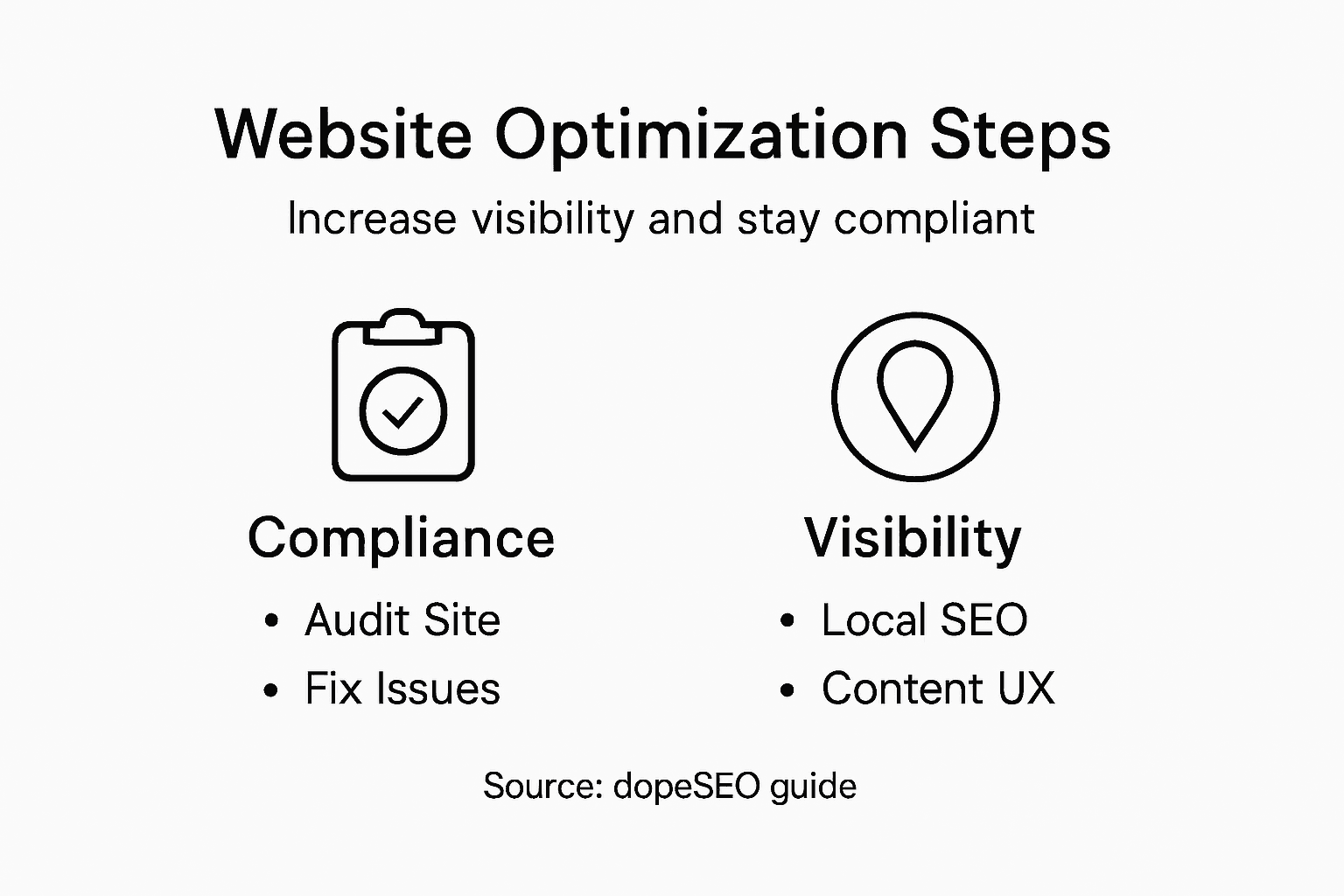
Technical compliance also means your website must perform well. Technical SEO factors directly impact how search engines crawl and rank your site, which influences your visibility to potential customers. A slow website, broken links, or poor site structure can tank your rankings regardless of how great your content is. Test your site’s speed using free tools, check for broken links, and ensure your navigation structure makes sense both for users and search engines.
Create a prioritized remediation list based on severity. Separate critical compliance issues (things that could get you fined or deplatformed) from technical improvements that will enhance performance and rankings. Critical items might include data security gaps, regulatory language problems, or age verification failures. Performance improvements like image optimization or removing duplicate content are important but can wait if resources are limited.
Here’s how common compliance and technical website elements impact dispensary operations:
| Element | Business Impact | Compliance Risk if Missing |
|---|---|---|
| Age Verification | Blocks underage users | High (legal penalties, fines) |
| SSL Encryption | Secures customer data | High (data breach risk) |
| POS System Integration | Enables legal sales tracking | Medium (regulatory issues) |
| Mobile Responsiveness | Improves user experience | Low (mainly conversion loss) |
| Hosting Uptime | Reduces downtime risks | Medium (lost revenue) |
Your compliance and technical foundation isn’t a one-time fix—it’s the bedrock that prevents problems and supports growth as your business scales.
Pro tip: Schedule a quarterly compliance review where you check for regulatory changes in your jurisdiction and test critical technical functions like age gates, payment processing, and mobile performance to catch issues before they impact customers or compliance.
Local SEO is where your dispensary gains visibility when potential customers search for cannabis products in your area. This step focuses on making sure your business shows up prominently in local search results, Google Maps, and location-based queries that matter most to your bottom line. When someone searches “dispensary near me” or “cannabis shop in Denver,” you want your business front and center.

Start by claiming and optimizing your Google Business Profile, which is your digital storefront in local search. This single listing influences how you appear in Google Maps, local search results, and even Google’s knowledge panel. Verify your business information is 100 percent accurate including your full address, phone number, hours of operation, and business category. Use the primary category “Cannabis Retail Store” and add relevant secondary categories if available. Upload high-quality photos of your storefront, interior, products, and team. The more visual content you provide, the more trustworthy and established your business appears to both Google and potential customers.
Next, ensure your NAP consistency across all online platforms. NAP stands for Name, Address, and Phone number, and it’s critical for local rankings. When Google finds conflicting information about your business across different directories and websites, it becomes uncertain which listing is correct, which hurts your rankings. Audit every platform where your business appears including Yelp, Apple Maps, Waze, industry-specific dispensary directories, and local chamber of commerce listings. Correct any inconsistencies immediately, and going forward, use exactly the same format for your address and phone number everywhere.
Build a foundation of local citations by getting your business listed in high-authority directories specific to the cannabis industry. Local citations are mentions of your business on other websites, and they signal legitimacy to search engines. Focus on directories with good domain authority and relevance to cannabis retail. Some directories may have restrictions based on your location and local regulations, so research what’s available in your area. Quality matters more than quantity here, so target 10 to 15 reputable directories rather than trying to submit to hundreds of low-quality sites.
Encourage and manage customer reviews strategically. Reviews are a major ranking factor for local search, and they directly influence whether potential customers trust your business enough to visit. Ask satisfied customers to leave reviews on Google, Yelp, and Waze. Make it easy by providing direct links to your review pages. When customers leave negative reviews, respond professionally and offer to resolve their concerns offline. This shows other potential customers that you take feedback seriously. Aim for at least one new review per week to show Google that your business is active and engaged.
Create location-specific content on your website that targets local search intent. Write about your neighborhood, local cannabis culture, events in your area, or community involvement. Pages targeting specific neighborhoods or nearby towns help you rank for “dispensary in [neighborhood]” type searches. Incorporate local keywords naturally into your page titles, meta descriptions, and header tags, but avoid keyword stuffing. Implementing local search strategies effectively requires balancing optimization with readability and genuine value for your audience.
Build local backlinks by partnering with other local businesses and organizations. Reach out to complementary businesses like wellness clinics, CBD shops, or local media outlets and ask for links from their websites. Sponsor local events or nonprofits in exchange for a mention and link from their site. Local backlinks carry significant weight in local search rankings and reinforce your connection to your community.
The chart below summarizes local SEO tactics and their core benefits:
| Local SEO Tactic | Main Benefit | Example Platform |
|---|---|---|
| Google Business Profile | Boosts map & local results | Google Maps |
| NAP Consistency | Increases trust signals | Yelp, Waze |
| Local Citations | Builds online authority | Cannabis-specific directories |
| Customer Reviews | Improves rankings and trust | Google, Yelp |
| Local Backlinks | Strengthens community ties | Local media, clinics |
Your local SEO foundation should feel like a living system, not a one-time setup. The businesses that dominate local search results are the ones actively managing and updating their local presence every month.
Pro tip: Set up Google Alerts for your business name and key local competitors to monitor who’s mentioning you online and catch opportunities for new local citations and backlinks before your competitors do.
Your website content is the bridge between what customers are searching for and the products or services your dispensary offers. This step focuses on creating content that not only ranks well in search engines but also resonates with your audience, builds trust, and encourages them to visit or make a purchase. The goal is to balance educational value, regulatory compliance, and genuine engagement.
Start by understanding your audience’s actual questions and pain points. Cannabis consumers search for information about product types, effects, consumption methods, dosing, and how different strains might help with their specific needs. They also want to know about your dispensary’s selection, pricing, location, and customer service. Use Google’s “People Also Ask” section, search suggestions, and customer reviews to identify the questions your target audience is asking. Create content that answers these questions directly and honestly. A page about the differences between Indica and Sativa strains, for example, attracts customers actively considering their options.
When writing cannabis content, you must navigate strict regulatory boundaries while still being engaging and valuable. Cannabis content marketing requires balancing educational value with compliance restrictions to maintain both search visibility and legal safety. Avoid making health claims or suggesting cannabis can treat medical conditions unless your state explicitly allows it and you have proper licensing. Focus instead on factual information about cannabinoids, terpene profiles, product origins, and customer testimonials that don’t cross into medical territory. Your tone should feel knowledgeable and trustworthy without being preachy or overly promotional.
Create diverse content formats that appeal to different learning styles and increase engagement. Blog posts work well for educational topics, but don’t stop there. Consider adding these content types to your strategy:
Optimize your content for both search engines and human readers by incorporating relevant keywords naturally. Include your local area in your content when appropriate (“Best cannabis dispensary in Portland” rather than generic “best cannabis dispensary”) to capture location-specific searches. Use your target keywords in your page title, first paragraph, and headers, but never force them in ways that sound awkward or unnatural. Readers can tell when content is written for robots rather than people, and Google rewards natural, readable content with better rankings.
Make your content visually scannable and easy to digest. Use short paragraphs, bullet points, and clear headers so readers can quickly find the information they need. Many people browse on mobile devices while shopping, so they’re scanning content rather than reading word-for-word. Break up long text blocks with images, product photos, or white space. Include a strong call-to-action at the end of each piece, whether that’s “Visit us in-store to explore these strains,” “Browse our full selection,” or “Call to speak with a product specialist.”
Update and refresh your existing content regularly. Cannabis information evolves as research emerges and regulations change. Review your top-performing pages every quarter and add new information, update product availability, or improve the overall quality. Fresh content signals to Google that your site is actively maintained, which improves rankings over time.
Content engagement isn’t about creating the most content, it’s about creating the most useful content for the specific customers you’re trying to reach.
Pro tip: Create a content calendar tied to your sales cycles and local events—seasonal content about summer outdoor consumption methods or holiday gift guides performs exceptionally well and drives traffic during high-intent periods.
Your website’s user experience directly determines whether visitors become customers or bounce to a competitor. This step focuses on removing friction from your customer’s journey, making it easy for them to find products, get information, and take action. When your website feels intuitive and trustworthy, conversions follow naturally.
Start with mobile optimization because most cannabis shoppers browse on their phones. Test your website on various devices and screen sizes to ensure everything works smoothly. Buttons should be large enough to tap easily, text should be readable without zooming, and images should load quickly. Mobile visitors often have limited patience, so they need to accomplish their goals in seconds, not minutes. Check your site’s mobile performance using Google’s Mobile-Friendly Test tool and address any issues it flags. A slow or broken mobile experience kills conversions regardless of how great your products are.
Simplify your navigation structure so customers can find what they’re looking for without getting lost. Good dispensary website UX includes intuitive navigation and clear product displays to guide customers through their journey efficiently. Organize your menu logically by product type (flower, edibles, concentrates, accessories), effects, or price range depending on what matters most to your customers. Include a search function that actually works and returns relevant results. Avoid cluttering your homepage with too many options, which overwhelms visitors and makes decisions harder. Instead, guide them toward your bestsellers, featured products, or seasonal items.
Optimize your product pages for conversion by making them informative and easy to scan. Each product should include clear photos from multiple angles, a concise description of effects or benefits, THC and CBD percentages, price, and availability status. Include customer reviews or ratings if you have them, as social proof dramatically increases conversion rates. Make your call-to-action obvious and compelling, whether that’s “Add to Cart,” “Check Availability,” or “Schedule a Consultation.” Don’t make customers guess whether a product is in stock or how they can purchase it.
Reduce friction in your checkout and purchase process. Customers should never feel confused about how to buy from you. If you offer online ordering, make the process straightforward with minimal steps. If you require in-store visits, make your location and hours crystal clear and consider offering online ordering for in-store pickup. Include age verification prominently but don’t make it feel invasive. Display your policies on returns, delivery, and payment methods upfront so customers aren’t surprised.
Improve your site’s loading speed because even one-second delays reduce conversions. Compress your images, minimize unnecessary code, and consider using a content delivery network if you operate in multiple locations. Use Google PageSpeed Insights to identify specific bottlenecks and fix them. Fast websites also rank better in search results, so you get a double benefit from optimization.
Build trust through transparent information and professional design. Display customer testimonials, your team’s expertise, community involvement, and compliance certifications. Make it easy for customers to contact you with questions through multiple channels. Ensure your design looks professional and current, not outdated or amateur. Trust takes time to build but seconds to lose, especially in the cannabis industry where customers are cautious about where they shop.
A beautiful website means nothing if customers can’t find what they need or don’t trust your business enough to complete a purchase.
Pro tip: Use heat mapping tools like Hotjar or Microsoft Clarity to see where visitors click, scroll, and get stuck on your site, then prioritize fixes based on actual user behavior rather than assumptions about what works.
Your website’s search visibility means nothing if your business isn’t legally compliant or your rankings suddenly disappear due to regulatory violations. This step ensures your SEO efforts stay within legal boundaries while you monitor whether your optimization work is actually moving the needle in search results. Think of this as your quality assurance checkpoint.
Start by tracking your search rankings for the keywords that matter most to your business. Set up tracking for local keywords like “cannabis dispensary near me,” “buy cannabis in [your city],” and branded searches like “[your dispensary name].” Use free tools like Google Search Console to see which keywords bring traffic to your site and where you rank for them. Google Search Console shows you your average position for each keyword, how many times you appeared in search results, and your click-through rate. This data tells you which optimization efforts are working and where you need to improve. Track your rankings weekly or monthly depending on how competitive your market is, and document progress in a spreadsheet so you can spot trends over time.
Monitor your local search visibility by checking your Google Business Profile performance. Google Business Profile shows you how many people searched for your business, viewed your photos, called your phone number, and visited your website. Compare these numbers month over month to see if your local SEO efforts are increasing customer interest. If impressions are flat or declining, it signals you need to adjust your strategy. Pay special attention to search queries that brought people to your listing, as these reveal what customers are actually looking for when they find you.
Ensure your website maintains full regulatory compliance by conducting regular audits. Your state and local jurisdiction may have specific requirements about what you can display, how you must handle customer information, and what disclaimers you need. Some states restrict online ordering, prohibit certain marketing language, or require specific age verification protocols. Create a checklist of your jurisdiction’s requirements and review your website quarterly to confirm you’re still meeting them. A website that ranks well but violates regulations is worse than no website at all because it exposes your business to fines, deplatforming, or legal action.
Verify your business license status is current and properly documented. Cannabis license verification services aggregate state agency data to confirm your active license status, ensuring your business maintains legal standing for search visibility and operations. Keep records of your current license, renewal dates, and any regulatory correspondence in one accessible location. If your license lapses even temporarily, immediately update your website to prevent misleading customers and triggering compliance issues.
Monitor platform compliance across all your digital properties. Review your Google Business Profile for any policy violations or warnings. Check that your social media accounts comply with platform policies on cannabis content, especially if you use Instagram, TikTok, or Facebook. Different platforms have different rules about cannabis marketing, and violations can result in account suspension. Regularly audit the language on your website, making sure you’re not making health claims or using restricted terminology that could trigger regulatory action.
Stay informed about regulatory changes in your jurisdiction. Cannabis regulations evolve constantly, and what’s legal today might be restricted tomorrow. Subscribe to your state cannabis board’s email updates, join industry associations, and follow trusted news sources that cover cannabis regulation. When regulations change, audit your website immediately to ensure compliance. A single outdated claim or restricted practice can undermine months of SEO optimization.
Create a monthly compliance and performance report that ties together your search rankings, traffic, customer engagement, and regulatory status. This helps you see the full picture of your digital health at a glance. If rankings are improving but compliance is slipping, you know where to focus. If rankings are flat despite good compliance, you know your SEO strategy needs adjustment.
Sustainable ranking growth only happens when your website operates legally, honestly, and consistently within your jurisdiction’s rules.
Pro tip: Set calendar reminders for your license renewal dates, regulatory review deadlines, and quarterly compliance audits so compliance checks become automatic rather than something you remember sporadically.
Navigating the complex world of cannabis regulations while trying to boost your website’s visibility is challenging. From ensuring age verification and SSL encryption to mastering local SEO and crafting cannabis-specific content, your dispensary faces many hurdles that affect both compliance and customer engagement. The pressure to maintain legal safety while ranking well and converting visitors can feel overwhelming.
At dopeSEO, we specialize in helping cannabis businesses overcome these exact obstacles. Our tailored strategies cover everything from Google Maps optimization and AI-driven SEO to content marketing designed specifically for dispensaries and cultivators. We understand the importance of keeping your site technically compliant and locally visible in order to attract targeted customers organically. Let us help you build a solid digital foundation that drives measurable growth and keeps your business protected.
Ready to dominate local search results and maintain full regulatory adherence? Visit dopeSEO to discover how our industry-focused team can transform your online presence. Don’t wait until compliance issues or poor search rankings hold your business back. Act now and start optimizing your dispensary website the right way.
Start by reviewing the specific compliance requirements for cannabis businesses in your jurisdiction. Document these regulations in a checklist, and ensure your website meets age verification, data protection, and online ordering standards as needed.
Claim and verify your Google Business Profile by ensuring all information is accurate, including your address, phone number, and hours of operation. Upload high-quality photos and select the primary category as “Cannabis Retail Store” to increase your visibility in local searches.
Focus on creating educational content that addresses common questions about cannabis types, effects, and consumption methods. For example, a blog post comparing Indica and Sativa strains can attract visitors actively researching their options.
Ensure your dispensary website is fully optimized for mobile devices by testing how it displays across various screen sizes. Simplify navigation and make buttons large enough to tap easily, which can enhance the customer experience and increase conversion rates.
Implement local SEO by ensuring your Name, Address, and Phone number are consistent across all platforms and by building local citations in high-authority directories. Aim to get listed in relevant directories and encourage customer reviews to improve your ranking in local search results.
Conduct regular audits of your website, ideally quarterly, to ensure continued compliance with local regulations and to monitor your search rankings. Use this time to update any outdated content and verify that all legal requirements are being met.

© 2026 Curious Monkeys Pressing Buttons LLC DBA Cannabiz Marketing Solutions AKA DopeSEO. All rights reserved.