
Cannabis businesses face unique SEO challenges in 2026 as federal regulations evolve and AI-driven search transforms how customers discover products online. Traditional advertising remains restricted, making organic search visibility more critical than ever for dispensaries, cultivators, and ancillary brands. This guide walks you through preparing, executing, and verifying a compliance-first SEO strategy that builds trust with search engines while reaching your target audience. You’ll learn how to prioritize owned content channels, leverage long-tail keywords for voice search, and measure real conversions that drive business growth in this rapidly changing landscape.
| Point | Details |
|---|---|
| Compliance-first approach | Building trust through regulatory adherence and owned content channels creates sustainable competitive advantage in restricted markets. |
| AI-ready optimization | Long-tail keywords combined with schema markup prepare your content for voice search and AI-powered search engines. |
| Depth over volume | Trusted content hubs with expert-level detail outperform shallow, high-volume article strategies in 2026 rankings. |
| Multi-channel measurement | Track conversions through Google Search Console and GA4 while leveraging email deliverability as a complementary growth channel. |
| E-E-A-T foundation | Demonstrating expertise, experience, authority, and trustworthiness through educational content builds long-term search visibility. |
Successful cannabis SEO starts with understanding the regulatory environment before you publish a single page. Federal cannabis regulations continue evolving in 2026, creating both opportunities and risks for businesses trying to increase online visibility. Unlike mainstream industries where paid advertising drives quick wins, cannabis brands must prioritize compliance-first owned channels like SEO over paid strategies to build sustainable growth.
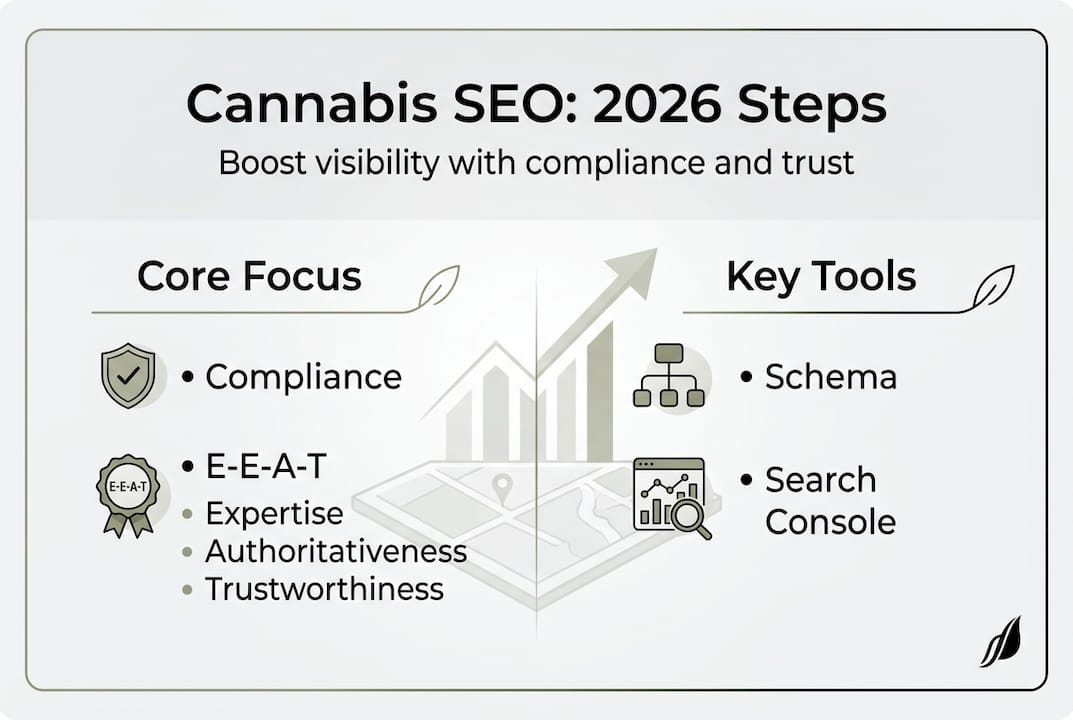
Your preparation phase centers on establishing Expertise, Experience, Authority, and Trustworthiness. Search engines evaluate these E-E-A-T signals heavily for Your Money or Your Life topics, which includes cannabis products affecting health and wellness. Building educational content hubs that demonstrate deep knowledge positions your brand as a trusted resource rather than just another seller.
Start by creating a compliance checklist specific to your state and local regulations. This includes proper age verification disclaimers, clear product descriptions that avoid medical claims, and transparent sourcing information. Your website architecture should separate educational content from transactional pages, making it easier for search engines to understand your content purpose.
Essential preparation steps:
Pro Tip: Build relationships with industry journalists and educational institutions early. Third-party citations and backlinks from authoritative cannabis education sites significantly boost your E-E-A-T signals and help you compete against established brands.
The shift from volume to depth requires rethinking your content calendar. Instead of publishing 20 thin articles monthly, focus on creating 3 to 5 comprehensive guides that thoroughly answer user questions. This approach aligns with how search engines now evaluate content quality, especially as AI systems become better at detecting shallow, keyword-stuffed pages.
Your preparation phase should also include technical SEO foundations. Ensure your site loads quickly on mobile devices, uses HTTPS encryption, and implements proper URL structures. These technical elements become even more important as SEO trends in cannabis markets emphasize user experience signals. Understanding what cannabis SEO means in 2026 helps you grasp why these foundational elements matter more than ever.
Keyword research for cannabis businesses in 2026 looks dramatically different from traditional SEO approaches. Voice search and AI-powered assistants now handle a significant portion of cannabis-related queries, making long-tail keywords and schema markup essential for visibility. Instead of targeting broad terms like “cannabis dispensary,” focus on specific phrases like “organic CBD flower for sleep near downtown Portland” that match how real customers search.
Your keyword strategy should map directly to user intent at different stages of the buying journey. Informational queries like “how does CBD affect anxiety” attract early-stage researchers building trust with your brand. Navigational searches indicate users looking for specific products or locations. Transactional keywords signal purchase readiness and should connect to optimized product pages.
Implementing schema markup for cannabis content:
Schema markup helps AI systems understand your content context, increasing chances of appearing in voice search results and rich snippets. This structured data becomes your competitive advantage as search engines rely more heavily on machine-readable information to generate AI-powered answers.
Content hubs represent your most powerful SEO asset in 2026. Rather than creating isolated blog posts, build interconnected topic clusters that comprehensively cover specific subjects. A hub about cannabis cultivation might include pages on soil preparation, lighting systems, nutrient schedules, pest management, and harvest techniques, all linking back to a central pillar page.

Pro Tip: Use Google Search Console to identify queries where you rank positions 4 through 10. These represent your biggest opportunities for quick wins. Create enhanced content targeting these keywords, focusing on answering the specific questions users ask.
Measuring success requires tracking conversions beyond simple traffic numbers. Set up call tracking to monitor phone inquiries generated from organic search. Configure GA4 to track direction requests from your Google Business Profile as conversion events. These metrics prove ROI far better than vanity metrics like page views or bounce rate.
| Content Type | Primary Goal | Key Metric | Update Frequency |
|---|---|---|---|
| Educational guides | Build authority | Time on page, backlinks | Quarterly review |
| Product pages | Drive conversions | Add to cart, purchases | Monthly optimization |
| Local content | Increase foot traffic | Direction requests, calls | Bi-weekly refresh |
| Comparison articles | Capture decision stage | Click-through to products | Monthly updates |
Your content creation process should emphasize quality research and original insights. Interview budtenders, cultivators, and customers to gather unique perspectives. Cite scientific studies and industry reports to back up claims. This original research and expert input separates your content from competitors relying on rewritten generic information.
Strategies to drive organic traffic for cannabis businesses in 2026 require balancing compliance with creativity. Stay current with top SEO tips for cannabis brands while adapting tactics to your specific market conditions and regulatory environment.
Verification transforms your SEO strategy from guesswork into data-driven decision making. Google Search Console provides the most direct insight into how search engines perceive your site. Monitor your Performance report weekly to identify trending queries, pages gaining traction, and opportunities where you rank just outside the top three positions.
GA4 offers deeper behavioral insights than Search Console alone. Set up custom conversion events for actions that matter to your business: newsletter signups, product page visits, store locator usage, and contact form submissions. Create audience segments for users who engage with educational content versus those who immediately browse products. This segmentation reveals which content types attract your most valuable visitors.
Critical metrics to monitor weekly:
The contrast between volume content and trusted depth becomes clear in your analytics. Pages with 3,000+ words of well-researched, expert-level content consistently outperform collections of 500-word articles on similar topics. Search engines reward comprehensive resources that fully answer user questions, especially when those resources demonstrate clear expertise and cite authoritative sources.
Email deliverability emerges as a complementary channel to SEO in 2026, particularly for cannabis brands facing advertising restrictions. Building an engaged email list from organic search visitors creates a owned audience you can reach directly. Strong email engagement signals to inbox providers that your brand is trustworthy, which indirectly supports your overall digital presence.
| Approach | Short-term Results | Long-term Sustainability | Resource Investment | Trust Building |
|---|---|---|---|---|
| Volume content | Moderate traffic spikes | Low, requires constant publishing | High ongoing costs | Minimal, seen as thin |
| Trusted depth | Slower initial growth | High, compounds over time | Higher upfront, lower maintenance | Strong, positions as expert |
Pro Tip: Set up automated reports in GA4 that email you weekly summaries of your top-performing content and conversion sources. This keeps SEO top of mind and helps you spot trends before they become problems.
Common mistakes plague cannabis SEO efforts even in 2026. Neglecting mobile optimization costs you visibility as mobile searches dominate local cannabis queries. Ignoring AI readiness means missing voice search traffic. Poor content depth signals low expertise to search engines. Inconsistent NAP information across directories confuses both users and search algorithms.
Social media amplifies your SEO content when used strategically. Share educational content on platforms where your audience congregates. Engage authentically with comments and questions. While social signals don’t directly impact rankings, the traffic and engagement they generate sends positive signals to search engines about your content value.
Leveraging proven strategies for dispensaries requires understanding your local competitive landscape. Analyze which competitors dominate local pack results and what content types they prioritize. Identify gaps in their coverage where you can establish authority. Understanding the role of social media in cannabis SEO helps you build a integrated digital presence that supports your search visibility.
Regularly audit your backlink profile to identify and disavow spammy links that could trigger penalties. Focus link building efforts on earning citations from industry publications, local business directories, and educational institutions. Quality backlinks from relevant, authoritative sources carry far more weight than hundreds of low-quality directory listings.
Navigating cannabis SEO complexity requires specialized expertise that understands both search engine algorithms and industry-specific compliance challenges. Dope SEO delivers tailored digital marketing strategies for cannabis companies facing the unique landscape of 2026 regulations and AI-driven search.
Our team has helped dispensaries, cultivators, and ancillary cannabis businesses build sustainable organic visibility through compliance-first SEO strategies. We understand the nuances of local search optimization for cannabis retailers and the content depth required to establish E-E-A-T in this heavily regulated industry. Whether you need proven dispensary SEO strategies or specialized services for cannabis accountants and CPAs, our industry-focused approach delivers measurable results. Schedule a consultation to discover how we can boost your cannabis business online with strategies designed specifically for the challenges and opportunities of 2026.
Cannabis SEO in 2026 emphasizes compliance-first strategies and AI readiness as federal regulations continue evolving and voice search becomes dominant. The shift from volume content to trusted depth content hubs reflects how search engines now prioritize expertise and comprehensive answers over keyword density. Schema markup and long-tail keyword optimization have become essential rather than optional, preparing content for AI-powered search assistants that parse structured data.
Compliance forms the foundation of sustainable cannabis SEO because non-compliant content risks penalties, deindexing, and legal consequences that destroy months of optimization work. Search engines evaluate trustworthiness heavily for cannabis topics, making regulatory adherence essential for building the authority signals that improve rankings. Proper disclaimers, accurate product information, and transparent sourcing demonstrate to both users and algorithms that your business operates responsibly within legal frameworks.
Use Google Search Console and GA4 to track conversions that matter for your business model, including phone calls, direction requests, newsletter signups, and product page engagement. Monitor average position changes for target long-tail keywords while measuring time on page and scroll depth for content hub pages. Set up custom conversion events in GA4 that align with your sales funnel, allowing you to calculate actual ROI from organic search rather than relying on vanity metrics like total traffic.
Long-tail keywords align closely with natural language voice queries and conversational AI search patterns that dominate cannabis-related searches in 2026. These specific phrases face less competition than broad terms while attracting visitors with clear intent who are further along the buying journey. Combined with schema markup that helps AI systems understand content context, long-tail strategies improve your chances of appearing in featured snippets and voice search results that drive qualified traffic.
