
Running a dispensary in the United States means working within a maze of rules that change from one city to the next. For American cannabis businesses, visibility is not just about being seen—it is about staying compliant and competitive within constantly shifting laws. Adopting geo-targeted SEO helps dispensaries reach the right local customers, keep ad dollars efficient, and ensure every listing and promotion matches local restrictions and preferences.
| Point | Details |
|---|---|
| Geotargeting Ensures Compliance | It aligns advertising with regional cannabis laws, avoiding legal issues while reaching the right customers. |
| Local SEO Focus is Essential | Geotargeted SEO prioritizes community engagement over broad visibility, driving higher conversion rates. |
| Adapt Messaging for Local Regulations | Tailor content to reflect varying state and local laws, ensuring compliance and relevance. |
| Mobile Optimization is Crucial | With the majority of searches originating from mobile devices, ensure all content is mobile-friendly to retain customer engagement. |
Geotargeting is the practice of delivering different content and advertisements to internet users based on their geographic location—whether that’s a country, state, or city. For cannabis dispensaries, it’s not just a marketing tactic. It’s a survival strategy in a heavily regulated industry.
Cannabis operates under a patchwork of state and local regulations that vary dramatically. What’s legal in Colorado differs from California, which differs again from Massachusetts. Geotargeting helps you comply with regional cannabis laws while simultaneously reaching the right customers in your specific market.
Here’s what makes it different from generic SEO:
Imagine running a dispensary in Portland, Oregon. Without geotargeting, your ads could reach cannabis consumers in Idaho—where delivery is illegal. You waste money, and you risk regulatory issues. With geotargeting, you reach only Oregon customers actively searching for local options.
Geotargeting enables cannabis businesses to present location-specific offers and content while staying compliant with regional regulations, directly improving conversion rates and marketing efficiency.
For dispensaries, geotargeting works through multiple data signals: IP addresses tell search engines where someone is browsing from, GPS data pinpoints mobile users, and Wi-Fi networks provide additional location confirmation. When someone searches “cannabis near me” in your city, geotargeting ensures your Google Business Profile, local landing pages, and ads appear in front of them.
Here’s a summary of how key geotargeting signals benefit cannabis dispensaries:
| Geotargeting Data Signal | How It Works | Business Benefit |
|---|---|---|
| IP Address | Locates desktop users by network location | Filters traffic by regional legality |
| GPS Data | Pinpoints mobile users’ exact position | Enables hyperlocal offers and ads |
| Wi-Fi Networks | Confirms presence at specific venues | Boosts local relevance and compliance |
| Local Search Queries | Matches keywords to neighborhood intent | Increases targeted visibility and engagement |
The business impact is measurable. A dispensary targeting only its actual service area converts browsers into customers more efficiently than one casting a wide national net. You’re also building a local search advantage—Google rewards businesses that appear genuinely rooted in their communities.
Key differences from broader SEO:
Your dispensary competes against other local shops, not national chains. Geotargeting shifts your entire marketing strategy from “rank for cannabis everywhere” to “dominate in my community.”
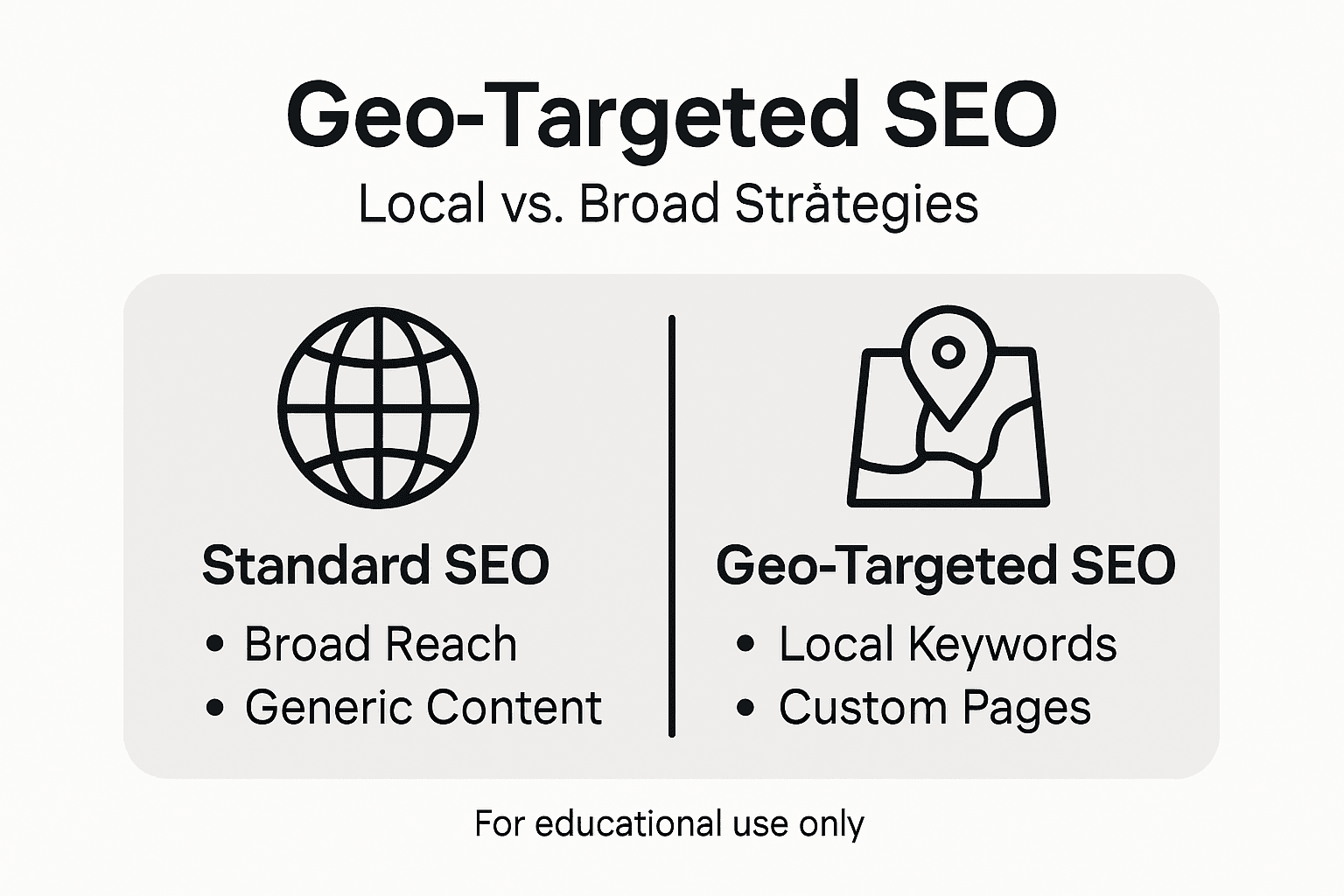
Compare the business impact of standard SEO versus geotargeted SEO for dispensaries:
| Aspect | Standard SEO | Geotargeted SEO |
|---|---|---|
| Legal Compliance | Non-specific, risky | Aligns with regional regulations |
| Target Audience | National or broad reach | Hyperlocal, community-focused |
| Cost Efficiency | Potentially wasteful | Budgets focused on top zones |
| Conversion Rates | Typically lower | Higher due to local relevance |
Pro tip: Set up location extensions in your Google Business Profile and create separate landing pages for each neighborhood or delivery zone you serve—geotargeting will automatically push these location-specific pages to local searchers, boosting click-through rates and foot traffic.
Cannabis regulation is fragmented across the United States. What works in one state becomes illegal in another. This isn’t hyperbole—it’s the operational reality for every dispensary owner trying to scale or stay compliant.
State-level cannabis laws differ widely between recreational and medical use, delivery services, potency limits, and advertising restrictions. Colorado allows online ordering with home delivery. New York restricts advertising near schools. California caps potency but allows lounges. Your geotargeted SEO strategy must reflect these differences or you risk legal violations and wasted marketing spend.
Here’s what varies by state and locality:
Your geotargeted approach must adjust messaging for each jurisdiction. A landing page targeting Denver customers can highlight delivery benefits. The same page targeting a no-delivery zone becomes instantly non-compliant.
Regulatory frameworks cover sales, advertising, potency limits, and packaging—requiring businesses to dynamically adjust marketing strategies to avoid legal risks and remain competitive.
Local ordinances layer additional complexity. Some cities prohibit dispensaries entirely. Others allow them but ban certain product types. Your SEO strategy can’t treat all California cities the same—San Francisco’s rules differ from those in conservative suburban areas.
This is where geotargeting becomes compliance infrastructure, not just marketing optimization:
The competitive advantage goes to dispensaries that understand their local regulatory environment deeply. You’re not just ranking for “cannabis near me.” You’re ranking with messaging that’s actually legal where your customers search.
Pro tip: Create a regulatory compliance spreadsheet listing the key restrictions for each state and city you serve, then map those restrictions to your geotargeted landing pages—this ensures your SEO content stays legally compliant as regulations evolve.
Local search optimization separates dispensaries that attract walk-in traffic from those that struggle for visibility. Your Google Business Profile, local landing pages, and location-specific content are the three pillars. Skip any one, and you’re leaving customers in competitors’ hands.

Start with your Google Business Profile—it’s your digital storefront. Ensure your business name, address, phone number, and hours are accurate and consistent across every platform. Google uses this foundation to decide when and where to show your dispensary in local search results.
Next, create location-specific landing pages for each neighborhood or delivery zone you serve. One page for all locations performs worse than dedicated pages for Denver, Boulder, and Fort Collins. Optimizing localized content and SEO strategies means using geo-targeted keywords, creating region-specific messaging, and addressing local consumer behaviors and preferences.
Here’s what each location page needs:
Content matters enormously. A page titled “Best Cannabis in North Denver” performs better than “Best Cannabis.” Readers want specificity. Google rewards it with higher rankings.
Using geo-targeted keywords and creating localized content increases online visibility and drives targeted local traffic by matching what customers actually search for in their neighborhoods.
Optimize for “near me” searches. When someone types “cannabis near me” or “dispensary open now,” you want to appear. This requires accurate location data, current hours, and reviews mentioning your proximity and convenience.
Your citation strategy matters too. Ensure your dispensary appears consistently on Google Maps, Apple Maps, Waze, and local directories. Inconsistencies confuse search algorithms and hurt rankings.
One tactical addition: add photo galleries to each location listing. Images of your storefront, product displays, and customer areas boost engagement and click-through rates significantly.
Local rankings depend on three factors:
You control relevance and authority through content and reviews. Proximity is determined by geotargeting infrastructure.
Pro tip: Create separate landing pages for each delivery zone or neighborhood, use neighborhood-specific keywords naturally throughout the content, and add local business schema markup to help Google understand your exact service areas and hours.
You can’t improve what you don’t measure. Geotargeted SEO requires constant monitoring or you’ll waste months chasing the wrong metrics. Track the right numbers, and you’ll know exactly where your customers come from and whether your strategy works.
Start with local search rankings. Use Google Search Console to monitor how you rank for location-specific keywords in each service area. Track “cannabis near me,” “dispensary in [neighborhood],” and variations specific to your markets. Rankings should improve within 60-90 days of launching geotargeted content.
Next, measure local traffic and conversions. Set up Google Analytics goals for each location page. Did visitors from North Denver call your store? Did Boulder customers add items to a cart? Connect traffic to actual business outcomes, not vanity metrics.
Common pitfalls destroy geotargeted SEO campaigns:
Monitoring organic rankings and local traffic metrics while avoiding non-compliance with regional laws ensures your strategy remains effective in dynamic regulatory environments.
Missing the mobile experience is particularly costly. Over 70% of local searches come from mobile devices. If your location pages aren’t mobile-optimized, you lose half your potential traffic.
Effective measurement involves tracking local search rankings, website traffic from target regions, and engagement metrics while addressing common pitfalls like inconsistent data and neglected reviews.
Reviews matter enormously. Customers searching “dispensary near me” see review scores prominently. One-star reviews tank your visibility. Encourage satisfied customers to leave reviews on Google, Yelp, and Waze.
Set up a simple tracking dashboard:
Check this monthly. If rankings drop, investigate immediately—you might have inconsistent data or a competitor made moves.
One final pitfall: setting and forgetting. Cannabis regulations change constantly. Your geotargeted content must evolve. What complied six months ago might violate new rules today.
Pro tip: Set up monthly automated reports in Google Analytics showing local traffic by location page and conversion rates, then create a simple spreadsheet tracking your top 10 local keywords and rankings—this identifies what’s working and what needs adjustment within minutes each month.
Navigating the complex world of cannabis regulations while trying to capture local customers can feel overwhelming. This article highlights how geotargeting is essential for dispensaries to comply with varying state and city laws, avoid wasted ad spend, and connect with the right audience. If you struggle with aligning your marketing strategy to location-specific legal frameworks or want to boost local search rankings with tailored content, you are not alone. The challenge is clear: without precise geotargeted SEO, your brand risks losing visibility to compliant competitors and missing valuable local traffic.
At dopeseo.com, we specialize in turning these challenges into opportunities by offering focused SEO strategies custom-built for cannabis businesses facing regulatory hurdles and tough local competition. Our services include optimizing your Google Business Profile, creating hyperlocal landing pages, managing compliant content, and leveraging AI-driven SEO tools to increase local visibility authentically. Whether you need help with local search optimization or crafting geo-aware content, we provide the expertise to convert nearby seekers into loyal customers without risking legal pitfalls.
Don’t let fragmented regulations and generic marketing dilute your impact. Partner with dopeseo.com now to dominate your community’s cannabis search landscape. Visit our landing page today to start a tailored strategy that ensures compliance while driving local conversions faster than ever.
Geo-targeted SEO involves optimizing your online content and advertisements based on the geographic location of your audience. For cannabis businesses, this means ensuring compliance with local regulations while effectively reaching potential customers in specific markets.
Geo-targeting ensures that your ads and content only appear in areas where your products are legally available, reducing the risk of serving prohibited claims and aligning marketing strategies with local laws.
Local SEO allows dispensaries to improve visibility and engagement with potential customers in their specific communities. It prioritizes hyperlocal intent over broader keywords, enhancing conversion rates by targeting customers who are actively searching for cannabis in their area.
An effective Google Business Profile for cannabis dispensaries includes accurate business name, address, phone number, and hours. It’s crucial to keep this information consistent across all platforms to maximize local search visibility and drive foot traffic.
