

Finding the boundaries between promotion and compliance can feel stressful for every U.S. cannabis dispensary owner. The reality is that even a single misstep with online advertising can mean account removal or legal headaches from missed regulation. This guide helps you master legal and platform restrictions for cannabis marketing so you can improve local visibility and build your reputation without risking penalties or lost business.
Table of Contents
- Step 1: Assess Legal and Platform Restrictions
- Step 2: Configure Website for Regulatory Compliance
- Step 3: Develop Content Targeting Compliant Keywords
- Step 4: Optimize Local SEO with Verified Listings
- Step 5: Monitor Results and Update Compliance Measures
Quick Summary
| Key Insight | Explanation |
|---|---|
| 1. Review Platform Policies Regularly | Understand and follow guidelines on cannabis advertising to avoid penalties and account shutdowns across major digital platforms. |
| 2. Implement Age Verification on Website | Ensure your website incorporates clear age verification to prevent underage access and comply with regulatory standards. |
| 3. Use Compliant Keywords in Content | Focus on educational and community-oriented content that adheres to regulations without making health claims or product endorsements. |
| 4. Optimize Local Listings for Compliance | Keep accurate and consistent information across digital listings to enhance local visibility while meeting regulatory requirements. |
| 5. Conduct Regular Compliance Audits | Regularly assess your website and marketing practices to stay aligned with evolving regulations and improve compliance monitoring. |
Step 1: Assess Legal and Platform Restrictions
Navigating the complex world of cannabis digital marketing requires a strategic understanding of legal and platform restrictions. Your goal in this step is to comprehensively evaluate the regulatory landscape that impacts your online presence, ensuring you can effectively promote your cannabis business without risking penalties or account shutdowns.
Start by thoroughly reviewing platform policies for major digital channels. Social media platforms like Facebook, Instagram, and Google have strict guidelines regarding cannabis advertising. Cannabis social media marketing guidelines typically prohibit direct product promotions, consumption imagery, and health claims. This means you will need to craft creative content that communicates your brand value without explicitly showcasing cannabis products.
Consult with legal professionals who specialize in cannabis regulations to develop a comprehensive compliance strategy. Cannabis regulators worldwide recommend developing clear social media policies that outline acceptable content parameters. Your strategy should include guidelines for community management, truth in advertising, and platform specific restrictions. Pay close attention to state level regulations which can vary significantly and impact your digital marketing approach.
Pro tip: Create a comprehensive compliance checklist that you review monthly to stay current with evolving platform policies and legal requirements in your specific cannabis market.
Here’s a quick comparison of popular digital platforms and their restrictions for cannabis marketing:
| Platform | Main Restriction | Risk if Violated |
|---|---|---|
| No cannabis product promotions | Account ban or post removal | |
| No consumption or product imagery | Shadowbanning or suspension | |
| No health claims or direct ads | Ad disapproval or suspension | |
| Weedmaps | Must verify licensing status | Delisting or profile removal |
| Yelp | Business info must meet guidelines | Listing flagged or edited |
Step 2: Configure Website for Regulatory Compliance
Configuring your cannabis website for regulatory compliance is a critical step in establishing a digital presence that meets legal standards and protects your business from potential penalties. Your primary goal is to create a website that communicates your brand effectively while adhering to strict cannabis marketing guidelines.

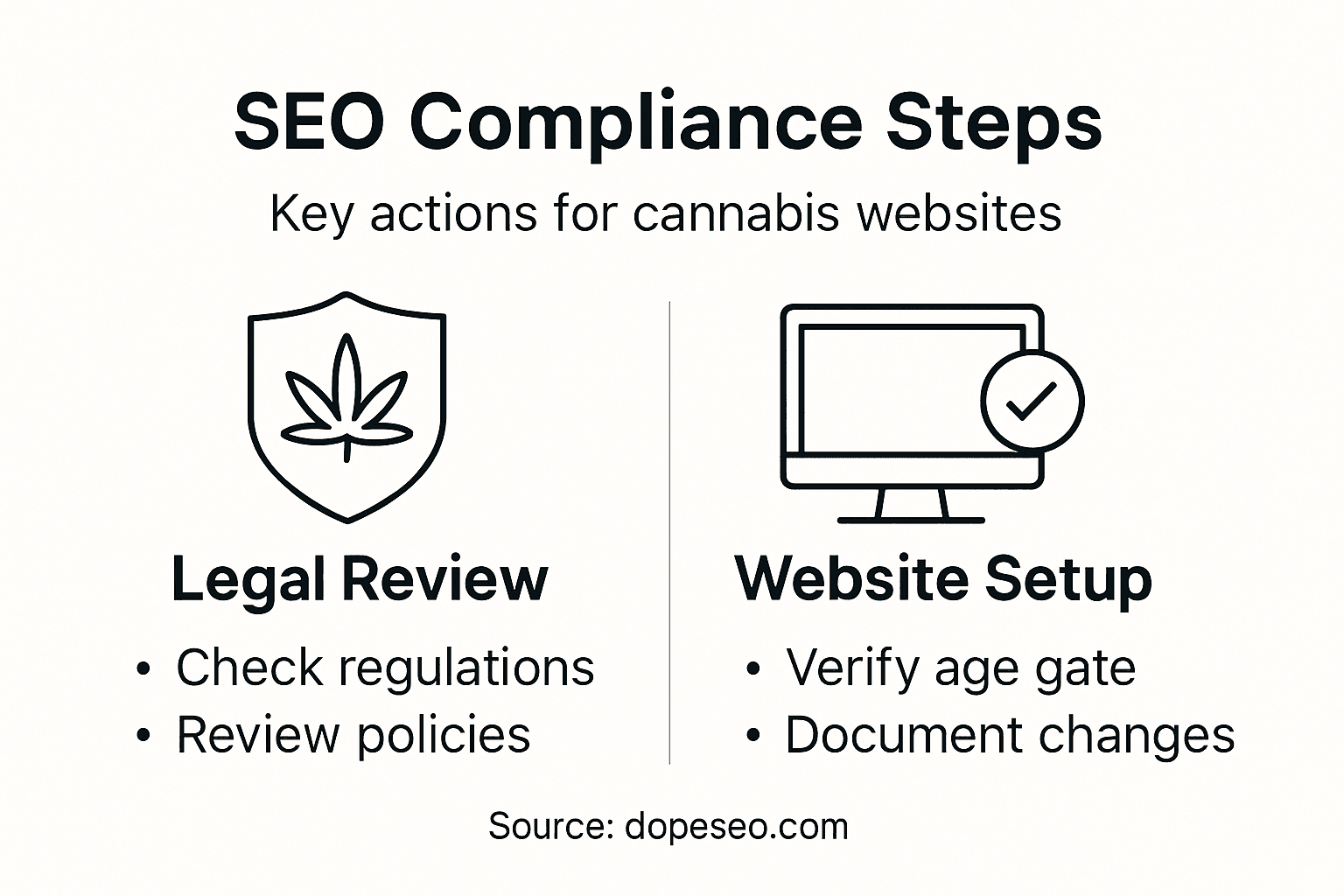
Begin by carefully reviewing cannabis compliance requirements specific to your state and local jurisdictions. This means implementing clear age verification mechanisms, avoiding direct product sales descriptions that could be interpreted as medical claims, and ensuring all content follows advertising guidelines. Focus on creating informative content that educates consumers about your brand philosophy and community involvement without making explicit product promises.
Develop a comprehensive documentation system that tracks all website content modifications and ensures ongoing compliance. Cannabis quality management standards recommend maintaining detailed records of website content revisions, advertising materials, and regulatory communications. Work closely with legal counsel to review your website content regularly and implement robust documentation practices that demonstrate your commitment to regulatory transparency.
Pro tip: Implement an automated quarterly content review process that checks all website materials against current regulatory guidelines and immediately flags potentially non compliant language or imagery.
This table highlights key compliance tasks and their business impact for cannabis websites:
| Compliance Task | Business Impact | Frequency |
|---|---|---|
| Age verification | Prevents underage access | Ongoing |
| Content audit | Reduces legal and platform risks | Quarterly |
| Licensing info updates | Maintains trust and SEO ranking | Monthly |
| Documentation of changes | Shows due diligence for regulators | With each update |
Step 3: Develop Content Targeting Compliant Keywords
Creating content with compliant keywords is a delicate balance of strategic communication and regulatory adherence for cannabis businesses. Your objective is to develop informative, engaging content that resonates with your audience while strictly avoiding language that could trigger regulatory scrutiny.
Cannabis SEO strategies emphasize the importance of carefully selecting keywords that communicate value without making medical claims or violating advertising restrictions. Start by conducting thorough keyword research that focuses on educational, community oriented, and brand positioning language. Instead of using terms that directly describe product effects or make health promises, concentrate on keywords that highlight your brand’s expertise, community involvement, and commitment to responsible cannabis education.
Develop a comprehensive keyword mapping strategy that categorizes acceptable terminology for different content types. This means creating separate keyword lists for blog posts, about pages, product descriptions, and educational resources. Each content type will require a nuanced approach to ensure you communicate effectively while maintaining strict compliance. Regularly audit and update your keyword lists to reflect changing regulatory landscapes and emerging industry communication standards.
Pro tip: Create a master compliance spreadsheet that color codes keywords based on their risk level green for completely safe, yellow for potentially problematic, and red for strictly prohibited terms.
Step 4: Optimize Local SEO with Verified Listings
Optimizing local SEO for cannabis businesses requires a strategic approach that balances accurate online representation with strict regulatory compliance. Your goal is to create verified listings that maximize local visibility while adhering to complex state and local regulations.
Cannabis business legislation demonstrates the critical importance of maintaining precise location information across digital platforms. Begin by conducting a comprehensive audit of your current online listings, ensuring that each digital profile accurately reflects your business location, operating hours, licensing details, and current regulatory status. Focus on creating consistent information across Google Business Profile, Yelp, Weedmaps, and other industry specific directories that verify cannabis business credentials.
Consider the broader landscape of cannabis accessibility. Recent marijuana legalization trends indicate that local search visibility can significantly impact customer discovery. Develop a systematic approach to managing your online listings by implementing monthly verification checks, updating seasonal hours, and promptly addressing any discrepancies. Coordinate closely with local regulatory agencies to ensure that your digital presence remains fully compliant with the most current licensing and operational guidelines.
Pro tip: Create a dedicated digital compliance spreadsheet that tracks all online listing details, verification dates, and required renewal processes to maintain seamless local SEO accuracy.
Step 5: Monitor Results and Update Compliance Measures
Monitoring and updating compliance measures is an ongoing process that requires consistent attention and proactive management. Your primary goal is to create a dynamic system that continuously evaluates your digital presence against evolving regulatory standards and search engine requirements.
Cannabis regulatory tracking involves developing a comprehensive monitoring strate