
Finding the right customers for your cannabis dispensary can feel frustrating when your site attracts clicks but not sales. Understanding the four types of search intent is what separates wasted traffic from buyers ready to visit your store or add to their cart. By aligning your SEO strategy with customer motivation—whether they are in research mode or ready to buy—you ensure each page actually reaches its most valuable audience and supports your business goals.
| Point | Details |
|---|---|
| Understand Search Intent | Align content with customer intent to improve conversion rates and avoid mismatched traffic. |
| Utilize All Intent Types | Focus on developing content that caters to informational, commercial, transactional, and navigational intents to capture customers at different stages. |
| Optimize Google Business Profile | Ensure accurate and comprehensive information in your Google Business Profile for local searches to enhance visibility and attract foot traffic. |
| Monitor and Audit Performance | Regularly track which intent types and content pages drive sales, allowing for focused improvement on underperforming areas. |
Search intent is the reason someone types a query into Google. It’s the underlying goal or question driving that search. In cannabis, this distinction matters because customer searches vary dramatically—from someone researching product types to someone ready to buy today.
Your customers search for different things at different stages. Understanding these stages helps you match your content to their actual needs.
Three Core Types of Search Intent in Cannabis
Informational intent: Customers want answers. “What are terpenes?” or “How does CBD help with anxiety?” These searchers educate themselves before deciding to purchase.
Commercial intent: Customers compare options. “Best indica strains for sleep” or “Delta-8 vs. Delta-9 differences.” They’re close to buying but still evaluating.
Transactional intent: Customers are ready to buy. “Buy edibles near me” or “Dispensary open now.” These are your highest-value searches because they convert quickly.
When someone searches “cannabis dispensary near me,” they’re not looking for a history lesson on cannabis. They want a location, hours, and product availability. That’s transactional intent, and your Google Business Profile needs to satisfy it immediately.
Search intent alignment determines whether your content converts or gets ignored. Ranking for the wrong type of intent means traffic without sales.
Brand versus buyer intent searches create another crucial distinction. Understanding brand versus buyer intent searches for dispensaries helps you identify which keywords drive actual foot traffic and which ones are informational only.
Why This Matters for Your Dispensary
You waste money ranking for the wrong searches. If you optimize your homepage for “cannabis history timeline,” you’ll get traffic from people who never buy. Meanwhile, someone searching “cannabis gummies 10mg near me” might bypass your site entirely because you’re not optimized for that intent.
Local cannabis markets are competitive. Matching search intent means your limited marketing budget reaches customers actually ready to visit your location or purchase your products.
Google’s algorithm rewards intent alignment. When your content matches what searchers actually want, Google shows it higher. You rank better, get more relevant traffic, and improve your conversion rate simultaneously.
Pro tip: Audit your current rankings by checking which queries bring traffic but produce zero sales or store visits—these are likely intent mismatches where your content answers the wrong question.
Google recognizes four distinct search intent types. Each one represents a different customer mindset and requires different content strategies. Understanding these four types helps you rank for the searches that actually matter to your dispensary.
Know Intent (Informational)
Searchers want answers and knowledge. “What are cannabinoids?” or “How long does CBD stay in your system?” These customers educate themselves before making purchase decisions.
Know intent searches are valuable but not immediately profitable. A customer researching cannabis benefits might not buy today. However, if your content answers their question, they remember your dispensary when they’re ready to purchase.
Do Intent (Transactional)
Searchers are ready to take action. “Buy cannabis edibles online” or “Order Delta-8 products near me.” These are your money keywords because they convert directly into sales.

Do intent searches generate the fastest ROI. Someone searching for this already wants your product. Your job is simply to make your store the easiest option to find and purchase from.
Website Intent (Navigational)
Searchers want to find a specific brand or dispensary. “Leafly” or “Green Thumb Industries.” They’re looking for a particular website or company.
Navigational searches help you capture branded traffic. When customers search your dispensary name, they should find your website first. This builds trust and confirms your legitimacy.
Visit-in-Person Intent (Local)
Searchers want to visit a physical location. “Cannabis dispensary near me” or “Best weed shop open now.” These searches drive foot traffic to your store.
Local intent searches are gold for brick-and-mortar dispensaries. Understanding buyer intent helps target consumers actively seeking your products in their area. Your Google Business Profile must be optimized for these searches.
Each intent type requires different content. Mixing them confuses your audience and wastes ranking potential on irrelevant searches.
Why All Four Matter
Optimize for only Do intent and you’ll miss customers still researching. Optimize only for Know intent and you’ll rank high with zero conversions. The strongest SEO strategy covers all four types strategically.
Your homepage should address Do and Website intent. Your blog should target Know intent. Your Google Business Profile should dominate Visit-in-Person intent. This balanced approach captures customers at every stage of their journey.
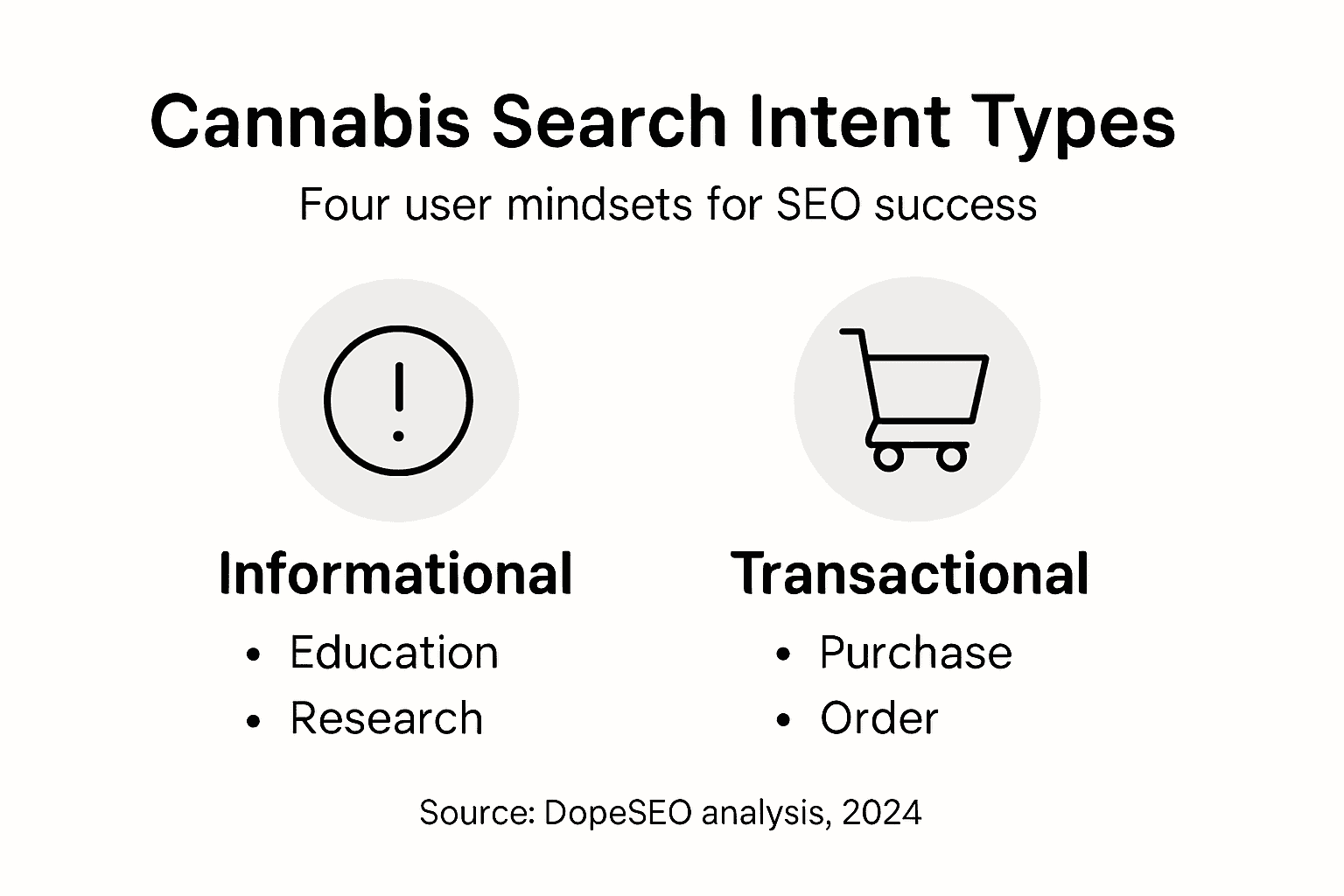
Here’s how each search intent type aligns with dispensary content and business goals:
| Intent Type | Best Content Format | Customer Stage | Business Impact |
|---|---|---|---|
| Informational | Educational blog posts | Awareness/Research | Builds authority, trust |
| Commercial | Comparison articles | Evaluation | Drives consideration, leads |
| Transactional | Product/location pages | Ready to Purchase | Boosts conversions, sales |
| Navigational | Homepage, brand pages | Brand-Seeking | Increases direct traffic, trust |
Pro tip: Create a content audit spreadsheet mapping each page to one primary intent type—this prevents overlap and ensures every URL on your site pulls its weight in converting customers.
Google doesn’t just match keywords anymore. Modern search engines use artificial intelligence to understand what customers actually mean, not just what words they type. This shift changes everything about how you should optimize your cannabis dispensary website.
Search engines now analyze context, user behavior, and semantic relationships between terms. When someone searches “cannabis for pain,” Google understands they might want information, products, or a nearby dispensary. The engine interprets intent based on dozens of signals simultaneously.
How AI Reads Between the Lines
Semantic analysis of queries using AI detects nuanced meanings beyond simple keyword matching. Google’s systems recognize that “best edibles for beginners” and “easiest cannabis products to start with” mean essentially the same thing, even though the words differ completely.
This is why keyword stuffing fails. Google sees through repetitive language and ranks based on actual topic relevance and user satisfaction signals instead.
Signals Google Uses to Identify Intent
Search history: What did this specific user search before? Previous cannabis searches suggest they’re further along the buying journey.
Location data: Someone searching near your dispensary shows local intent. Google prioritizes location-based results for “dispensary near me.”
Device type: Mobile users searching “cannabis now” likely want immediate access. Desktop users researching “cannabis strains” might be information-seeking.
Click behavior: If users click results and immediately return to search, Google recognizes that content didn’t match intent.
Time of day: Searches at 11 PM on weekends carry different intent signals than weekday searches.
Google combines these signals to predict what you actually want before you finish typing your full search.
Search engines now predict intent before you complete your query. Static content can’t match this dynamic interpretation—your site must address multiple intent angles simultaneously.
What This Means for Your Dispensary
You can’t optimize a single page for one narrow keyword anymore. Google expects comprehensive content covering related concepts and intent variations. A page about Delta-8 products should address informational questions, comparisons, and purchase options all together.
User experience signals matter more than ever. Pages that answer questions quickly, load fast, and don’t frustrate visitors rank higher. Bounce rate, time on page, and scroll depth all influence whether Google thinks your content matched the searcher’s intent.
Pro tip: Test your pages by searching your target keywords from different devices and locations, then note which results rank—this shows you exactly what intent Google thinks your content satisfies and reveals optimization gaps.
Cannabis SEO isn’t like optimizing a coffee shop or fitness studio. Your industry faces unique regulatory, platform, and visibility constraints that standard SEO strategies don’t address. Success requires understanding these obstacles and building around them strategically.
Google, Facebook, and Instagram restrict cannabis content in ways they don’t restrict other legal products. You can’t run paid search ads on Google for cannabis products. You can’t use standard Facebook retargeting. These platform limitations force you to rely heavily on organic search and owned channels.
Regulatory Complexity Across Markets
Cannabis regulations differ dramatically by location. What’s legal in California might be prohibited in Texas. Federal restrictions complicate everything, even though many states legalized cannabis.
This means your SEO strategy must account for local regulations. You can’t make claims that work in one state but violate laws in another. Content claiming specific medical benefits faces stricter scrutiny than lifestyle messaging.
The Major Challenges You Face
Payment processing issues: Banks refuse cannabis businesses, limiting ecommerce options and affiliate relationships that boost ranking potential.
Listing platform restrictions: Google Maps shows dispensaries, but Yelp and other review sites have complicated policies around cannabis listings.
Content moderation: Even legitimate cannabis content gets flagged as spam or prohibited in various systems.
Brand safety concerns: Mainstream publications avoid covering cannabis, limiting backlink opportunities competitors in other industries enjoy.
Ad platform limitations: No Google Ads, limited Facebook advertising, restricted YouTube promotion.
These aren’t problems you solve overnight. They require workarounds and strategic planning.
Compare the biggest cannabis SEO challenges and best practice solutions:
| Challenge | Why It Matters | Strategic Solution |
|---|---|---|
| Paid ads are restricted | Limited customer reach options | Prioritize organic and local SEO |
| Regulatory differences | Risk of legal issues by location | Use compliant, generalized language |
| Payment processing hurdles | Fewer ecommerce and affiliate tools | Focus on in-store and pickup sales |
| Content moderation/flagging | Reduced content/platform visibility | Emphasize education, avoid claims |
| Fewer backlink opportunities | Harder to build domain authority | Cultivate industry partnerships |
Cannabis businesses must build SEO strategies that work within platform restrictions, not against them. Organic search becomes your primary customer acquisition channel.
Best Practices That Actually Work
Industry-specific SEO challenges in cannabis require adapting standard strategies to your unique situation. Focus on local SEO aggressively since you can’t compete nationally through paid channels.
Optimize your Google Business Profile meticulously. This is your storefront when ads aren’t an option. Complete every field, add high-quality photos, and respond to reviews religiously.
Build content addressing all four intent types, especially informational and local. Your blog educating customers on cannabis basics builds authority while your location pages capture transactional searches.
Create content that serves multiple regulatory jurisdictions by focusing on benefits, education, and lifestyle rather than medical claims. This broader approach expands your organic reach without legal liability.
Pro tip: Document your SEO baseline metrics (rankings, traffic, conversions) by location before implementing changes—cannabis markets vary so much that what works in one area might flop in another, so tracking regional performance separately reveals what actually drives results.
Creating content without understanding user intent is like opening a dispensary in the wrong neighborhood. You might have great products, but nobody’s looking there. Aligning your content strategy with what customers actually want transforms your SEO from guesswork into predictable results.
Every piece of content you publish should serve a specific intent. Your homepage targets navigational and transactional intent. Your blog targets informational intent. Your product pages target both commercial and transactional intent. This strategic alignment means each page pulls its weight instead of competing internally.
Map Your Content to Intent Types
Start with keyword research grouped by intent, not just volume. Tools show you search volume, but they don’t reveal intent automatically. You must manually sort keywords into the four categories.
Once sorted, build content specifically for each intent type:
Informational pages: Blog posts answering “What is Delta-8?” or “How long does CBD stay in your system?” These build authority and trust.
Commercial pages: Comparison articles like “Sativa vs. Indica vs. Hybrid” help customers evaluate options before buying.
Transactional pages: Product pages, checkout pages, and location pages designed for immediate action.
Navigational pages: Your homepage, menu structure, and brand pages help customers find you specifically.
Don’t force keywords into the wrong intent category. Ranking for “best cannabis for sleep” (informational) on your product checkout page wastes that ranking. That keyword belongs on a blog post comparing strains.
How to Build Aligned Content
Tailoring content formats to intent categories improves both rankings and conversions simultaneously. Informational content works better as detailed guides or educational articles. Transactional content needs clear calls-to-action and minimal friction.
Consider the user journey. Someone searching “cannabis for anxiety” isn’t ready to buy yet. They need education first. Your informational content educates them, builds trust, and naturally guides them toward your product pages later.
Create content that answers specific intent questions completely. Don’t just mention your products in passing. If someone searches “best edibles for beginners,” your content should thoroughly compare products, explain dosing, and describe effects—then naturally recommend where to buy.
Misaligned content ranks but doesn’t convert. Aligned content does both because it matches exactly what searchers expect to find.
Performance Tracking by Intent
Monitor which intent categories drive actual conversions. You might rank well for informational keywords but see zero sales. That’s a signal to invest more in transactional content optimization.
Track separately: informational traffic that educates, commercial traffic that compares, and transactional traffic that converts. This data reveals which intent types your audience prioritizes and where your real opportunities exist.
Pro tip: Create a content audit spreadsheet listing every page, its primary intent, target keywords, and current ranking position—this visual map reveals intent gaps and shows exactly which intent categories need more content investment.
Understanding search intent is crucial to stop wasting time and money on traffic that does not convert. The article highlights common challenges like ranking for the wrong types of searches and failing to capture local, transactional, and commercial intent effectively. If you are struggling to align your content with what your customers really want, you are missing out on valuable sales and foot traffic.
At DopeSEO, we specialize in helping cannabis businesses navigate the complex world of search intent through tailored strategies including AI-driven SEO, local Google Business Profile optimization, and content marketing designed specifically for dispensaries and ancillary operators. We know how to build content that matches all four key intent types so you can attract and convert customers at every stage of their journey.
Take control of your online presence today by partnering with experts who understand the unique regulatory challenges and platform restrictions in cannabis. Visit DopeSEO now to unlock the full potential of your SEO strategy and start turning your site visitors into loyal customers.
Search intent refers to the reason behind a user’s query when they search on Google. It indicates whether the user is looking for information, comparing products, or ready to make a purchase. Understanding search intent helps cannabis businesses align their content with what customers actually want.
The main types of search intent in cannabis include informational intent (seeking knowledge), commercial intent (comparing options), transactional intent (ready to buy), and navigational intent (looking for a specific brand or dispensary). Each type requires different content strategies to meet customers’ needs effectively.
Aligning content with search intent is crucial because it determines whether a cannabis business will convert visitors into customers. Content that matches the user’s intent is more likely to generate relevant traffic and increase sales, while mismatched content may lead to high traffic without conversions.
Cannabis businesses can optimize for different types of search intent by creating tailored content. Informational blogs can address common questions, comparison articles can help users evaluate options, and product pages can focus on transactional intent. Additionally, local SEO efforts can attract customers looking to visit in person, ensuring a comprehensive approach to meet various user needs.

© 2026 Curious Monkeys Pressing Buttons LLC DBA Cannabiz Marketing Solutions AKA DopeSEO. All rights reserved.