
Think cannabis SEO is just like regular SEO with a few compliance tweaks? Most business owners do, until they realize cannabis SEO requires navigating complex legal and advertising restrictions that make strategies 45% more complex than standard approaches. The reality is that cannabis businesses face unique challenges from platform bans to content restrictions that force a complete rethink of online marketing. This guide breaks down what cannabis SEO actually involves, why organic search is your lifeline when paid ads are blocked, and how to build visibility despite industry hurdles.
| Point | Details |
|---|---|
| Cannabis SEO differs fundamentally | Legal restrictions and advertising bans require specialized strategies beyond standard SEO practices. |
| Local search dominates customer acquisition | Over 80% of cannabis searches have local intent, making Google Business Profile optimization essential. |
| Technical and AI optimization matter | Structured content and technical SEO prepare sites for AI-driven search engines and featured snippets. |
| Content authority builds trust | E-E-A-T focused educational content ranks 40% higher and establishes compliance credibility. |
| Metrics drive sustainable growth | Tracking organic traffic, local pack visibility, and engagement reveals what works and guides optimization. |
Cannabis SEO is the practice of optimizing online presence for cannabis businesses while navigating strict legal frameworks and advertising restrictions unique to the industry. Unlike general SEO, cannabis optimization faces advertising restrictions limiting paid channel options by over 70%, forcing brands to rely almost exclusively on organic search tactics. This creates a specialized discipline where compliance, local focus, and content authority intersect.
The misconception that cannabis SEO mirrors general SEO costs businesses thousands in wasted effort. Standard SEO playbooks fail because they assume open access to Google Ads, social media promotion, and unrestricted content topics. Cannabis businesses cannot leverage these channels without risking account suspension or legal penalties. Instead, they must master organic ranking factors, local search mechanics, and content strategies that satisfy both search engines and regulatory bodies.
Effective cannabis SEO blends multiple disciplines:
“Cannabis marketers who treat SEO as just another marketing channel consistently underperform those who recognize it as their primary growth engine in a restricted advertising landscape.”
This fundamental shift in perspective separates thriving cannabis brands from those struggling to gain traction. When paid advertising is blocked, organic search becomes the battleground where visibility and customer acquisition happen. Understanding this reality shapes every tactical decision in cannabis digital marketing.
Cannabis businesses operate under unprecedented digital marketing constraints that reshape SEO priorities. Major platforms including Google Ads, Facebook, and Instagram prohibit cannabis advertising, eliminating over 70% of paid acquisition channels available to other industries. This forces cannabis marketers to develop sophisticated organic strategies or face invisibility in competitive markets.
Content compliance adds another layer of complexity. Search engines penalize sites promoting illegal activity, even in states where cannabis is legal. Cannabis businesses must carefully balance promotional content with educational value, avoiding language that could trigger algorithmic flags or manual penalties. One misstep can result in deindexing, effectively removing your business from search results overnight.
Common regulatory pitfalls include:
Ongoing audits become essential rather than optional. Cannabis businesses need regular SEO compliance reviews to catch issues before they trigger penalties. This means monitoring content for regulatory changes, reviewing technical implementations for age gates, and ensuring backlink profiles don’t include questionable sources that could damage domain authority.
Pro Tip: Create a compliance calendar tracking regulatory review dates for each state you serve, ensuring content updates happen before law changes take effect and potentially trigger search penalties.
The expertise required extends beyond traditional SEO knowledge. Successful cannabis SEO practitioners combine technical optimization skills with regulatory understanding, creating strategies that satisfy both search algorithms and compliance frameworks. This dual focus differentiates cannabis SEO from simpler optimization disciplines.
Local search drives the majority of cannabis customer acquisition, with over 80% of cannabis consumer searches having local intent. Customers actively searching for “dispensary near me” or “cannabis delivery in [city]” represent high-intent traffic ready to convert. Capturing this audience requires aggressive local SEO optimization that places your dispensary in map packs and local listings where purchase decisions happen.

Google Business Profile optimization stands as the single most impactful local SEO tactic for dispensaries. A fully optimized profile with accurate hours, updated photos, product categories, and regular posts increases visibility in local map results by up to 200%. Complete profiles signal relevance to Google’s local algorithm, pushing your dispensary above competitors with incomplete or neglected listings.
NAP consistency across the web amplifies local ranking power. NAP (Name, Address, Phone) must match exactly across your website, Google Business Profile, Yelp, Weedmaps, Leafly, and every directory listing. Even minor variations like “Street” versus “St.” confuse search algorithms and dilute ranking signals. Standardize formatting and conduct quarterly audits to maintain consistency.
| Local SEO Element | Impact on Rankings | Implementation Priority |
|---|---|---|
| Google Business Profile completeness | 35-40% ranking factor | Highest |
| NAP citation consistency | 20-25% ranking factor | High |
| Local reviews quantity and quality | 15-20% ranking factor | High |
| Localized on-page content | 10-15% ranking factor | Medium |
| Local backlinks from community sites | 10-12% ranking factor | Medium |
Reviews drive both rankings and conversions. Dispensaries with 50+ Google reviews rank 65% higher in local packs than competitors with fewer than 10 reviews. Beyond rankings, review volume and ratings directly influence customer decisions, with 87% of consumers reading reviews before visiting a dispensary. Implement systematic review collection through post-purchase texts, email campaigns, and in-store signage.
Pro Tip: Respond to every review within 24 hours, including negative ones, showing potential customers you value feedback and demonstrating active management signals to search algorithms.
Local content strategy completes the picture. Creating location-specific landing pages for each service area, publishing local event coverage, and developing neighborhood guides establishes topical authority in your geographic market. This hyper-local content captures long-tail searches and positions your dispensary as the community cannabis expert. Combined with technical optimization and citation building, these tactics form a complete local SEO foundation that boosts visibility and foot traffic.
Content quality determines cannabis SEO success more than any other factor because regulatory scrutiny demands exceptional trust signals. Google evaluates cannabis content through E-E-A-T (Experience, Expertise, Authoritativeness, Trustworthiness), and content demonstrating high E-E-A-T signals ranks on average 40% higher in cannabis industry search results. This means superficial blog posts and thin product descriptions won’t compete against comprehensive, expert-driven resources.
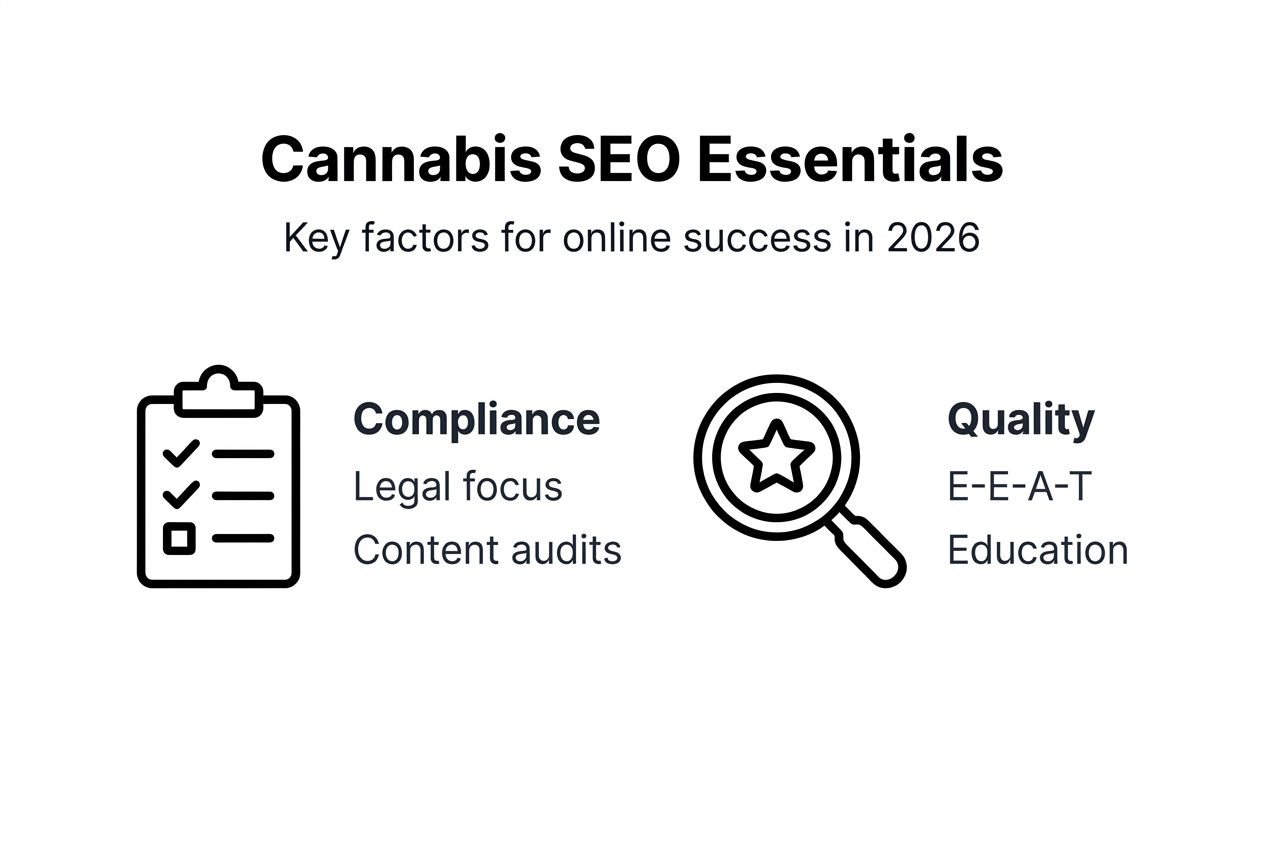
Educational content builds the authority foundation cannabis brands need to overcome industry stigma. Rather than purely promotional material, successful cannabis sites publish in-depth guides on consumption methods, strain profiles, legal compliance, and responsible use. This educational approach positions your brand as a trusted information source rather than just another retailer pushing products.
Topic clusters organize content for maximum SEO impact:
This structure helps search engines understand your site’s expertise depth while providing users with comprehensive learning paths. Clusters also capture broader keyword ranges, from informational searches early in the buyer journey to transactional queries near purchase.
Long-form content dominates cannabis SEO performance. Research shows long-form content outperforms shorter posts by 35% in generating backlinks and search rankings in cannabis SEO contexts. Articles exceeding 2,000 words tend to cover topics thoroughly enough to rank for multiple related queries while naturally incorporating semantic keywords that strengthen topical relevance.
Key content types for cannabis SEO success:
Balancing user value with search optimization requires intentional planning. Content should answer real customer questions first, with keyword integration happening naturally through comprehensive coverage. Forced keyword stuffing triggers quality filters and creates poor user experiences that increase bounce rates. Focus on optimizing cannabis content by addressing user intent thoroughly, and rankings follow organically.
AI-powered search engines like ChatGPT, Google’s Search Generative Experience, and Perplexity are fundamentally changing how users find cannabis information. These platforms generate direct answers rather than listing links, reducing traditional click-through by up to 25%. Cannabis businesses must optimize content for AI consumption to maintain visibility as search behavior evolves.
Structured content helps AI engines extract and cite your information accurately. Use clear headings, concise paragraphs, and definitive statements that AI can confidently quote. When AI pulls information from your site to answer queries, it typically cites the source, driving qualified traffic and building brand recognition even without traditional click-throughs.
Technical barriers prevent AI crawling more often than you’d expect:
Removing these obstacles ensures AI engines can access, understand, and utilize your content. Implement structured data markup for products, reviews, FAQs, and articles. This machine-readable formatting helps AI parse information accurately and increases chances of being featured in AI-generated responses.
Balancing AI optimization with human user experience prevents over-optimization pitfalls. Content written solely for AI extraction often reads mechanically and fails to engage human visitors who land on your site. The solution involves layering optimization: clear, factual statements for AI extraction surrounded by engaging context, examples, and storytelling for human readers.
Pro Tip: Create dedicated FAQ sections using question-and-answer formatting with schema markup, making it easy for AI engines to extract direct answers while providing value to human visitors scanning for quick information.
Emerging AI-focused SEO tactics include optimizing for voice search queries, which tend to be conversational and question-based. Cannabis users increasingly ask devices questions like “What’s the difference between indica and sativa?” rather than typing truncated keywords. Content addressing these natural language queries positions your brand for AI-powered search success.
Tracking the right metrics separates effective cannabis SEO from wasted effort. Organic traffic growth serves as the primary success indicator, but context matters. A 20% traffic increase from irrelevant keywords generates zero business value, while a 10% increase in qualified local traffic directly impacts revenue. Focus on targeted organic sessions from users in your service areas searching commercial intent keywords.
Keyword rankings provide directional guidance but require nuanced interpretation. Rankings for branded terms (your dispensary name) indicate brand awareness but don’t reflect SEO performance. Track rankings for category keywords (“cannabis dispensary [city]”), product terms (“sativa strains near me”), and informational queries (“cannabis dosage guide”) to measure different funnel stages.
Local pack appearances drive dispensary foot traffic more than organic rankings. Monitor how often your Google Business Profile appears in the local 3-pack for priority keywords. Tools like Local Falcon provide heat maps showing your visibility across your service area, revealing geographic gaps where optimization efforts should focus.
| Metric Category | Specific Metrics | Measurement Frequency | Action Threshold |
|---|---|---|---|
| Traffic | Organic sessions, pages per session, new vs. returning | Weekly | 15% variance from baseline |
| Rankings | Position for 20 priority keywords, featured snippet ownership | Bi-weekly | Top 10 position changes |
| Local | Map pack appearances, Google Business Profile views, direction requests | Weekly | 20% variance from baseline |
| Engagement | Bounce rate, average session duration, conversion rate | Weekly | 10% variance from baseline |
| Technical | Core Web Vitals, crawl errors, indexation coverage | Monthly | Any errors or warnings |
Engagement metrics reveal content quality and user experience effectiveness. Click-through rate from search results indicates how compelling your titles and descriptions are, while session duration and pages per visit show whether content delivers promised value. Cannabis sites should target 2+ minute average sessions and 2.5+ pages per visit for educational content.
Implementation workflows ensure consistent optimization progress:
Success benchmarks provide context for performance evaluation. Data shows top-performing cannabis brands saw an average 30-50% increase in organic traffic within 6 months of focused SEO implementation. These results require consistent effort across technical, content, and local optimization rather than sporadic campaigns.
Regular measurement supports sustainable long-term growth by revealing what works in your specific market. Cannabis SEO effectiveness varies by location, competition level, and regulatory environment. Monthly reporting establishes performance baselines, identifies trends early, and guides resource allocation toward highest-impact tactics.
Navigating cannabis SEO’s unique challenges requires specialized expertise that most general agencies lack. Dope SEO offers tailored strategies specifically designed for cannabis compliance, local dominance, and sustainable organic growth. Their team understands the regulatory landscape, platform restrictions, and competitive dynamics that shape cannabis digital marketing.
Whether you’re mastering cannabis SEO best practices for the first time or boosting cannabis SEO for established dispensaries, professional guidance accelerates results. Dope SEO’s proven frameworks cover technical optimization, content authority building, and comprehensive local search strategies that drive foot traffic and online conversions. Their cannabis-specific approach addresses challenges general SEO services simply can’t solve.
Cannabis SEO is the specialized practice of optimizing online presence for cannabis businesses within strict legal and advertising frameworks. It differs fundamentally because advertising restrictions eliminate over 70% of paid channels, forcing complete reliance on organic tactics that general SEO treats as supplementary.
Advertising bans on major platforms like Google Ads and Facebook make organic SEO the primary customer acquisition channel for cannabis businesses. This shifts strategy from balanced paid and organic efforts to intensive focus on local search, content authority, and technical optimization that general marketers rarely prioritize.
Over 80% of cannabis searches have local intent, meaning customers are actively looking for nearby dispensaries ready to serve them. Strong local SEO ensures your business appears in map packs and local listings where these high-intent purchase decisions happen.
High-quality, compliant content establishes the expertise and trustworthiness search engines demand for cannabis topics. Long-form educational content ranks 35% higher and generates more backlinks than short promotional posts, building the authority foundation necessary for competitive rankings.
Track organic traffic growth from qualified local searches, monitor keyword rankings for commercial intent terms, and measure local pack appearances in your service areas. Engagement metrics like click-through rates and session duration reveal whether traffic converts, while regular audits ensure technical health supports ongoing growth.

© 2026 Curious Monkeys Pressing Buttons LLC DBA Cannabiz Marketing Solutions AKA DopeSEO. All rights reserved.