
TL;DR:
- In 2026, cannabis dispensaries must prioritize local search signals like Google Business Profile optimization and review velocity to boost visibility. Regulatory restrictions make organic search, citations, and reviews more critical than traditional advertising channels. Focusing on compliance, NAP consistency, and active monitoring ensures lasting brand recognition in a crowded, highly regulated market.
Running a cannabis dispensary or product brand in 2026 means competing in one of the most regulated and crowded markets in the country. You can have the best products on your shelves, a beautiful storefront, and a loyal customer base, yet still be virtually invisible online. Brand visibility in 2026 is about being found where buyers pay attention, not just search rankings. Cannabis operators face a unique combination of advertising bans, platform restrictions, and compliance requirements that make traditional marketing tactics unreliable. This guide walks you through proven, step-by-step strategies to build real visibility that drives foot traffic, online orders, and lasting brand recognition.
| Point | Details |
|---|---|
| Optimize Google profile | Your verified, complete Google Business Profile is always the strongest foundation for cannabis visibility. |
| Maintain NAP consistency | Exact matching name, address, and phone number across all platforms prevents costly suspensions. |
| Prioritize local signals | Reviews and local relevance matter more than traditional content or backlinks for cannabis brands. |
| Measure the right metrics | Go beyond rankings by tracking reviews, local actions, and AI-generated citations to see true visibility gains. |
Before you build anything, you need to understand exactly what “visibility” means in the cannabis space and why the usual playbook does not always apply here.
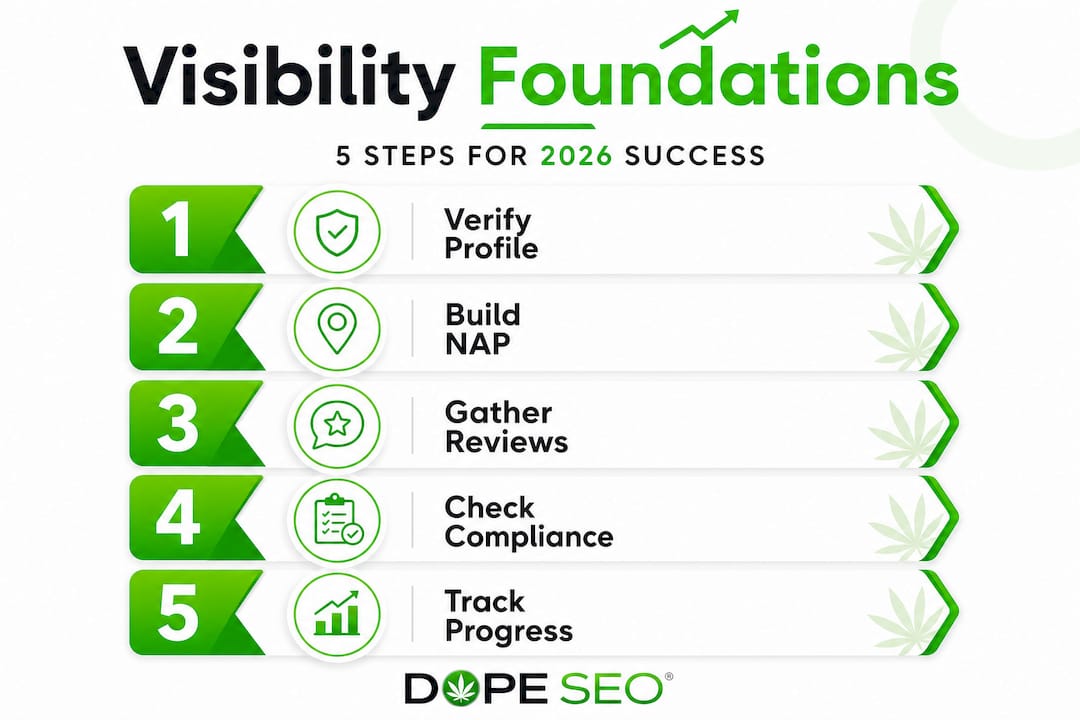
Visibility today means being found and recommended across search engines, social media, and AI-driven results, not just appearing on page one of Google. When someone asks their phone to find a dispensary near them, or when an AI assistant recommends a cannabis brand, those results are shaped by factors that go far beyond your website’s design or a paid ad budget. Understanding this shift is the starting point for everything else you do.
Cannabis operators face a set of challenges that most businesses never encounter. Social media platforms restrict promotional content. Google restricts cannabis advertising. Dispensaries regularly experience what’s called a shadowban, where their content is suppressed without any clear notification, simply because of the nature of their industry. These restrictions make organic search and local search signals far more valuable for cannabis brands than they are in most other sectors. Knowing this means you should invest your energy where you have the most control: your Google Business Profile, your review volume, and your listing consistency.
A few essential terms you need to know:
Success in 2026 also depends heavily on how you navigate cannabis compliance basics. Regulatory requirements vary by state and even by city, which means your online presence must reflect your actual license type, your real operating hours, and your legal business name at all times.
| Visibility channel | Control level | Cannabis-specific risk |
|---|---|---|
| Google Business Profile | High | Suspension for keyword-stuffed names |
| Social media (organic) | Medium | Shadowbans, content removal |
| Paid advertising | Very low | Outright bans on most platforms |
| AI/voice search mentions | Growing | Dependent on citation consistency |
| Local directories | High | NAP mismatch penalizes rankings |
Pro Tip: Track not just your keyword rankings but also where your business is cited in AI-generated answers and voice search results. Tools that monitor brand mentions across the web can surface opportunities and risks that standard rank trackers miss entirely.
With foundational terms and compliance challenges covered, it’s time to execute proven steps for building robust visibility.
The single most impactful action you can take right now is optimizing your Google Business Profile. Think of it as your digital storefront in Google Maps. A fully optimized GBP acts as your primary touchpoint for local and Maps searches, often before a potential customer ever visits your actual website. Here is exactly how to do it right.
Claim and verify your listing. If you have not claimed your GBP, search for your business on Google and follow the verification steps. Google typically verifies by phone, email, or postcard. Do not skip this step, because unverified listings can be edited by anyone.
Use your real, legal business name. Your GBP name must match your business license. No additions, no geographic keywords tacked on, no promotional phrases. “Green Leaf Dispensary” is correct. “Best Weed Dispensary Denver Green Leaf” will trigger a suspension review.
Ensure your NAP matches everywhere. Your name, address, and phone number on GBP must be identical to your website, your Yelp listing, your Weedmaps profile, and every other directory. Even small differences, like “St.” versus “Street,” can signal inconsistency to search engines and hurt your local rankings.
Upload high-quality photos. Businesses with current, professional photos receive significantly more clicks and direction requests than those without. Include interior shots, product photos where legally permitted, exterior photos showing your signage, and staff images that humanize your brand.
Set accurate hours and keep them updated. Holiday hours, special events, and temporary closures should all be reflected in real time. Inaccurate hours lead to frustrated customers and negative reviews.
Request reviews from satisfied customers. Review velocity, meaning how frequently new reviews come in, is a significant factor in local pack rankings. Create a simple process for asking customers in person or via text follow-up to leave a Google review.
For a more thorough breakdown, the step-by-step dispensary SEO process we recommend starts with GBP and builds outward from there.
| Platform | Visibility impact | Effort level | Cannabis-specific notes |
|---|---|---|---|
| Google Business Profile | Very high | Low to medium | Core local ranking signal |
| Yelp | Medium | Low | Important for review diversity |
| Weedmaps | High | Medium | Cannabis-specific discovery tool |
| Leafly | High | Medium | Strong for product searches |
| Facebook Business Page | Medium | Medium | Limited organic reach for cannabis |
| Apple Maps | Medium | Low | Growing with Siri/voice adoption |
Pro Tip: Never use terms like “best weed” or city names as part of your GBP business name. This practice, often called keyword stuffing, is a direct violation of Google’s guidelines and regularly triggers suspensions. Use your dispensary Google Business optimization strategy to earn rankings through legitimate signals, not name manipulation.
Now that you have executed your core steps, let’s cover the mistakes and risks that can undercut your efforts in seconds.
The most common reason cannabis businesses lose visibility overnight is not a Google algorithm update. It is a GBP suspension, and it almost always comes down to avoidable mistakes. Local cannabis visibility requires consistent NAP and legitimate, non-keyword-stuffed names, and errors in either can trigger suspensions that take weeks to resolve.
Here are the most frequent mistakes that can cripple your online presence:
Warning: A suspended GBP can remove your business from Google Maps entirely. During a suspension, customers searching for you by name may not find your location. Reinstatement can take two to six weeks and requires documentation of your business legitimacy. Treat your GBP like a licensed asset, because in practice, it is one.
To check your NAP consistency, compare your business name, address, and phone number across your website’s contact page, your GBP, your social media bios, and your directory listings manually or using a citation audit tool. Document any discrepancies and correct them in order of platform authority, starting with your own website, then GBP, then major directories.
For a deeper look at both defensive and offensive strategies, the cannabis local SEO guide and our SEO best practices resources are worth bookmarking.
Key stat: Research consistently shows that businesses with complete, verified, and consistently cited GBP listings outperform incomplete profiles in local pack rankings, often appearing two to three positions higher when all core fields are populated and active.
Pro Tip: Schedule a monthly audit of all your business listings. Set a recurring calendar reminder and use it to check for accidental edits, outdated hours, removed photos, or new reviews that need a response. Catching problems early is far less costly than recovering from a suspension or a wave of unanswered negative reviews.
Once you are protected against costly mistakes, the next priority is active measurement and verification of your efforts.
Visibility without measurement is just guesswork. Tracking your presence, reviews, and citation in AI answers, not just search rankings, is what separates brands that grow sustainably from those that plateau. Here is how to build a simple but effective visibility scorecard.
Key metrics to monitor monthly:
| Metric | Measurement method | Review frequency | Target benchmark |
|---|---|---|---|
| GBP actions (calls, clicks) | GBP Insights dashboard | Monthly | Month-over-month growth |
| Maps impressions | GBP Insights dashboard | Monthly | Upward trend |
| Review count and velocity | Manual or reputation tool | Weekly | 2 to 5 new reviews per week |
| NAP consistency score | Citation audit tool | Quarterly | 90% or higher |
| AI mention tracking | Brand monitoring tool | Monthly | Increasing citations |
Steps to audit, measure, and document your progress:
For advanced SEO tactics that build on this foundation, moving into content strategy and backlink development makes more sense once your core local signals are solid.
Here is some straight talk on what actually moves the needle for cannabis brands, because a lot of the advice circulating in the marketing world still misses this.
Most content you will read about building brand visibility focuses heavily on blogging, backlink campaigns, and social media follower growth. For general consumer brands, that advice is reasonable. For cannabis operators, it is often the wrong priority, at least in the early stages of building your presence.
The reality is that AI assistants and voice search are rapidly replacing traditional search engine results pages as the first touchpoint for local discovery. When someone asks their phone “where’s a dispensary near me,” the answer does not come from a well-written blog post. It comes from a verified GBP, a strong review velocity, and consistent citations across trusted directories. GBP completeness, review velocity, and local relevance are the benchmark mechanisms that move the needle first.
We have seen dispensaries invest months into content creation and backlink outreach before locking down their GBP or auditing their NAP. The result is almost always disappointing. Rankings improve slowly, if at all, because the foundational trust signals that Google and AI systems use to recommend local businesses are still weak.
“Focus where buyers make choices, not where marketers chase traffic numbers.”
That means your local presence comes first. Get your GBP verified, optimized, and generating reviews. Build NAP consistency across every directory. Then, and only then, layer in content marketing and link building to scale your authority.
Our local search strategy insights reinforce this sequencing with real-world examples from dispensaries that have made exactly this shift with measurable results.
Pro Tip: Do not wait until you have a “perfect” content strategy before building your local presence. Local signals compound over time. A GBP that has been consistently active, reviewed, and optimized for six months will outperform a brand-new one every time, regardless of how good the website is.
Implementing everything in this guide takes focus, time, and deep familiarity with how cannabis-specific platforms and regulations work. If you are managing daily operations while trying to keep up with SEO, compliance changes, and listing audits, it is easy for things to slip.
That is where a specialized team makes the difference. At dopeseo.com, we work exclusively with cannabis and hemp businesses, which means we understand the platform restrictions, compliance landscapes, and local search dynamics that generic marketing agencies simply do not. Our cannabis SEO 2026 guide outlines the full range of strategies we use to move dispensaries into the local pack and keep them there. From GBP optimization and NAP audits to reputation management and cannabis marketing strategies, every service is built around your industry’s specific needs. If you are ready for a structured plan, our SEO strategy for cannabis brands is a strong next step toward sustainable, trackable growth.
The fastest way is to fully optimize your Google Business Profile, ensuring all fields are complete and accurate, because GBP completeness directly boosts local pack competitiveness and can produce visible results within weeks.
Consistent NAP ensures search engines can confidently verify your business details, and mismatches across directories can weaken your local rankings or even trigger a GBP suspension.
Social ads and paid boosts are heavily restricted or outright banned for cannabis brands on most major platforms, so organic channels like local search, reviews, and content are where most brands need to focus their visibility efforts.
Always use your real, legal business name with no added keywords or geographic terms, because avoiding keyword-stuffed names is one of the most effective ways to reduce the risk of GBP suspension.
Monitor your GBP actions, Maps impressions, review velocity, and your brand’s citations in search or AI-generated answers monthly to get a clear picture of whether your visibility efforts are producing real results.

© 2026 Curious Monkeys Pressing Buttons LLC DBA Cannabiz Marketing Solutions AKA DopeSEO. All rights reserved.