
TL;DR:
- Gray area marketing in cannabis involves promotional practices that are legally and ethically ambiguous due to inconsistent laws and platform restrictions. Brands that focus on compliant organic SEO, influencer partnerships, and endemic ad networks can build trust and sustainable growth despite platform bans. Viewing regulatory challenges as strategic opportunities creates a competitive advantage and long-term resilience in a complex legal landscape.
If you’ve ever wondered whether your cannabis brand’s Instagram post, blog article, or email campaign is technically “legal,” you already understand what is gray area marketing. It sits in the uncertain space between what’s explicitly allowed and what’s clearly prohibited, and for cannabis businesses, that space is enormous. Federal law, state regulations, and platform policies all say different things, often at the same time. This guide breaks down the definition of gray area marketing, the risks you face, and how to build a strategy that keeps your brand growing without crossing lines that could cost you your license.
| Point | Details |
|---|---|
| Gray area marketing defined | It involves promotional practices in ambiguous legal or ethical zones, common in cannabis advertising due to fragmented regulations. |
| Platform and legal restrictions | Google, Meta, and TikTok largely ban paid cannabis ads, forcing marketers to use organic SEO and influencer marketing. |
| Risks of non-compliance | Misleading health claims can lead to heavy FTC fines, state penalties, and loss of brand trust. |
| Strategic compliant marketing | Successful brands use compliance as an advantage via endemic networks, education-focused content, and local SEO. |
| Multi-state complexities | Cannabis marketers must navigate diverse state laws and product-specific restrictions like those on delta-8 THC. |
To grasp why gray area marketing is particularly relevant for cannabis businesses, we first need a clear definition of the concept in this specialized context.
The definition of gray area marketing is rooted in ambiguity. It refers to promotional practices that exist at the margins of legal compliance or established ethical standards. As one industry resource puts it, “Marketing Gray Areas” designates the spectrum of promotional practices that exist at the margins of legal compliance or established ethical codes, where truthfulness and fairness remain ambiguous.
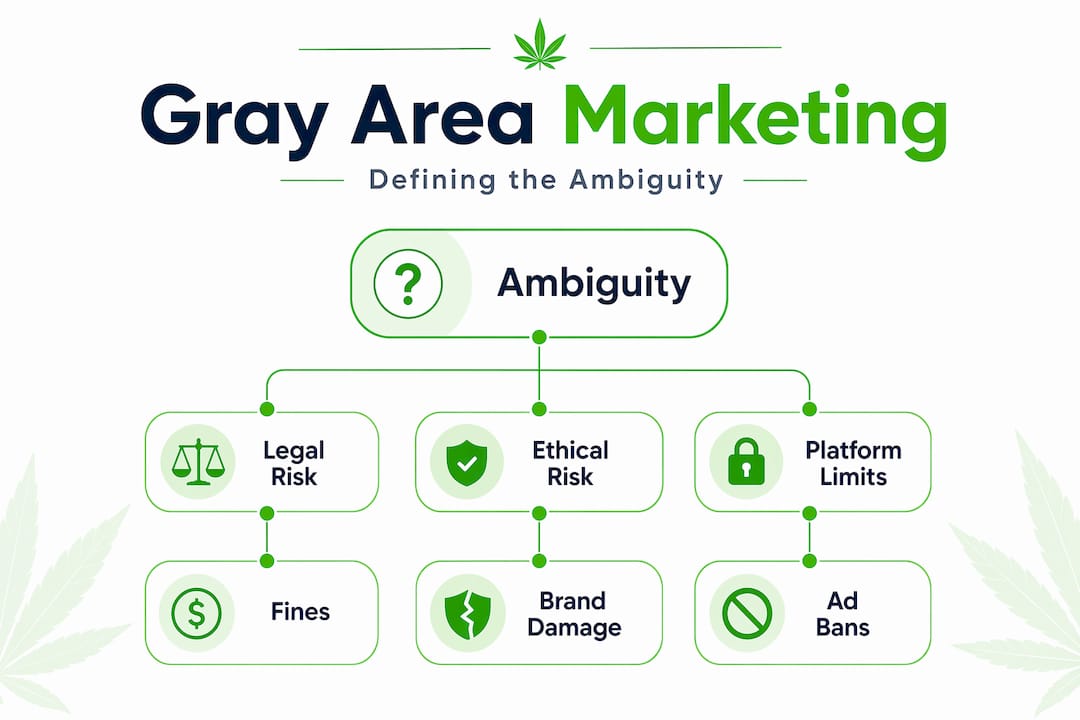
In plain terms: you’re not doing anything explicitly illegal, but you’re not in the clear either. The rules are vague, contradictory, or simply unenforced. And that gray space is exactly where most cannabis marketing lives.
Here’s what makes the cannabis context especially complicated:
Operating in this zone is not inherently wrong. But it does carry real risk. Gray area advertising techniques that push too far can damage your brand’s reputation and invite regulatory scrutiny that no cannabis business wants.
Understanding the legal landscape and ad platform restrictions clarifies the limits and risks of gray area marketing in cannabis.
The 2018 Farm Bill federally legalized hemp with less than 0.3% delta-9 THC, but that federal permission did not open the digital advertising floodgates. Google bans most CBD ads even when THC content is low, Meta prohibits THC ads except for limited licensed dispensaries, and TikTok restricts all cannabis paid ads, forcing brands to rely almost entirely on organic SEO and influencer partnerships.
On the state side, the picture gets even more complicated. Cannabis marketing violations in 2026 can result in fines from $5,000 to $50,000 per false health claim and license revocations. While 38 states allow medical cannabis and 24 permit recreational use, nearly every state has its own rules about ad placement, audience age restrictions, and proximity to schools.

Here’s how major platforms currently handle cannabis advertising:
| Platform | Hemp/CBD policy | THC policy | Best compliant channel |
|---|---|---|---|
| Google Ads | Most CBD ads banned | Prohibited | Organic SEO |
| Meta (Facebook/Instagram) | Limited exceptions only | Prohibited except licensed dispensaries | Organic content, influencer posts |
| TikTok | Heavily restricted | Prohibited | Educational organic content |
| Connected TV (CTV) | Allowed with age gating | Allowed in legal states with age gating | Programmatic CTV campaigns |
| Cannabis ad networks (Weedmaps, Leafly) | Allowed | Allowed per state law | Paid placements, sponsored listings |
The key things to watch for as you build any campaign:
Understanding hemp marketing best practices around these restrictions is not optional. It’s the foundation of every compliant campaign you build.
Pro Tip: Since paid ads are largely unavailable, invest that budget into organic SEO and a compliant influencer program with full FTC disclosures. These channels often outperform paid ads in cannabis because audience trust is higher and ban risk is zero.
With the risks clear, let’s explore how leading cannabis marketers navigate these challenges effectively.
The risks of gray area marketing fall into three categories: legal, reputational, and long-term brand health. Each one can hit your business hard if you’re not careful.
On the legal side, FTC 2025 guidelines impose fines from $5,000 to $50,000 per misleading health claim. State authorities can revoke licenses for violations. Puffery claims (subjective statements like “the best strain in Denver”) are generally protected, but specific claims like “relieves chronic pain” require clinical substantiation you almost certainly do not have. Read that distinction carefully. It matters.
The ethical risks are just as serious. Operating within gray areas erodes legitimacy and can prompt scrutiny or backlash. Repeated testing of ethical boundaries undermines the consumer trust that cannabis brands desperately need to build in a market where public skepticism is still real.
Consider these practical risks when evaluating your current marketing:
The trust equation matters most. Cannabis is still fighting for legitimacy in the eyes of many consumers. Every brand that makes unsubstantiated claims makes it harder for the entire industry to be taken seriously. Compliance isn’t just about avoiding fines. It’s about building content that earns trust and survives regulatory change.
The brands that win long-term are the ones that treat compliance as a core part of their identity, not a box to check.
These practical strategies allow brands to succeed safely amid legal complexities and platform restrictions.
The good news: top hemp marketers treat compliance as a strategic advantage. They use endemic networks and influencer partnerships with full FTC disclosures to drive higher conversions despite platform bans. You can do the same. Here’s how:
Build an organic SEO program focused on local and long-tail searches. Organic SEO on local queries plus Weedmaps and Leafly citations generate 20-30% of discovery traffic without paid ads, provided you use 21+ disclaimers and avoid health claims. Target searches like “dispensary near downtown Portland” or “best CBD gummies for sleep without THC claims.”
Launch a compliant influencer marketing campaign. Work with creators who have verified adult audiences. Require FTC #ad disclosures in every post. Brief them on what they can and cannot say about your products. This protects both of you.
Use cannabis-friendly and endemic ad networks. Platforms built for the industry already know the rules. Programmatic networks with age-gating and Connected TV advertising in legal states give you reach that Google and Meta simply will not allow.
Implement a claim substantiation process. Before any claim goes live, run it through a simple test: is this a subjective opinion (puffery) or a factual assertion? “Our customers love this product” is puffery. “This product reduces inflammation” requires proof. Build this into your cannabis content strategy from day one.
Invest in educational content over direct product claims. Blog posts, guides, and videos that explain how cannabinoids work, what terpenes do, or how to choose the right product build authority and drive organic traffic. They also stay far from the enforcement lines that health claims trigger.
Pro Tip: Collect compliant opt-in data through in-store QR codes that link to educational pop-ups. Pair this with a solid email marketing program. Email is one of the few direct channels where cannabis brands have real flexibility, provided subscribers actively opted in. You own that list. No platform can ban it.
Pair these strategies with strong social media compliance practices and you have a defensible, growth-oriented marketing program.
Successfully navigating these nuances is essential for brands aiming to expand regionally without regulatory exposure.
If you sell across state lines or operate dispensaries in multiple states, your marketing complexity multiplies fast. Each jurisdiction has its own rules, and delta-8 THC is banned in about 18 states as of 2026, requiring geo-fencing of ads 500-1,500 feet from schools and explicit labeling to reduce consumer skepticism.
Hemp loopholes involving delta-9 THC conversion post-harvest have also led to increased scrutiny affecting interstate shipping and tax liabilities. This is not just a marketing problem. It’s a compliance problem that feeds back into how you can legally promote your products.
Here’s a snapshot of how regulations vary across key states:
| State | Delta-8 status | Distance restriction | Recreational advertising allowed |
|---|---|---|---|
| Colorado | Legal | 1,000 ft from schools | Yes, with 21+ labeling |
| California | Legal | 1,000 ft from schools | Yes, with age gating |
| Texas | Banned | N/A | No recreational market |
| New York | Legal | 500 ft from schools | Yes, regulated platforms only |
| Florida | Banned | 1,500 ft from schools | Medical only |
To manage this across your operation:
Product category also matters. Pipes and accessories typically face fewer marketing restrictions than THC products or CBD tinctures. Know what category each product falls into before you build a campaign around it.
Most cannabis marketers experience gray area restrictions as a wall. We see them as a filter. And that reframe changes everything.
When Google bans your ads and Meta restricts your content, it’s frustrating. But those same restrictions eliminate most of your less disciplined competitors. The brands that figure out organic SEO, compliant influencer marketing, and endemic ad networks are operating in a far less crowded space than brands running unrestricted paid advertising in other industries.
Operators win by viewing federal restrictions as creative opportunities. Connected TV ad spend is growing specifically because it allows age-gated targeting that avoids ban risk entirely. Brands building CTV campaigns right now are getting in early on a channel that will become far more competitive within two years.
There’s also a trust dynamic that most cannabis marketers underestimate. Consumers in this space have been burned by overpromising brands. The company that shows up with transparent, educational, claim-substantiated content builds a level of credibility that a flashy ad never could. Compliance earns trust in a way that corner-cutting can’t.
The real gray area marketing advantage is that compliance becomes a moat. Brands that build systems for it early create marketing infrastructure that competitors cannot easily replicate.
Pro Tip: Set a calendar reminder every quarter to review updates from the FTC, your state cannabis authority, and your primary ad platforms. Policy changes come fast in this industry. The brands that stay ahead of those changes are the ones that master cannabis marketing strategies before everyone else catches up.
Gray area marketing in cannabis requires more than good intentions. It requires specialized knowledge, tested frameworks, and the ability to move quickly when regulations shift.
At Dope SEO, we work exclusively with cannabis and hemp businesses facing exactly these challenges. Whether you need a professional cannabis marketing strategy built around compliance, a cannabis SEO program that drives organic traffic without paid ad risk, or guidance on social media’s role in your SEO strategy, our team understands the regulatory environment from the inside. We do not guess. We build campaigns that grow your brand sustainably within the rules of every jurisdiction you operate in.
Gray area marketing refers to promotional tactics that operate in legally or ethically ambiguous zones where compliance rules are unclear or differ between regions and platforms. In cannabis, this is especially common because laws vary widely across federal, state, and local levels.
Most major platforms prohibit paid ads for CBD and THC products. Google bans most CBD ads and Meta prohibits THC ads with limited exceptions, so cannabis marketers typically rely on organic SEO, endemic networks, and compliant influencer marketing instead.
Making unsubstantiated health or disease claims can lead to FTC fines from $5,000 to $50,000 per violation and possible state licensing penalties. Subjective puffery claims are generally safe, but any factual health assertion requires substantiation.
You must tailor campaigns to each state’s specific regulations, respect distance restrictions from schools, prohibit targeting of minors, and geo-fence products like delta-8 THC in states where it is banned to avoid fines and license issues.
Yes. Channels like programmatic networks built for cannabis, digital out-of-home advertising, and Connected TV with age gating provide legal ways to reach adult audiences, along with compliant influencer partnerships that include proper FTC disclosures.

© 2026 Curious Monkeys Pressing Buttons LLC DBA Cannabiz Marketing Solutions AKA DopeSEO. All rights reserved.