
Reaching the right cannabis consumer today feels less like traditional retail and more like competing for space in the crowded wellness market. As dispensary owners and marketers across the United States and Canada know, success hinges on aligning your digital strategy with shifting consumer views, strict state-by-state laws, and ever-changing platform rules. This article lays out what cannabis digital marketing truly involves, highlighting how wellness messaging and strict compliance shape your path to sustainable growth.
| Point | Details |
|---|---|
| Wellness Focus | Shift cannabis marketing from recreational use to promoting wellness benefits such as sleep aid and stress relief. |
| Regulatory Compliance | Understand and adapt to varying state regulations and compliance requirements in cannabis advertising. |
| Local SEO Importance | Optimize your online presence using local SEO strategies to attract high-intent customers searching for cannabis products. |
| Multi-Channel Marketing | Employ a multi-channel approach to navigate platform restrictions while effectively reaching diverse audiences. |
Cannabit digital marketing has shifted fundamentally over the past few years. Your job is no longer just promoting cannabis as a recreational product. Instead, you’re positioning it as a wellness solution that competes with skincare, supplements, and other health products. Modern consumers view cannabis through a wellness lens, seeking specific outcomes like better sleep, stress relief, or relaxation rather than just getting high.
This shift changes everything about your messaging and targeting strategy. You need to reach new audiences including Gen Z and millennials who care about product quality, ingredient transparency, and health benefits. Cannabis marketing trends increasingly emphasize wellness positioning rather than lifestyle branding alone. Your digital channels must reflect this evolution, from your website content to your social media approach.
Effective cannabis digital marketing also means understanding the regulatory environment. Telemedicine and policy complexities shape how products reach consumers across different states and markets. You cannot market the same way in Massachusetts that you do in California or Colorado. Each jurisdiction has unique rules about what claims you can make, which platforms you can use, and how you can target customers.
Discreet product formats drive your marketing focus too. Edibles, beverages, and other convenient formats appeal to consumers who want cannabis without the traditional smoking experience. These products align with the wellness narrative and attract demographics that might not have considered cannabis before. Your digital marketing must highlight these specific product categories and their practical benefits.
Your marketing strategy also integrates where customers actually shop and research. Many people discover cannabis through health and wellness searches, not recreational drug searches. This means optimizing for keywords around sleep, anxiety, pain management, and wellness rather than just “cannabis dispensary near me.”
Pro tip: Start mapping your top competitor keywords related to wellness benefits, not just product names, to identify gaps in your local market where your dispensary can capture high intent searches.
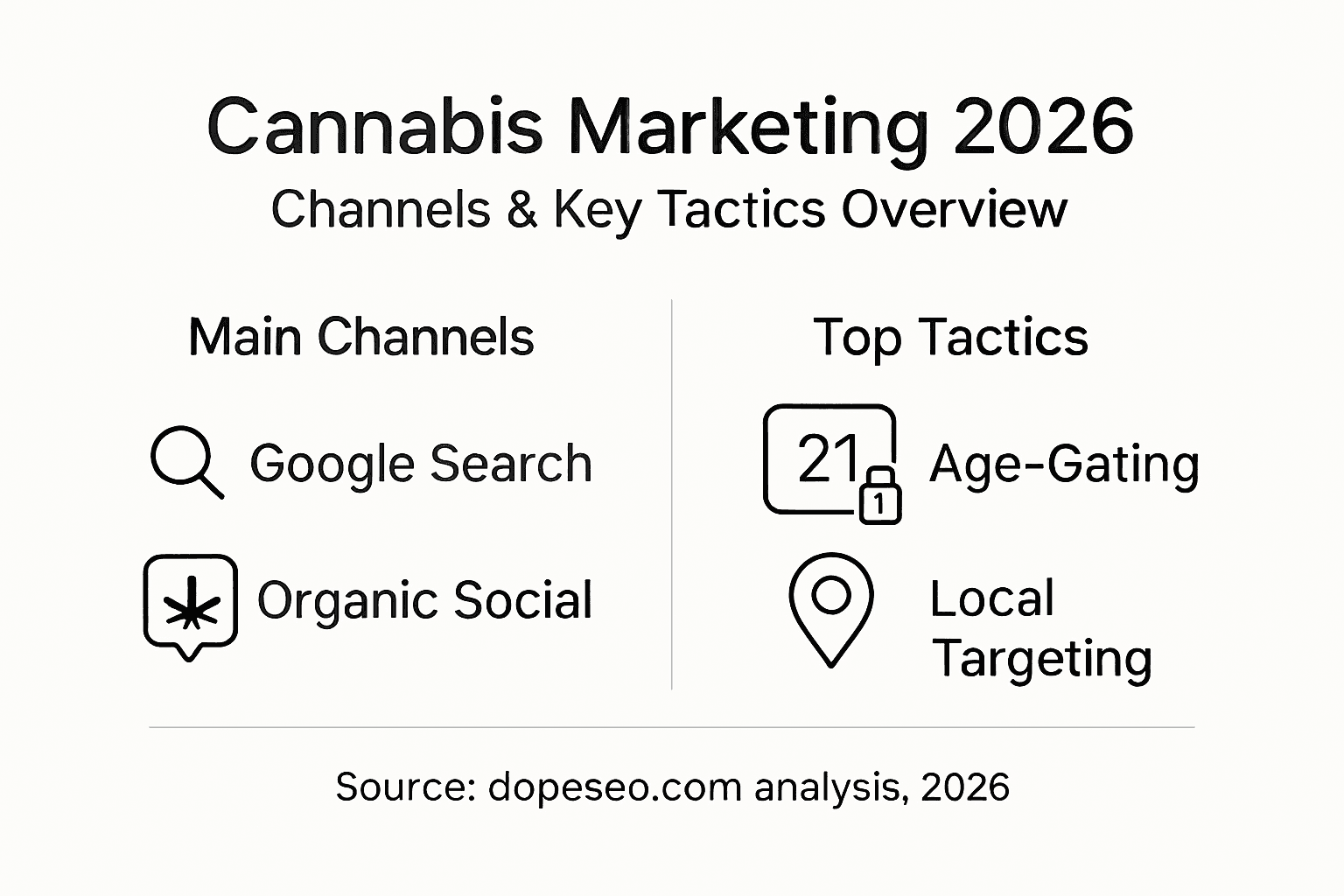
Your channel selection directly impacts campaign performance and regulatory compliance. Google, Meta, and TikTok dominate cannabis marketing, but each platform enforces different rules about age verification, claim restrictions, and audience targeting. What works on one platform may violate policies on another. You need a multi-channel approach that accounts for these differences.
Programmatic advertising and Connected TV represent growing opportunities for reaching consumers at scale. These channels allow you to bypass some platform restrictions while maintaining compliance through technical controls. Programmatic digital advertising and Connected TV demand strict compliance strategies that align with local regulations. The advantage is precision: you can reach specific demographics without wasting budget on unqualified audiences.
Here’s a summary of how cannabis digital marketing channels differ in audience and compliance aspects:
| Channel | Primary Audience | Compliance Requirements | Unique Advantage |
|---|---|---|---|
| Health & wellness seekers | Must avoid product claims | High-intent search traffic | |
| Meta (Facebook/IG) | Millennials, Gen Z | Strict audience age restrictions | Visual storytelling options |
| TikTok | Younger demographics | Bans most cannabis content | Viral short-video potential |
| Programmatic/CTV | Broad, geo-targeted | Technical compliance controls | Precision local targeting |
Location-based targeting and age-gating are non-negotiable tactics. Your ads should never appear to users under the legal age, and they must respect state and local boundaries. Someone in Colorado shouldn’t see advertising for a Massachusetts dispensary. Use geo-fencing to limit impressions to your service area and implement age verification at every touchpoint.

Audience segmentation goes deeper than demographics. Segment by purchase intent, product preference, and consumer behavior. A first-time buyer needs different messaging than a loyal customer. Someone searching for sleep aids requires different creative than someone looking for social use products. Tailor your approach accordingly.
Multi-state operators face the biggest challenge: customizing campaigns across jurisdictions. Massachusetts has different rules than California, which differs from Colorado. You cannot run one universal campaign. Instead, build modular creative assets that adapt to local compliance requirements while maintaining brand consistency.
Pro tip: Create a compliance checklist for each platform and state you operate in, then audit your campaigns monthly to catch policy changes before they impact your performance.
Cannabis advertising operates in a fragmented legal environment where federal prohibition collides with state legalization. Federally, cannabis remains a Schedule I controlled substance, which means the FDA does not approve cannabis advertising and most traditional advertising channels reject cannabis ads outright. This creates immediate friction: you cannot advertise on major platforms the way alcohol or tobacco companies do.
State laws compound this complexity. Some states allow images of cannabis flower in advertisements, while others restrict you from showing the product at all. Potency claims, pricing mentions, and health benefits face different restrictions depending on your jurisdiction. State advertising rules vary significantly across cannabis marketing regulations, meaning what you can legally say in Colorado may violate Massachusetts law.
Age-based prohibitions are universal but inconsistently defined. All states prohibit advertising near schools and to minors, but they use different legal age thresholds. Some align with drinking age at twenty-one, others set different standards. You must research your specific state requirements and enforce strict age-gating on every digital touchpoint.
Platform policies create an additional layer of restriction. Google and Meta maintain strict policies against most cannabis advertising, though they occasionally run pilot programs with limited allowances for certain states. TikTok bans nearly all cannabis content. Social media platforms have varied and ambiguous policies on cannabis promotion, with inconsistent enforcement and unclear definitions of what constitutes prohibited content.
This means you cannot rely on traditional paid social media channels. Instead, focus on organic content, search engine marketing through compliant channels, email marketing, and direct consumer outreach. Your strategy must work within these constraints rather than fight against them.
Pro tip: Maintain a living document tracking which claims, imagery, and messaging are legal in each state and state where you operate, updating it quarterly as regulations change.
Compliance failures in cannabis marketing happen fast and cost more than money. Account bans, content removals, regulatory fines, and reputational damage accumulate when you cut corners on legal requirements. The worst part: these mistakes are often preventable with proper planning and attention to detail.
One common error is treating compliance as a checkbox instead of a core strategy. Brands deploy generic age restrictions, reuse campaigns across multiple states without adaptation, and rely on vague disclaimers instead of actual legal compliance. Common compliance mistakes include ignoring local nuances and using non-compliant visual elements. What works in one state fails in another, and platforms catch these violations quickly.
Another costly mistake is assuming uniform standards across states. Cannabis testing requirements, sampling protocols, and quality assurance standards vary dramatically by jurisdiction. You cannot use the same testing lab in Massachusetts and Colorado and expect the same results. State-specific compliance processes are not optional.
Cannabis brands often fail by assuming uniform testing standards across states, leading to failed product batches and regulatory delays. This impacts your supply chain, customer trust, and legal standing simultaneously. One failed batch can cascade into weeks of lost revenue and damaged credibility.
Visual content creates particular risk. Images that appeal to minors, even accidentally, trigger platform violations and regulatory action. Bright colors, cartoon aesthetics, lifestyle imagery targeting young audiences, and celebrity endorsements all raise red flags. Your creative assets must reflect the product’s serious health and wellness positioning, not recreational lifestyle appeal.
Successful dispensaries treat compliance as competitive advantage. They continuously monitor regulation changes, maintain detailed documentation, and adjust campaigns proactively rather than reactively.
This reference table highlights typical cannabis advertising compliance challenges and the impact on dispensaries:
| Challenge | Example Risk | Business Impact |
|---|---|---|
| Non-adaptive cross-state campaigns | Violates local regulations | Fines, bans, lost revenue |
| Inadequate age-gating | Minors exposed to ads | Account suspension, reputation loss |
| Misleading wellness claims | Regulatory investigation | Legal action, customer distrust |
| Non-compliant product visuals | Ads appeal to minors | Content removal, fines |
Pro tip: Hire a cannabis-specialized compliance consultant for quarterly audits of your campaigns, testing processes, and advertising creative to catch violations before regulators do.
SEO drives sustainable growth for cannabis dispensaries because it captures customers actively searching for your products. Unlike paid advertising, organic search traffic doesn’t disappear when you stop spending money. This makes SEO the foundation of long-term dispensary growth, especially in competitive markets.
Cannabis SEO in 2026 demands a shift from volume to value. Expertise, authority, and trust through educational content answers user queries thoroughly, which Google rewards with higher rankings. Create detailed guides about cannabis strains, effects, consumption methods, and wellness benefits. Answer the questions your customers actually ask rather than focusing on keyword density or backlink counts.
Local SEO separates successful dispensaries from struggling ones. Your Google Business Profile is your digital storefront. It shows up when people search “cannabis dispensary near me,” and a complete, optimized profile with photos, hours, reviews, and accurate location data captures these high-intent customers. Local keywords matter too: target phrases like “THC edibles in Boston” or “cannabis flower delivery in Denver” rather than generic national terms.
Review management directly impacts local rankings and customer trust. Encourage satisfied customers to leave Google reviews, respond professionally to negative feedback, and maintain a strong reputation signal. One negative review can cost you dozens of customers if you ignore it.
Technical SEO creates the foundation for everything else. A fast-loading mobile-friendly website, proper structured data markup, and clean site architecture help Google understand and rank your content. If customers struggle to navigate your site or it loads slowly on their phones, they leave before converting.
Data analytics inform sustainable growth decisions. Track which keywords drive traffic, which pages convert browsers into customers, and where your traffic comes from geographically. Use this information to double down on what works and eliminate what doesn’t.
Pro tip: Audit your Google Business Profile monthly, add new local keywords to your site content quarterly, and request five customer reviews each week to build momentum in local search rankings.
Navigating the complex regulations and platform restrictions of cannabis marketing in 2026 can feel overwhelming. From mastering compliance challenges like age-gating and local restrictions to optimizing your dispensary’s SEO and local search presence cannabis businesses face unique hurdles that demand specialized strategies. If you want to avoid costly mistakes and boost your organic traffic with tailored content marketing and AI-driven SEO techniques you need a partner who truly understands these nuances.
At dopeseo.com we specialize in helping cannabis brands build sustainable growth through expert local search optimization, reputation management, and compliance-focused digital marketing. Our deep knowledge of platform policies and state laws allows us to craft campaigns that attract targeted customers while staying fully compliant. Don’t let the fragmented legal landscape slow your success. Take control of your online presence today with cannabis digital marketing solutions designed to get your dispensary or cannabis business found where it matters most.
Effective cannabis digital marketing in 2026 involves positioning cannabis as a wellness solution, understanding the regulatory environment, highlighting discreet product formats, and optimizing for health-related search queries rather than just recreational use.
To ensure compliance, it’s important to research state-specific advertising regulations, maintain a compliance checklist for each platform and jurisdiction, and customize campaigns that adapt to local requirements while respecting age-gating and location-based targeting.
SEO is crucial as it drives sustainable growth by capturing customers actively searching for cannabis products. Focusing on local SEO, optimizing your Google Business Profile, and providing educational content can enhance visibility and credibility in competitive markets.
Audience segmentation allows for tailored messaging based on purchase intent and consumer behavior. Different segments, like first-time buyers or loyal customers, require unique approaches to effectively address their specific needs and preferences.

© 2026 Curious Monkeys Pressing Buttons LLC DBA Cannabiz Marketing Solutions AKA DopeSEO. All rights reserved.