
TL;DR:
- Cannabis advertising in the U.S. is governed by federal, state, and platform policies, with restrictions remaining despite federal rescheduling efforts. Businesses must navigate complex, often conflicting rules by mapping regulations, maintaining ongoing compliance workflows, and ensuring ad-to-landing-page consistency. Effective long-term success depends on continuous documentation, team training, and working with specialists aware of evolving legal and platform requirements.
Cannabis advertising in the United States sits at the intersection of federal law, state regulations, platform policies, and agency enforcement rules. Many business owners assume that recent federal rescheduling activity opens new marketing doors, but advertising restrictions remain firmly in place regardless of how marijuana is classified at the federal level. The FTC, FDA, and each individual state still set the boundaries for what you can say, where you can say it, and to whom. This guide walks you through the actual legal landscape, the practical compliance steps, and the strategic thinking that separates businesses that grow from those that get penalized.
| Point | Details |
|---|---|
| State rules govern most ads | Even after federal rescheduling, state cannabis advertising rules set most compliance requirements. |
| FTC disclosures are critical | Missing required influencer or testimonial disclosures can trigger costly enforcement actions. |
| Workflow reduces risk | A systematic compliance workflow helps avoid common campaign pitfalls and platform takedowns. |
| Edge cases add exposure | Podcasts, streaming, and creative use of testimonials can bring surprise legal liabilities. |
The single biggest misconception in cannabis marketing is that advertising law has one source. It doesn’t. You’re actually dealing with at least three separate rule-making bodies at the same time: federal agencies, state regulators, and private advertising platforms.
At the federal level, the FTC governs truth-in-advertising standards. The FDA controls health and medical claims. Together, these agencies create a floor that applies everywhere, regardless of your state’s position on cannabis. Federal rescheduling developments may adjust the risk profile for medical marijuana classification, but they do not remove these foundational restrictions.
State rules are often far stricter than what the federal floor requires. California, Colorado, Illinois, and Michigan each have their own advertising codes. Some states prohibit certain ad placements near schools. Others require age disclaimers in specific fonts and sizes. A few mandate that your license number appear on every piece of advertising. What’s acceptable in one state may be a violation in another, and that matters a great deal if you run digital campaigns that cross state lines.
“The reality is that even the most cannabis-friendly states have advertising rules that go well beyond what federal law currently requires. State regulators are not waiting for federal reform to move forward with enforcement.”
Platform policies add a third layer entirely. Google, Facebook, Instagram, YouTube, and most programmatic ad networks have their own independent rules that restrict cannabis advertising, and these policies are not synchronized with state or federal law. You can be in full legal compliance with California state rules and still get your ad account banned on Google. Understanding these digital advertising challenges is essential before you spend a dollar on paid promotion.
Multi-state operators face the hardest version of this problem. A campaign that’s compliant in Oregon may trigger violations in Florida because the two states have completely different sets of restrictions on language, imagery, and audience targeting. Here’s a quick comparison to illustrate how much variation actually exists:

| Requirement | California | Colorado | Florida | Texas (hemp only) |
|---|---|---|---|---|
| Age disclaimer required | Yes | Yes | Yes | Yes |
| License number in ads | Yes | Yes | Yes | N/A |
| Health claim restrictions | Strict | Strict | Very strict | Strict |
| Imagery near minors | Prohibited | Prohibited | Prohibited | Prohibited |
| Platform-specific bans | Yes | Yes | Yes | Yes |
Building an age-gate on your website is not optional in most states. It’s a required component of responsible advertising, and failing to implement one correctly can expose you to state enforcement actions even when your ad content itself is technically compliant.
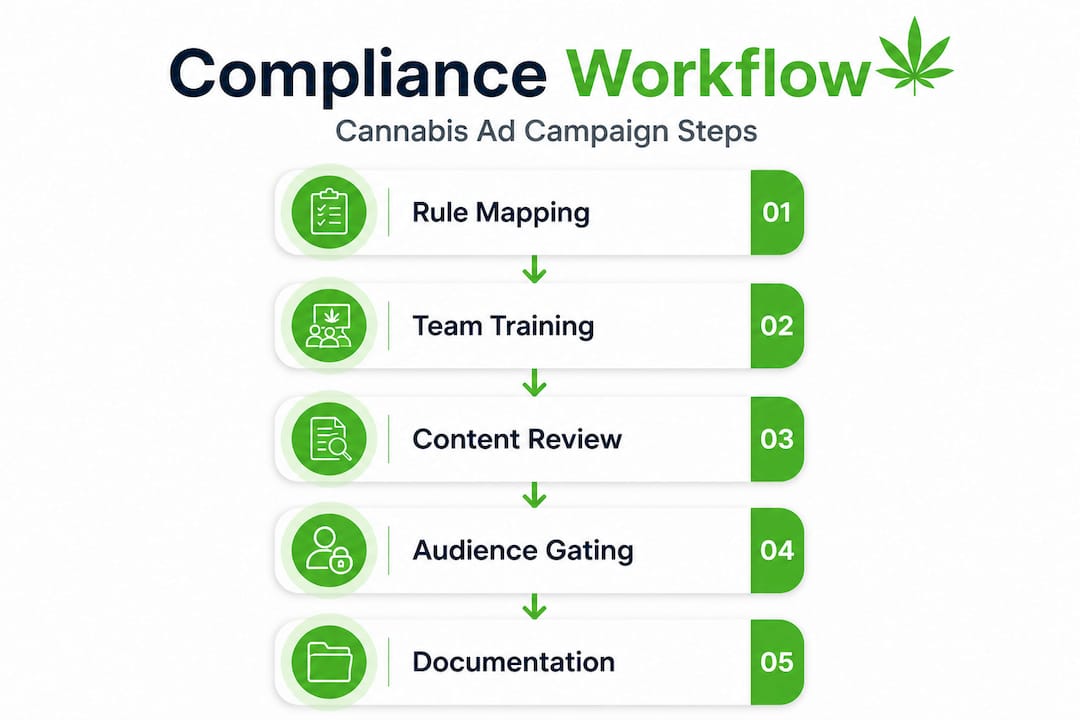
Knowing the landscape is step one. Building a repeatable workflow is step two. A solid compliance workflow covers four areas: mapping each state’s rules, running a content checklist, aligning your ad creative with landing pages, and governing your influencer and UGC activity.
Here’s the full process broken down:
Map your target states first. Before writing a single headline, identify every state where your ads will be seen. Pull the specific rules for your product category: medical vs. adult-use, THC percentage, and format (display, video, email). Each of these variables changes what’s allowed.
Run a content checklist on every campaign. Your checklist should include: no imagery or language that appeals to minors, no prohibited health claims, no misleading statements about effects or benefits, required age warnings, required licensee identification, and accurate pricing disclosures if prices are shown.
Match your landing pages to your ad creative. This step gets overlooked constantly. Ad platforms scan the destination URL of your campaign, not just the ad copy. If your ad promotes a specific product category and the landing page features unrelated or non-compliant content, your account gets flagged. This “ad-to-landing-page mismatch” is one of the top reasons cannabis businesses lose ad accounts unnecessarily. Review your cannabis marketing checklist to make sure landing pages and ad copy are consistent before launch.
Set up an influencer approval process. Every creator who posts about your brand is technically creating advertising risk that you own. Their posts need the same compliance review as your own ads. Contracts should include content pre-approval rights, required disclosure language, and clear terms around prohibited claims.
Pro Tip: Assign one person internally as the compliance lead for every campaign. Not a lawyer reviewing everything after the fact, but someone on your marketing team who runs the checklist before launch. This single change catches most issues before they become violations. For a deeper look at building efficient advertising campaigns, you can structure your entire launch process around this gating step.
The content checklist in particular deserves extra attention. Health claims are a consistent source of enforcement action. Saying your product “relieves anxiety” or “treats inflammation” crosses into medical territory unless backed by FDA-approved evidence, which doesn’t exist for cannabis at the current federal level. Use language that describes the experience without making therapeutic promises.
Endorsements, reviews, and user-generated content (UGC) are among the most powerful marketing tools in cannabis. They’re also the most legally exposed. The FTC treats influencer posts as advertising when there’s a material connection between the brand and the creator, and this applies whether you’re paying the influencer or simply sending them free product.
Endorsements and testimonials must be truthful and cannot be misleading. Material connections, meaning payment, gifted product, a discount, or any other business relationship, must be disclosed clearly. The FTC does not accept “implied” disclosure. It must be explicit, upfront, and easy to understand.
The risks by channel look like this:
Consumer reviews present a separate but related risk. Deceptive or misleading review practices and missing disclosures can trigger FTC enforcement even when the business didn’t write the review itself. If your team has any role in curating, filtering, or incentivizing reviews, you’re responsible for how they appear to consumers.
| Channel | FTC Rule | State Rule | Platform Rule |
|---|---|---|---|
| Paid influencer post | Disclosure required | May restrict content | Often prohibited entirely |
| Gifted product review | Disclosure required | Varies by state | Often prohibited entirely |
| Customer testimonial | Must be truthful | Varies by state | Allowed with restrictions |
| Branded sponsorship | Disclosure required | Varies by state | Treated as advertising |
Pro Tip: Use a two-step contract for influencer work. The first document covers the creative deliverables and compensation. The second is a content pre-approval addendum that gives your compliance lead final review rights before anything goes live. This protects you legally even if the creator posts something that violates your agreement. Good content marketing practices always account for the legal ownership of claims, not just the creative value.
Building a compliant review strategy is also smart from an SEO perspective. Authentic, detailed reviews improve your local search rankings. Your SEO and review strategy should include a process for requesting reviews through compliant channels, responding to reviews professionally, and removing incentivized reviews that weren’t properly disclosed at the time of collection.
You’ve handled your own ads and your influencer partnerships. But there’s a category of advertising risk most businesses never plan for: the content that functions like advertising even when you don’t think of it that way. Multi-state reach through podcasts or streaming creates overlapping jurisdiction issues, audience verification obligations, and state-specific content compliance requirements all at once.
Consider a branded podcast. If your show is distributed on Spotify and reaches listeners in 12 states, you’re technically operating a cross-state advertising channel. Each of those states may have rules about what can be said in a cannabis-related audio ad. The same logic applies to a YouTube channel, a live-streamed event, and even a well-trafficked blog post with embedded product mentions.
Here’s a numbered checklist of must-verify items for edge-case legal exposure:
Streaming and podcast ads: Identify every state where your audio reaches a meaningful audience. Check each state’s rules for audio advertising. Include required disclaimers in the script.
YouTube and video content: Age-restrict your channel settings through the platform’s own tools. Add required age warnings to video descriptions and verbal warnings in the video when discussing specific products.
Audience verification: Platforms and states may both require verification that your audience is 21 or older. Using platform-level targeting controls is not always sufficient to satisfy state-level requirements.
Branded sponsorships of events: If your brand sponsors a non-cannabis event (a concert, sports team, or festival), the sponsorship itself may be subject to cannabis advertising rules in the state where the event occurs.
Employee social media: Posts by employees that mention your brand or products can be treated as advertising if there’s an apparent connection to the company. A social media policy with clear guidelines protects you here.
Email marketing: Many businesses forget that email campaigns fall under CAN-SPAM rules at the federal level AND state cannabis advertising rules simultaneously. Age verification of your email list is a critical and often overlooked requirement.
Here’s what we’ve observed working with cannabis businesses across multiple states: the ones that fail compliance reviews are rarely the ones ignoring the rules entirely. They’re the ones treating compliance as a checklist they complete once at campaign launch and then forget. That’s the core mistake.
Real compliance is a living system, not a one-time event. Regulations change. State agencies update their guidance mid-year. The FTC issues new enforcement priorities. A rule that was compliant six months ago may not be today. Businesses that win long-term are the ones that treat their compliance documentation the way they treat their financial records: updated continuously, reviewed regularly, and accessible to anyone who needs to reference it.
The other thing that actually works is team training. Not legal briefings from outside counsel once a year, but internal training that your copywriters, social media managers, and campaign leads receive before they touch a piece of content. A copywriter who understands why health claims are prohibited makes fewer mistakes than one who only knows they’re “not allowed.” Context matters for judgment calls.
We’ve also seen businesses flip the script entirely and use mastering marketing strategies with compliance as a feature of their brand positioning. When your competitors are cutting corners and getting flagged, your clean track record with platforms and regulators becomes a competitive advantage. Advertisers who have survived audits without violations have better relationships with platforms, faster ad approvals, and more sustainable growth over time.
Meticulous documentation is the final differentiator. Keep records of every compliance review, every influencer contract, every content approval decision. If a state regulator ever contacts you, the fastest resolution comes from showing organized, dated records that demonstrate proactive, good-faith compliance.
Staying ahead of cannabis advertising regulations while running a business is a full-time job on its own.
That’s where working with a specialized cannabis marketing partner changes the equation. At Dope SEO, we track regulatory developments across states, monitor platform policy updates, and build campaigns that are designed for compliance from the start rather than fixed after the fact. Our team has experience with the digital strategies for cannabis that generate real organic traffic without triggering platform bans or regulatory flags. We also keep you current on marketing trends for dispensaries as the industry evolves. If you’re ready to build a marketing program that grows your business without the legal exposure, connect with us and let’s map out what that looks like for your specific market.
No, rescheduling does not automatically lift advertising restrictions on mainstream platforms; Google and Facebook maintain their own independent cannabis advertising policies that remain in effect regardless of federal classification changes.
Missing disclosure can lead to FTC enforcement actions including fines, required public corrections, and ongoing regulatory scrutiny that affects future marketing activity.
Both apply simultaneously, but state regulations are often stricter and must be followed in addition to federal requirements; state and FTC rules operate independently, meaning compliance in one area does not guarantee compliance in the other.
Require clear disclosure of any material connection between your brand and the reviewer, and ensure all testimonial claims are truthful and not misleading; review each piece of content before publication using a consistent internal approval process.

© 2026 Curious Monkeys Pressing Buttons LLC DBA Cannabiz Marketing Solutions AKA DopeSEO. All rights reserved.