
TL;DR:
- Cannabis websites must prioritize ongoing compliance with varying state regulations to avoid penalties and license loss.
- Core compliance pillars include effective age verification, accurate content, privacy policies, and licensing disclosures.
- Regular audits and adaptation to regulatory updates are essential for maintaining legal and customer trust.
Running a cannabis dispensary means operating under a microscope. Regulators scrutinize your physical location, your staff, and increasingly, your website. Many operators are surprised to learn that a non-compliant website can trigger fines, license reviews, or forced shutdowns, even when everything else is running smoothly. The rules are not universal: Maryland mandates DOB entry for age gates and actively audits websites, while other states require third-party ID checks or restrict what content visitors can see before verifying their age. This guide gives you a clear, actionable roadmap to keep your cannabis website fully compliant in 2026.
| Point | Details |
|---|---|
| Compliance is state-specific | Each state sets its own cannabis website rules, so always verify your local laws. |
| Verifiable age gates required | Reliable date of birth entry is a standard for preventing underage access and passing audits. |
| Regular audits mitigate risk | Review your site every six months and after regulatory changes to protect your license. |
| Stay ahead with tech | Hybrid and biometrics-ready systems help future-proof compliance as technology and laws evolve. |
Cannabis sits in a unique legal position. It remains federally controlled, yet 38 states have legalized it in some form. That gap creates a patchwork of rules where state regulators, not federal agencies, set the standards for how you operate online. Your website is a licensed extension of your business, and regulators treat it that way.
The most common compliance failures are not exotic or technical. They tend to be straightforward oversights:
Each of these can draw regulatory attention. State cannabis agencies publish official bulletins that signal enforcement priorities and upcoming audit waves. Ignoring those bulletins is one of the costliest mistakes a dispensary can make.
“Your cannabis website is not just a marketing tool. It is a regulated asset, and regulators are actively reviewing it.”
The consequences of non-compliance are serious. Fines can reach tens of thousands of dollars per violation. Regulators can order your site taken offline. In repeat or egregious cases, your operating license itself can be at risk. A compliant website design is not optional. It is a business requirement.
Beyond penalties, there is a trust dimension. Customers who encounter a poorly structured site with vague claims or missing legal disclosures may simply leave. A clean, compliant site signals professionalism and builds the kind of credibility that converts visitors into loyal buyers. Pairing compliance with SEO compliance for cannabis means your site ranks well and stays out of trouble at the same time.
Now that you know the urgent need for compliance, let’s look at how regulations differ across the country.
With an understanding of why compliance is critical, the next challenge is recognizing how requirements diverge between states. There is no single federal template. Each state writes its own rules, and those rules evolve constantly.
Maryland offers one of the clearest examples. The state requires dispensary websites to collect a visitor’s date of birth through an input field, not just a checkbox. It also conducts active website audits, meaning regulators visit your site and test your age gate. Other states take different approaches. California leans on content restriction, limiting what unverified visitors can see. Colorado and Oregon have both used third-party verification systems in certain contexts.
Here is a snapshot of how major states approach age verification:
| State | Verification method | Audit activity |
|---|---|---|
| Maryland | DOB input required | Active website audits |
| California | Content restriction | Complaint-driven |
| Colorado | DOB input or third-party | Periodic review |
| Oregon | Third-party ID check | Complaint-driven |
| Illinois | DOB input | Periodic review |
The gaps between these approaches matter. A dispensary operating in multiple states cannot apply a one-size-fits-all solution. What satisfies Maryland’s auditors may fall short in Oregon, and vice versa.
Key risks from ignoring state variations include:
Pro Tip: Subscribe to your state cannabis agency’s email list. Official bulletins often signal Maryland verification rules and enforcement changes weeks before they take effect, giving you time to update your site before auditors arrive.
The variety of age verification approaches across states means you need to treat compliance as a location-specific project, not a one-time checkbox.
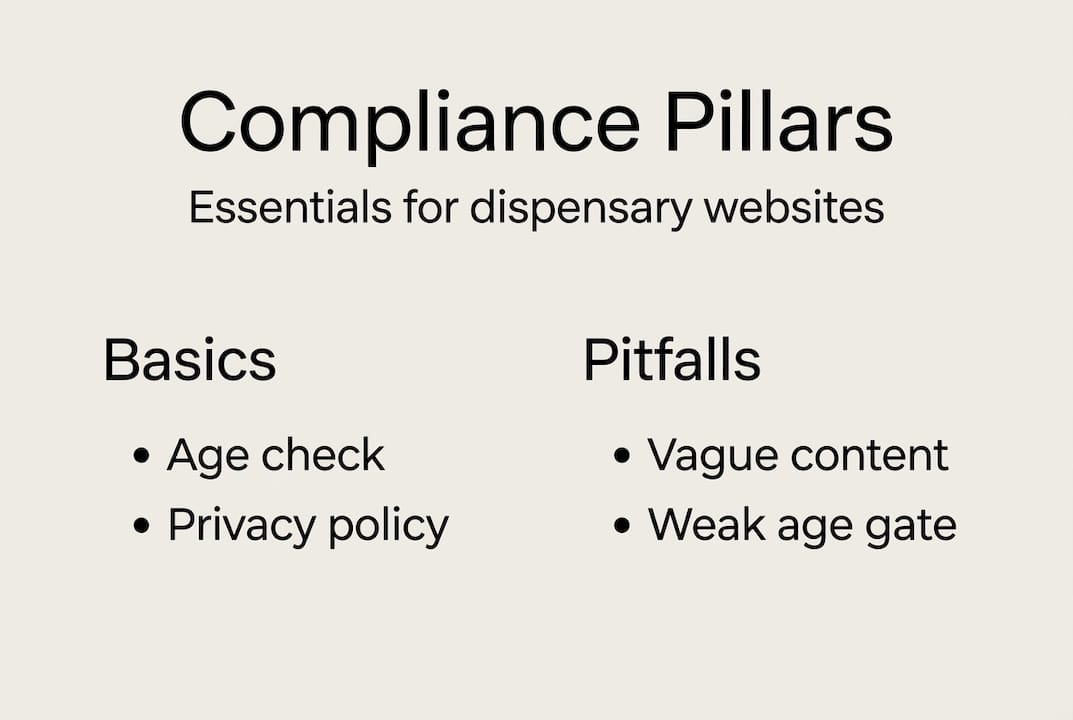
Understanding variations is essential, but every cannabis website must also master a set of core universal principles. Regardless of your state, these pillars form the foundation of a defensible compliance posture.
Here is a quick reference for each pillar:
| Pillar | Minimum standard | Common pitfall |
|---|---|---|
| Age verification | DOB input field | Using a checkbox only |
| Content accuracy | No medical claims | Vague efficacy language |
| Accessibility | WCAG 2.1 AA | Ignoring screen reader needs |
| Privacy policy | Full data disclosure | Outdated boilerplate |
| Licensing | Visible license number | Buried in footer only |
Pro Tip: When implementing age gates, test them on mobile devices. Many compliance failures happen because the gate works on desktop but breaks on smaller screens where most users actually browse.
Getting these pillars right sets the foundation. Designing compliant cannabis websites means building each of these elements into the site architecture from the start, not bolting them on later.
One pillar deserves special attention: age verification, where technology and law are in constant flux. The method you choose affects both your compliance standing and your user experience.
Here is how the main approaches compare:
| Method | How it works | Compliance strength | User friction |
|---|---|---|---|
| Self-attestation | Checkbox only | Weak | Very low |
| DOB input | Enter birth date | Moderate to strong | Low |
| Third-party ID | Upload or scan ID | Strong | High |
| Biometric | Face scan or fingerprint | Very strong | Very high |
Self-attestation is essentially a “yes, I’m 21” checkbox. It is the weakest option and is no longer accepted in states with active enforcement. DOB input is the current baseline standard. It requires visitors to enter their date of birth, which the system validates against the legal minimum age.
Third-party verification goes further, requiring users to upload a government ID or scan it through a service. This is more secure but creates friction that can hurt conversion rates. Some states require it; most do not yet.

Biometric verification is still emerging. Some states are moving toward advanced biometrics, while others still require only minimum DOB entry. No state currently mandates biometrics, but the trend is worth watching.
The privacy tradeoff is real. Collecting more identity data means greater responsibility for securing it. A data breach involving customer ID documents is a serious liability.
Pro Tip: A hybrid approach works well for most dispensaries. Use DOB input as your primary gate, and layer in third-party verification only for high-risk actions like account creation or online orders. This balances compliance strength with user experience. Explore your age gate solutions with this layered model in mind.
Here is the uncomfortable truth most compliance guides skip: the biggest risk is not ignorance of the rules. It is the assumption that yesterday’s compliance is still good enough today.
We have seen dispensaries invest in a solid site build, check every box at launch, and then leave it untouched for 18 months. Regulations change. State agencies update their bulletins. Enforcement priorities shift. A site that was fully compliant in early 2025 may have gaps by mid-2026 without a single line of code changing.
Treating compliance as a one-time project is the mistake. Treating it as an ongoing process is the solution. Schedule regular internal audits. Assign someone to monitor state bulletins. Build a review cycle into your operations calendar, not just your legal calendar.
Hybrid verification and regular audits also position you for the next wave of regulatory change. When biometrics or mobile driver’s licenses become standard, businesses with a compliance habit will adapt quickly. Those who scramble to catch up will face exposure. Staying ahead of updates is not just smart compliance. It is a competitive advantage.
Compliance does not have to be a burden you carry alone. When your website is built with compliance baked in from day one, you spend less time firefighting and more time growing.
At dopeseo.com, we specialize in compliance-focused web design built specifically for cannabis businesses. We understand the regulatory landscape because we work in it every day. Our team builds age gates, structures content to meet state standards, and integrates the privacy and licensing disclosures your site needs. We also connect compliance to visibility: a well-structured, compliant site performs better in search. If you want the full picture of how SEO and compliance work together, our cannabis SEO guide is a strong starting point.
The most common mistake is relying on a basic self-attestation checkbox instead of a verifiable date of birth entry. Official sources favor verifiable DOB over self-attestation because a checkbox provides no real barrier to underage access.
While federal law prohibits cannabis sales, compliance rules for websites are set and enforced by each state individually. State variations are significant, ranging from DOB input requirements to third-party ID checks and content restrictions.
You should review compliance at least every six months and immediately after any regulatory update in your state. State-specific audits are essential because official bulletins often signal new enforcement waves before they begin.
Some states require advanced verification, but most currently accept a reliable DOB entry as the minimum standard. Maryland requires DOB input and enforces through active audits, while other states mandate third-party checks, so always verify your state’s specific rules.
No state makes biometrics mandatory yet, but the regulatory trend is moving in that direction. Using hybrid verification approaches now can help future-proof your site against upcoming requirements.

© 2026 Curious Monkeys Pressing Buttons LLC DBA Cannabiz Marketing Solutions AKA DopeSEO. All rights reserved.