
Finding new ways to stand out in a crowded market can feel overwhelming for dispensary owners in cities from California to Toronto. When most cannabis businesses face strict advertising limits, customer reviews step in as your most powerful and organic marketing tool. Online reviews function as social proof that directly influences both consumer decisions and search engine rankings, meaning a solid review strategy can mean the difference between appearing first or last in local searches.
| Point | Details |
|---|---|
| Online reviews are crucial for SEO. | Reviews act as social proof, significantly influencing consumer decisions and local search engine rankings for dispensaries. |
| Quality and recency matter. | Focus on accumulating high-quality, recent reviews as they provide more value for SEO compared to older or less detailed reviews. |
| Engage with all feedback. | Responding to both positive and negative reviews demonstrates engagement and can improve customer perception and SEO performance. |
| Prioritize diverse review sources. | Aim for a presence on Google Business Profile, Leafly, and Weedmaps to maximize local visibility and consumer trust. |
When people search for a cannabis dispensary online, they’re not just looking for location and hours. They want to know whether real customers actually trust your business. Online reviews function as social proof that directly influences both consumer decisions and search engine rankings. For dispensaries, reviews aren’t optional marketing extras—they’re foundational SEO signals that determine how prominently your dispensary appears in local search results.
Customer reviews affect consumer decision-making across all e-commerce sectors, and cannabis dispensaries are no exception. Reviews communicate genuine customer experiences, build credibility, and signal to Google that your business is active and legitimate. When potential customers in your area search for terms like “cannabis dispensary near me” or “buy flower online,” search algorithms evaluate your review quantity, quality, and recency to determine ranking positions. A dispensary with 47 five-star reviews showing consistent recent activity will outrank competitors with only three reviews from six months ago. Reviews also serve another critical function: they provide fresh, user-generated content that keeps your Google Business Profile and website updated without requiring constant manual effort.
For cannabis businesses navigating strict advertising restrictions, reviews become even more valuable. Traditional cannabis marketing channels face platform limitations and regulatory constraints that don’t apply to other industries. Reviews bypass these restrictions by allowing customers to organically share their experiences with your products, staff, and store environment. This customer-generated content helps you compete locally without relying solely on paid advertising or content you create directly. When a customer writes “Best edible selection I’ve found in the city” or “Staff actually knew about different strains and effects,” you’re getting authentic marketing that resonates with local prospects far more than any promotional copy you could write yourself. Dispensary SEO success depends on integrating reviews into local search strategy, particularly when competing against other dispensaries in your market.
Understanding the difference between review volume, review velocity, and review quality matters for your SEO strategy. Volume means the total number of reviews your dispensary has accumulated. Velocity refers to how frequently new reviews appear—Google favors businesses getting consistent recent reviews rather than those with many old reviews and current silence. Quality encompasses star ratings, detailed review content, and reviewer credibility. A single authentic five-star review with specific details (“Their concentrate prices are competitive and the budtenders actually educated me on extraction methods”) outweighs ten one-star reviews, yet both impact your overall rating average. Search algorithms weight all three factors when determining local rankings.
Pro tip: Focus on encouraging reviews immediately after purchase by including a QR code or link in your receipt or packaging—customers are most likely to leave positive reviews within 24-48 hours of a satisfying transaction.
Not all reviews carry the same weight in search algorithms. Google and other search engines distinguish between different review sources, and each type sends distinct signals about your dispensary’s credibility and relevance. Understanding these differences helps you prioritize which platforms deserve your focus and how to encourage the most impactful review types.
Google Business Profile reviews represent your most valuable review real estate. These reviews appear directly in Google Maps and local search results, meaning they influence both ranking and click-through rates simultaneously. When a customer searches for cannabis dispensaries in your area, Google displays your star rating and recent review snippets before they even visit your website. A dispensary with 4.8 stars and recent positive reviews showing up in search results converts significantly more clicks than one with lower ratings or no visible reviews. Google’s algorithm prioritizes review recency heavily, so consistent recent activity matters more than accumulated historical reviews.
Website reviews (those posted on your own dispensary’s site) serve a different SEO function. While they don’t carry the same local ranking weight as Google reviews, they provide fresh on-page content that search engines crawl and index. Website reviews also reduce bounce rates by showing real customer testimonials that build trust before visitors reach your contact information or product pages. Third-party review platforms like Leafly, Weedmaps, and local cannabis directories occupy middle ground. Different review sources impact consumer trust and search credibility in distinct ways. Reviews on cannabis-specific platforms carry authority with customers actively seeking dispensaries but may not influence Google’s core local ranking algorithms as directly as Google Business Profile reviews.
Verified purchase reviews outrank unverified reviews in algorithm calculations. When a customer leaves a review after an actual transaction, it signals authenticity. Google and other platforms can verify actual purchases through transaction data, making these reviews significantly more trustworthy signals. An unverified one-star review from someone who may have never visited your dispensary carries minimal SEO weight compared to a verified three-star review from an actual customer. Star rating distribution also matters. A dispensary with mostly five-star reviews and a few three-star reviews (indicating realistic diversity) ranks better than one with exclusively five-star reviews, which can appear suspicious to algorithm evaluators.
Review content quality directly impacts SEO performance. Detailed reviews containing specific product names, strain types, or customer service details generate more searchable content keywords than generic statements like “great place.” When customers write “Their Tahoe OG flower is consistently dense with a strong pine aroma, and budtenders explained the difference between this and their Kush strains,” that review becomes findable through specific product and strain searches. Review sentiment matters too. Negative reviews shouldn’t alarm you—a mix of four and five-star reviews alongside occasional lower ratings appears more authentic to search algorithms than perfect ratings across the board.
Here is a quick comparison of major review platforms and their SEO value for dispensaries:
| Platform | Search Impact | Customer Trust Level | Unique Consideration |
|---|---|---|---|
| Google Business Profile | Highest; affects local ranking | Very high | Most important for map visibility |
| Leafly | Moderate; niche influence | High | Popular among cannabis consumers |
| Weedmaps | Moderate; niche influence | High | Strong in cannabis-specific searches |
| Website | Low; aids on-page SEO | Moderate | Adds trust on site, not local SEO |
Pro tip: Prioritize Google Business Profile reviews first, but also encourage Leafly and Weedmaps reviews since customers often research on cannabis-specific platforms before visiting—these secondary platforms build trust that eventually converts to Google reviews and store visits.
Google’s local search algorithm treats reviews as a primary ranking factor, not a secondary consideration. When the search engine evaluates which dispensaries should appear at the top of local pack results and map listings, review metrics heavily influence those decisions. The algorithm doesn’t just count reviews—it analyzes their recency, quality, consistency, and relevance to determine your ranking position. A dispensary that received 30 reviews last month ranks differently than one with 30 reviews spread across two years, even if the star ratings are identical.
Review quantity directly impacts visibility in local search results. More reviews signal to Google that your business is active, popular, and trustworthy. Dispensaries with 80 reviews typically outrank competitors with 20 reviews in local search results, assuming similar star ratings and geographic proximity. Customer reviews improve click-through rates and local search visibility, meaning more people see your dispensary name and click through from search results. This increased engagement further boosts rankings because Google tracks user behavior signals. When your Google Business Profile appears in search results with prominent positive reviews visible, more searchers click it compared to profiles with no reviews or low ratings. That click pattern tells Google your listing is relevant and valuable.

Review recency matters more than you might expect. Google’s algorithm prioritizes fresh reviews over old ones. A single five-star review posted this week carries more ranking weight than five five-star reviews from two years ago. This is why establishing a consistent flow of new reviews maintains better rankings than accumulating reviews sporadically. When a customer searches for “best cannabis near me” on Monday, Google favors dispensaries that received customer reviews last week over those with months of silence. The algorithm interprets recent reviews as proof that your business is currently operating well and satisfying customers right now, not just years ago.
Review quality and specificity amplify ranking impact. A detailed review mentioning specific products, pricing, or customer service experience provides more ranking value than a generic “great place” comment. Positive reviews improve relevancy signals crucial for local rankings because they contain searchable keywords customers actually use when looking for dispensaries. When reviews mention product names like “Sativa hybrids,” “live resin cartridges,” or “knowledgeable budtenders,” those terms become indexed and connected to your business. This increases the likelihood your dispensary appears when customers search using those specific terms combined with location modifiers.
Star rating distribution also influences rankings. Google’s algorithm doesn’t treat all five-star ratings equally. A dispensary with ratings distributed across three, four, and five stars appears more authentic and ranks better than one with exclusively five-star ratings. The distribution pattern suggests honest feedback rather than fake positive reviews. Additionally, your overall rating percentage (the proportion of five-star versus one-star reviews) directly correlates with click-through rates. A 4.7-star dispensary with 120 reviews converts significantly more map clicks than a 3.8-star competitor, even if both appear in the same local search results.
Pro tip: Implement a post-purchase email campaign asking customers to leave Google Business Profile reviews within 48 hours of their visit—this timing captures the review momentum when satisfaction is highest while feeding Google’s algorithm the fresh review signals it prioritizes for ranking.
Review management in the cannabis industry operates within constraints that don’t exist for other sectors. Federal regulations, state-specific licensing requirements, and platform policies create a complex landscape where one misstep can result in suspended accounts, delisted profiles, or worse. You cannot simply encourage reviews the way a coffee shop or retail store does. Cannabis dispensaries must balance aggressive review collection with strict compliance to avoid triggering platform violations or regulatory scrutiny.
Each review platform has unique rules about solicitation and content. Google Business Profile explicitly prohibits offering incentives for reviews, yet many platforms enforce this rule more strictly for cannabis businesses than others. You cannot offer a discount code, entry into a drawing, or loyalty points in exchange for a review. What you can do is send a simple post-purchase follow-up asking customers to share their experience without mentioning any reward. Review solicitation and moderation practices require careful attention to platform policies, especially within the heavily regulated cannabis space. Leafly, Weedmaps, and other cannabis-specific platforms have different rules from Google. Some cannabis directories allow incentivized reviews under specific conditions, while others mirror Google’s prohibition. Before launching any review campaign, read the terms of service for each platform where you want reviews. Screenshot the relevant policy sections for your records in case disputes arise later.
Content moderation presents another compliance consideration. You cannot delete or suppress negative reviews simply because they damage your reputation. Platforms detect when businesses systematically remove critical reviews and penalize accounts for manipulation. However, you have legitimate grounds to request removal if a review violates platform guidelines. A review containing profanity, harassment, or false claims about your business can be reported. Genuine reviews from customers expressing dissatisfaction, even one-star reviews, must remain visible. Some dispensaries make the mistake of deleting negative reviews only to have their profiles flagged for suspicious activity, which harms rankings more than the original bad review would have.
Cannabis-specific regulations add another layer. Some states restrict advertising claims or prohibit testimonials about health effects. A customer review stating a product “cured my anxiety” could technically violate state advertising laws. You cannot edit customer-written reviews, but you can respond professionally and note that individual results vary. Your response demonstrates transparency while protecting your business from potential regulatory complaints. Similarly, never ask customers to make health claims in their reviews, and avoid amplifying reviews containing unsubstantiated medical statements.
Verification authenticity matters for both platform compliance and SEO performance. Platforms use various methods to identify fake reviews generated by bots or paid review services. Using review generation services might boost your numbers temporarily, but platform algorithms detect suspicious patterns and penalize accounts severely. Fake reviews tank rankings faster than no reviews at all. Authentic customer reviews, even negative ones, signal legitimacy to both platforms and search algorithms.
Pro tip: Create a simple post-purchase email template asking customers to share their experience on Google, Leafly, and Weedmaps separately, without mentioning incentives, making it easy for satisfied customers to leave authentic reviews on each platform without violating any policies.
Successful review management requires consistent action across multiple platforms and touchpoints. You cannot simply enable reviews on Google Business Profile and expect them to accumulate passively. The most successful dispensaries treat review management as an ongoing operational priority, integrating it into daily workflows the same way they manage inventory or customer service. This means designating a team member responsible for monitoring reviews, responding to feedback, and implementing strategies to encourage new reviews from satisfied customers.
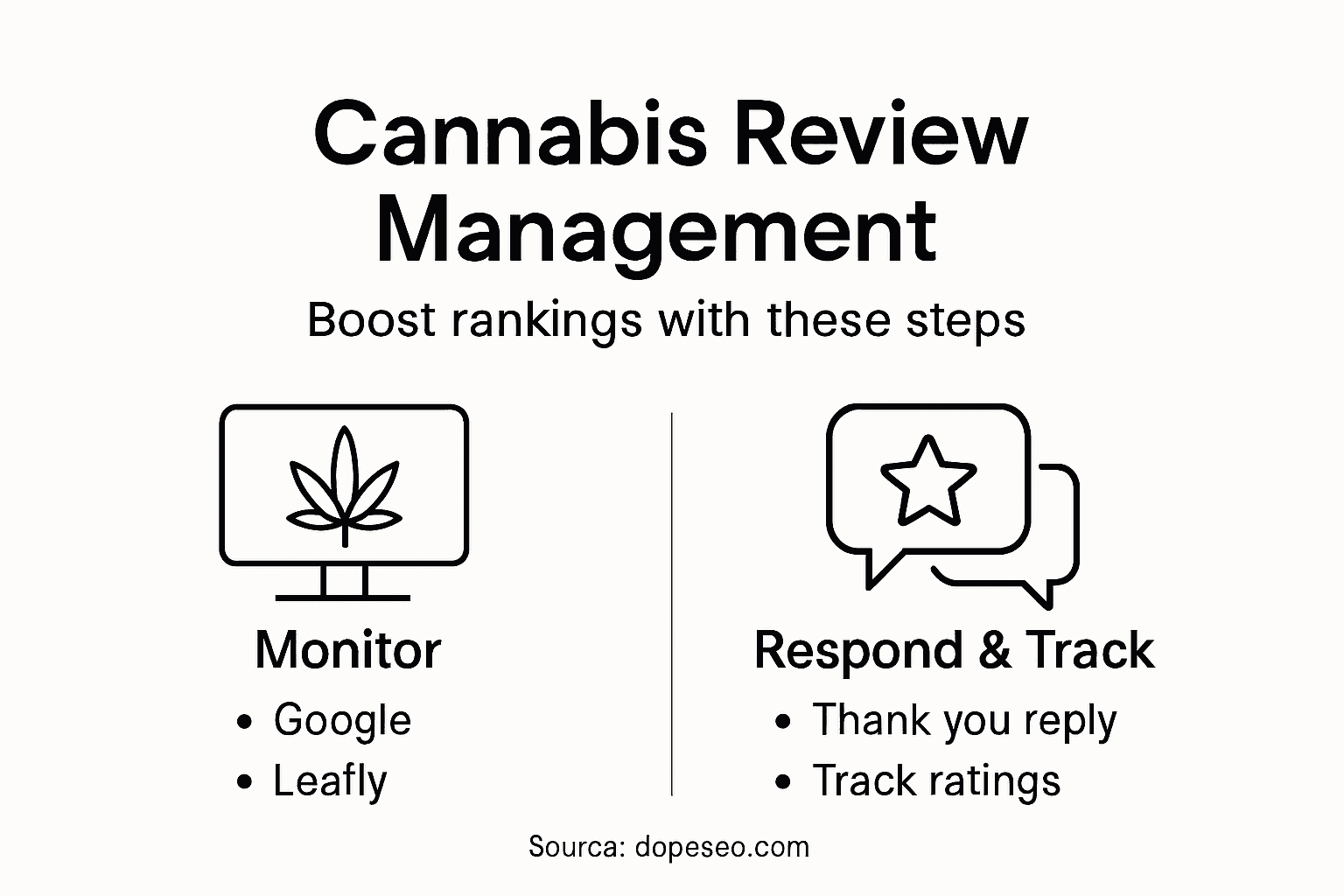
Monitor reviews across all platforms daily. Google Business Profile, Leafly, Weedmaps, and any local cannabis directories should be checked every morning for new reviews. Set up notifications so you receive alerts immediately when someone leaves feedback. Responding quickly to reviews signals to customers and search algorithms that you actively engage with feedback. When a customer leaves a review on Monday evening and receives a thoughtful response by Tuesday morning, they feel valued and are more likely to recommend your dispensary to friends. Google’s algorithm also prioritizes businesses with regular response activity. Monitoring and responding to reviews improves trust and engagement while strengthening your SEO performance through consistent platform interaction.
Respond strategically to every review, positive and negative. Positive reviews deserve genuine appreciation. Write personalized responses mentioning specific details from their review: “Thanks for highlighting our concentrate selection and the team’s knowledge—we pride ourselves on educating customers.” Generic responses like “Thanks for the review” waste the opportunity. For negative reviews, stay professional and never defensive. Acknowledge their concern, explain what went wrong if possible, and offer a resolution. A one-star review from someone complaining about wait times becomes an SEO opportunity when you respond by explaining your current staffing improvements and inviting them back to experience the changes. This response demonstrates accountability and commitment to improvement, which influences how future customers perceive your business.
Build a systematic review solicitation process. Create touchpoints where customers naturally receive review requests. Include a QR code linking to your Google Business Profile in receipts so customers can leave reviews immediately while still in your store or shortly after leaving. Send a follow-up email 24 hours after purchase with links to Google, Leafly, and Weedmaps. Train staff to verbally mention reviews during checkout: “We’d love to hear about your experience on Google if you have a moment.” Time your solicitation strategically. Customers are most motivated to leave reviews immediately after a positive experience, not weeks later. Multiple gentle reminders across different channels yield significantly higher review volumes than a single email request.
Organize and showcase reviews across your digital presence. Pull top reviews from platforms and feature them prominently on your website. Create a dedicated testimonials page displaying five-star reviews with photos when possible. This user-generated content proves far more effective for conversion than corporate marketing copy. Reviews containing specifics like “Their budtenders actually answered my questions about terpene profiles” and “Prices beat competitors by 15 percent on average” resonate with prospects far more than generic marketing claims. Include review snippets in blog content and social media posts.
Pro tip: Create a simple spreadsheet tracking review volume, average rating, and response rate by month so you can identify trends, celebrate progress with your team, and adjust your review strategy based on what’s actually working for your dispensary.
Many dispensary owners approach reviews with good intentions but make critical mistakes that undermine their SEO efforts and damage customer trust. Understanding these pitfalls helps you avoid costly errors that can take months to recover from. The difference between a thriving review strategy and a failing one often comes down to avoiding these preventable missteps.
Purchasing fake reviews represents the most dangerous pitfall. It might seem tempting when competitors appear to have hundreds of reviews and your dispensary has only ten. Services exist that promise to generate reviews quickly and cheaply. Resist this temptation completely. Search algorithms have become sophisticated at detecting suspicious review patterns. A sudden spike in reviews from new accounts with generic content, all posted within days of each other, triggers automated flags. When Google detects fake reviews, it doesn’t just remove them. It penalizes your entire profile, suppressing your visibility in search results. You end up ranking lower than you would have with genuine reviews. Review manipulation and lack of transparency undermine consumer trust and SEO effectiveness, creating long-term damage that authentic reviews would never cause. The recovery process takes months, and some businesses never fully regain their previous rankings.
Ignoring negative reviews compounds problems over time. When a customer leaves a one-star review criticizing your pricing or product selection, your instinct might be to ignore it or hope it disappears. Ignoring negative reviews sends a message to potential customers that you don’t care about feedback. It also signals to search algorithms that your business is inactive or unresponsive. When you respond professionally to negative reviews, you demonstrate accountability. A thoughtful response to criticism often converts that negative experience into proof of your commitment to improvement. Customers reading your response see a business that takes concerns seriously. Unresponded negative reviews, by contrast, sit visible on your profile indefinitely, influencing every visitor who sees them.
Failing to respond promptly to positive reviews wastes SEO and conversion opportunities. A customer takes time to leave a five-star review praising your budtenders’ knowledge. Two weeks pass with no response. That customer’s positive sentiment fades slightly when they realize you didn’t acknowledge their feedback. Meanwhile, search algorithms track response patterns. Businesses that respond within 24 hours rank better than those with slower response times. Your response doesn’t just need to exist. It needs to be personalized and substantive. Generic responses like “Thanks for choosing us” add no value. Personalized responses that reference specific details from their review demonstrate genuine engagement and give search engines more indexed content tied to your business.
Concentrating exclusively on Google reviews while ignoring cannabis-specific platforms creates visibility gaps. Customers actively seeking cannabis dispensaries use Leafly and Weedmaps before Google Maps. A dispensary with 50 Google reviews but zero Leafly presence misses opportunities to influence customers during their research phase. These platforms have their own ranking algorithms. Building review presence across all relevant platforms ensures maximum local visibility.
The following table summarizes common review strategy pitfalls and how to avoid them:
| Pitfall | SEO/Trust Risk | Prevention Strategy |
|---|---|---|
| Buying fake reviews | Severe ranking penalties | Focus on organic, authentic reviews |
| Ignoring negative feedback | Erodes reputation quickly | Respond professionally and promptly |
| Delayed response to positives | Missed engagement signals | Thank customers within 24–48 hours |
| Relying only on Google reviews | Misses niche site traffic | Build presence on Leafly and Weedmaps |
Pro tip: Set a weekly calendar reminder to audit your review profiles on Google, Leafly, and Weedmaps, checking response times and flagging any reviews you haven’t responded to within 48 hours, so you catch lapses before they damage your SEO momentum.
Navigating the complex world of cannabis SEO requires more than basic strategies. This article highlights critical challenges like building authentic review velocity, maintaining high-quality and verified customer feedback, and complying with strict platform and regulatory rules. These pain points often leave cannabis dispensaries struggling to boost their local search rankings or capture genuine consumer trust. Understanding that Google Business Profile reviews carry the most weight while also leveraging platforms like Leafly and Weedmaps can drastically change how your dispensary appears in local searches and attracts new customers.
At dopeseo.com, we specialize in delivering tailored cannabis SEO solutions that directly address these unique challenges. Our expertise helps you generate consistent, compliant reviews that Google values and your customers trust. Through strategies including Google Maps optimization, AI-driven SEO, and reputation management, we ensure your dispensary stands out with authentic social proof across all key platforms. Don’t let review management overwhelm you when you can partner with a results-driven agency focused exclusively on the cannabis industry. Discover how you can increase organic traffic and maximize your local visibility by visiting dopeseo.com today and start turning your customer reviews into your strongest SEO asset.
Learn more about our approach to local search optimization and reputation growth to capture the market you deserve.
Online reviews serve as social proof that builds credibility and influences search engine rankings. They indicate to Google that your business is active and trustworthy, impacting how prominently your dispensary appears in local search results.
Google Business Profile reviews are the most valuable for local SEO as they directly influence rankings and click-through rates. Website reviews and reviews from cannabis-specific platforms like Leafly and Weedmaps also play important roles in establishing credibility and engaging potential customers.
Google prioritizes recent reviews because they indicate current customer satisfaction and business activity. A steady influx of recent positive reviews enhances your visibility in local search results compared to reviews that are old and stagnant.
Dispensaries can encourage reviews by including QR codes or links in receipts, sending follow-up emails shortly after purchases, and training staff to gently remind customers to share their experiences on various review platforms.

© 2026 Curious Monkeys Pressing Buttons LLC DBA Cannabiz Marketing Solutions AKA DopeSEO. All rights reserved.