
TL;DR:
- Content clustering groups related cannabis content around key topics, improving search rankings and authority.
- Implementing a structured hub-and-spoke model enhances user experience and regulatory compliance across your website.
Cannabis brands with exceptional products still struggle to rank online, and the reason is rarely about the product itself. The real problem is structural. Without an organized content strategy, even well-written blog posts get buried under more authoritative competitors. Cannabis content marketing requires more than publishing articles regularly. It demands a strategic framework that signals expertise to search engines while guiding customers through your site naturally. Content clustering is that framework, and this guide breaks down exactly what it is, why it works, and how to apply it to your cannabis business right now.
| Point | Details |
|---|---|
| Content clustering basics | Grouping related cannabis topics boosts SEO and clarifies user navigation. |
| Why structure matters | A well-organized cluster strategy outranks scattershot content in cannabis marketing. |
| Step-by-step application | Start with a main topic, add 5-7 supporting subtopics, and interlink all content for best results. |
| Compliance advantage | Clusters help cannabis businesses stay compliant by organizing information clearly. |
| Future-proofing SEO | Regular updates to clusters keep your cannabis site competitive as regulations and search trends evolve. |
Content clustering is a modern SEO strategy that groups related website content around a central topic, creating a hub-and-spoke model where information connects logically. At its core, the approach involves two main components: a pillar page and cluster content.
A pillar page is a broad, authoritative guide covering a main topic in enough depth to serve as the definitive resource on your site. Around that pillar, you build cluster pages, which are detailed articles or guides that explore specific subtopics in greater depth. Each cluster page links back to the pillar, and the pillar links out to each cluster. This creates a tightly woven internal linking structure that search engines can crawl efficiently and that users can navigate intuitively.
In the cannabis industry, this matters for a specific reason: marketing regulations restrict what you can say and where you can say it. Optimizing cannabis content through a clustered structure allows you to communicate authority clearly and compliantly, without relying on paid ads or social media platforms that restrict cannabis promotion.
“Content clustering is a modern SEO content strategy that boosts topic authority and search rankings.” This is especially true in regulated industries where trust and clarity are non-negotiable.
| Benefit | What it means for your business |
|---|---|
| Topical authority | Google sees your site as a reliable cannabis resource |
| Internal linking | Search engines index more of your pages effectively |
| Compliance support | Organized content reduces risk of misleading claims |
| Customer clarity | Users navigate your site and convert more easily |
| Organic traffic | You attract qualified visitors without ad restrictions |
This structure is not just helpful for dispensaries. Cultivators, manufacturers, and edible brands all benefit from the clarity and ranking power that clustered content delivers.
Now that you know the basics, here’s how clusters function in real cannabis marketing. Think of your website as a library. Without a catalog system, visitors wander and leave frustrated. Content clusters are that catalog, organizing your knowledge so that both people and search engines can find exactly what they need.
The typical cluster model works like this. Your pillar page covers a broad topic such as “cannabis edibles for beginners.” Then, cluster pages drill into specifics: dosing guidelines, onset times, state laws, product comparisons, and storage safety. Every cluster page links back to the main pillar, and the pillar includes links to each cluster. Content clusters connect related articles together, helping search engines better understand your site structure and rewarding you with stronger rankings across all the connected pages.
| Factor | Unstructured content | Cluster-based content |
|---|---|---|
| Navigation | Confusing, isolated pages | Clear pathways between topics |
| Ranking potential | Low, fragmented authority | High, consolidated authority |
| Authority building | Slow and unpredictable | Systematic and scalable |
| Compliance organization | Difficult to maintain | Easier to audit and update |
| User experience | Poor, high bounce rates | Strong, lower bounce rates |
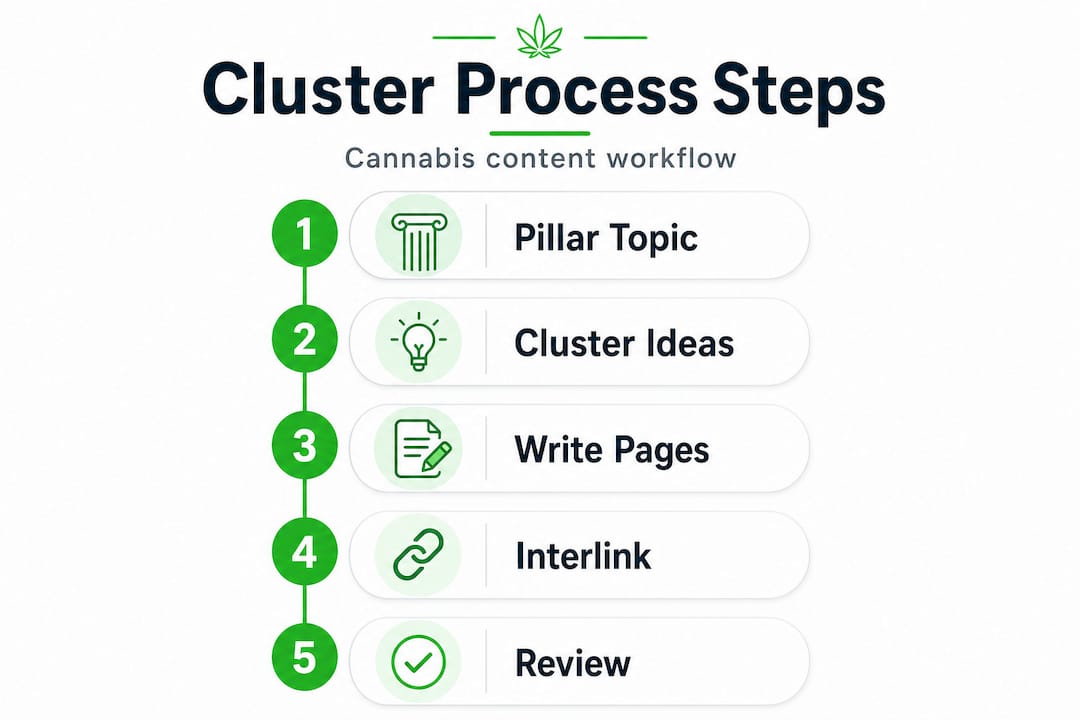
Identify your main topic. Choose a subject central to your business and your customers’ questions. For a dispensary, that might be “cannabis for pain relief” or “THC vs. CBD products.” For an edible manufacturer, it could be “edible safety and dosing.”
Break it into 5 to 7 subtopics. Each subtopic should answer a specific question your customers are already searching for. Use keyword research tools and review your Google Search Console data to identify real search queries.
Write your pillar page first. This is your comprehensive overview. It should be at least 1,500 to 2,000 words, cover the topic broadly, and include links to the cluster pages you plan to create.
Write each cluster page in depth. Each cluster should go deeper on one subtopic. Think 800 to 1,200 words minimum. Include local regulation information where relevant, since cannabis SEO best practices consistently show that localized, specific content outperforms generic articles.
Build the internal links. Every cluster page must link back to the pillar. The pillar must link out to every cluster. This creates the web structure that search engines reward.
Optimize each piece for search. Use relevant keywords naturally, include metadata, structure content with clear headings, and optimize images with alt text.
Publish, then promote. Share your pillar page as a primary resource in email campaigns and any compliant social media efforts. The pillar will carry the most authority, so make sure it gets visibility.
Pro Tip: When selecting topics and subtopics, filter every idea through two lenses: does this match what customers are searching for, and does this stay within your state’s advertising and content compliance requirements? Both filters matter equally in cannabis marketing.
So why does clustering matter so much more than older SEO methods, especially in cannabis? The answer starts with how competitive and regulated the market has become.
Old-school SEO relied on publishing individual posts targeting single keywords. You’d write an article on “best edibles in Denver,” rank for a while, then watch competitors overtake you. The problem is that isolated posts carry limited authority. They don’t signal to Google that your site truly understands the subject. They just answer one question, once.
The cannabis market faces strict marketing rules and high competition at the same time. This combination makes strong topical authority more critical than ever before. When your site clusters dozens of related pages around a pillar, Google recognizes your site as a genuine authority on that subject and rewards you with higher rankings across all those pages simultaneously.
Watch for these warning signs on your own website:
If two or more of these describe your website, you’re leaving significant organic traffic on the table.
To see clustering in action, here’s how a dispensary would implement this strategy from start to finish. Using SEO for cannabis dispensaries as a foundation, let’s map out a complete cluster around the topic “Edible Safety Laws.”

1. Define the pillar topic. “Edible Safety Laws” is broad enough to anchor multiple subtopics and specific enough to attract customers with real purchase intent. A customer researching edible safety is likely close to making a buying decision.
2. Build your subtopic list. For this pillar, five to seven strong subtopics might include:
3. Write the pillar page. Your pillar page covers all of these areas at a high level, introduces the topic clearly, and promises deeper reading on each subtopic through internal links.
4. Write each cluster page in depth. For example, the cluster page on “State-by-state edible packaging requirements” would cover specific regulations in your operating states, link to official state agency sources for compliance credibility, and connect back to the pillar.
5. Interlink every page in the cluster. Every cluster page links to the pillar. The pillar links to every cluster. Where relevant, clusters can link to one another. This mirrors how dispensaries boost local search presence through organized, locally relevant content.
6. Promote the pillar. Feature the pillar page in your email newsletter, link to it from your Google Business Profile posts, and include it in any content partnership outreach.
Pro Tip: Cannabis laws change frequently. Schedule a quarterly review of every cluster to update statistics, adjust for new regulations, and refresh content with current search trends. A stale cluster is worse than no cluster at all because outdated compliance information can harm your reputation and your rankings.
Beyond the how-to, here’s what most cannabis businesses miss when they adopt content clusters. After working with dozens of brands in this space, a clear pattern of mistakes emerges, and most of them have nothing to do with technical SEO.
The biggest misconception is that content clustering is purely a linking exercise. Brands will group ten articles together, add some internal links, and call it done. But clustering is fundamentally about topical depth. If your cluster pages are thin, surface-level, or written primarily for search engines rather than actual customers, the strategy will underperform regardless of how well linked the pages are.
Most cannabis brands spend too much time chasing keyword volume and not enough time thinking about user intent and compliance. A customer searching “can I fly with edibles” needs a clear, accurate, legally responsible answer. Giving them a vague, keyword-stuffed paragraph that avoids the actual answer destroys trust. Real authority means being the most helpful, accurate, and legally sound resource on your topic.
“In compliance-heavy industries, true authority means understanding legal nuance as much as SEO best practices.”
There is also a temptation to build out clusters quickly by publishing lots of short, thin articles. More content does not equal more authority. Ten genuinely useful, well-researched cluster pages will consistently outperform fifty weak, hastily written posts. Quality and depth signal authority. Volume alone signals noise.
For cannabis businesses looking to build real online authority, exploring SEO compliance in cannabis is as important as any technical optimization work. The brands that win search are the ones that treat their content as a legal and educational resource first, and a marketing tool second.
Content clustering is one of the highest-leverage strategies available to cannabis brands right now, but building and maintaining a cluster system takes time, expertise, and a clear understanding of both SEO and industry regulations. Getting the structure right from the start pays dividends in rankings, traffic, and customer trust for years.
At Dope SEO, we specialize exclusively in cannabis digital marketing, and we know how to build compliant, high-performing content clusters for dispensaries, manufacturers, and cultivators. Whether you need a complete cannabis SEO strategy built from the ground up or targeted help strengthening your existing content structure, our team has the industry-specific expertise to deliver results. Explore our full suite of cannabis digital marketing solutions or check out our dedicated SEO for dispensaries services to see how we can help your business rank higher and grow faster.
Clustering signals to search engines that your site is a trusted authority on cannabis topics, which boosts your search visibility and makes every page in the cluster rank more effectively.
A pillar page is a comprehensive guide on a main topic that links to in-depth pages about related subtopics, creating a connected cluster structure that builds authority across your entire site.
Aim for 5 to 7 detailed subtopics per main pillar to cover your subject thoroughly, maximize your interlinking, and give search engines enough depth to recognize genuine expertise.
Yes, content clustering helps dispensaries rank better in local search results by organizing region-specific content and regulatory information, with cannabis dispensaries boosting local presence consistently through this approach.
Review and refresh your clusters at least twice a year, or immediately whenever significant changes occur in cannabis laws, packaging regulations, or search behavior in your market.

© 2026 Curious Monkeys Pressing Buttons LLC DBA Cannabiz Marketing Solutions AKA DopeSEO. All rights reserved.