
TL;DR:
- Structured, compliant content marketing boosts traffic, engagement, and protects cannabis businesses legally.
- Effective strategies focus on AUDITING content, targeted low-competition keywords, and E-E-A-T principles.
- Ongoing performance tracking and regular updates are essential for sustainable growth in a regulated industry.
Cannabis businesses that skip a structured content marketing approach don’t just lose traffic. They risk compliance violations, platform bans, and a shrinking customer base while competitors quietly capture every search. Dispensaries relying on blogs get up to 70% of their traffic from them, and question-based content converts at rates 340% higher than generic pages. The cannabis industry faces a unique set of legal and marketing restrictions that make a random, unplanned approach genuinely dangerous. This guide walks you through a proven, stepwise content marketing process designed to increase organic traffic, improve customer engagement, and protect your business from costly missteps.
| Point | Details |
|---|---|
| Compliance is essential | Build trust and avoid fines by making all content YMYL/E-E-A-T compliant and regularly updated. |
| Prioritize owned channels | Leverage your website, blog, and email for the best reach and resilience against ad restrictions. |
| Question-based content converts | Focus on answering commercial and educational queries to drive up to 340% higher conversion. |
| Measure and improve | Track performance metrics and iterate quarterly to keep content relevant, compliant, and ROI-positive. |
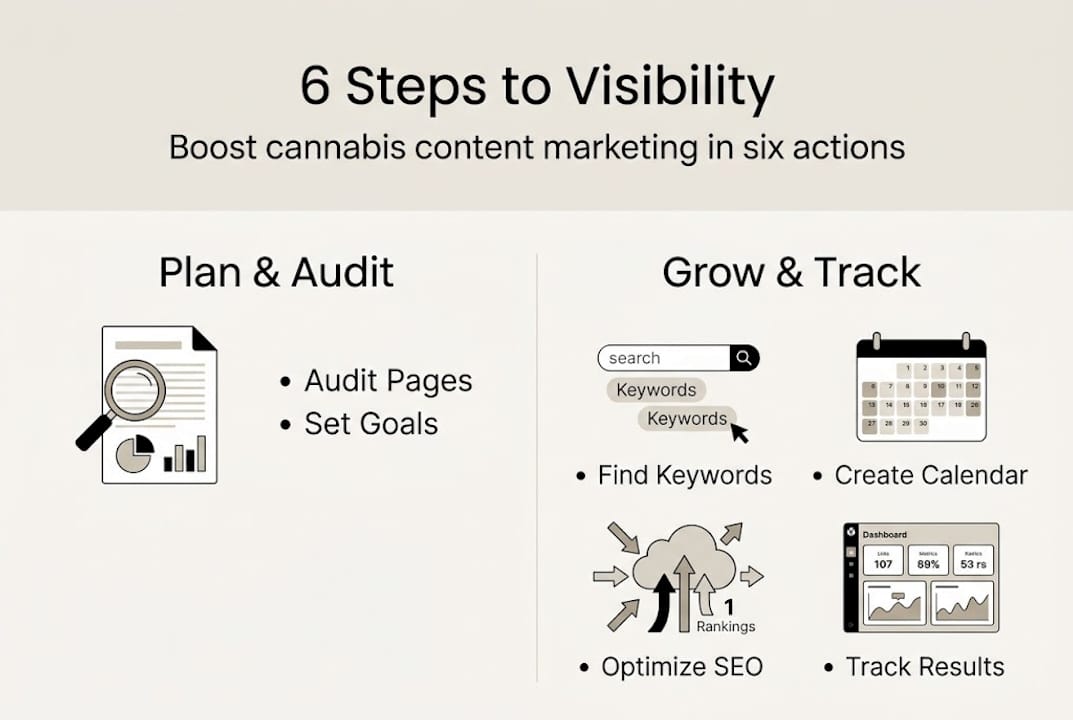
Before you create a single new piece of content, you need to know exactly where you stand. Auditing your existing content and setting SMART goals (Specific, Measurable, Achievable, Relevant, and Time-bound) is the essential first step toward better content marketing performance. Without this baseline, you are guessing.
A content audit for cannabis businesses goes beyond checking word counts. You need to flag compliance risks, identify keyword gaps, and measure how each page performs against your business goals.
| Audit metric | What to measure | Why it matters |
|---|---|---|
| Organic visits | Monthly sessions per page | Shows what is already working |
| Keyword rankings | Position for target terms | Identifies quick-win opportunities |
| Compliance errors | Health claims, missing disclaimers | Reduces legal and platform risk |
| Engagement rate | Time on page, scroll depth | Reveals content quality issues |
| Conversion rate | Form fills, calls, purchases | Ties content to revenue |
Once you have your audit data, set goals that are grounded in reality. For example, a dispensary might target a 30% increase in local organic traffic within six months, or aim to fix all compliance errors across existing posts within 90 days.
Pro Tip: Use a simple spreadsheet to score each page on compliance, SEO performance, and engagement. This makes it easy to prioritize which content to fix first versus what to leave alone.
For deeper content marketing compliance guidance, refer back to this audit regularly as regulations and algorithms shift.
Once your goals are set, you need the right language to reach your audience. Cannabis consumers search with very specific intent, and matching that intent is what separates content that ranks from content that sits unread.
Keyword research should center on low-competition, educational, and local-focused terms to capture high-intent traffic. Broad terms like “cannabis” or “CBD” are dominated by major publishers and impossible to compete for as a local business.
Here is a step-by-step process to find the right keywords:
| Keyword type | Example | Competition | Intent |
|---|---|---|---|
| Broad | “cannabis dispensary” | Very high | Low specificity |
| Long-tail | “best indica strains for sleep” | Low | High purchase intent |
| Question-based | “how do I dose CBD oil?” | Low | Educational, high trust |
| Local | “dispensary open now in Denver” | Medium | Ready to buy |
Question-based content converts 340% higher than generic pages, which makes FAQ-style posts and how-to guides some of your most valuable assets. Build these intentionally.
Pro Tip: Use cannabis local SEO strategies to layer “near me” and city-specific modifiers into your keyword targets. This captures customers who are ready to visit or buy right now. For a deeper look at building your keyword list, explore these cannabis keyword research tips to sharpen your targeting.
With target topics in hand, focus shifts to planning and producing compliant content. A content calendar keeps your team consistent and ensures you cover seasonal opportunities, regulatory updates, and product launches without scrambling.

Aim for at least two posts per month as a minimum baseline. Structure your calendar around monthly themes (for example, wellness in January, 420 education in April) and leave room for timely regulatory or industry news.
High-ROI content formats for cannabis businesses include:
E-E-A-T stands for Experience, Expertise, Authoritativeness, and Trustworthiness. Google applies this framework especially strictly to cannabis content because it falls under YMYL (Your Money or Your Life) classifications. This means your content must avoid health claims and be reviewed by someone with genuine subject matter knowledge.
Warning: Never claim that cannabis or CBD treats, cures, or prevents any medical condition. Statements like “CBD eliminates anxiety” or “THC cures insomnia” can trigger platform penalties, legal action, and loss of your Google Business Profile. Always use educational framing and include appropriate disclaimers.
Pro Tip: Have every piece of content reviewed before publishing. A knowledgeable budtender, compliance officer, or cannabis attorney can catch claims that could put your business at risk. Learn more about boosting cannabis sales with content while staying within safe boundaries.
Next, make every piece go further by optimizing and syndicating it to compliant channels. Creating content is only half the work. Getting it seen requires deliberate on-page and off-page SEO, plus smart repurposing.
Here are the essential SEO optimization tasks to complete for every piece of content:
Statistic callout: Cannabis email open rates run between 21% and 35%, significantly above the cross-industry average of around 17%. This makes email one of your most effective owned channels, especially given the paid ad restrictions cannabis brands face across Google, Meta, and most social platforms.
Where to repurpose your content ethically:
Before republishing anywhere, check that all compliance items are intact: disclaimers present, no health claims, no age-restricted content on open platforms. Explore marijuana content marketing strategies for more channel-specific guidance.
Finally, how do you know it is working and how do you keep momentum over time? Measuring the right metrics is what separates businesses that grow from those that spin their wheels.
Content marketing can drive 121% to 534% more organic traffic and generate 13X ROI when executed consistently. But those results only come to businesses that track, learn, and adjust.
| KPI | What to track | Review frequency |
|---|---|---|
| Organic traffic | Sessions from search engines | Monthly |
| Keyword rankings | Position changes for target terms | Bi-weekly |
| Engagement rate | Time on page, bounce rate | Monthly |
| Conversion rate | Calls, form fills, in-store visits | Monthly |
| Compliance score | Flagged claims, missing disclaimers | Quarterly |
Auditing tips to keep your content performing:
Pro Tip: Explore cannabis SEO performance benchmarks to understand how your results compare to industry standards. If your team lacks bandwidth for regular audits, partnering with cannabis SEO specialists gives you scalable, up-to-date evaluations without pulling your staff away from core operations.
Most cannabis marketers we talk to are chasing quick wins. They want viral posts, fast rankings, and immediate traffic spikes. We understand the pressure. But in this industry, that mindset is a liability.
The businesses that consistently outperform their competitors are the ones treating compliance as a competitive advantage, not a burden. Educational, transparent content builds trust and authority while bypassing the ad bans that cripple less disciplined brands. Every compliant, expert-reviewed post you publish compounds over time. It earns backlinks. It ranks for more terms. It builds the kind of credibility that no paid ad can replicate.
Algorithm updates and regulatory shifts will keep coming. The businesses most vulnerable to those changes are the ones relying on shortcuts or ignoring compliance. The ones least affected are those with a library of genuinely helpful, well-sourced, E-E-A-T-aligned content. That content does not disappear when a platform changes its rules.
Our perspective is straightforward: compliance-first is not the cautious choice. It is the aggressive, long-term growth strategy that most of your competitors are too impatient to execute. Explore compliance-centered marketing to see how this philosophy translates into real results.
Building a structured, compliant content marketing system takes time, but the compounding returns are worth every step. Working with specialists who understand the cannabis industry’s unique restrictions accelerates your results and helps you avoid the costly mistakes that set businesses back months.
At Dope SEO, we specialize in exactly this kind of work. From building your cannabis SEO strategy to executing dispensary SEO strategies that drive real local traffic, our team handles the complexity so you can focus on running your business. If you are ready to stop guessing and start growing, let’s build something that lasts.
Focus on educational, E-E-A-T-compliant content, avoid all health claims, include disclaimers on every relevant page, and monitor state-specific regulations regularly to keep your content within legal boundaries.
Owned channels including your website, blog, email list, and compliant cannabis directories are the most sustainable options because ad bans and high open rates make paid platforms unreliable for cannabis brands.
Question-based, intent-matched, and educational posts drive the highest conversions. Question-based content converts 340% higher than generic pages, making FAQ posts and how-to guides your most valuable format investments.
Update content at least quarterly, or immediately when regulations or search engine algorithms change. Regular audits are essential because both the legal landscape and ranking factors shift frequently in this industry.
Monitor organic traffic, keyword ranking positions, engagement rates, conversion rates, and compliance risk scores. Tracking these core content KPIs consistently gives you the data needed to improve performance and justify your marketing investment.

© 2026 Curious Monkeys Pressing Buttons LLC DBA Cannabiz Marketing Solutions AKA DopeSEO. All rights reserved.