
Many cannabis business owners mistakenly believe cannabis SEO is just like any other SEO, overlooking critical regulatory nuances. This creates confusion that leads to compliance violations, traffic drops, and lost revenue. Understanding specialized cannabis SEO terminology is not optional anymore. Mastering these terms empowers you to navigate platform restrictions, boost local visibility, and achieve sustainable growth in 2026’s competitive cannabis market.
| Point | Details |
|---|---|
| Cannabis SEO requires specialized vocabulary | Regulatory constraints and platform policies demand unique terminology beyond standard SEO language. |
| Compliance terms prevent penalties | Age gating, medical claims restrictions, and content compliance language protect your rankings. |
| Local SEO terms drive foot traffic | NAP consistency and local pack optimization increase dispensary visits by up to 35%. |
| Keyword restrictions shape content strategy | Long tail keywords and semantic clustering help you rank while avoiding penalized terms. |
| Industry specific KPIs measure success | Tracking compliance violation rates alongside organic growth ensures sustainable performance. |
Cannabis SEO differs fundamentally from general SEO because federal and state laws dictate what content you can publish and how you can rank it. While standard SEO focuses on keywords, backlinks, and technical optimization, cannabis SEO must adapt digital marketing strategies to regulated industry nuances. Google and social platforms enforce strict policies that ban certain cannabis keywords and advertising approaches, forcing marketers to develop specialized terminology and tactics.
This specialized language framework rests on four pillars: compliance, local optimization, content adaptation, and measurement. Compliance terms help you avoid penalties by understanding age gating requirements and medical claims restrictions. Local optimization vocabulary drives dispensary foot traffic through geo specific strategies. Content adaptation language guides how you communicate product benefits without triggering platform violations. Measurement terminology tracks performance while monitoring regulatory risks.
To succeed with cannabis SEO, you need foundational knowledge of both basic SEO principles and cannabis regulatory landscapes. Understanding search engine algorithms matters, but so does knowing how state laws affect keyword targeting and content creation. You must speak two languages simultaneously: the technical language of search optimization and the compliance language of cannabis regulation.
“Cannabis marketers who master specialized SEO terminology gain competitive advantages by executing cannabis marketing strategies that rank well while maintaining full compliance.”
The terms you’ll learn here form the building blocks for effective cannabis digital marketing in 2026. They enable clear communication with SEO professionals, help you evaluate strategy proposals, and empower you to make informed decisions about your online presence. Think of this terminology as your operational vocabulary for navigating the unique intersection of search marketing and cannabis regulation.
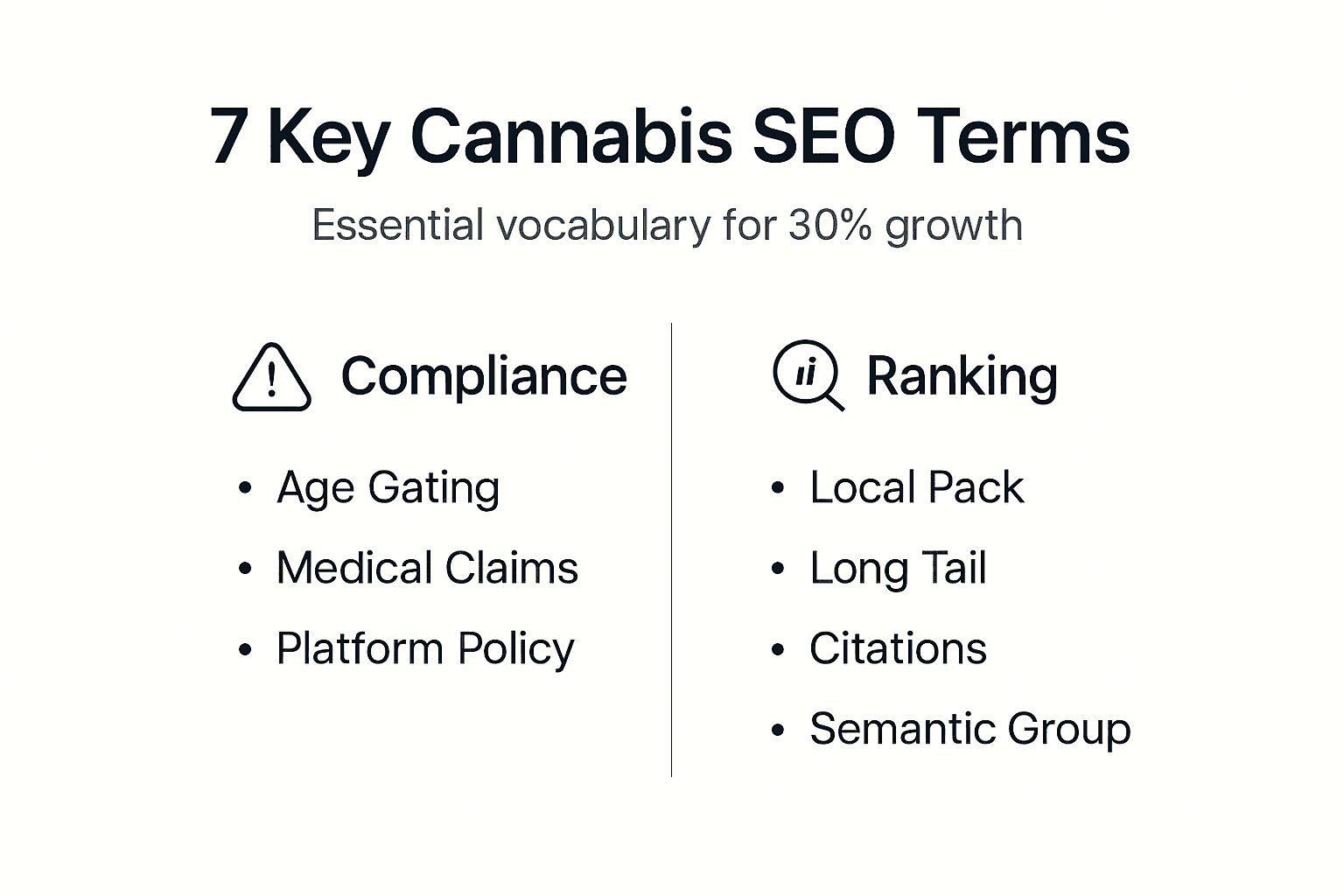
Age gating refers to the mandatory verification process that confirms website visitors meet minimum age requirements before accessing cannabis content. Search engines favor properly implemented age gates because they demonstrate compliance with legal requirements. Your age gate must appear before any cannabis product information loads, and it should collect genuine verification data rather than simple click through acknowledgments.
Medical claims restrictions prevent you from stating that cannabis products treat, cure, or prevent specific medical conditions. Using prohibited medical language triggers Google penalties and significant traffic drops that can devastate your online visibility. You can describe general wellness benefits and cite published research, but you cannot make direct therapeutic claims without risking platform violations and legal consequences.
Compliance violations occur when your content breaches platform policies or regulatory guidelines, resulting in penalties ranging from reduced rankings to complete deindexing. Google’s algorithm specifically targets cannabis sites that violate advertising policies, use banned keywords inappropriately, or make unsubstantiated claims. Recovery from major compliance violations can take months and requires comprehensive content audits plus significant remediation work.
Platform policies shape your SEO language choices by defining acceptable terminology and content approaches. Google Ads bans most cannabis advertising, forcing you to rely entirely on organic search strategies. Facebook and Instagram restrict cannabis business pages and limit post reach, making SEO compliance for cannabis websites essential for maintaining any digital presence.
Pro Tip: Create a monthly compliance checklist that reviews all published content for age gating functionality, medical claims language, and adherence to current platform policies. This proactive approach catches violations before they trigger penalties.
Regular monitoring of regulatory changes helps you adjust terminology and content strategies as laws evolve. State regulations shift frequently, and platform policies update without warning. Subscribing to cannabis business legal newsletters and following SEO industry sources keeps you informed about terminology changes that affect your compliance status.
NAP consistency refers to maintaining identical Name, Address, and Phone number information across all online directories, citations, and platforms. Search engines use NAP data to verify your business legitimacy and determine local ranking positions. Even minor inconsistencies like abbreviating “Street” as “St” on some listings but not others can confuse algorithms and lower your local pack rankings.

Local pack ranking describes your position in the map results that appear at the top of local search queries. Securing a spot in the local three pack drives massive foot traffic because users click these prominent listings first. Cannabis dispensaries that achieve local pack placement see up to 35% increases in walk in customers compared to businesses ranking below the map section.
Local citations are online mentions of your business name, address, and contact information on directories, review sites, and local business databases. Each citation acts as a trust signal that reinforces your legitimacy to search engines. Quality citations from authoritative cannabis business directories carry more weight than generic listings on low authority sites.
Geo fencing keywords target searchers within specific geographic boundaries by including location modifiers in your content. Terms like “Denver dispensary near downtown” or “Portland cannabis delivery 97202” capture high intent local searchers ready to visit or purchase. These hyper local keywords convert better than generic terms because they match precise user intent.
| Local SEO Term | Primary Impact | Implementation Priority |
|---|---|---|
| NAP Consistency | Trust signals, ranking stability | Critical, verify monthly |
| Local Pack Position | 35% traffic increase potential | High, optimize continuously |
| Local Citations | Authority building, discovery | High, build systematically |
| Geo Fencing Keywords | Conversion rate improvement | Medium, target high intent terms |
Pro Tip: Set calendar reminders to verify and update your Google Business Profile, Weedmaps listing, and top 10 local citations quarterly. This maintenance prevents data drift that erodes your local SEO for cultivators and dispensary rankings.
Google Business Profile optimization encompasses all strategies that improve your free business listing on Google Maps and local search results. Completing every profile section, posting regular updates, collecting reviews, and uploading photos significantly boost your visibility. Profiles with 50 or more recent reviews typically outrank competitors with fewer reviews, making reputation management integral to local SEO for cannabis dispensaries success.
Head terms are short, high volume keywords like “cannabis” or “dispensary” that attract massive search traffic but face intense competition and low conversion rates. These broad terms rarely drive qualified traffic because searcher intent remains unclear. A person searching “cannabis” might seek news, education, or product purchases, making it difficult to match content to their needs.
Long tail keywords are longer, more specific phrases like “organic CBD flower for anxiety relief near Seattle” that attract lower search volumes but deliver highly qualified traffic with clear intent. These detailed queries convert significantly better because they match precise user needs. Cannabis marketers who focus on long tail terms avoid competing with massive brands while capturing ready to buy customers.
Banned keywords are terms that trigger platform penalties or violate advertising policies when used in certain contexts. Words like “marijuana” receive less algorithmic favor than “cannabis” in some contexts, while making sales claims with terms like “cure” or “treatment” triggers immediate content flags. Understanding which keywords to avoid and which alternatives to use protects your rankings.
Semantic clustering groups related keywords and concepts together to create comprehensive content that ranks for multiple terms simultaneously. Instead of targeting one keyword per page, you build topic authority by covering an entire subject area with semantically related terms. This approach works especially well for cannabis content because it allows you to discuss products and benefits without overusing potentially risky keywords.
| SEO Approach | Standard SEO Strategy | Cannabis Specific Adaptation |
|---|---|---|
| Keyword Selection | Target high volume head terms | Prioritize compliant long tail keywords |
| Content Tone | Promotional, sales focused | Educational, compliance conscious |
| Keyword Density | 1 to 2% for primary terms | Lower density, semantic variation |
| Link Building | Aggressive outreach campaigns | Selective, industry relevant partnerships |
Content compliance language uses carefully worded descriptions that communicate product benefits without making prohibited claims. Instead of saying “treats anxiety,” compliant content states “many users report feeling calmer.” This subtle shift in terminology conveys the same message while avoiding regulatory triggers. Learning to speak in compliance friendly language becomes second nature with practice.
Optimizing cannabis content requires balancing keyword targeting with regulatory constraints. You must create engaging, informative content that ranks well while respecting platform policies and legal boundaries. This dual focus on optimization and compliance defines successful cannabis content marketing in 2026.
Organic foot traffic growth tracks increases in store visits attributed to local search and organic rankings rather than paid advertising or other channels. This metric directly connects your SEO efforts to revenue by measuring real customer behavior. Cannabis dispensaries should track month over month changes in organic visits alongside search ranking improvements to validate strategy effectiveness.
Compliance violation rate measures the frequency of content flags, penalties, or policy warnings across your digital properties. Tracking this metric helps you identify problematic content patterns before they escalate into major penalties. A rising compliance violation rate signals that your content strategy needs immediate adjustment to avoid traffic losses.
Local pack rankings show your position in the map results for priority keywords in your service area. Monitoring these rankings weekly reveals the impact of local SEO efforts and competitive movements. Most cannabis businesses should track 10 to 20 high priority local keywords that drive the majority of foot traffic.
Organic search traffic from target keywords indicates how well your content ranks for terms that matter to your business. Tools like Google Search Console show which queries drive traffic to your site, helping you identify successful content and optimization opportunities. Cannabis businesses should segment organic traffic by keyword type to understand which content themes perform best.
Conversion rate from organic traffic measures the percentage of search visitors who complete desired actions like store visits, phone calls, or online orders. High traffic means nothing without conversions, making this metric essential for evaluating true SEO ROI. Cannabis businesses typically see 2% to 5% conversion rates from organic local search traffic.
Google Analytics 4 provides the primary measurement platform for tracking cannabis SEO performance, offering custom reporting that segments traffic sources and user behavior. Setting up enhanced measurement with properly configured goals and events lets you connect SEO activities to business outcomes. Regular monthly reporting on these metrics informs strategy adjustments and demonstrates SEO value.
Many cannabis business owners assume SEO works the same regardless of industry, failing to recognize that regulatory constraints fundamentally alter best practices. This misconception leads to copied strategies from other sectors that trigger compliance violations in cannabis contexts. What works for e-commerce or local services often fails spectacularly when applied to cannabis marketing without adaptation.
Another prevalent myth suggests all cannabis keywords carry equal risk and effectiveness, ignoring the nuanced differences between compliant and problematic terminology. In reality, keyword selection requires careful analysis of regulatory implications, platform policies, and local laws. Terms acceptable in one state might trigger violations in another, and words safe for CBD marketing often differ from those used for THC products.
Some marketers mistakenly believe local SEO matters less than national visibility for cannabis brands. This backwards thinking ignores the hyperlocal nature of cannabis retail and the legal restrictions preventing interstate commerce. Since customers can only purchase from licensed dispensaries in their state, dominating local search delivers far more value than ranking nationally for generic terms.
The idea that compliance monitoring can happen occasionally rather than continuously represents a dangerous misconception. Platform policies and regulations change frequently, turning previously safe content into violations overnight. Cannabis businesses that review compliance quarterly rather than monthly risk sudden traffic drops from unnoticed policy updates.
“Understanding the specialized language of cannabis SEO separates successful marketers from those struggling with penalties and poor performance. The terminology reflects real regulatory constraints that demand ongoing attention and expertise.”
Businesses also wrongly assume generic SEO agencies can effectively manage cannabis digital marketing without specialized knowledge. While these agencies understand general optimization principles, they lack the compliance expertise and industry specific terminology knowledge needed to navigate proven cannabis SEO strategies safely. This gap between general SEO knowledge and cannabis specific requirements causes costly mistakes.
Mastering cannabis SEO terminology empowers you to execute compliant, effective digital marketing strategies that drive growth while managing risk. The seven critical terminology pillars covered here provide the foundation for all cannabis SEO success: regulatory compliance language, local optimization terms, keyword strategy vocabulary, content adaptation phrases, measurement metrics, platform policy concepts, and industry specific best practices.
Implementing this terminology knowledge requires systematic action:
Continuous learning remains essential because regulations evolve and platform policies shift without warning. Subscribe to cannabis business publications, follow SEO industry news, and participate in cannabis marketing communities to stay informed. Your terminology knowledge must grow alongside industry changes to maintain effectiveness.
The cannabis SEO case studies demonstrate how businesses applying specialized terminology and compliance focused cannabis SEO strategies achieve 30% or greater growth in organic visibility. These real world examples show that mastering cannabis SEO language translates directly to business results when implemented consistently.
Navigating cannabis SEO terminology and regulatory complexities demands specialized expertise that general marketing agencies cannot provide. Dope SEO speaks your language because we focus exclusively on cannabis and hemp businesses facing the unique challenges you encounter daily. Our team understands every term covered in this guide and applies that knowledge to craft strategies delivering measurable growth.
We translate cannabis SEO terminology into practical campaigns that boost your local visibility, drive qualified traffic, and maintain full compliance with evolving regulations. From mastering cannabis SEO best practices to executing comprehensive cannabis marketing strategies, our proven approaches help dispensaries, cultivators, and ancillary businesses dominate their markets. We even provide specialized SEO services for cannabis accountants serving the industry.
Pro Tip: Cannabis businesses that invest in specialized SEO consulting within their first year achieve 3x faster growth compared to those attempting generic strategies, according to industry benchmarks.
Cannabis SEO terminology encompasses the specialized language and concepts needed to execute compliant, effective search marketing in the regulated cannabis industry. This vocabulary matters because using incorrect terms or failing to understand compliance language leads directly to penalties, traffic losses, and wasted marketing budgets. Mastering these terms gives you a competitive advantage by enabling clear communication with SEO professionals and informed decision making about your digital strategy.
Regulations dictate specific terms like age gating and medical claims restrictions that prevent penalties and maintain rankings. Your content must comply with these rules to avoid traffic loss from algorithm penalties or complete deindexing. Platform policies from Google, Facebook, and Instagram further limit acceptable language, forcing cannabis marketers to develop alternative terminology that communicates value without triggering violations.
Dispensaries should prioritize NAP consistency, local pack ranking, local citations, and geo fencing keywords as their core local SEO focus areas. These terms directly impact foot traffic because they control your visibility in map results and local search queries where customers find nearby dispensaries. Mastering these concepts typically increases store visits by 25% to 35% within six months of consistent implementation.
The most damaging mistake involves treating cannabis SEO as generic SEO without adapting for compliance requirements and industry constraints. Marketers also frequently ignore banned keywords and use prohibited medical language that triggers penalties. Neglecting local SEO terminology represents another critical error since hyperlocal visibility drives the majority of dispensary revenue. Finally, failing to monitor compliance related terms continuously leads to sudden traffic drops when policies change.
Implementing proper cannabis SEO terminology and compliance practices typically shows initial ranking improvements within 60 to 90 days for local keywords and 4 to 6 months for competitive organic terms. The timeline depends on your current compliance status, existing technical issues, and competitive landscape. Businesses with severe compliance violations may need to remediate content before seeing positive movement, while those starting from a solid foundation can achieve faster results through strategic terminology application.