
Many cannabis businesses chase high-volume keywords thinking they’ll unlock instant traffic, but this common mistake often leads to wasted resources and disappointing results. In reality, long-tail keywords drive 25% higher conversions than broad terms in the cannabis industry. This guide reveals how to navigate keyword research amid strict advertising restrictions, compliance requirements, and platform limitations. You’ll discover proven strategies to boost visibility, attract qualified local customers, and avoid costly penalties while building a sustainable organic presence.
| Point | Details |
|---|---|
| Compliance shapes keyword choices | Federal restrictions and platform policies require careful keyword selection to avoid penalties and account suspensions. |
| Local keywords outperform broad terms | Geo-targeted keywords drive more qualified traffic and conversions for dispensaries than high-volume generic phrases. |
| Specialized tools enable success | Cannabis-focused SEO platforms and mainstream tools with filtering capabilities help identify compliant, profitable keywords. |
| Long-tail strategy wins conversions | Niche keywords with purchase intent consistently deliver better ROI than broad competitive terms in cannabis markets. |
Keyword research is the process of identifying the exact words and phrases potential customers type into search engines when looking for cannabis products, information, or services. For cannabis businesses, this foundational SEO practice becomes your roadmap to online visibility in an industry where traditional advertising remains largely restricted.
Your success depends on understanding how people search for cannabis products in your market. When you target the right keywords, you attract qualified visitors who are ready to buy, ask questions, or visit your dispensary. Without strategic keyword research, you’re essentially guessing what matters to your audience.
The cannabis industry faces unique challenges that make keyword research more complex than in conventional sectors:
These restrictions mean you can’t simply copy strategies from other industries. You need a tailored approach that accounts for platform policies, legal boundaries, and local market conditions. A robust local search strategy guide for cannabis dispensaries helps you navigate these complexities while maximizing visibility.
Pro Tip: Start with location-specific keywords rather than broad industry terms to avoid platform restrictions while capturing high-intent local searchers.
Federal prohibition creates a complex landscape where cannabis remains Schedule I despite widespread state legalization. This disconnect forces you to carefully select keywords that acknowledge legal status without triggering platform violations. State laws vary from full recreational legalization to medical-only programs to complete prohibition, requiring geo-specific keyword strategies.
Google Ads prohibits over 75% of cannabis campaigns due to restricted terms, making paid advertising extremely challenging. Facebook, Instagram, and TikTok maintain similar restrictions, often suspending accounts that use cannabis-related keywords even in organic posts. These platform policies force reliance on organic SEO strategies.
Restricted keywords typically include direct product names, consumption methods, and recreational use implications:
Allowed keywords focus on education, compliance, and medical applications:
Account suspensions, ad disapprovals, and domain blacklisting represent real risks when you use noncompliant keywords. Some businesses have lost entire Google Ads accounts valued at thousands of dollars per month due to policy violations. Others face reduced organic visibility when search engines flag domains for repeated compliance issues.
Pro Tip: Maintain a living document of approved versus restricted keywords in your market, updating it quarterly as platform policies evolve.
Continuous monitoring of policy updates protects your investment. Subscribe to industry newsletters, join cannabis SEO communities, and regularly review platform advertising policies to stay ahead of changes that could impact your keyword strategy.
Cannabis consumers overwhelmingly search with local intent. Someone looking for products wants a nearby dispensary they can visit today, not generic information about cannabis. This behavior makes local keywords your most valuable asset for driving foot traffic and online orders.
Integrating geo-modifiers transforms generic terms into powerful local signals:
Google Maps optimization amplifies your local keyword strategy. Nearly half of dispensary foot traffic originates from local SEO and Maps optimization efforts. When you rank in the Maps pack, you capture high-intent searchers at the exact moment they’re ready to visit.
A Colorado dispensary implemented geo-targeted keywords across their website, Google Business Profile, and content strategy. Within four months, they saw a 43% increase in Maps impressions, 38% growth in direction requests, and a 29% rise in store visits directly attributed to local search. Their investment in geo-targeted SEO for cannabis paid off through measurable foot traffic growth.

| Local Keyword Type | Example | Search Volume | Conversion Potential |
|---|---|---|---|
| City + Product | “Denver CBD oil” | Medium | High |
| Neighborhood + Service | “Capitol Hill dispensary” | Low | Very High |
| Near me + Category | “dispensary near me” | Very High | High |
| State + Medical | “California medical cannabis” | High | Medium |
Pro Tip: Claim and optimize every local directory listing using consistent NAP information and location-specific keywords to strengthen your local search signals.
Follow this local keyword research approach to maximize visibility:
This systematic approach, detailed in guides on how to boost local SEO for cannabis dispensaries, ensures you capture the most valuable local traffic.
SEMrush and Ahrefs offer robust keyword research capabilities with filtering options that help you navigate cannabis restrictions. Both platforms let you analyze competitor keywords, identify content gaps, and track ranking performance while filtering out terms that violate platform policies. Their organic keyword data helps you find compliant alternatives to restricted paid search terms.
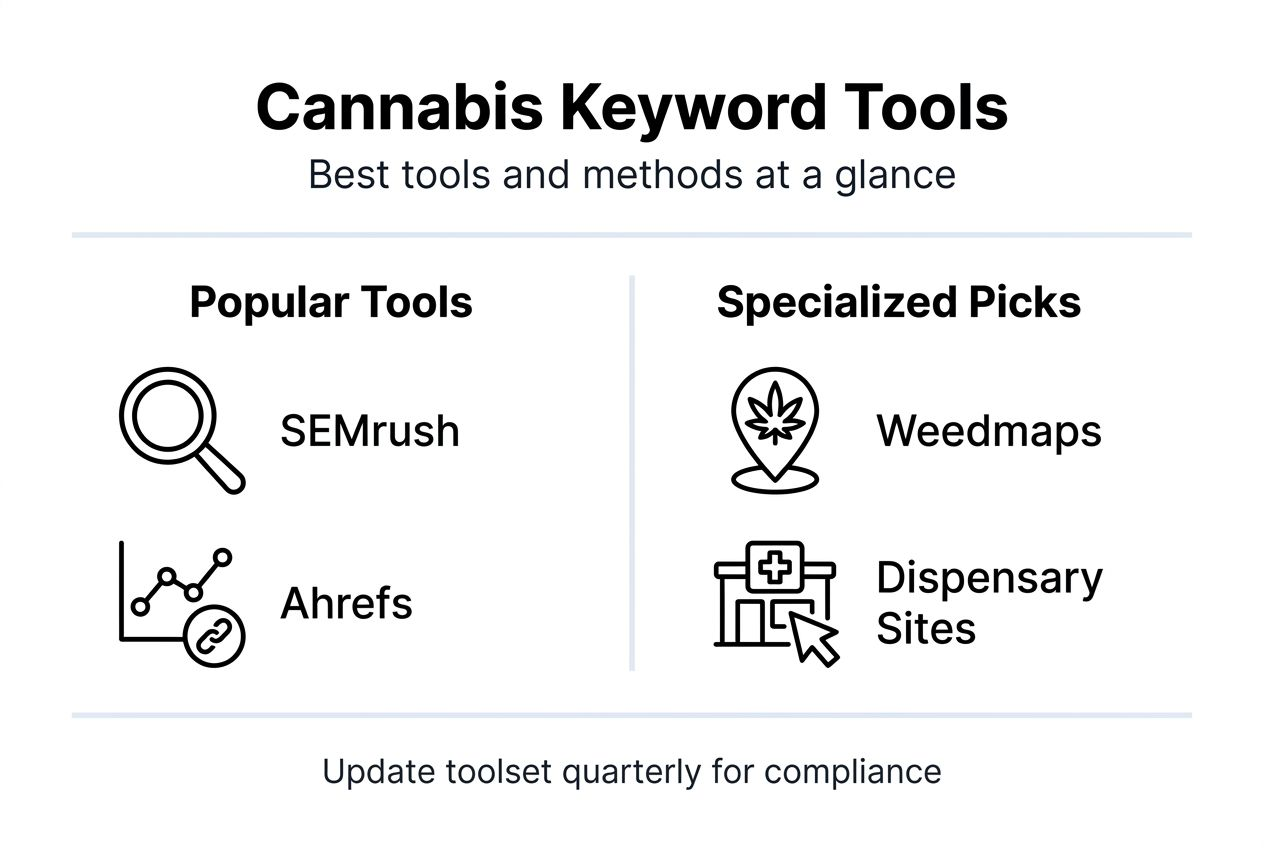
Emerging cannabis-focused platforms understand industry nuances better than generalist tools. These specialized services account for state-by-state legality, platform restrictions, and cannabis-specific search behavior patterns. They often include compliance filters that automatically flag potentially problematic keywords before you invest time optimizing for them.
AI-driven keyword discovery tools excel at finding niche long-tail keywords that competitors overlook. These platforms analyze search patterns, question-based queries, and semantic relationships to suggest highly specific terms with lower competition but strong purchase intent. For cannabis businesses, this technology uncovers profitable micro-niches within broader categories.
Best practices for filtering restricted keywords include:
Validating keywords for cannabis market relevance requires understanding searcher intent behind each term. A keyword might have high volume but attract information seekers rather than customers. Analyze search results for your target keywords to ensure they show dispensaries and cannabis businesses, not news articles or advocacy sites. This validation process, combined with strategies for optimizing cannabis content, ensures your efforts target qualified traffic.
The belief that highest-volume keywords deliver the best results leads many cannabis businesses astray. These broad terms attract massive competition, high costs in paid channels, and often generate low-quality traffic that doesn’t convert. Someone searching “cannabis” could want news, research, advocacy information, or products, making the intent unclear.
Long-tail keywords with clear purchase intent consistently outperform broad terms. A search for “organic CBD tincture for anxiety near me” signals strong buying intent and location specificity. Cannabis sites targeting long-tail keywords see 25% higher conversions than those chasing broad high-volume phrases.
Many business owners underestimate how regulations impact keyword viability:
Skipping competitor keyword analysis means missing valuable opportunities. Your competitors have already tested keywords, identified what converts, and built authority around specific terms. Analyzing their strategies reveals gaps you can exploit and successful patterns you can adapt to your market.
| Keyword Type | Pros | Cons |
|---|---|---|
| Broad (“cannabis”) | High search volume, brand awareness potential | Low conversion rates, intense competition, unclear intent |
| Long-tail (“organic CBD oil for sleep Portland”) | High conversion rates, clear intent, lower competition | Lower individual search volume, requires more keywords |
Pro Tip: Build your keyword strategy around 10-15 medium-tail terms that balance search volume with specificity, then create content clusters targeting related long-tail variations.
The most successful cannabis SEO strategies combine both approaches. Use broad terms for brand awareness content while building conversion-focused pages around specific long-tail keywords that match your products and services to searcher needs.
The highest-volume cannabis keywords often trigger the strictest platform restrictions. Terms like “buy marijuana online” or “THC delivery” might show 50,000 monthly searches but face near-universal advertising bans and increased scrutiny in organic results. Pursuing these keywords risks account suspensions worth thousands in lost advertising spend.
Substituting restricted keywords with compliant alternatives maintains visibility while reducing risk:
Organic SEO and paid keyword targeting require different approaches in cannabis. Organic strategies allow more flexibility with product-focused terms since you’re not directly subject to ad platform policies. Paid campaigns demand strict adherence to platform rules, focusing on educational content and brand awareness rather than direct product promotion.
A practical framework balances three priorities:
Keyword policy changes happen frequently as platforms adjust to evolving cannabis legalization. Google updated its cannabis advertising policies three times in 2025 alone, each time shifting which terms and business types qualify for paid promotion. Monitor these changes through:
Pro Tip: Set calendar reminders to review your keyword lists quarterly, removing newly restricted terms and adding compliant alternatives that emerge as policies evolve.
Transforming keyword research into actionable SEO requires a systematic implementation process:
Aligning keywords with content strategy ensures every page serves a purpose. Your blog should target educational long-tail keywords that attract top-of-funnel traffic. Product pages optimize for commercial keywords with clear purchase intent. Location pages focus on geo-specific terms that drive local traffic.
Leveraging local SEO keywords across Google Maps and directories multiplies their impact. When you consistently use location-specific terms in your Google Business Profile, website, and citation listings, you strengthen local ranking signals. This consistency helps search engines understand your service area and match you to relevant local searches.
Continuous monitoring protects your investment as the regulatory landscape shifts:
Iterative adjustments maintain compliance while maximizing results. When a keyword gets restricted, immediately pivot to compliant alternatives rather than risking penalties. When new opportunities emerge through policy changes or market shifts, quickly capitalize on them before competitors do. This agile approach, supported by proven strategies for boosting cannabis SEO, keeps you ahead in a rapidly evolving industry.
Navigating keyword research amid changing regulations and platform restrictions demands specialized expertise. Our team understands the unique challenges cannabis businesses face and delivers customized solutions that drive measurable results.
We’ve helped dispensaries and cannabis brands across the country achieve first-page rankings for competitive local keywords, increase organic traffic by over 200%, and generate consistent customer acquisition through proven cannabis SEO strategies. Our approach combines compliance monitoring, competitive analysis, and conversion-focused optimization to maximize your ROI.
Whether you need comprehensive keyword research, local SEO implementation, or ongoing optimization support, our top-ranking strategies for mastering cannabis SEO deliver sustainable growth. Discover why SEO matters for cannabis brands and how our tailored solutions can transform your online visibility.
Cannabis keyword research requires navigating federal illegality, state-by-state regulations, and strict platform advertising restrictions that don’t exist in most industries. You must balance high-volume terms with compliance requirements while focusing on local search since most platforms prohibit interstate commerce advertising.
Avoid direct product promotion keywords in paid campaigns, focusing instead on educational terms and brand awareness phrases. Regularly review platform policy updates, test new keywords in small campaigns first, and maintain a documented list of restricted terms based on your previous experiences and industry reports.
SEMrush and Ahrefs offer robust filtering capabilities for cannabis research, while emerging cannabis-focused platforms provide industry-specific compliance filters. Combine these with AI-driven discovery tools to find profitable long-tail keywords that competitors miss while staying within platform guidelines.
Local keywords capture high-intent searchers ready to visit your store today, with nearly half of dispensary foot traffic coming from local SEO and Maps optimization. These geo-targeted terms face fewer restrictions than broad cannabis keywords and deliver significantly higher conversion rates for brick-and-mortar locations.
Review your keyword strategy quarterly at minimum, or immediately when major platform policy changes occur. Monitor rankings weekly to catch compliance issues early, and continuously analyze conversion data to shift focus toward your most profitable terms as market conditions and regulations evolve.
