
TL;DR:
- Most cannabis brands waste ad budgets on broad audiences that rarely convert, driving up costs.
- Precision audience targeting, based on behavior and location, significantly improves ROI and reduces waste.
Most cannabis businesses are burning ad budget on people who will never buy from them. They cast wide nets with generic messaging, hope the right customer sees it, and wonder why their cost per acquisition keeps climbing. Understanding why audience targeting matters in cannabis marketing is the difference between a campaign that breaks even and one that generates $1 million in revenue on a $73,000 ad spend. That gap is real. It happened for a Maryland dispensary using precision targeting, and it can happen for your brand too — if you stop marketing to everyone and start marketing to the right people.
| Point | Details |
|---|---|
| Precision beats volume | Behavior-based targeting consistently outperforms broad demographic campaigns in cannabis ROI. |
| Compliance is non-negotiable | At least 70–85% of your ad audience must be 21+ or you risk fines exceeding $250,000. |
| Local SEO drives real traffic | Dispensaries in the local map pack receive 126% more traffic than those ranked below position 3. |
| Retargeting high-intent shoppers pays | Cart abandonment retargeting yields ROI between 800% and 1,300% in cannabis retail. |
| CRM data unlocks growth | Analyzing past customer behavior lets you cut acquisition costs and increase repeat purchase rates. |
Audience targeting means delivering your message to people who are most likely to buy, based on what you know about their demographics, behaviors, location, and purchase intent. In cannabis marketing, this is not just a best practice. It is a survival strategy.
Cannabis marketers face restrictions that most industries never deal with. Google, Meta, and other major platforms restrict or outright ban cannabis advertising. This means you cannot rely on the same broad-reach tools that a shoe brand or a restaurant uses. Every dollar you spend must work harder because your options are more limited.
Here is what effective audience targeting covers in the cannabis context:
Understanding different customer personas matters more in cannabis than almost any other retail category. A medical patient managing chronic pain has completely different needs from a recreational buyer browsing for weekend edibles. Sending the same message to both groups wastes your spend and dilutes your brand.
Pro Tip: Build at least three to four distinct customer personas before launching any paid campaign. Base them on actual purchase data from your point-of-sale system, not assumptions about what your customers look like.
Precise audience targeting cuts waste by concentrating your budget where conversion probability is highest. That is the core value of audience segmentation in cannabis: you spend less to acquire each customer, and you earn more from each relationship over time.
The evidence for audience targeting in cannabis is not theoretical. The numbers are concrete and they are striking.
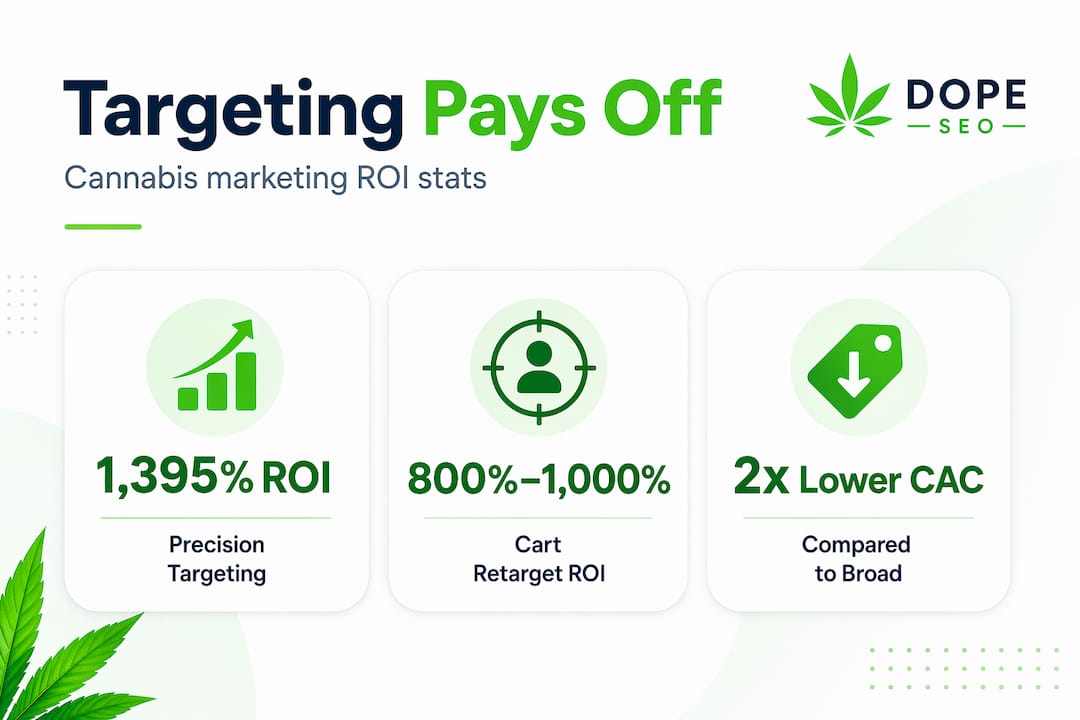
A Maryland dispensary generated $1.02M through precision targeting on just $73,511 in ad spend, achieving a 1,395% ROI by focusing on high-intent audiences rather than broad demographic blasts. That is not a rounding error. That is what happens when you stop paying for impressions from people who have no interest in buying.
| Campaign type | Ad spend | Revenue generated | ROI |
|---|---|---|---|
| Behavior-based targeting (Maryland dispensary) | $73,511 | $1,020,000 | 1,395% |
| Seasonal targeting (Nevada dispensary) | $59,891 | $508,000 | 849% |
| Broad prospecting (industry average) | Variable | Lower conversion rate | Typically under 300% |
A Nevada dispensary ran a holiday campaign with smart audience segmentation that focused on seasonal purchase behavior and returned 849% ROI, earning $508,000 on $59,891 spent. The difference between these results and industry averages comes down to one thing: both campaigns targeted people already moving toward a purchase decision.
Local SEO tells a similar story. Dispensaries in the map pack receive 126% more traffic and 93% more calls and clicks than dispensaries ranked in positions 4 through 10. Google Maps is the most reliable discovery tool for cannabis shoppers, with 96% sensitivity for “cannabis near me” searches. If you are not showing up in those top three positions, you are invisible to most of the high-intent local searchers in your area.
“Successful cannabis marketing shifts from seeking visibility to performance by using real-time audience data and continuously optimizing creative to match audience behavior and seasonal demand.” — New Frontier Data
Cart abandonment retargeting is where this gets even more specific. Retargeting cart abandoners yields ROI between 800% and 1,300% because those shoppers are already deep in the decision process. They looked at your menu. They added products. They did not check out. Bringing them back costs far less than finding a brand-new customer from scratch.
Compliance is not a box you check after building your campaign. It is a structural filter that shapes who you can target before a single dollar gets spent.
Federal restrictions and state-level cannabis advertising laws significantly limit where and how you can run paid campaigns. Major platforms either prohibit cannabis advertising outright or apply strict content filters that make most campaigns non-viable. You need to understand these cannabis advertising laws before you commit budget to any channel.
The core compliance requirements for audience targeting in cannabis include:
The risk of non-compliance extends beyond legal penalties. Platform bans mean you lose ad accounts, historical data, and audience lists that took months to build. Recovery is costly and slow.
Pro Tip: Before launching any paid campaign, request an audience composition report from your ad platform or programmatic partner. This document confirms your age-gate compliance and becomes part of your regulatory paper trail.
Compliance and targeting precision are not in conflict. When you build your audience correctly, you naturally filter out underage and out-of-jurisdiction users, which makes your campaigns both cleaner and more effective.
Knowing that targeting matters is one thing. Knowing how to do it well in a restricted environment is what separates high-performing cannabis brands from everyone else.
Do not guess who your customers are. Pull reports from your point-of-sale system and identify patterns. Which products do your highest-spend customers buy? How often do they visit? What time of day do they shop? These behavioral signals let you target cannabis consumers with messaging that reflects their actual habits rather than generic assumptions.

Geofencing around your dispensary, competitor locations, and cannabis-adjacent businesses (like smoke shops or wellness centers) gives you a pool of people with demonstrated intent. Pair this with localized ad creative that speaks to your neighborhood, your pricing, and your menu, and your relevance score goes up immediately.
Your existing customer database is your most underutilized asset. CRM data analysis lets you identify lapsed customers, high-value segments, and loyalty members who are due for re-engagement. Retargeting these groups costs significantly less than prospecting for new customers, and their lifetime value is already proven.
About 68% of cannabis dispensaries fail to use UTM tracking on their Google Business Profile, which means they cannot attribute local search traffic to specific campaigns. Without measurement, you cannot optimize. Set up UTM parameters on every campaign link, connect your Google Business Profile to your analytics platform, and track call volume alongside website traffic.
The comparison below shows how segmented targeting stacks up against a generic broadcast approach:
| Strategy | Audience basis | Expected CAC | Expected ROI |
|---|---|---|---|
| Broad reach / untargeted | Loose demographics | High | Low to moderate |
| Segmented by behavior | Purchase history, browsing | Moderate | High |
| CRM retargeting | Known customers | Low | Very high |
| Cart abandonment retargeting | High-intent shoppers | Lowest | 800–1,300% |
Precision targeting can reduce acquisition costs by up to 50% compared to broad prospecting. In cannabis, where your ad channel options are already constrained, keeping CAC low is not a growth tactic. It is a requirement.
I have watched cannabis businesses pour money into awareness campaigns for audiences that had no real purchase intent. They ran broad geo-targeted ads, saw decent impression counts, and called it success. The metrics looked fine until they compared ad spend to actual in-store revenue.
Here is what I have learned from working through this with cannabis brands: the instinct to reach more people is almost always the wrong instinct. The brands that outperform everyone else are obsessively focused on re-engaging the people who already showed interest. They retarget cart abandoners. They send personalized messages to lapsed loyalty members. They optimize their Google Business Profile because they know that local search traffic value can differ by $252,642 per month between top-ranked and lower-ranked dispensaries.
What most brands miss is that compliance and targeting precision are the same discipline. When you document your audience composition to satisfy regulators, you are also forcing yourself to know exactly who you are reaching. That knowledge makes every creative decision sharper.
The businesses that treat targeting as a compliance obligation tend to do the minimum. The ones that treat it as a competitive advantage build customer relationships that compound over time. In a saturated market, that difference is everything.
— Max
Dopeseo works exclusively with cannabis and hemp businesses, which means the team understands the platform restrictions, state-level compliance requirements, and audience segmentation strategies specific to your market.
Whether you need to build a local SEO presence that captures high-intent map pack traffic, develop audience segments based on your CRM data, or run compliant programmatic campaigns, Dopeseo has built these systems for dispensaries exactly like yours. Explore the cannabis marketing strategies that Dopeseo has developed to help cannabis brands grow without the guesswork. Or start with the 2026 cannabis SEO guide to see how search-driven targeting can become your highest-ROI channel.
Audience targeting in cannabis marketing means directing your campaigns toward people defined by age, location, purchase behavior, and intent signals rather than broadcasting to everyone in a given geography. This approach maximizes budget efficiency and reduces wasted spend.
Cannabis marketers face platform bans and regulatory restrictions that limit available ad channels, which makes every impression more costly. Precise targeting compensates by concentrating spend on high-probability buyers, which is why behavior-based campaigns in cannabis have produced ROI as high as 1,395%.
Regulations require that at least 70 to 85% of your advertising audience be 21 years of age or older. Failure to document this can result in fines exceeding $250,000 and forced removal from advertising platforms.
Local SEO is one of the most reliable targeting channels available to cannabis brands. Dispensaries in the Google Maps top three positions receive 126% more traffic and 93% more calls than those ranked below them, making local search optimization a direct driver of high-intent customer acquisition.
Cart abandonment audiences consistently produce the highest returns. Retargeting shoppers who added products to their cart but did not complete a purchase yields ROI between 800% and 1,300%, far above what broad prospecting campaigns typically return.

© 2026 Curious Monkeys Pressing Buttons LLC DBA Cannabiz Marketing Solutions AKA DopeSEO. All rights reserved.