
TL;DR:
- Top cannabis brands achieve significant returns through data-driven marketing, often with minimal paid advertising due to industry restrictions. Analytics help identify key metrics like engagement, conversion, and customer lifetime value, enabling smarter decision-making and campaign optimization. Building owned data channels, such as email and SMS, offers a legal and effective way to nurture customer relationships and improve revenue.
Top cannabis brands are quietly generating impressive returns through data-driven marketing while many of their competitors guess their way through campaigns. One segmentation and retargeting strategy produced 849% ROI for a cannabis operator, a result that surprises anyone who assumes heavy advertising restrictions make smart marketing impossible in this industry. The truth is that analytics give you a road map, even when paid ad platforms are largely off-limits. This guide walks you through exactly how to use data to boost online visibility, sharpen customer engagement, and grow revenue on your own terms.
| Point | Details |
|---|---|
| Analytics drive results | Leverage analytics for measurable boosts in email revenue, inventory control, and customer engagement. |
| Regulatory hurdles exist | Strict advertising restrictions force cannabis marketers to prioritize data from owned channels like email and SMS for growth. |
| Smart strategy delivers high ROI | Using segmentation and retargeting in cannabis marketing can deliver dramatic returns and sustainable growth. |
| Tailored analytics tools matter | Choosing the right metrics and platforms is crucial for gaining actionable insight and outpacing competitors. |
Cannabis marketing is not like marketing a hotel or a software product. You operate under restrictions that block most mainstream paid advertising, which means every dollar you spend on organic or owned channels has to work harder. Analytics tell you whether it is working at all.
When you track the right metrics, you stop guessing. You know which product pages attract buyers, which email subject lines drive opens, which customer segments spend the most, and which campaigns are draining budget without results. That clarity is what separates dispensaries that grow consistently from those that plateau.
Here are the top metrics cannabis brands are tracking right now:
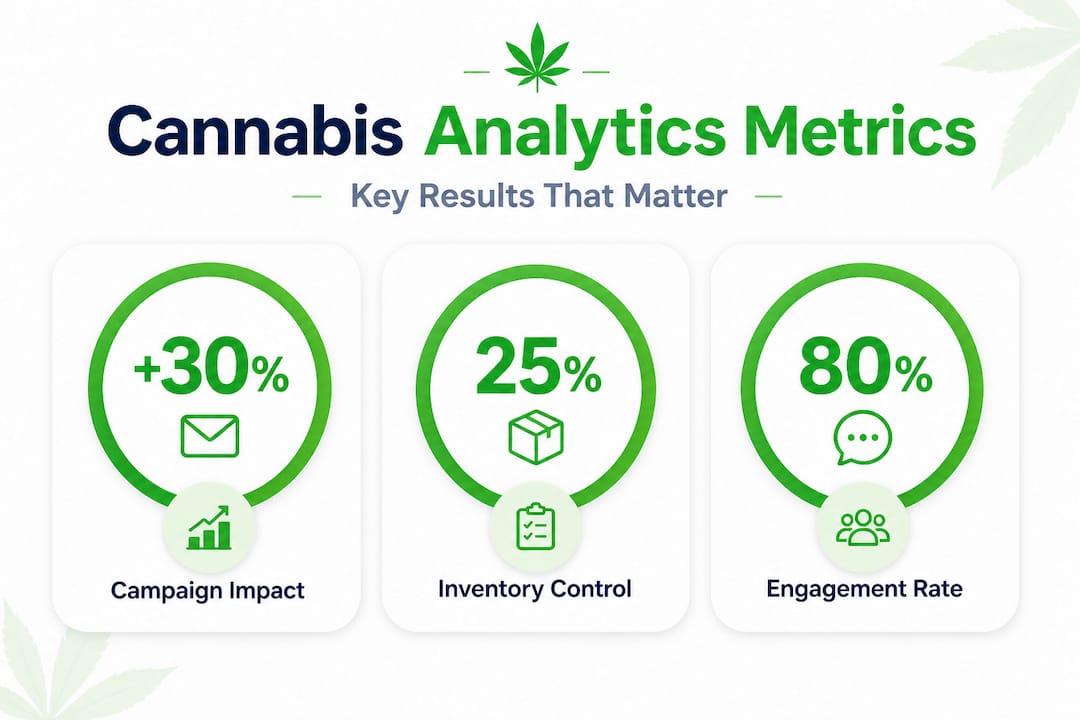
The revenue impact of getting these numbers right is real. Email segmentation drives a 44% revenue increase and a 30% revenue lift when paired with consistent execution. These are not projections. They are documented results from cannabis operators who made owned channel analytics a core part of their strategy.
“Analytics aren’t just a reporting tool. In cannabis marketing, they are the engine behind every profitable campaign decision.”
Your social media analytics and content marketing analytics feed this same decision-making loop. When you connect engagement data across channels, patterns emerge that no single platform view can reveal. That cross-channel picture is where your biggest opportunities hide.
Paid advertising in cannabis is a minefield. Google, Meta, and most programmatic networks either outright ban cannabis ads or apply restrictions so tight that reaching your actual audience becomes nearly impossible. Even hemp and CBD brands run into walls regularly. Understanding these constraints is the first step to working around them intelligently.
Here is how the major platform limitations affect your marketing:
These digital advertising challenges push smart brands toward owned data channels. Email lists, SMS subscriber databases, and loyalty programs become your most valuable marketing assets because you own and control that customer relationship without depending on a third party’s ad policies.
“When paid reach is constrained, owned data becomes the competitive advantage. The brands building email and SMS lists today are the ones who will dominate their local markets tomorrow.”
The digital marketing rules that govern cannabis businesses create a counterintuitive advantage for disciplined operators. Because your competitors are often distracted by chasing paid channels that barely work, you can build a loyal, high-value subscriber base that converts at rates traditional advertisers can only envy.

Effective SMS marketing strategies give you a direct line to your customer’s phone. SMS open rates in cannabis consistently outperform email, often reaching 90% or higher. When you combine that reach with behavioral segmentation, you can send the right offer to the right person at the right moment.
Pro Tip: Build your email and SMS lists through in-store incentives, loyalty program sign-ups, and gated content on your website. Even 500 highly engaged subscribers generate more consistent revenue than a social following of 10,000 passive followers.
Knowing what to measure is one thing. Knowing which tools to use and how to apply the data is where most cannabis marketers fall short. This section gives you a practical framework.
| Metric | What it measures | Why it matters |
|---|---|---|
| Email open rate | Subscriber engagement with messaging | Reveals subject line effectiveness and list health |
| Click-through rate (CTR) | Interest in specific offers or content | Identifies top-performing promotions |
| Conversion rate | Purchase completion from campaign | Ties marketing directly to revenue |
| Customer retention rate | Repeat purchase behavior | Measures loyalty program effectiveness |
| Inventory turnover | Product sell-through speed | Informs purchasing and promotional strategy |
| Segmentation lift | Revenue difference between segments | Proves the value of personalized messaging |
| Page dwell time | Time spent on website content | Signals content quality and purchase intent |
Not all analytics platforms are created equal for cannabis businesses. Some flag your account or limit access due to industry restrictions. Here are categories that consistently deliver value:
AI analytics in cannabis is also evolving rapidly. AI-powered tools can now predict which products a customer is likely to purchase next, identify customers at risk of churning, and automate personalized follow-up sequences without manual intervention. That level of personalization used to require a dedicated data team. Now it is accessible to dispensaries of all sizes.
Use your marketing checklist to audit whether each of these tool categories is currently in use at your business. Gaps in your analytics stack are gaps in your visibility into what is actually driving revenue.
Pro Tip: Connect your POS system to your ESP as early as possible. This single integration unlocks purchase-based segmentation, which is the foundation for the highest-ROI campaigns you will ever run.
Predictive analytics reduces stockouts by 25% when applied to inventory management. That means fewer disappointed customers, less emergency purchasing, and more consistent margins. The same data that runs your marketing also protects your operations.
Theory is useful. Numbers are better. Here is what analytics-driven campaigns actually produce when executed correctly in cannabis marketing.
| Strategy | Best use case | Average impact | Key requirement |
|---|---|---|---|
| Segmentation | Targeting by product type, spend level, or purchase frequency | 44% revenue increase | Clean customer data and a capable ESP |
| Retargeting | Re-engaging cart abandoners or lapsed customers | 849% ROI documented | Tracking pixels or loyalty platform data |
| Predictive analytics | Anticipating demand, preventing churn, personalizing next-purchase recommendations | 25% stockout reduction | POS integration and purchase history data |
These three strategies work together. Segmentation defines your audience groups. Retargeting brings back customers who showed intent but did not convert. Predictive analytics tells you what to offer them before they even know they want it.
Cannabis brands that consistently execute this process see revenue grow steadily with each campaign cycle. The key is discipline: running these campaigns consistently rather than occasionally.
Marketers overcoming digital marketing challenges in the cultivation and dispensary space report that segmentation alone is often the single biggest lever available to them. It does not require a large budget. It requires clean data and consistent execution.
Here is what we observe repeatedly in this industry: cannabis business owners often treat analytics as a reporting function rather than a decision-making function. They check numbers after campaigns to confirm what they already believe, rather than using data to challenge assumptions before they spend.
That backward approach is expensive. It is the same reason so many cannabis brands keep pouring money into social media follower counts while their email list sits at 200 people with a 12% open rate. Follower counts feel like momentum. They look impressive in a meeting. But they do not pay bills. Your owned data does.
The brands winning in cannabis marketing right now are not the ones with the biggest Instagram presence. They are the ones who know their average order value by customer segment, their 30-day repurchase rate, and their top-performing product page by conversion rate. They use AI-powered analytics to predict demand and personalize outreach at scale, not to replace human judgment, but to sharpen it.
There is also a compliance dimension that gets ignored in conversations about analytics. Collecting and using customer data in cannabis comes with real legal obligations around privacy, age verification, and consent. Ignoring those requirements does not just create legal risk. It destroys the trust that makes owned channel marketing work in the first place.
The mindset shift we push our clients toward: treat analytics as a strategic asset that requires investment, protection, and ongoing refinement. Not a checkbox. Not a quarterly report. A living tool that makes every campaign smarter than the last. The brands that adopt this approach build something their competitors cannot easily copy: institutional knowledge about their own customers. That is a durable competitive advantage in any market, but especially in one as restrictive and competitive as cannabis.
If this article has you rethinking how your team approaches marketing data, that is a good starting point. But knowing the framework is different from having a partner who can help you execute it within the specific compliance and competitive pressures of the cannabis industry.
At Dope SEO, we specialize in exactly that. We work exclusively with cannabis businesses, which means we understand the ad restrictions, the platform limitations, and the content compliance requirements that generalist agencies routinely get wrong. If you want a clear-eyed look at where your analytics strategy stands today and what it would take to build campaigns that consistently drive revenue, start with our comprehensive cannabis SEO guide for foundational strategy. When you are ready to build a custom roadmap, our SEO strategy for cannabis outlines exactly how we approach visibility and growth for dispensaries and cannabis brands in competitive markets.
Engagement rate, conversion rate, retention, segmentation performance, and inventory turnover are the most actionable metrics for cannabis marketers, with segmentation and retargeting campaigns documented to generate up to 849% ROI and a 44% revenue increase.
Yes. Predictive analytics reduces stockouts by 25%, which means fewer lost sales, better margin control, and a more consistent customer experience at the point of purchase.
Strict ad regulations limit cannabis brands on mainstream platforms like Google and Meta, so owned channels like email and SMS deliver more reliable reach, stronger engagement benchmarks, and better long-term ROI.
Properly executed segmentation and retargeting campaigns can drive up to 849% ROI and increase revenue by 44%, based on documented results from cannabis operators using behavioral data to personalize outreach.

© 2026 Curious Monkeys Pressing Buttons LLC DBA Cannabiz Marketing Solutions AKA DopeSEO. All rights reserved.