
TL;DR:
- Cannabis content must prioritize compliance due to strict advertising bans and platform restrictions.
- Building a strong audience profile and compliance style guide ensures relevant, legal, and effective content.
- Educational, FAQ, and local community content boost organic growth while avoiding regulatory risks.
Most cannabis brands waste resources on content that risks compliance penalties and invisibility. Generic strategies built for mainstream industries simply don’t account for platform bans, state-specific regulations, or the absence of paid search options. Content marketing delivers 13X ROI compared to traditional methods, and brands that blog regularly see 55% more site visitors. That’s a massive opportunity, but only if your strategy is built for cannabis from the ground up. This guide walks you through exactly how to do that.
| Point | Details |
|---|---|
| Compliance first | Protect your brand by mastering state and platform rules before you publish any cannabis content. |
| Content quality beats quantity | Strategic, high-quality posts attract more customers than mass-produced or generic articles. |
| Hyper-local SEO wins | Local content and geo-targeted strategies boost visibility and engagement, even under ad bans. |
| Document and audit | Keep your own compliance style guide and audit content regularly to stay ahead of evolving regulations. |
Before you write a single word, you need to understand what makes cannabis content fundamentally different from content in other industries. The restrictions aren’t minor inconveniences. They shape your entire marketing approach.
Neither Google nor Meta allows cannabis product advertising. That’s not a policy gray area. It’s a hard wall. Because paid acquisition is largely off the table, organic content becomes your primary growth engine. This is why content marketing compliance is not optional. It’s the foundation everything else is built on.
The social media reality is sobering. 80% of cannabis Facebook pages are removed within the first year. Even well-intentioned brands get flagged, suspended, or banned for content that wouldn’t raise an eyebrow in another industry. This forces cannabis marketers to prioritize owned channels, SEO, and email over social reach.
Compliance failures carry real financial consequences. Non-compliance fines average $52,000 per incident. That’s not a theoretical risk. It’s a very practical budget drain that can cripple a growing business.
Here are the most common compliance pitfalls to avoid:
| Risk Area | Common Mistake | Potential Consequence |
|---|---|---|
| Health claims | “Our CBD cures insomnia” | Regulatory fines, platform removal |
| Imagery | Cartoon branding or youth-adjacent visuals | Account suspension, legal action |
| Age gating | No age verification on website | State license violations |
| State-specific rules | Using one-size-fits-all copy | Non-compliance fines averaging $52K |
The brands that treat compliance as a strategic asset, not a bureaucratic hurdle, are the ones that survive and grow. When your competitors are getting removed from platforms and hit with fines, your clean, compliant brand stays visible.
This is not about being cautious to the point of being boring. It’s about being smart enough to stay in the game.
With compliance risks in focus, it’s time to build a solid strategy foundation. And that foundation starts with knowing exactly who you’re talking to.
Most cannabis brands make the mistake of starting with keyword research. The smarter approach is to start with ICP research, meaning your ideal customer profile, before you touch a keyword tool. Who is your customer? What do they care about? What are they nervous about when walking into a dispensary for the first time? What local factors influence their purchasing decisions?
Here’s a simple process to identify and document your ICP:
Once you know your audience, you need a compliance style guide. This is a non-negotiable document that governs every piece of content your brand produces. It should include approved and prohibited language, claim-vetting procedures, state-specific wording requirements, and formatting rules for disclosures.

Compliance style guides are mandatory for any brand serious about longevity. And one critical warning: don’t rely on AI-generated content alone. AI tools don’t know your state’s specific regulations. They can produce copy that sounds polished but creates serious compliance risks in cannabis marketing. Always have a human reviewer check content against your style guide before publishing.
Pro Tip: Build your compliance style guide before you hire a content writer or agency. Handing someone a clear rulebook upfront prevents expensive rewrites and legal exposure down the road. Your SEO compliance guide should live alongside your brand voice guide as a foundational document.
With brand and compliance groundwork set, now develop content that ranks, educates, and drives action.
Not all content types perform equally in cannabis. The ones that consistently deliver results are educational articles, product FAQs, strain and effects guides, responsible consumption advice, and local community guides. These formats work because they answer real questions without making promotional claims that trigger platform restrictions.
SEO-optimized pillar pages and topic clusters drive 60% of dispensary organic search clicks. A pillar page covers a broad topic like “cannabis for beginners” in substantial depth. Cluster articles then go deep on subtopics like “how to choose the right strain” or “what to expect on your first dispensary visit.” Together, they signal topical authority to Google.
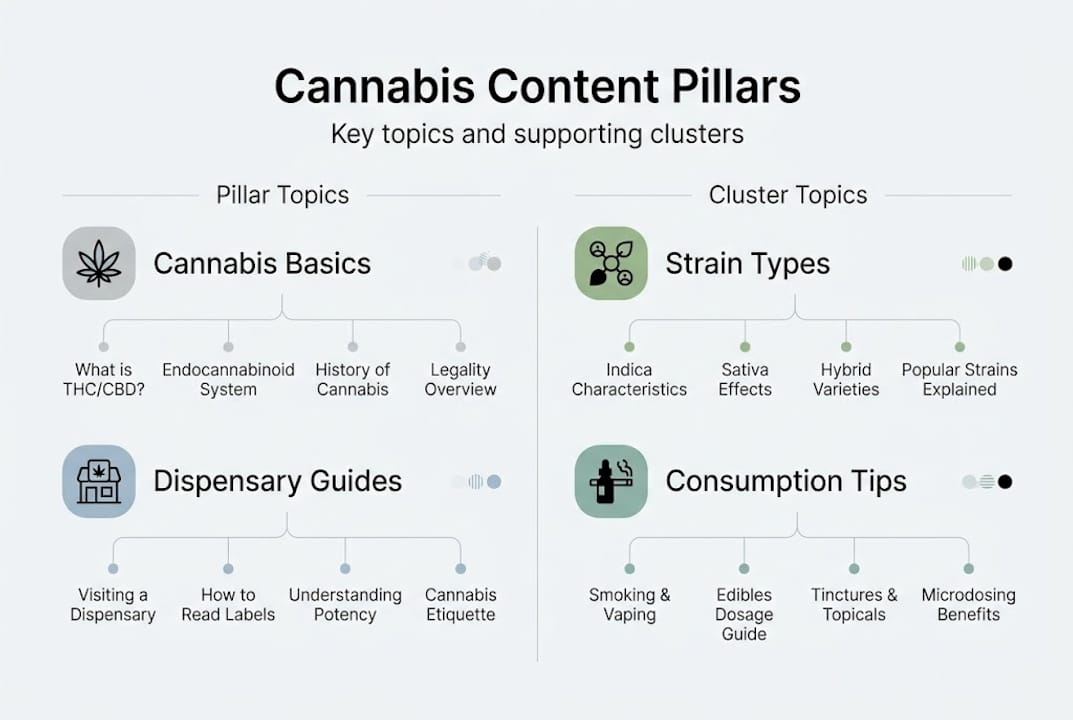
Here’s a sample pillar-cluster structure for a dispensary:
| Pillar Page | Cluster Topics |
|---|---|
| Cannabis 101 for new customers | Strain types, dosing basics, effects explained |
| Local dispensary guide | Neighborhood store page, city-specific regulations |
| Responsible consumption | Driving laws, safe storage, dosing for beginners |
| Product education | Edibles vs. flower, tinctures explained, lab results |
Once you create strong core content, repurpose it. Turn a detailed blog post into an email series, an SMS tip sequence, or a downloadable guide for in-store customers. This lets you optimize cannabis content across multiple channels without creating everything from scratch.
Key content production principles:
Pro Tip: Map each content piece to a stage in the buyer journey. Awareness content educates. Consideration content compares. Decision content builds trust and removes friction. Mixing all three types keeps your site useful to customers at every stage.
Once you have authoritative content, ensure your audience can actually find and engage with it.
Local SEO is critical for dispensaries because organic search accounts for roughly 60% of total clicks in this space. Customers searching “dispensary near me” or “best cannabis in [city]” are high-intent buyers. You need to show up for those searches.
Here’s a step-by-step approach to hyper-local content:
Owned channels are your long-term safety net. Email marketing for cannabis brands sees 21% open rates, well above the industry average. SMS performs even better for time-sensitive promotions. Both let you reach your audience without relying on platforms that could ban you overnight.
The importance of local SEO cannot be overstated when organic traffic is your primary growth channel. Use a local SEO strategy guide to prioritize your location-specific efforts, and reference a cannabis local SEO guide tailored to the dispensary market.
Pro Tip: Segment your email list by state. Promotions, product availability, and legal messaging vary by jurisdiction. Sending the wrong message to the wrong market is both a compliance risk and a trust problem.
Here’s a perspective most content guides skip: compliance isn’t a burden your competitors share equally. Most cannabis brands are not compliant. Platforms remove them. Regulators fine them. Their content disappears. That thins the competitive field for brands that do the work.
Treating compliance as a strategic moat means seeing regulation as a barrier that keeps underprepared competitors out of the game. When a rival gets their Facebook page removed or their site flagged, your clean, well-structured content is the one that stays indexed and visible.
We recommend auditing your own content at least twice as often as you think necessary. Regulations shift. State rules get updated. What was compliant last year may not be this year. Build a quarterly content audit into your standard workflow using practical compliance advice specific to the cannabis industry.
The brands that win long-term in cannabis are not necessarily the loudest or most creative. They’re the ones that stay in the game. Compliance keeps you in the game.
Building a content strategy that performs in cannabis takes more than good writing. It takes industry-specific knowledge, regulatory awareness, and a distribution plan that works around platform restrictions.
At Dope SEO, we specialize in helping cannabis brands grow through strategies built for this industry. Whether you need a fully developed cannabis SEO strategy, targeted local search strategies that put you on the map in your market, or a compliant cannabis website design that converts visitors into customers, we have the tools and expertise to make it happen. Let’s build something that lasts.
Cannabis brands face federal and state advertising restrictions that prohibit most paid placements, and major platforms enforce strict bans on cannabis product ads, with 80% of cannabis Facebook pages removed in the first year alone.
Educational articles, product FAQs, local dispensary guides, and responsible consumption content consistently drive the most organic traffic and engagement, particularly because they answer real customer questions without triggering platform content restrictions.
Build a mandatory compliance style guide before producing any content, require human review of every piece, avoid unverified health claims, and tailor copy to state-specific regulatory requirements for each market you serve.
Pillar pages address broad topics in depth while cluster articles cover related subtopics, and together they signal topical authority to search engines, which is why pillar-cluster ecosystems improve rankings for competitive cannabis keywords.
AI tools can produce content that sounds polished but lacks awareness of your state’s specific rules, so human review is critical for ensuring regulatory accuracy and maintaining E-E-A-T standards with search engines.

© 2026 Curious Monkeys Pressing Buttons LLC DBA Cannabiz Marketing Solutions AKA DopeSEO. All rights reserved.