
Many cannabis business owners assume that if they can’t run paid ads, they simply can’t compete online. That assumption is costing them customers every single day. Major platforms like Google and Facebook place strict restrictions on cannabis advertising, which leaves a massive gap that most businesses don’t know how to fill. Organic traffic, meaning visitors who find you through unpaid search results, is not just a workaround. It’s actually the most powerful, sustainable growth channel available to hemp and cannabis brands. This guide breaks down what organic traffic really means for your industry, why it delivers results that paid ads never could, and exactly how to start building it.
| Point | Details |
|---|---|
| Organic outperforms paid | In highly regulated industries like cannabis, organic traffic provides a legal, sustainable channel for reaching customers. |
| Trust drives conversions | Users trust organic search results more, leading to higher quality leads and brand loyalty. |
| SEO requires patience | Organic growth is slow but delivers compounding results over time for persistent cannabis businesses. |
| Compliance is critical | Staying up-to-date with regulations prevents penalties and ensures long-term organic visibility. |
Organic traffic refers to visitors who land on your website after clicking a search engine result, without you paying for that click. They searched for something, your page appeared, and they chose to visit. No ad spend required. For most industries, organic and paid traffic work side by side. For cannabis, the equation is very different.
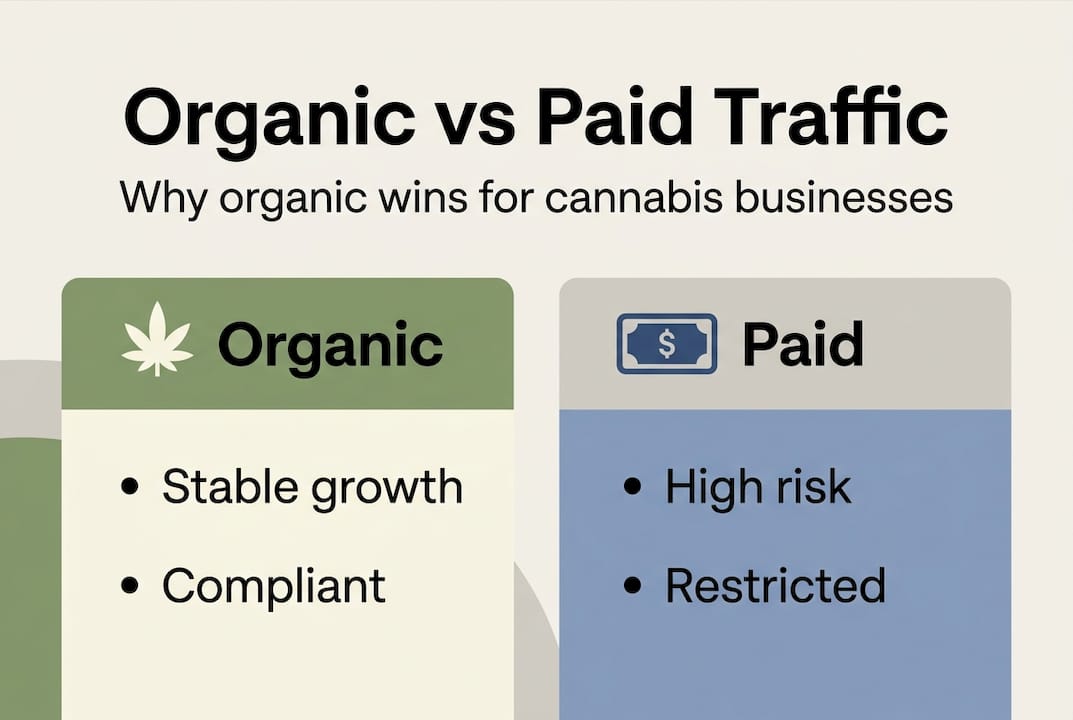
Paid channels are restricted for cannabis advertising across most major platforms. Google, Facebook, Instagram, and even some programmatic networks either ban cannabis ads outright or impose restrictions so tight that running effective campaigns is nearly impossible. This forces cannabis businesses to find another path, and organic traffic for cannabis businesses becomes not just a nice-to-have but a core business strategy.
Challenges cannabis companies face with traditional marketing:
Here’s a quick comparison of how paid and organic approaches stack up for cannabis businesses:
| Factor | Paid traffic | Organic traffic |
|---|---|---|
| Allowed for cannabis? | Severely restricted | Yes, fully available |
| Cost per visit | Ongoing spend required | Free after initial investment |
| Longevity | Stops when budget ends | Compounds over time |
| Platform risk | High (account bans) | Low |
| Audience reach | Limited by policy | Broad and scalable |
The contrast is stark. Paid traffic is fragile in this industry. Organic is stable. When you invest in optimizing cannabis content for search engines, you’re building an asset that keeps working for you around the clock.
Pro Tip: Never build your entire customer acquisition strategy on a single channel. In cannabis, that’s especially dangerous. Organic search gives you a foundation that no platform can take away overnight.
With those differences in mind, let’s dig into exactly why organic traffic pays off for cannabis companies.
First, consider trust. When your dispensary or hemp brand appears in the top organic results, users perceive that as a signal of credibility. Paid ads are labeled as ads. Organic rankings feel earned, and to your potential customers, they are. Organic search boosts trust and delivers more sustainable leads than paid placements, especially in a category where consumers are already cautious about who they buy from.
Here’s how an organic visit turns into a qualified lead:
This process happens without you spending a dollar on that specific visit. And it repeats every single day.
Organic vs. paid ROI over 12 months:
| Metric | Paid campaigns | Organic SEO |
|---|---|---|
| Month 1 results | Immediate (if allowed) | Minimal |
| Month 6 results | Consistent but costly | Growing steadily |
| Month 12 results | Same cost, same results | Compounding returns |
| After budget stops | Zero traffic | Traffic continues |
The proof of SEO results is clear: businesses that invest in organic early see compounding returns that paid campaigns simply can’t replicate over time.

This applies across all cannabis business types. Whether you run a dispensary, a hemp brand, or a consumption lounge, organic visibility connects you with customers who are already searching for exactly what you offer.
Pro Tip: Organic visitors tend to have lower bounce rates and higher conversion rates than paid visitors. They found you because they were looking. That intent makes them far more valuable.
For ethical cannabis marketing, organic search also keeps you on the right side of platform policies and consumer expectations simultaneously.
Having covered why organic matters, here’s how to start building your own organic growth engine.
Specialized SEO strategies drive effective organic growth for cannabis businesses, and the approach needs to be tailored to your industry’s unique constraints and opportunities. Generic SEO advice won’t cut it here.
Follow these steps to build organic traffic that lasts:
Top content types that drive organic results for cannabis brands:
“The cannabis businesses that win in organic search are the ones that treat content as a long-term investment, not a one-time task. Publish consistently, answer real questions, and your rankings will follow.”
For a deeper breakdown of the full approach, the cannabis SEO guide covers every layer of this strategy. You can also explore the cannabis marketing blog for ongoing tactics and updates.
Taking action is essential, but knowing what NOT to do is just as valuable.
Even well-intentioned cannabis businesses make costly mistakes when building organic traffic. Here are the five most common ones and how to sidestep them.
1. Inconsistent messaging across pages. If your homepage says one thing and your product pages say another, search engines and users both lose confidence. Keep your brand voice, product descriptions, and value propositions consistent everywhere.
2. Neglecting compliance in content. Compliance is vital for cannabis websites or they risk being penalized. Making unverified health claims, using restricted language, or ignoring age-gating requirements can get pages removed from search results entirely.
3. Ignoring technical SEO. Broken links, duplicate content, missing meta tags, and slow load times quietly destroy rankings. A technical audit should be part of every cannabis site’s regular maintenance.
4. Publishing low-quality content. Thin, keyword-stuffed pages don’t rank anymore. Search engines reward depth, accuracy, and genuine usefulness. If your content doesn’t help the reader, it won’t help your rankings either.
5. Failing to target local users. Most cannabis purchases happen locally. If you’re not optimizing for city-specific and neighborhood-level searches, you’re leaving your most qualified traffic on the table.
Risks from poor compliance in cannabis digital marketing:
“One compliance mistake can undo months of SEO progress. Build a review process into every piece of content before it goes live.”
Pro Tip: Cannabis laws and platform policies change frequently. Set a monthly reminder to review your content against current regulations. What was compliant six months ago may not be today. Resources like cannabis law marketing strategies can help you stay current. For businesses in cultivation and growing, marketing for cannabis growers also outlines compliance considerations specific to that segment.
Here’s something most marketing guides won’t tell you directly: the biggest reason cannabis businesses fail at organic traffic isn’t a lack of knowledge. It’s a lack of patience.
Every business owner wants results in 30 days. Organic SEO rarely works that fast, especially in a regulated industry where search engines apply additional scrutiny to cannabis-related content. The businesses that win are the ones that start early, stay consistent, and don’t abandon the strategy when month two looks quiet.
We’ve seen it repeatedly. A cannabis brand invests in SEO for three months, sees modest gains, and pulls back. Meanwhile, a competitor who started at the same time keeps publishing, keeps building links, and by month seven is dominating local search. The cannabis SEO case studies tell this story clearly.
The uncomfortable reality is that your competitors’ impatience is your opportunity. Most of them will quit. If you stay in the game, you inherit their rankings. Organic traffic in cannabis rewards persistence above almost everything else. No shortcut, no hack, and no single viral post replaces the compounding value of a well-maintained SEO strategy built over time.
If this guide has made one thing clear, it’s that organic traffic isn’t optional for cannabis businesses. It’s the foundation of sustainable online growth in an industry where paid channels are largely off-limits.
At Dope SEO, we specialize in exactly this. We understand the regulatory landscape, the platform restrictions, and the content strategies that actually move the needle for cannabis brands. Whether you’re starting from scratch or looking to scale what’s already working, our cannabis SEO guide is a strong first step. When you’re ready to put a full strategy in motion, explore how we can boost your cannabis SEO with a plan built specifically for your business and market.
Google and Facebook ban most cannabis ads due to federal and platform-level regulations, making organic search the most reliable and compliant way to get found online.
Building organic traffic typically takes 3 to 6 months, but the growth is gradual and sustainable, compounding over time in ways that paid ad bursts simply cannot match.
Strategic content creation shows that educational blogs, how-to guides, FAQs, and location-specific pages consistently deliver the strongest organic search returns for cannabis brands.
Yes. Organic channels carry far less legal and platform risk than paid advertising in the cannabis sector, and they build the kind of long-term brand trust that ethical cannabis marketing depends on.

© 2026 Curious Monkeys Pressing Buttons LLC DBA Cannabiz Marketing Solutions AKA DopeSEO. All rights reserved.