
TL;DR:
- Most dispensaries lose traffic mainly due to missing foundational visibility steps.
- Consistent optimization of online profiles, local SEO, reviews, and educational content boosts local search rankings.
- Organic visibility strategies outperform paid ads and provide long-term growth opportunities.
The visibility gap between the top dispensary in your city and the one ranking tenth is not just a number on a screen. That difference can represent a $252,000 monthly traffic value gap when you compare first-place map pack positions to those buried below the fold. Most dispensaries are losing that ground not because of bad products or poor service, but because they have skipped foundational visibility steps that are entirely within reach. This guide walks you through a practical, compliant roadmap covering profile optimization, local SEO, reputation building, content strategy, and analytics so you can close that gap with confidence.
| Point | Details |
|---|---|
| Optimize your profiles | A complete and consistent business presence across Google, Weedmaps, and directories anchors top search visibility. |
| Dominate local SEO | Local landing pages, schema markup, and mobile-first websites connect you with ready-to-buy local customers. |
| Leverage reviews | Encouraging authentic reviews and responding fast boosts visibility and buyer trust. |
| Publish compliant content | Educational, regulation-friendly blog topics earn traffic and trust, outperforming paid ads long-term. |
| Track and adapt | Using analytics tools and KPIs keeps your visibility efforts on track and growing. |
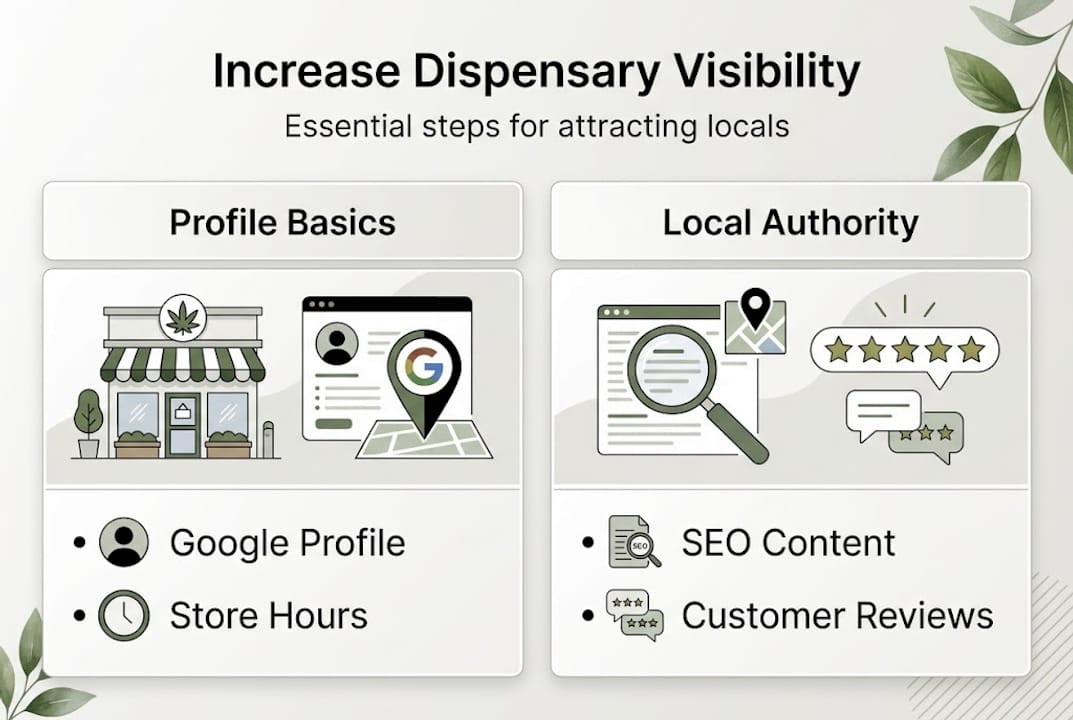
With the financial stakes of visibility laid out, let’s start by addressing core online profiles and directories. Your first move is making sure your business name, address, and phone number (known as NAP) are identical everywhere they appear online. Even a small inconsistency, like writing “Ave” in one place and “Avenue” in another, can undermine your local authority. Consistent NAP across 50+ directories is crucial for building the citation signals Google uses to rank local businesses.
Your Google Business Profile (GBP) is your most powerful digital storefront. Fill in every field: hours, services, attributes, and your menu link. Use the “Cannabis Store” category specifically, as it signals relevance to search engines. Beyond Google, claim and fully optimize your profiles on Weedmaps, Leafly, and Yelp. Upload high-quality photos of your storefront, interior, and team. Businesses with photos get significantly more direction requests and website clicks than those without.
| Profile element | Optimal listing | Average listing |
|---|---|---|
| GBP category | Cannabis Store (exact) | General retail or uncategorized |
| Photos | 20+ high-quality images | 1-3 low-res images |
| NAP consistency | Matches 50+ directories | Inconsistent across platforms |
| Review responses | Every review answered | Rarely or never responded |
| UTM tracking on links | Active on all GBP links | Not implemented |
For optimizing Google Business Profile performance, the details really do matter. 68% of dispensaries lack UTM tracking on their GBP links, meaning they cannot see which visits and sales actually originated from Google. Pair that with reviewing current cannabis marketing research to stay aligned with what top performers are doing.
Pro Tip: Add UTM parameters to every link inside your GBP, including your website URL and menu link. This simple step transforms your GBP from a passive listing into a trackable revenue source.
Once your core profiles and citations are solid, the next high-impact step is upgrading your website’s local authority. Your website needs to speak the language of local search, and that starts with a few technical and content fundamentals.
Here is a numbered checklist to set up your local presence correctly:
Keyword strategy matters, too. Target phrases like “[Your City] cannabis dispensary,” specific strain names, and locally relevant regulatory terms. Reference the dispensary SEO guide for a deeper breakdown of keyword frameworks that work in regulated markets.
| SEO element | Ranking impact | Common mistake |
|---|---|---|
| Local schema markup | High | Missing or incomplete |
| Location-specific pages | High | One generic contact page |
| Mobile page speed | High | Slow load times |
| Internal linking | Medium | Isolated pages, no link flow |
| Keyword stuffing | Negative | Overusing exact phrases |
For cannabis content for SEO that actually ranks, use keyword variations naturally throughout your pages. Your cannabis local SEO guide will give you a full framework for building location authority the right way.
Pro Tip: Avoid repeating the exact same city plus keyword phrase more than once or twice per page. Use natural variations like neighborhood names, nearby landmarks, or product category terms to stay relevant without triggering keyword stuffing penalties.
A trustworthy online presence is not complete without proof. Reviews can skyrocket your visibility and credibility in ways that most dispensary owners underestimate. What matters most is not just the total number of reviews but review velocity, meaning how consistently new reviews are coming in. A steady stream of fresh reviews signals active business health to Google’s local ranking algorithm.

Top dispensaries average 1,011 reviews at a 4.7-star rating. That level of social proof does not happen by accident. It happens through consistent, systematic review generation.
Here are four proven methods to generate real, regular reviews:
Responding to every review, positive or negative, signals to Google that your business is actively managed. It also builds visible trust with new customers reading your profile before they visit.
When you respond to reviews, keep your replies compliant. Avoid making health claims or referencing specific products in ways that could trigger regulatory issues. Acknowledge the feedback, thank the customer, and keep it professional. Review proven cannabis SEO strategies and cannabis SEO best practices for more on building a review strategy that compounds over time.
Pro Tip: Use a reputation management tool like Podium or Birdeye to automate review requests and monitor incoming feedback across Google, Weedmaps, and Leafly from one dashboard.
With your reputation growing, amplifying compliant educational content drives new discovery and builds trust. Content marketing is one of the most powerful visibility tools a dispensary has access to, especially because SEO outperforms restricted paid ads for generating compliant, sustainable exposure.
Here are four must-have content types for your dispensary site:
Publishing content that educates rather than sells is not just a compliance strategy. It is what builds lasting trust with the community and search engines simultaneously.
Always review your state’s advertising guidelines before publishing any piece of content. Even well-intentioned posts can become compliance risks if they use language that implies medical benefits or targets minors. Check dispensary content strategies for examples of compliant content formats that drive real organic traffic.
For building out your blog and page structure, optimizing cannabis content is a practical starting point, and learning how to boost local SEO through content will sharpen your editorial calendar significantly.
Pro Tip: Consult your state cannabis regulatory authority’s published advertising guidelines before finalizing any content calendar. Staying ahead of compliance protects your license and your brand reputation.
To ensure your new strategies are truly effective, let’s finish with proven ways to track and optimize for continuous improvement. Without data, you are guessing. With it, you can make precise decisions that compound your results.
Here are the three essential tools to set up immediately:
| Metric | What it measures | Target range |
|---|---|---|
| Organic traffic | Monthly site visitors from search | 20-40% monthly growth |
| Local keyword rankings | Position for city-based terms | Top 3 for primary keywords |
| Review velocity | New reviews per month | 10-30+ per month |
| GBP actions | Calls, directions, website clicks | Steady week-over-week increase |
| Conversion rate | Visitors who take action | 3-7% depending on page |
Expect SEO results in 3 to 6 months for measurable gains, with the biggest ranking jumps typically appearing between months 9 and 12. The payoff is real: documented cannabis campaigns show 150 to 400% organic traffic growth and ROI figures reaching 1,395%. Browse cannabis marketing results for documented case data that shows what consistent SEO execution actually delivers.
Review top cannabis SEO tips for a sharper look at the tactics that move numbers fastest.
Pro Tip: Set a recurring monthly reporting appointment in your calendar. Review your top 10 keywords, GBP action trends, and new review count each month. This habit catches quick wins and course corrections before small dips become big problems.
Stepping back, our field experience reveals some counterintuitive truths about what really drives dispensary growth. Most dispensary owners we work with initially believe that paid advertising is the fastest path to new customers. The reality is the opposite. Paid ads in the cannabis space are heavily restricted, frequently flagged or removed, and can put your accounts at risk. The instability alone makes them an unreliable growth channel.
What works, and what keeps working, is organic visibility. SEO outperforms restricted paid ads long-term precisely because compliance barriers make paid channels inconsistent. Every blog post you publish, every review you earn, and every citation you build becomes a permanent asset that compounds in value month after month. Paid clicks disappear the moment you stop spending. Organic rankings do not.
Here is the part most dispensary owners miss: your competitors are also underinvesting in SEO. The barrier to standing out is lower than it looks. The dispensaries pulling the most foot traffic in 2026 are not necessarily spending the most on marketing. They are the ones who started their organic visibility strategy earlier and stayed consistent. The window to act before your market gets crowded is still open. Explore advanced dispensary SEO tactics to understand what separates the leaders from the followers in your local market.
Now that you understand the full roadmap, here’s how to accelerate results even faster with expert support. Dope SEO specializes exclusively in cannabis and hemp businesses, which means we understand the regulatory landscape, platform restrictions, and local competition you navigate every day. We are not a generalist agency applying a one-size-fits-all approach. We build visibility strategies that are built specifically for dispensaries.
Whether you are starting from scratch or scaling an existing presence, our cannabis SEO 2026 guide is a strong next step for understanding what the landscape looks like right now. When you are ready for a full growth plan, explore our cannabis SEO strategy page, or dive directly into our dispensary website optimization resources to see exactly where your site can improve. Let’s get your dispensary found by the customers who are already searching for you.
Most dispensaries see measurable improvements in 3 to 6 months, with the largest ranking gains typically arriving between months 9 and 12 as domain authority builds. SEO timelines of 3 to 6 months are standard across the industry.
Google prioritizes a complete GBP, consistent NAP data, regular review velocity, and locally optimized web content. Profile completion and reviews are the two fastest-moving ranking signals for local dispensary searches.
Paid ads in the cannabis space face heavy restrictions and frequent account suspensions, making them unreliable. SEO delivers more reliable results for dispensaries because it operates within compliant, organic channels that are not subject to the same platform bans.
Ask every customer at checkout, use QR codes at your register, and send a follow-up text or email within 24 hours of a purchase. Responding to every review and training your staff to invite feedback consistently is what drives steady review velocity.
Yes, educational and compliant content remains one of the highest-return strategies for dispensaries because it attracts local search traffic and builds long-term trust. Content marketing stays central to organic growth and compliance-safe visibility in 2026.

© 2026 Curious Monkeys Pressing Buttons LLC DBA Cannabiz Marketing Solutions AKA DopeSEO. All rights reserved.