
TL;DR:
- Cannabis keyword research requires industry-specific strategies due to complex regulations and platform policies.
- Regular quarterly updates are essential to adapt to evolving laws, platform restrictions, and search behavior.
- Focus on local and transactional keywords to attract nearby customers and drive conversions while maintaining compliance.
Keyword research sounds straightforward until you try it in the cannabis industry. Unlike retail, hospitality, or finance, cannabis businesses operate in a space where the wrong phrase can get your content flagged, your ad account suspended, or your site penalized before you even know what happened. Generic SEO playbooks simply were not built for this reality. This guide walks you through exactly how cannabis-specific keyword research works, why it matters more than ever in 2026, and how dispensaries, cultivators, and other plant-touching businesses can build a search strategy that actually holds up.
| Point | Details |
|---|---|
| Cannabis SEO is unique | Cannabis businesses face strict regulations requiring tailored keyword research for effective online visibility. |
| Frameworks boost compliance | An industry-specific keyword strategy helps avoid legal risks and drives targeted, qualified traffic. |
| Mix keyword types for results | Transactional, informational, and local keywords work together to capture interest and convert cannabis industry customers. |
| Ongoing updates are essential | Regularly updating keyword strategies is vital as laws and user behavior change rapidly in the cannabis industry. |
Now that you know generic keyword research won’t cut it, let’s dig into what makes cannabis industry SEO fundamentally different from other sectors.
Cannabis businesses operate under strict, frequently changing regulations that directly affect how you can market online. What is legal to say in Colorado may be restricted in Texas. What Google allows on one type of page may be blocked on another. This fragmented landscape means your keyword decisions carry real legal and business weight, not just traffic implications.
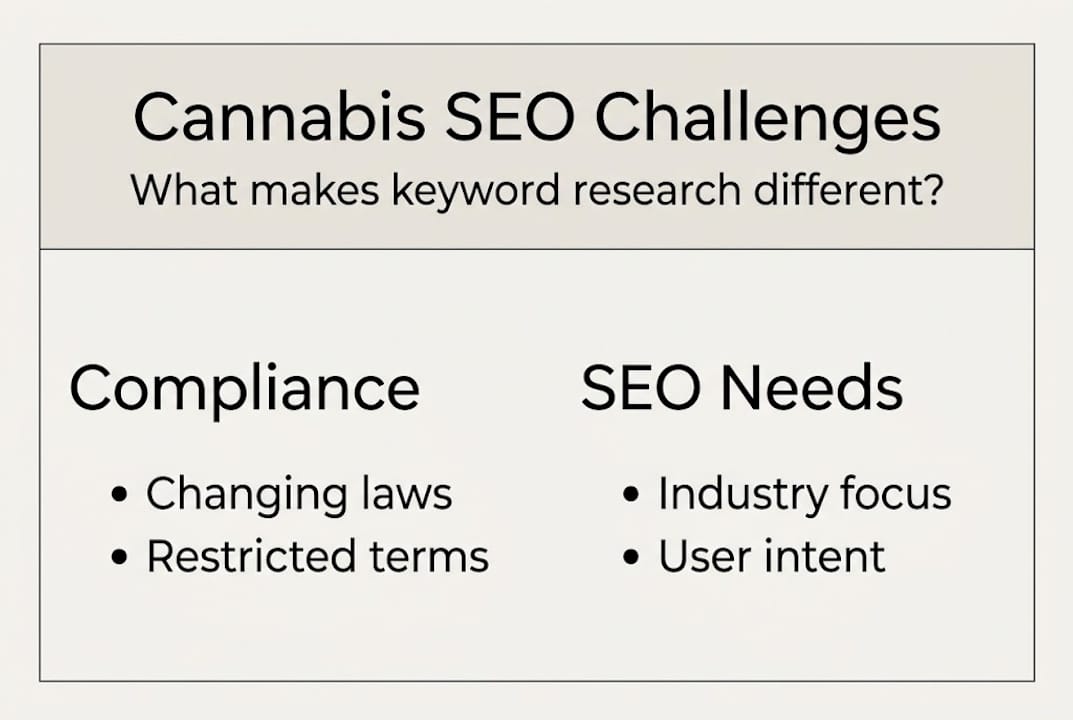
Platforms like Google and Meta treat cannabis content differently than most industries. Certain terms trigger automated filters that can suppress your pages or block your ads entirely. This is not theoretical. Dispensaries and growers regularly find that content using common product terms simply does not appear in paid results, and sometimes in organic results too, depending on how it is phrased.
Here are the key factors that separate cannabis keyword research from mainstream SEO:
“The intersection of compliance and search intent is where most cannabis SEO strategies either win big or fall apart entirely.”
Understanding SEO compliance challenges specific to cannabis is not optional. It is the foundation of every keyword decision you make. Even SEO keyword research basics acknowledge that industry context shapes strategy. In cannabis, that context is heavier and more consequential than almost anywhere else.
With those challenges in mind, here is how to craft a research process that keeps your cannabis business both visible and compliant.
Industry-specific frameworks are essential for cannabis SEO success because a generic keyword list pulled from a standard tool will include terms that put your site at risk. You need a structured approach that accounts for your business type, your audience, and your regulatory environment all at once.
Start by mapping your core business areas. A dispensary has different keyword needs than a cultivator or a CBD manufacturer. Each requires its own cluster of terms, and those clusters need to be vetted separately. The SEO keyword research guide from Search Engine Land outlines general research principles, but for cannabis you need an additional compliance layer built in from the start.
Use this table to organize your keyword clusters by business type:
| Business type | Core keyword focus | Compliance priority |
|---|---|---|
| Dispensary | Product + location terms | High: age-gating, local laws |
| Cultivator | Strain, grow, wholesale | Medium: agriculture regulations |
| CBD brand | Wellness, product benefits | High: FDA claims rules |
| Ancillary business | B2B services, tools | Lower: general compliance |
Here is a step-by-step process to build your framework:
Pro Tip: Create a simple spreadsheet with three columns: keyword, compliance status, and user intent. Review it every time a regulatory update hits your state. Small adjustments made early prevent big problems later.
This structured approach, like those outlined when you master cannabis keyword research, keeps your team aligned and your site protected.
Once your framework is set, choosing the right keyword types is the next critical step. Here is how to match keywords with your specific goals.

Targeting a mix of transactional, informational, and local keywords enhances both visibility and compliance across the buyer journey. Each type serves a different purpose, and a balanced strategy uses all three.
Here is a breakdown of how the three keyword types work for cannabis businesses:
| Keyword type | Example | Goal | Buyer stage |
|---|---|---|---|
| Transactional | “buy CBD tincture near me” | Drive purchases | Ready to buy |
| Informational | “cannabis laws in California” | Build authority | Researching |
| Local | “dispensary in Denver” | Capture nearby traffic | Near decision |
Transactional keywords carry the highest commercial intent. They signal that someone is close to making a purchase. For dispensaries, these are the terms most directly tied to foot traffic and online orders. However, they also carry the highest compliance scrutiny, so every transactional page needs to be carefully reviewed.
Informational keywords are your long game. They build trust, establish your site as an authority, and attract users who are not ready to buy yet but will be soon. Content like “what is the difference between indica and sativa” or “how to get a medical card in [state]” builds the kind of credibility that supports your transactional pages.
Local keywords are non-negotiable for dispensaries and cultivators with physical locations. Searches like “dispensary open near me” or “cannabis delivery in [city]” connect you with customers who are ready to act right now. Your local search strategy for dispensaries should prioritize these terms above nearly everything else.
Pro Tip: Do not treat local keywords as a separate effort. Weave them into your product pages, blog posts, and meta descriptions so every piece of content does double duty.
Learn more about keyword types for SEO to see how these categories apply broadly, then map those principles back to your cannabis-specific situation.
Choosing the right keywords is only half the battle. Their careful integration is vital for compliance and search success.
Improper keyword use can lead to content being flagged or removed by platforms, and in serious cases can attract legal attention from regulators. This is one area where cannabis businesses cannot afford to be casual. Every keyword that makes it onto your site needs to be placed with intention.
Here is a proven process for compliant keyword integration:
You can also review cannabis SEO rules from Search Engine Journal for platform-specific guidance on what to avoid.
“Compliance documentation is not just good legal practice. It also gives you a clear record of your SEO decisions, which makes future strategy adjustments far faster and more accurate.”
For those running growing operations, specific SEO compliance for cultivators addresses unique challenges around agricultural claims and wholesale marketing language. It is also worth reviewing your cannabis SEO terminology to make sure your team is working from a consistent, compliant vocabulary across all content.
Let’s step back and look at where most well-intentioned cannabis SEO efforts actually go off track.
The biggest mistake we see is treating keyword research as a one-time task. Businesses invest in a solid initial list, rank for a few terms, and then stop. Meanwhile, regulations shift, competitors pivot, and user language evolves. The keyword list that worked in early 2025 may be a liability by mid-2026.
Most guides focus on the research itself and skip over the refresh cycle. That is where real ROI lives. Proactive quarterly keyword reviews, where you cross-reference your terms against new regulations and updated platform policies, are the difference between consistent visibility and a slow traffic decline nobody notices until it is too late.
There is also hidden value in tracking what we call “gray area” keywords. These are terms that are not clearly restricted but carry some risk depending on context. Monitoring them gives you early warning signals when regulatory winds are shifting, which means you can adjust before a penalty hits.
Copying keyword lists from non-cannabis industries is another trap. A wellness brand and a CBD dispensary are not the same, and the keywords that work for one can get the other flagged. The common cannabis SEO challenges that define this space require a research process built from the ground up for cannabis, not adapted from somewhere else.
If navigating these complexities sounds overwhelming, here is how trusted, expert help can make all the difference for your business.
At Dope SEO, we build keyword strategies specifically for dispensaries, cultivators, and cannabis brands that need to grow without running into compliance walls. Our team understands the regulatory landscape, the platform rules, and the local search dynamics that shape cannabis visibility in 2026.
Whether you are starting from scratch or fixing a strategy that has stalled, our cannabis SEO 2026 guide is a strong first step. Ready to go further? Explore how we boost your online visibility with proven, compliant frameworks built for this industry. You can also review our approach to dispensary website optimization to see how keyword strategy connects to site-wide performance improvements.
Regular keyword updates are critical in the dynamic cannabis space. Cannabis businesses should refresh keyword strategies at least quarterly to keep pace with regulatory shifts and evolving search behaviors.
Certain keywords may trigger legal or platform actions against cannabis content. Compliance risks include using restricted terms that prompt removal by platforms or violate local and state laws.
Local and transactional keywords drive conversions for dispensaries. These keyword types tend to attract the most qualified traffic from customers who are close to making a purchase or visiting in person.
Yes, but industry-specific vetting is required with standard SEO tools. You must manually filter and vet results for compliance and local relevance before applying any keyword list to your cannabis site.

© 2026 Curious Monkeys Pressing Buttons LLC DBA Cannabiz Marketing Solutions AKA DopeSEO. All rights reserved.