
TL;DR:
- Effective cannabis SEO requires proper keyword targeting, high-quality content, and strong technical foundations. Neglecting local SEO, link building, and ongoing performance tracking hampers organic growth significantly. Prioritizing technical fixes and accurate search intent alignment lays the best groundwork for sustainable rankings.
If your cannabis website isn’t pulling in organic traffic, the problem usually isn’t your product. It’s your SEO. The common seo mistakes list affecting small business sites reads like a checklist that most cannabis businesses fail quietly. You’re competing in a regulated, often ad-restricted industry where organic search is one of your best legitimate growth channels. Getting SEO wrong here costs you real revenue, not just rankings. This article breaks down the most damaging mistakes cannabis businesses make, with specific fixes you can act on today.
| Point | Details |
|---|---|
| Fix technical SEO first | Indexing errors, blocked pages, and canonical issues prevent any other SEO work from paying off. |
| Keyword research must match intent | Targeting high-volume terms that don’t match what your customer actually wants kills conversions. |
| Content quality beats content volume | Thin or duplicated pages on cannabis sites actively hurt rankings and erode trust with Google. |
| Local SEO is your competitive edge | Incomplete Google Business Profiles and inconsistent NAP data suppress local visibility for dispensaries. |
| On-page basics still matter | Missing meta tags and slow page speed reduce click-through rates and user engagement across every page. |
This is where most cannabis SEO campaigns fall apart before they even get started. You pick keywords that sound relevant, maybe even terms your competitors use, but they don’t match what your customers are actually typing into Google.
The mistake shows up in two ways. First, targeting terms with no real search volume. Second, targeting terms where the intent doesn’t match your page. Ranking for “cannabis” when your dispensary serves a single city won’t convert anyone. Ranking for “buy weed online” when online sales aren’t legal in your state sends the wrong signal to both Google and your customers.
Ignoring search intent significantly reduces ranking potential and user engagement. Search intent alignment is foundational. No amount of keyword tweaking compensates for content that ignores what users actually want.
Pro Tip: Try searching your own target keywords and study the top-ranking pages. If they’re all how-to guides and yours is a product page, you have an intent mismatch that no amount of optimization will overcome.
Cannabis websites are especially vulnerable to this mistake. When you have a menu with 80 product variants, it’s tempting to auto-generate pages for each one using the same template. The result is dozens of near-identical pages that offer Google nothing unique to index.
Thin content is any page that doesn’t meaningfully answer a user’s question or serve a distinct purpose. Duplicate content means the same text appearing on multiple pages, either internally or copied from suppliers and other sites. Both are SEO errors to avoid at all costs.
Google’s E-E-A-T standards require that cannabis content show real experience and trustworthiness, not just keyword-stuffed filler. A product page that says “Indica strain, 22% THC, relaxing effects” repeated 40 times across your site is not content. It’s clutter. Scaling repetitive AI cannabis content can actively trigger traffic losses and ranking penalties without human oversight and uniqueness.
Pro Tip: Set a quarterly content audit reminder. Even pages that ranked well six months ago can become stale as your menu changes, local competition grows, or Google updates its quality criteria.
Technical SEO mistakes are the ones that quietly undo everything else you’re doing. Your content can be outstanding, your keywords perfectly researched. But if Google can’t crawl and index your pages correctly, none of it matters.
The most common technical SEO issues on cannabis sites fall into three categories:
Canonical tag errors add another layer of complexity. Canonical mismatches occur when your canonical tag points to a non-200 page, conflicts with your sitemap, or when HTTP and HTTPS versions of the same URL both exist without proper canonicalization. Cannabis sites with parameterized product URLs (like filters for potency or strain type) are especially prone to this.
| Technical Issue | What It Does | How to Find It |
|---|---|---|
| Noindex on live pages | Removes page from Google index | Google Search Console > Indexing |
| Robots.txt blocking | Prevents crawling of key sections | Search Console > Crawl Stats |
| Soft 404 errors | Confuses Google about page validity | Search Console > Page Indexing |
| Canonical mismatches | Creates duplicate content signals | Site audit tools, manual checks |
Google Search Console is your starting point for identifying all of these, but the fix requires updating your CMS or site templates, not just monitoring the dashboard.
On-page SEO is not glamorous work, but skipping it is one of the most common seo issues that cannabis businesses overlook until rankings stagnate. The basics include meta titles, meta descriptions, header tags, and image alt text. These are small inputs with outsized impact on click-through rates and search relevance.
Missing or duplicate meta titles across your dispensary’s pages tell Google that your pages are all equally relevant (or irrelevant) to any given query. A product page titled “Cannabis Products” is competing against your homepage, your about page, and every other page with a generic title.
Mobile usability and page speed problems compound the issue. Cannabis sites often carry heavy compliance content, modal pop-ups for age verification, and large product photography. All of that adds page weight and slows load time. Core Web Vitals failures are common and addressable through technical fixes.
Pro Tip: Your age verification modal can kill your Core Web Vitals score if it’s built poorly. Work with your developer to load it asynchronously so it doesn’t block page rendering for Google’s crawlers.
If you have a physical cannabis location, local SEO is not optional. It’s the primary channel through which nearby customers discover you when they’re ready to buy. Yet more than 60% of cannabis local SEO failures stem from incomplete Google Business Profiles or inconsistent NAP data across directories.
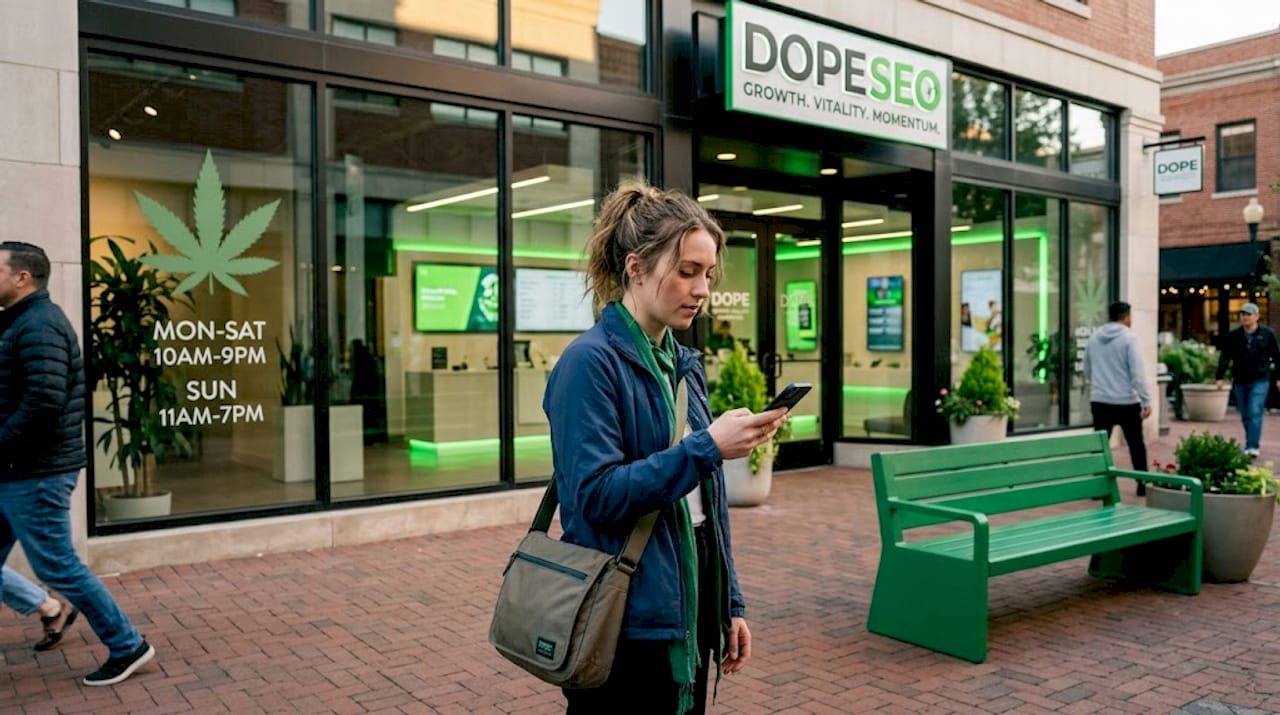
Your Google Business Profile is your digital storefront in local search. An incomplete profile, one with no photos, outdated hours, or the wrong primary category, tells Google you’re not an active, credible business. That translates directly to lower rankings in the Map Pack.
NAP consistency (your Name, Address, and Phone number) matters more than most dispensary owners realize. Even minor formatting differences, like “Suite 200” versus “Ste. 200,” create conflicting signals across directories. Cannabis-specific aggregators like Weedmaps and Leafly count as citations too. Inconsistency there affects your overall local authority.
For a more thorough breakdown, Dopeseo’s guide on local search for dispensaries walks through every ranking factor with cannabis-specific examples.
Cannabis businesses often skip link building entirely because the industry’s restrictions make it feel impossible. Ad platforms reject you, mainstream publications won’t touch cannabis content, and paid links violate Google’s guidelines. So nothing gets done. That’s a top SEO pitfall with real ranking consequences.
Off-page authority, meaning the quality and quantity of sites linking to yours, remains one of Google’s strongest ranking signals. A cannabis site with no inbound links from any credible source will always rank below a competitor who has earned even a handful of relevant, authoritative links.
The path forward isn’t mass outreach to random blogs. It’s building relationships with cannabis trade publications, local media, industry associations, and complementary businesses like dispensary delivery services or hemp wellness brands. Guest contributions, original research, and local press mentions all build the kind of link equity that moves rankings over time.
You can fix every mistake on this list and still fail at SEO if you stop paying attention after implementation. SEO is not a one-time project. It’s an ongoing practice that requires you to monitor what’s working, identify what isn’t, and adjust.
Many cannabis businesses set up Google Analytics and Search Console once and never return to them. Without regular review, you won’t notice when a Google algorithm update drops your traffic, when a new competitor takes your top local ranking, or when a technical regression reintroduces a noindex error after a site update.
A focused approach works well here. A two-week SEO sprint can fix 80% of typical issues on cannabis-related small business websites. Pair that with monthly performance reviews in Search Console and you’ll stay ahead of most competitors who are flying blind.
I’ve worked with enough cannabis businesses to know that the instinct is almost always to start with content. More blog posts, more product descriptions, more pages. But in my experience, that’s exactly backwards.
When you publish new content on a site that still has noindex errors or broken canonical tags, you’re adding weight to a leaking boat. The first two weeks of any cannabis SEO engagement should be spent entirely in Google Search Console, fixing indexing blocks, cleaning up canonicals, and making sure Google can actually see what you’ve built.
The second thing I see consistently is over-reliance on AI-generated pages. Scaling formulaic AI content without human review is one of the fastest ways to trigger a ranking drop. It works right up until it doesn’t, and the recovery is painful. Human oversight and real subject matter expertise on every page are non-negotiable in cannabis SEO.
Finally, be realistic about timelines. SEO for cannabis businesses takes longer than most industries because of platform restrictions, limited link-building options, and market-level competition. Set 90-day milestones, not weekly expectations. Track your progress and stay consistent.
— Max
Dopeseo specializes in exactly the kind of SEO problems this article covers, but for cannabis businesses specifically. Generic SEO agencies don’t understand why your Google Business Profile gets flagged, why certain keywords require compliance-conscious framing, or how to build local authority in a market where your advertising options are limited.
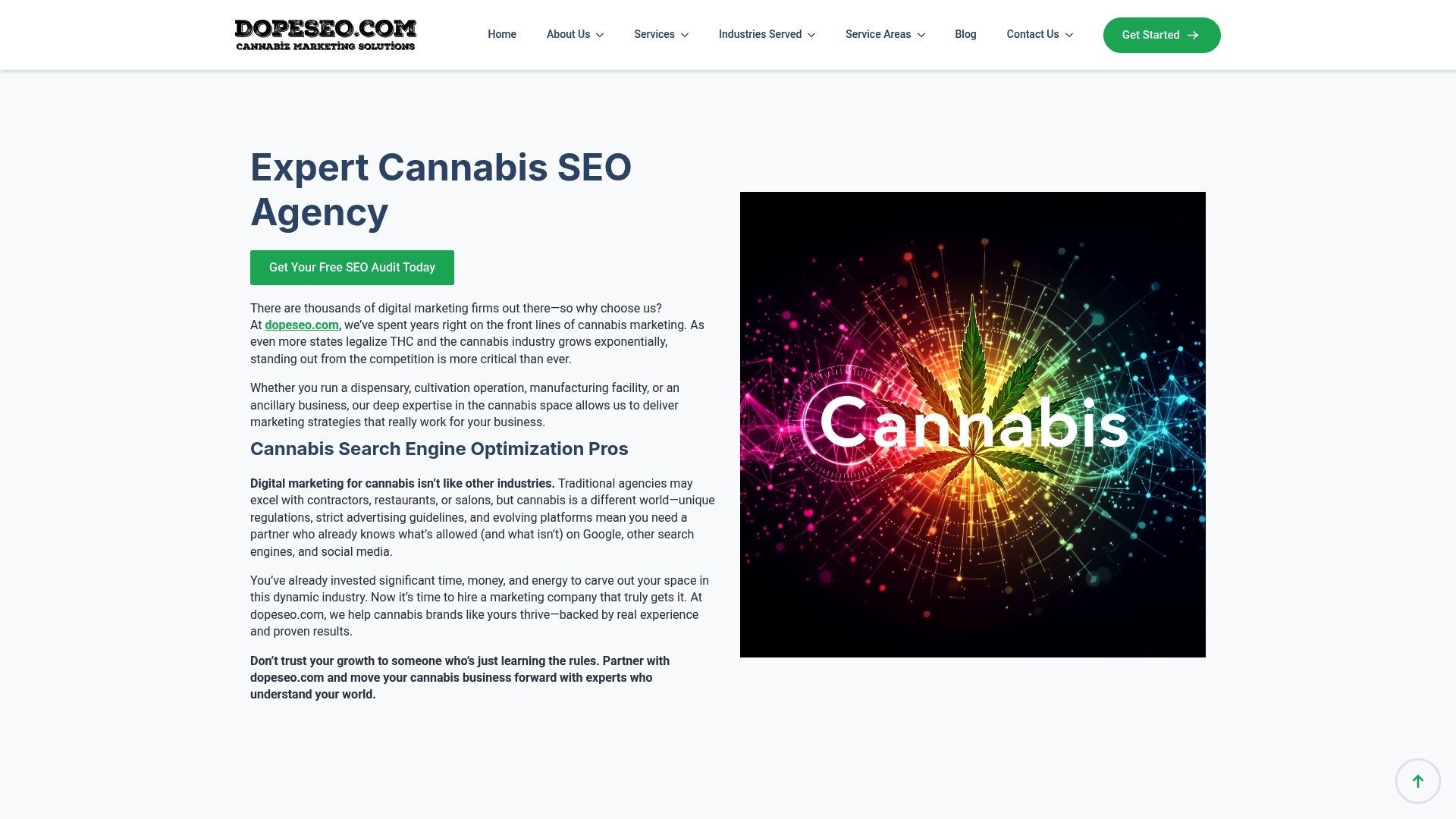
The team at Dopeseo offers technical SEO audits, local search optimization, content strategy, and keyword research built entirely around the cannabis industry. Whether you need to fix a crawling issue that’s been suppressing your rankings for months, or build a local SEO foundation from scratch, the work is grounded in real cannabis market experience.
Start with the cannabis SEO 2026 guide to understand how these foundational principles apply to your business. When you’re ready to move from diagnosis to results, explore the full cannabis SEO strategy Dopeseo builds for dispensaries, cultivators, and cannabis brands looking to grow organically.
The most frequent mistakes include poor keyword targeting, thin or duplicate content, technical indexing errors, missing meta tags, and incomplete Google Business Profiles. Most of these are fixable with a structured audit and prioritized fixes.
Open Google Search Console and navigate to the Indexing report. Look for noindex tags on live pages, robots.txt blocks, and soft 404 errors. Fixing these requires updating your CMS settings or site templates, not just acknowledging the errors in Search Console.
Local SEO determines whether your dispensary appears in Google’s Map Pack when nearby customers search for cannabis. Incomplete Google Business Profiles and inconsistent NAP data across directories are the two leading causes of poor local rankings for cannabis businesses.
Most cannabis businesses see measurable improvements within 90 to 180 days of consistent SEO work. Technical fixes can show results faster, while content and link-building strategies typically take longer to impact rankings.
It can. Scaling formulaic AI pages without human review creates thin, repetitive content that Google’s quality systems flag and penalize. AI content can be part of your workflow, but every page needs human editing, unique details, and real subject matter expertise to perform well.

© 2026 Curious Monkeys Pressing Buttons LLC DBA Cannabiz Marketing Solutions AKA DopeSEO. All rights reserved.