
TL;DR:
- Ancillary cannabis marketing promotes support services for the industry rather than direct cannabis sales, representing a vast and growing market. Successful strategies focus on proof-based B2B credibility, local SEO, and relationship-building while ensuring compliance with complex regulations. Building authority through education and documented results is key to accelerating growth in this specialized sector.
Most cannabis marketing conversations center on dispensaries and growers. But for every licensed operator, there are an estimated 8 to 10 ancillary businesses providing support goods or services. That is a massive ecosystem most marketers overlook. Understanding what is ancillary cannabis marketing means recognizing a distinct category of promotion built around non-plant-touching businesses: the packaging suppliers, technology providers, compliance consultants, and marketing agencies that power the cannabis industry from behind the scenes. This guide breaks down what ancillary cannabis marketing is, how it works, and how to do it well.
| Point | Details |
|---|---|
| Ancillary vs. plant-touching | Ancillary cannabis marketing promotes businesses that support, not sell, cannabis products directly. |
| Massive market opportunity | The cannabis technology market is projected to reach USD 20.01 billion by 2031 at 25.4% CAGR. |
| Compliance still matters | Ancillary businesses avoid licensing costs but still face zoning, advertising, and safety compliance obligations. |
| B2B proof beats hype | Ancillary marketing wins through case studies, compliance rates, and measurable ROI, not brand campaigns. |
| Local SEO is underused | Local search and listings management bypass major platform ad restrictions and build long-term visibility. |
The term trips people up for a simple reason: “ancillary” is not commonly used in most industries, and in cannabis, it carries specific legal and operational weight.
An ancillary cannabis business is any company that provides goods or services to the cannabis industry without directly touching the plant. That includes packaging manufacturers, point-of-sale software companies, security firms, compliance consultants, HR platforms, real estate brokers who specialize in cannabis properties, and yes, marketing agencies like Dopeseo that serve cannabis clients.
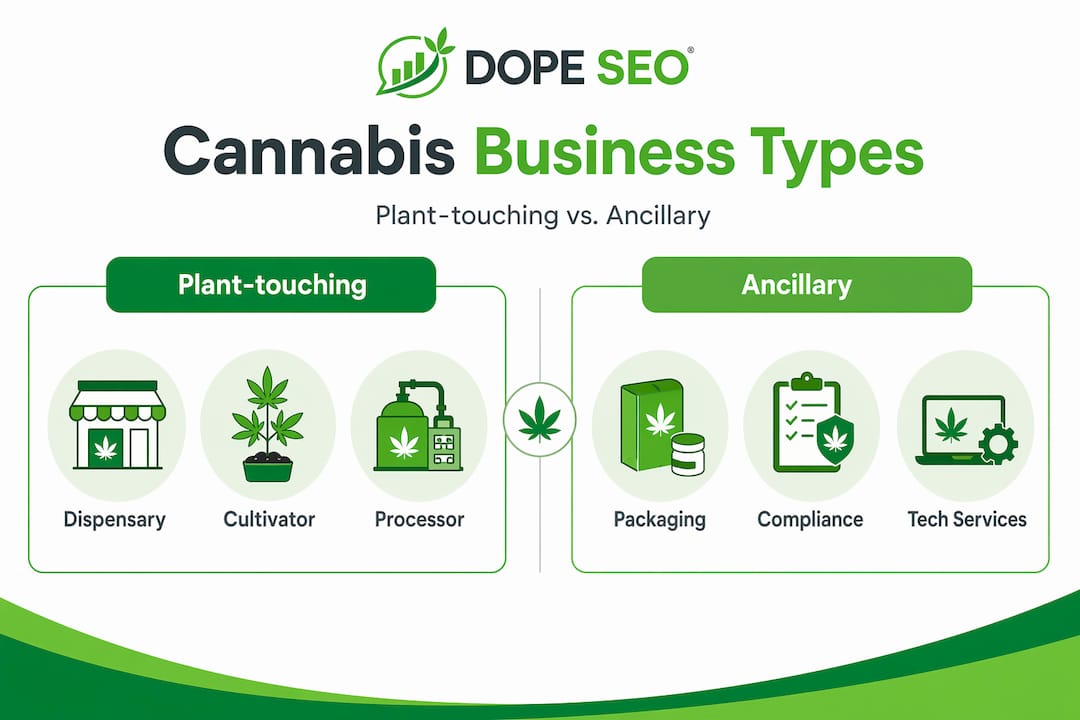
Ancillary cannabis marketing, then, is the practice of promoting those businesses and their services to the broader cannabis industry. You are marketing TO cannabis operators, not marketing cannabis products TO consumers. That shift in direction changes everything: the audience, the messaging, the channels, and the compliance framework.
Here is a quick reference of what falls inside the ancillary category versus what does not:
| Business type | Plant-touching | Ancillary |
|---|---|---|
| Dispensary retail | Yes | No |
| Cannabis cultivator | Yes | No |
| Packaging supplier | No | Yes |
| Seed-to-sale software | No | Yes |
| Cannabis marketing agency | No | Yes |
| Compliance consultant | No | Yes |
| Security and surveillance firm | No | Yes |
The cannabis packaging market alone is expected to grow from USD 2.64 billion in 2023 to USD 13.17 billion by 2030. That is not a niche. That is a full industry vertical with its own supply chains, buyer personas, and marketing needs.
Understanding what are cannabis ancillary services is the foundation. Once you see the full scope of ancillary businesses, the marketing strategy falls into place.
The range of ancillary cannabis services is broader than most people expect. Breaking them into categories helps you understand which marketing approaches apply to each.
Each of these service types requires a different marketing emphasis, but they share a common strategic thread: you are selling B2B, and your buyers are sophisticated operators who need proof, not promises.
Effective ancillary marketing blends several channels. Content marketing through educational blog posts, whitepapers, and webinars builds authority and attracts search traffic without triggering platform ad policies. LinkedIn operates in a far less restricted space for B2B cannabis marketing than Meta or Google, making it a primary outreach tool for ancillary businesses targeting operators and procurement teams.

Community engagement via education builds loyalty more effectively than price promotions under advertising restrictions. Trade shows like MJBizCon give ancillary businesses direct access to decision-makers in a way no paid ad can replicate.
Pro Tip: If you are an ancillary cannabis business marketing to dispensaries, prioritize producing content that solves their operational problems. A guide on avoiding packaging compliance fines will earn you more trust from a procurement manager than a product brochure ever will.
One of the most common misconceptions about ancillary cannabis businesses is that they operate in a compliance-free zone because they do not touch the plant. That is not accurate.
Ancillary businesses avoid licensing costs of plant-touching businesses but still face zoning, safety, and compliance obligations. Local zoning laws can restrict where a cannabis-adjacent business operates. Fire codes and OSHA standards apply to warehouses storing cannabis packaging materials. And when it comes to marketing, the restrictions are real.
Here is where ancillary cannabis marketers most often run into trouble:
“Ancillary businesses must navigate local zoning and drug-adjacent buffers while maintaining compliance with fire codes and OSHA standards despite avoiding cannabis licenses.” — 420 Property
The practical takeaway here is clear: do not assume that being ancillary means being unconstrained. Build a compliance review step into every marketing campaign you launch. If you work with an agency, verify they understand cannabis advertising laws at the federal and state level, not just general digital marketing rules.
Knowing what ancillary cannabis marketing is matters less than knowing how to execute it. Here is what actually moves the needle.
Ancillary cannabis marketers should prioritize B2B proof points like compliance rates and operational efficiencies over product hype, focusing on proof-based case studies. A cannabis technology company that can show a dispensary client reduced inventory shrinkage by 18% will close deals faster than one running awareness ads. Build a library of documented outcomes and make them the center of your sales and marketing process.
Local SEO and listings management are critical channels that bypass advertising restrictions on major platforms. For ancillary businesses with regional focus, appearing in local search results when operators search for “cannabis packaging supplier near me” or “dispensary security systems in Denver” is far more cost-effective than any ad spend. Claim and fully optimize your Google Business Profile, build consistent citations across industry directories, and actively manage your reviews.
Effective ancillary marketing requires a 360-degree industry view that maps parent-subsidiary ties to effectively engage decision-makers. Cannabis multi-state operators (MSOs) have complex procurement structures. The person you need to reach may not be the license holder. Investing in data intelligence tools that map cannabis ownership structures will improve your outreach precision dramatically.
Disciplined merchandising focusing on top SKUs, clear menu architecture, and aligned incentives is a more effective marketing tool than brand campaigns in cannabis retail. Apply this same logic to your own digital storefront. Your website should surface your highest-demand services first, with clear proof points and friction-free conversion paths.
Here is a practical comparison of marketing tactics for ancillary cannabis businesses:
| Marketing tactic | Primary benefit | Compliance consideration |
|---|---|---|
| SEO and content marketing | Long-term organic visibility | Low risk, high credibility |
| LinkedIn B2B outreach | Direct access to decision-makers | Minimal restrictions |
| Trade show presence | In-person relationship building | No digital ad restrictions |
| Case study campaigns | Proof-based credibility | Claims must be documented |
| Local SEO and listings | Bypasses platform ad bans | Standard business practices |
| Email marketing | Nurtures warm leads | CAN-SPAM compliance required |
Pro Tip: When building your content calendar for ancillary cannabis marketing, weight it at least 70% toward educational content that solves operator problems. Reserve the remaining 30% for service showcases and case studies. This ratio builds trust before it asks for the sale.
I have seen a consistent pattern in this space. Ancillary cannabis businesses often default to the same consumer-style marketing playbook used by dispensaries, and it consistently underperforms. The audience is different. You are talking to operators, buyers, and executives who are skeptical by default because they have been oversold by vendors many times before.
What I have found actually works is treating every piece of marketing as a proof delivery vehicle. Instead of “our software is the best,” show a client’s compliance audit score before and after implementation. Instead of a product launch post, publish a breakdown of what changed operationally for a real client.
There is also a persistent misconception that being ancillary means your marketing is free from cannabis-specific constraints. In my experience, the gray area gets grayer the more you lean into cannabis branding. An ancillary business that heavily co-brands with plant-touching operators will inherit their advertising restrictions on most platforms.
The ancillary businesses I have seen grow fastest focus on two things: building authority through education, and executing cannabis campaigns with documented, defensible claims. The ones that struggle are usually chasing awareness before they have established credibility. In B2B cannabis, trust comes before visibility. Get the sequence right and the growth follows.
— Max
If you are building or scaling an ancillary cannabis business, generic marketing advice will not get you far. The platform restrictions, compliance nuances, and B2B buyer psychology in this industry require a specialized approach.
Dopeseo is a digital marketing agency built specifically for cannabis and hemp businesses. The team understands the unique challenges ancillary businesses face, from navigating ad platform restrictions to building search visibility without triggering compliance flags. Dopeseo offers cannabis SEO strategies designed to generate organic traffic that converts, plus content marketing and local search optimization tailored to the ancillary sector. For businesses ready to move beyond guesswork, Dopeseo’s cannabis marketing services provide a clear, compliant path to growing your brand presence in a competitive market.
An ancillary cannabis business provides goods or services to the cannabis industry without directly handling the plant. Examples include packaging suppliers, technology companies, security firms, and marketing agencies.
Ancillary cannabis marketing targets B2B buyers like operators and procurement teams rather than consumers. It focuses on proof-based credibility, case studies, and educational content rather than product promotion.
Yes. While they avoid plant-touching licensing requirements, ancillary businesses still face platform ad restrictions, state-level advertising rules, and FTC compliance obligations for endorsements and claims.
SEO, content marketing, LinkedIn outreach, trade shows, and local search optimization consistently outperform paid advertising for ancillary cannabis businesses due to lower compliance risk and stronger B2B alignment.
Local SEO allows ancillary businesses to appear in relevant search results without relying on paid platforms that restrict cannabis-adjacent advertising, making it a high-value, lower-risk channel for regional operators.

© 2026 Curious Monkeys Pressing Buttons LLC DBA Cannabiz Marketing Solutions AKA DopeSEO. All rights reserved.