
Cannabis cultivators operate in one of the fastest-growing industries in the country, yet most struggle to reach buyers online. Federal illegality drives bans on major ad platforms like Google Ads, Meta, and programmatic networks, cutting off the paid channels most businesses rely on. The result is a marketing landscape where the standard playbook simply does not apply. This article breaks down the specific barriers you face and gives you a clear, actionable path to building real online visibility without risking your license or your accounts.
| Point | Details |
|---|---|
| Legal barriers are unique | Federal restrictions make most digital ad platforms inaccessible to cannabis cultivators. |
| SEO and local search lead | Organic SEO and local strategies are the most reliable ways to grow online visibility. |
| First-party data is critical | Building email and SMS engagement helps overcome ROI and tracking challenges. |
| Education boosts social presence | Educational and lifestyle content minimizes risks and supports compliant social media growth. |
| Compliance ensures longevity | Maintaining flexible, compliant systems keeps your brand resilient as laws and channels change. |
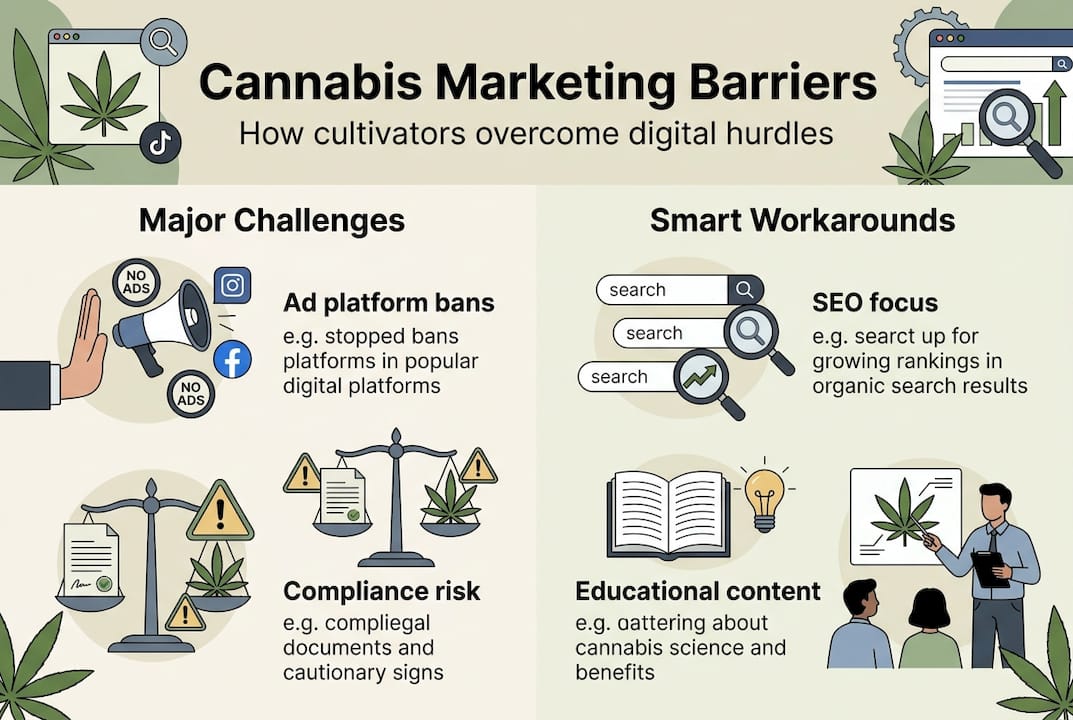
Before you can solve a problem, you need to understand exactly what you are up against. Cannabis digital marketing is not just “harder” than other industries. It operates under a completely different set of rules.
Here are the core barriers cultivators face:
“The primary digital marketing challenge for cannabis cultivators is federal illegality, which leads to bans on major platforms and forces brands to find alternative paths to visibility.”
| Challenge | Impact on cultivators | Workaround |
|---|---|---|
| Ad platform bans | No paid reach on Google or Meta | SEO, content marketing |
| Social media removals | Loss of audience overnight | Education-first content strategy |
| Banking restrictions | Poor ROI tracking | First-party data programs |
| B2B digital outreach | Hard to reach licensed buyers | Industry directories, email |
| State law variations | Campaigns fail compliance audits | Jurisdiction-specific content |
Understanding these digital ad campaign challenges is the first step. The second step is knowing what actually works instead.
Paid advertising is the default growth lever for most businesses. For cannabis cultivators, it is largely unavailable. Even when workarounds exist, the risks are significant: account bans, wasted spend, and potential legal exposure.
Overcoming advertising bans requires a shift in mindset. Instead of chasing paid reach, you build organic authority that compounds over time.
| Channel | Compliance risk | Long-term value | Cost over time |
|---|---|---|---|
| Google Ads (cannabis) | Very high | Low (account bans) | High with no return |
| Meta Ads (cannabis) | Very high | Low (account bans) | High with no return |
| SEO and content | Low | Very high | Decreases over time |
| Local SEO | Low | High | Moderate |
| Email and SMS | Low | High | Low |
| CTV and DOOH | Moderate | Moderate | Moderate |
70% of cannabis marketers now prioritize SEO over paid ads because of platform restrictions. Local SEO is especially critical for cultivators targeting regional dispensaries and processors.
Pro Tip: SEO content builds compounding returns. A well-optimized article or location page keeps driving traffic for years. A paid ad stops the moment you stop paying. For cultivators with tight margins, that difference matters enormously.
The most effective organic alternatives include SEO for cannabis brands, educational content marketing, partnerships with compliant publishers, and industry directory listings. These channels are not just safer. They are more sustainable.
With paid ads mostly off the table, cannabis marketers are doubling down on organic strategies, especially SEO and local search. And the data backs this up: 70% of cannabis cultivators now see SEO as their most effective marketing channel.
Here is how to build a strong local SEO foundation:
Pro Tip: Use structured data markup (schema) on your location pages and add geo-targeted keywords like “cannabis cultivator in [city]” to your title tags and headers. This helps search engines understand exactly who you serve and where, which improves your visibility in local map results.
Common SEO pitfalls unique to cannabis include using non-compliant claims on product pages, building backlinks from low-quality or unrelated sites, and ignoring SEO compliance strategies that protect your rankings long-term. Staying current with 2026 cannabis SEO trends gives you a real competitive edge.
For cultivators specifically, local SEO for cultivators focuses on reaching licensed buyers in your region, not just end consumers. That distinction shapes your keyword strategy and content approach.

Social media is a minefield for cannabis brands. 80% of cannabis business pages are removed by Facebook within their first year. Instagram and TikTok enforce similar restrictions, often without warning.
The solution is not to avoid social media. It is to use it differently.
“Brands that lead with education, transparency, and community building consistently outlast those that push direct product promotion on social platforms.”
Content types that work without triggering removal:
For B2B presence, LinkedIn is underused by cultivators and offers far less content restriction than Instagram or Facebook. For B2C brand awareness, Instagram and YouTube work well when content stays educational.
Consistency matters more than volume. Posting three times a week with compliant, valuable content beats daily posts that risk removal. Always review platform community guidelines before publishing, and understand cannabis social media strategies that keep your accounts safe. Social activity also supports your broader SEO efforts, as covered in using social media for SEO. Be aware of shadowbanning risks that can quietly suppress your reach even when your account stays active.
Here is a sobering reality: 65% of consumers can name three or fewer cannabis brands. In a market with thousands of cultivators, most brands are invisible to buyers.
Building recall requires more than a logo and a website. It requires a consistent story told across multiple channels.
Effective brand differentiation tactics for cultivators:
Strong visual identity ties all of this together. Your brand colors, photography style, and tone of voice should be immediately recognizable across every touchpoint. The 2026 cannabis SEO guide covers how brand signals interact with search rankings, and winning consumer trust outlines the specific credibility markers that move buyers from awareness to action.
Differentiating your brand is only effective when you can measure and nurture the relationships you are building. For cannabis cultivators, that is harder than it sounds.
85% of cannabis transactions are cash-based, and banking restrictions limit access to standard analytics and payment tracking tools. This makes traditional ROI measurement unreliable.
First-party data programs solve this problem directly.
| Tactic | Compliance level | Effectiveness | Cost |
|---|---|---|---|
| Email marketing | High | High | Low |
| SMS programs | High | Very high | Low to moderate |
| Loyalty programs | High | High | Moderate |
| CRM integration | High | Very high | Moderate to high |
Here is how to launch a basic first-party data program:
These tools give you direct communication channels that no platform can take away. They also feed into your broader tracking SEO ROI efforts by showing which content types drive the most qualified leads.
With ROI and first-party data in hand, the final building block for sustainable growth is anticipating regulatory shifts and staying ahead of them.
State-by-state variations mean a campaign that is fully compliant in one market can trigger fines or license loss in another. Multi-state operators face this risk constantly and must audit every campaign against each jurisdiction’s rules.
Federal rescheduling discussions are ongoing. Schedule III momentum may eventually unlock new advertising channels, but it will not eliminate state-level variations. Build compliant systems now so you are ready to scale when the landscape shifts.
Compliance must-dos for cannabis cultivators:
Proactive compliance is not just risk management. It is a brand asset. Dispensaries and processors want to work with cultivators who operate cleanly. Demonstrating that through your marketing builds trust before the first conversation. Review your SEO compliance approach regularly to make sure your organic strategy stays protected as rules evolve.
Every strategy in this guide works. But implementing SEO, local search, compliance audits, first-party data programs, and social media simultaneously is a significant lift for any cultivation operation.
At Dope SEO, we specialize in exactly this. We work exclusively with cannabis and hemp businesses, which means we understand the regulatory nuances, platform restrictions, and local market dynamics that generalist agencies miss. Our cannabis SEO strategy services are built for cultivators who want sustainable, compliant growth. We also offer local search optimization and a full cannabis local search guide to help you dominate your regional market. If you are ready to stop guessing and start growing, let’s talk.
SEO, local search, content marketing, and first-party email or SMS programs are the most effective and compliant channels available. 70% of cannabis marketers prioritize SEO specifically because paid platforms remain largely off-limits.
Focus your content on education, behind-the-scenes storytelling, and community topics rather than direct product promotion. 80% of cannabis pages removed by Facebook in their first year were promoting products directly.
Mainstream platforms generally prohibit cannabis ads. Cultivators can use compliant organic tactics and select alternative channels like CTV and DOOH, which offer paid reach without the ban risk of Google or Meta.
Heavy cash usage and banking limits create significant tracking gaps. 85% cash transactions make standard analytics unreliable, so first-party tools like email, SMS, and loyalty programs become your most dependable ROI measurement sources.

© 2026 Curious Monkeys Pressing Buttons LLC DBA Cannabiz Marketing Solutions AKA DopeSEO. All rights reserved.