
TL;DR:
- Domain authority (DA) is a Moz metric used for benchmarking, not a direct Google ranking factor in cannabis SEO. Relevancy, content depth, and toxic link management are more crucial for improving rankings than solely chasing DA. Building topical authority through quality backlinks and strategic content ultimately influences search visibility and trust.
If you run a cannabis business and have spent any time researching SEO, you have probably heard about domain authority and assumed it directly controls your Google rankings. That assumption is one of the most common mistakes cannabis entrepreneurs make. Understanding what is domain authority in cannabis SEO means looking past the score itself and grasping what it actually measures, where it falls short, and how to use it as one part of a larger strategy. This article breaks all of that down clearly, with practical guidance built specifically for the cannabis industry.
| Point | Details |
|---|---|
| DA is not a Google ranking factor | Domain Authority is a Moz metric for benchmarking, not a signal Google uses to rank your site. |
| Topical relevance beats raw DA | In cannabis SEO, a link from a relevant cannabis site often outweighs a link from a high-DA unrelated domain. |
| DA growth takes real time | Reaching a DR of 20 takes 3 to 6 months; climbing to DR 60 can take 12 to 36 months of consistent effort. |
| Toxic links damage trust | Regular backlink audits are non-negotiable for cannabis sites operating under regulatory scrutiny. |
| Use DA for benchmarking only | Pair DA data with keyword rankings, content quality, and competitor analysis for meaningful SEO decisions. |
Domain Authority, or DA, is a proprietary Moz metric that predicts a website’s potential to rank in search results relative to other sites. It scores websites on a scale from 1 to 100, and the scale is logarithmic. That means moving from a score of 20 to 30 is considerably easier than moving from 60 to 70. As context, only three websites globally have achieved a DA of 100, while hundreds of millions of sites score below DA 10.
Moz calculates DA by analyzing a domain’s backlink profile, the quality and trustworthiness of those links, and the site’s historical ranking patterns across search results. It also weighs Page Authority (PA), which evaluates ranking potential at the individual page level rather than the whole domain. For link building, consider both DA and PA when identifying targets. A high-DA domain with lower-PA pages on a relevant topic can represent a strong outreach opportunity.
Here is what DA measures and what it does not:
Pro Tip: Never use DA as your only SEO decision-making tool. A cannabis site with a DA of 25 but deep topical coverage on specific strains or local compliance topics can outrank a DA 50 competitor that covers topics broadly and shallowly.
This distinction matters enormously for cannabis marketers. The importance of domain authority lies in its usefulness as a benchmarking tool, not as a direct ranking lever.
Cannabis websites face link acquisition challenges that most industries do not. Many mainstream publications decline to link to cannabis brands for legal or policy reasons. Ad networks restrict promotion. Payment processors add friction. These barriers make the importance of domain authority feel more pronounced because earning quality backlinks in this space is genuinely harder.

That difficulty, however, does not mean you should chase any link available. Research confirms that cannabis-relevant content clusters pass more authority than links from high-DA but unrelated domains. A backlink from a cannabis lifestyle publication or a hemp industry news outlet carries more real SEO weight for your site than a random link from an unrelated tech blog with a DA of 60.
Here is what specifically affects domain authority in cannabis SEO:
One cannabis dispensary can have a lower DA than a competitor yet outrank them consistently because its content covers local compliance, product education, and consumer FAQs in a way that builds genuine topical trust. Smaller cannabis sites can outrank larger domains through topical depth and entity trust, which is worth more than raw domain-level authority.
This section trips up a lot of cannabis marketers. DA does not equal Google’s ranking algorithm. Google uses its own internal metric called “siteAuthority,” which focuses on E-E-A-T (Experience, Expertise, Authoritativeness, Trustworthiness) and topical relevance rather than backlink volume alone. Google’s system values backlinks based on the organic traffic of the linking page and how topically relevant that page is to the content being linked.
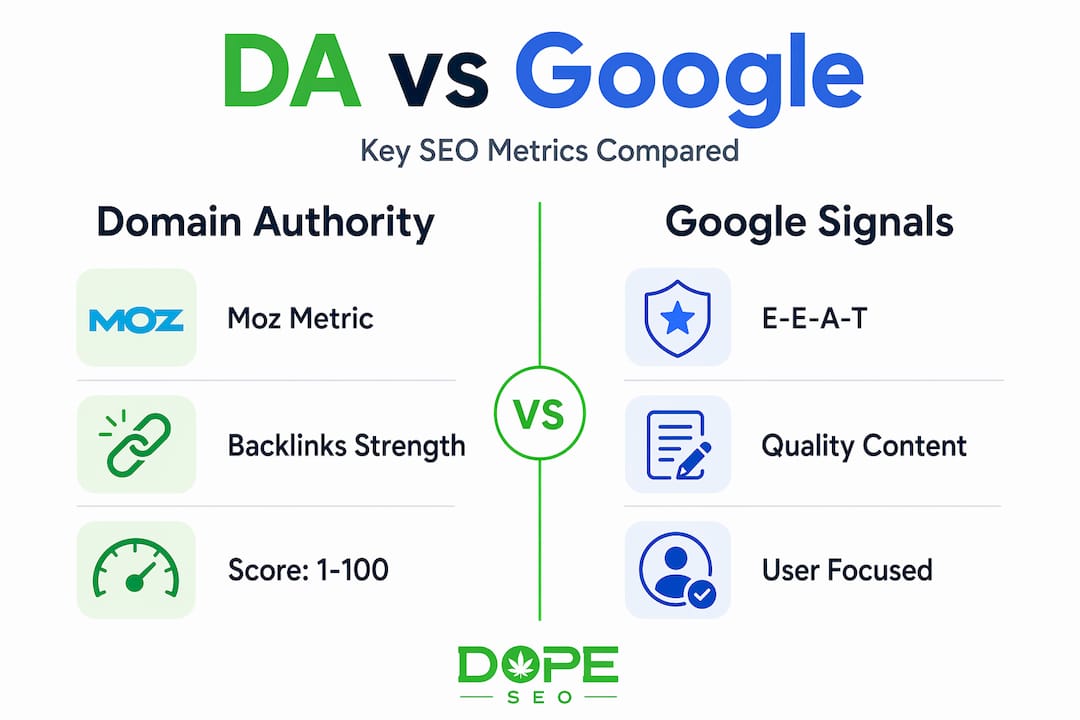
When you compare the tools available for measuring domain authority and similar scores, the differences matter for your strategy:
| Metric | Provider | What It Measures | Update Frequency | Best Use Case |
|---|---|---|---|---|
| Domain Authority (DA) | Moz | Backlinks, ranking signals, site trust | Monthly | Competitive benchmarking, link prospecting |
| Domain Rating (DR) | Ahrefs | Backlink profile strength only | Frequent (more volatile) | Quick backlink comparison |
| Google siteAuthority | Google (internal) | E-E-A-T, topical depth, traffic signals | Continuous | Actual rankings (not publicly visible) |
Ahrefs DR is simpler than Moz DA: it measures backlink profile strength without incorporating site signals or ranking pattern analysis. DR updates frequently, which makes it more volatile. DA updates monthly and reflects a more stable picture. You should not compare DA and DR scores directly because they measure different things. For a deeper breakdown of which metric fits your campaigns best, this Moz DA vs Ahrefs DR comparison is worth reviewing.
The practical takeaway is this: DA is correlated with Google rankings but does not cause them. The trust signals and content quality behind a high DA score are what actually influence where your pages appear. DA is a useful proxy for those signals, not the signal itself.
The most direct path to improving domain authority for a cannabis site runs through earning high-quality, relevant backlinks consistently over time. There are no shortcuts that hold up to scrutiny, especially in a regulated industry where Google already watches cannabis-related sites carefully.
Here is a step-by-step approach that works in the cannabis sector:
Pro Tip: When pitching cannabis media for backlinks, lead with data your own dispensary or grow operation has collected. Journalists and editors are far more likely to cite a proprietary statistic than a repackaged industry opinion.
Knowing your DA score is only useful if you know how to act on it. Here is how cannabis marketers should integrate DA into their broader SEO strategy:
Cannabis digital marketing trends in 2026 show that dispensaries combining strong local SEO with steady authority building are outperforming those that focus on either strategy alone. DA is one piece of that picture.
I have worked with cannabis businesses that were borderline obsessed with their DA score. They spent months chasing backlinks from any site willing to publish them, celebrated every point gained, and were confused when their rankings did not follow. That approach is outdated and, in cannabis, genuinely risky.
What I have seen work is treating DA as a report card, not a goal. The real work is building topical authority through content that covers your niche thoroughly, earning backlinks that are editorially placed in relevant contexts, and cleaning up your link profile before it becomes a liability. Those three things will raise your DA as a side effect.
The other shift I am watching closely is AI search. Platforms like Google’s AI Overviews are prioritizing brand trust and topical expertise signals that DA simply does not capture. A cannabis brand that publishes consistent, well-researched content and earns recognition from industry publications will gain visibility in AI-generated results whether or not their DA score is impressive. Cannabis marketers who shift focus toward E-E-A-T compliance and content depth will be better positioned than those still chasing a number.
The most expensive mistake I see is buying backlinks. In the cannabis space, bought links are often traced back to link farms, and Google scrutinizes cannabis sites more carefully than most. The short-term DA bump is not worth the penalty risk.
— Max
If reading through all of this feels like a lot to manage on top of running your actual cannabis business, that is exactly why Dopeseo exists. Building domain authority in a regulated, high-scrutiny industry like cannabis requires the kind of specialized knowledge that generic SEO agencies do not have.
Dopeseo works specifically with cannabis dispensaries, cultivators, and ancillary businesses to build authority the right way. That means backlink audits that catch toxic links before they cost you rankings, digital PR strategies that earn placements in cannabis and wellness publications, and content built to attract natural links over time. The team understands the regulatory restrictions, platform limitations, and competitive pressures that make cannabis SEO different from every other niche. If you are ready to move beyond chasing a DA score and build an SEO foundation that actually produces rankings and revenue, explore Dopeseo’s cannabis SEO best practices and see what a purpose-built strategy looks like for your business.
Domain Authority is a Moz metric scored from 1 to 100 that predicts a website’s relative ability to rank in search results. In cannabis SEO, it serves as a benchmarking tool for comparing your site against competitors, not a direct Google ranking signal.
No. DA correlates with rankings but does not cause them. Google uses its own internal signals focused on E-E-A-T, topical relevance, and content quality, none of which DA directly measures.
Reaching a DR of 20 typically takes 3 to 6 months of consistent link building. Climbing from DR 20 to 40 takes 6 to 18 months. Expect a multi-year commitment if your goal is a DA above 50.
The quality and topical relevance of your backlinks matter most. Links from cannabis-relevant publications pass more authority than high-DA links from unrelated domains. Regular toxic link audits also protect your score from declining.
Use DA primarily for competitor benchmarking and link prospecting. Pair it with keyword ranking data and content quality analysis rather than treating the score as the end goal of your SEO program.

© 2026 Curious Monkeys Pressing Buttons LLC DBA Cannabiz Marketing Solutions AKA DopeSEO. All rights reserved.