
TL;DR:
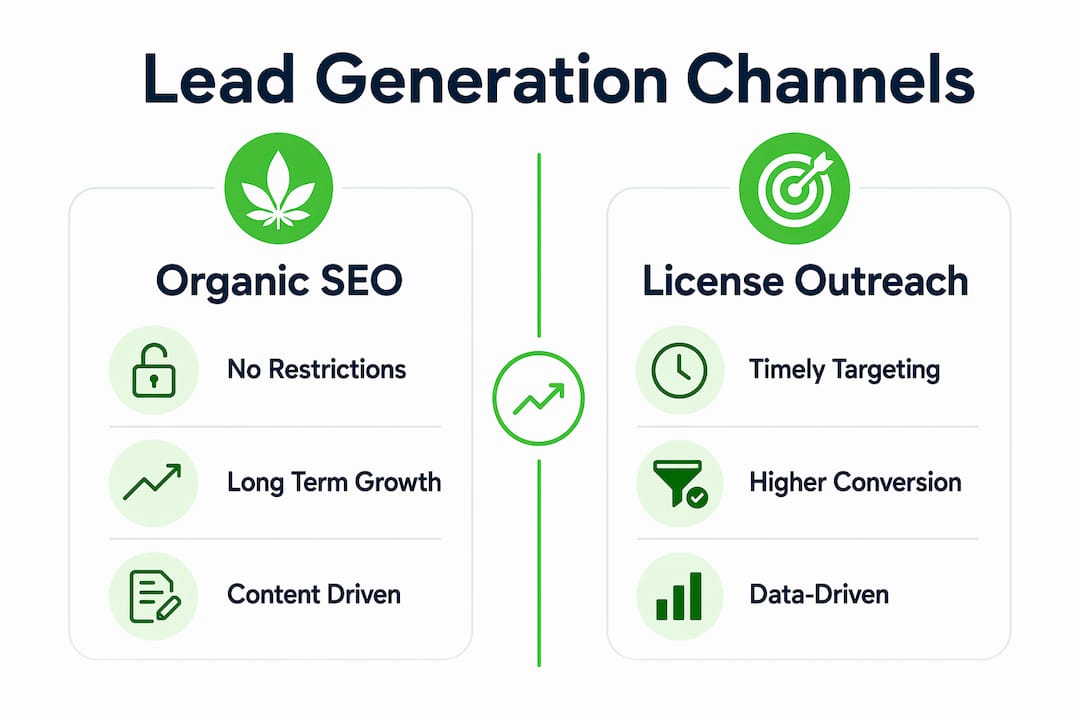
- Ancillary cannabis businesses rely on organic marketing and license data outreach due to restrictions on paid advertising. Timely targeting of operators during license issuance or expansion signals yields higher conversion rates. Building a strong organic presence and tailored messaging helps generate sustainable leads in a highly regulated sector.
Effective lead generation for ancillary cannabis businesses is the process of attracting and converting cannabis industry buyers through specialized outreach, organic marketing, and data-driven targeting tailored to a heavily regulated sector. Ancillary businesses, meaning companies that serve the cannabis industry without touching the plant, face a distinct set of marketing challenges that general B2B playbooks simply do not address. Paid advertising on Google and Meta is largely off-limits. Buyer cycles are longer. And the most reliable signals for timing your outreach come from regulatory data, not CRM guesswork. This guide covers the specific tactics that work: license trigger outreach, SEO, LinkedIn, email sequencing, and trade show integration.
Ancillary cannabis businesses operate in a category with real financial weight. Ancillary services command valuation multiples of 6–10x revenue, compared to just 2–4x for plant-touching operators. That premium reflects the cleaner margins and lower regulatory exposure these businesses carry. It also means competition for cannabis operator clients is fierce, and generic B2B outreach falls flat.

The core challenge is channel restriction. Google and Meta restrict paid cannabis promotion, which forces ancillary businesses to rely on organic and owned media for lead generation. That is not a disadvantage if you plan for it. It is a structural advantage for businesses willing to invest in SEO and content before their competitors do.
Several factors make cannabis B2B lead generation distinct from other industries:
Understanding these dynamics is the starting point for any cannabis business marketing strategy that actually produces results.
Cannabis license data is the most underused asset in ancillary B2B prospecting. License records include type, issue date, expiration, status, and legal entity information. Cross-referencing licenses across states reveals operational scale and the regulatory frameworks each operator must navigate. That data lets you build a prospect profile before you ever send a message.
The real power comes from timing. Not all operators are equally ready to buy. The ones most likely to convert are those in active transition. Here is how to build a trigger-based outreach system:
Outreach within 60–90 days of license issuance is far more effective than cold outreach to established operators. Newly licensed operators are in setup or transition mode, which means they are actively evaluating vendors rather than defending existing relationships. That window closes fast once they have locked in their supplier stack.
Pro Tip: Build a simple license monitoring spreadsheet segmented by state, license type, and issue date. Set a 30-day review cadence to catch new issuances before your competitors do. Even a manual process beats no process.
Messaging should reflect the operator’s stage. A new single-location dispensary needs onboarding support and compliance guidance. A multi-state operator expanding into a new market needs scalability and integration. Precise message customization based on license status is what separates a response from a delete.
SEO is the strongest long-term channel available to ancillary cannabis businesses, precisely because it operates without platform restrictions. SEO functions without the ad bans that limit paid acquisition, driving sustainable organic traffic from high-intent buyers who are already searching for what you sell. The catch is patience. SEO typically requires 6–12 months to deliver meaningful, compounding traffic results. That timeline rewards businesses that start early and penalizes those that wait for a slow quarter to act.
Here is how organic channels stack up for ancillary cannabis lead generation:
| Channel | Strengths | Limitations |
|---|---|---|
| Organic SEO | No platform restrictions, compounds over time, captures high-intent buyers | Requires 6–12 months to build; needs consistent content investment |
| Reliable B2B reach, operator-relevant content, direct messaging | Slower audience growth; requires consistent posting cadence | |
| Live product catalog | Always-on sales channel, builds buyer trust, integrates with compliance systems | Requires ongoing updates and ERP integration |
| Email outreach | Direct, segmentable, measurable | Effectiveness depends on list quality and message relevance |
Content is the engine behind SEO for ancillary businesses. B2B cannabis buyers consume three to five pieces of content before engaging a vendor. That means your blog posts, whitepapers, and technical guides are not just marketing collateral. They are the actual sales process for a significant portion of your pipeline.
LinkedIn deserves specific attention. LinkedIn is the most reliable social channel for B2B cannabis brand credibility. Posting operator-relevant content, compliance updates, and product education builds an audience of exactly the buyers you want to reach. Direct promotions on LinkedIn underperform. Educational content that positions you as an expert consistently outperforms.
A live, searchable product catalog connected to your inventory and compliance systems creates an always-on sales channel. Buyers who find your catalog through organic search can evaluate your products, check compliance documentation, and initiate contact without a sales call. That is a lead generation asset that works around the clock.
Pro Tip: Publish one technical whitepaper per quarter targeting a specific operator pain point, such as state-by-state compliance requirements or packaging regulations. Whitepapers attract high-intent buyers and generate backlinks from cannabis industry publications, both of which accelerate your SEO results. For a deeper look at ancillary cannabis SEO tactics, Dopeseo has a full 2026 guide worth reading.
Email and trade shows work best as a combined system, not as separate tactics. Email builds the relationship before and after an event. Trade shows create the in-person moment that converts a warm prospect into an active account.
Effective email campaigns for ancillary cannabis businesses share several characteristics:
Trade shows serve a function email cannot replicate: they compress trust-building into a single conversation. An operator who meets your team at a booth and handles your product leaves with a different level of confidence than one who only reads your emails. The goal is to use email to warm prospects before the show and to maintain momentum after it.
Technical content and compliance whitepapers serve double duty here. They give your email sequences something valuable to share, and they give trade show attendees a reason to visit your booth and take something home.
Most lead generation failures in ancillary cannabis come down to a handful of repeatable mistakes. Recognizing them early saves significant budget and time.
Ancillary cannabis businesses must also maintain clear separation between their operations and any plant-touching entities they serve. IRS scrutiny on intercompany transactions can jeopardize tax deductions if those links appear inextricable. Keep your marketing and operational structures clean.
Effective lead generation for ancillary cannabis requires timing outreach to license trigger events, investing in organic SEO before you need it, and matching every message to the operator’s current business stage.
| Point | Details |
|---|---|
| License data drives timing | Outreach within 60–90 days of license issuance converts far better than cold outreach to established operators. |
| SEO compounds over time | Organic search requires 6–12 months to build but delivers restriction-free, high-intent traffic that paid channels cannot match. |
| Content builds the pipeline | B2B cannabis buyers consume three to five pieces of content before contacting a vendor, making whitepapers and blog posts core sales tools. |
| Segmentation determines relevance | Messaging must match license type and operator stage; generic pitches consistently underperform targeted ones. |
| Email and trade shows work together | Trigger-based email sequences before and after events accelerate trust-building and shorten the sales cycle. |
The businesses I see winning in ancillary cannabis are not the ones with the biggest ad budgets. They are the ones that built their organic infrastructure early and got serious about license data before it became common practice.
The mistake I see most often is treating SEO as a backup plan. Operators who come to Dopeseo after exhausting paid channels are always starting from zero on organic. They have no content authority, no backlink profile, and no ranking history. That gap takes time to close. The businesses that treated SEO as their primary channel from day one are the ones generating consistent inbound leads now, without paying per click.
License trigger data is the other area where most ancillary businesses leave money on the table. The information is largely public. The tools to monitor it exist. But most teams are still doing cold outreach to established operators who have no reason to switch vendors. Shifting even 30% of your outreach effort toward newly licensed or recently expanded operators changes your conversion rate materially.
LinkedIn is underrated for this space. I have watched ancillary businesses build genuine pipeline by posting compliance updates, product education, and operator case studies consistently over 12 months. No paid promotion. Just consistent, relevant content that attracts the exact buyers they want. The role of social media in cannabis SEO is real, and LinkedIn is where B2B cannabis buyers actually pay attention.
The regulatory environment will keep shifting. Businesses with strong organic presence and data-driven outreach systems will adapt faster than those dependent on paid channels that can disappear overnight.
— Max
Ancillary cannabis businesses need a marketing partner who understands the channel restrictions, the buyer behavior, and the regulatory context that make this industry different from every other B2B market.
Dopeseo specializes in cannabis SEO and digital marketing for ancillary businesses, dispensaries, cultivators, and manufacturers. The team builds organic search presence, content programs, and local visibility strategies designed specifically for the cannabis industry. If you are ready to build a lead generation system that does not depend on ad platforms that can ban you tomorrow, Dopeseo is the right partner to start with.
Lead generation for ancillary cannabis is the process of attracting and converting cannabis industry operators as buyers using organic marketing, license data outreach, and content strategies tailored to the regulated cannabis sector. It differs from standard B2B lead generation because paid advertising channels are largely restricted.
Google and Meta restrict cannabis-related paid promotion, which means ancillary businesses must rely on organic SEO, LinkedIn, email outreach, and trade shows to generate leads. Violating these policies risks account suspension and wasted spend.
License data reveals which operators are newly licensed or recently expanded, signaling they are actively buying. Outreach within 60–90 days of license issuance is significantly more effective than cold outreach to established operators with locked-in vendor relationships.
SEO typically requires 6–12 months to deliver meaningful, compounding organic traffic. The investment needs to start well before you feel pipeline pressure, because there is no shortcut to building search authority in a competitive niche.
Technical whitepapers, compliance guides, and operator case studies perform best because B2B cannabis buyers consume three to five pieces of content before contacting a vendor. Educational content on LinkedIn also builds brand credibility with the exact operators you want to reach.

© 2026 Curious Monkeys Pressing Buttons LLC DBA Cannabiz Marketing Solutions AKA DopeSEO. All rights reserved.