
Every dispensary owner has felt that frustration when a customer says they could not find your business at the top of Google search results. Competing for attention in cities like Denver or Los Angeles depends on much more than having the best products or a convenient location. Understanding local search ranking factors—proximity, relevance, and prominence—gives you control over whether your dispensary gets discovered by nearby cannabis customers or buried beneath competitors. This guide explains why Google chooses certain businesses for the top spots and what you can do to earn one of them.
| Point | Details |
|---|---|
| Local Search Factors | Google ranks cannabis dispensaries based on proximity, relevance, and prominence, influencing their visibility in local searches. |
| Google Business Profile Importance | A fully optimized Google Business Profile is crucial for local search rankings, requiring accuracy and regular updates to attract customers. |
| Citations and Directories | Consistent citations across high-authority directories enhance legitimacy and improve local rankings; focus on quality over quantity. |
| Compliance Matters | Dispensaries must navigate strict regulations in their online presence, ensuring that all marketing content complies with local laws to avoid penalties. |
Local search ranking factors are the specific criteria Google uses to determine which cannabis dispensaries appear at the top of search results when someone in your area searches for cannabis products or services. These factors work together to answer a fundamental question: should this dispensary show up for this local search? The answer isn’t random. Google’s algorithm evaluates hundreds of signals, organized into distinct groups, to decide which dispensaries deserve the most visibility.
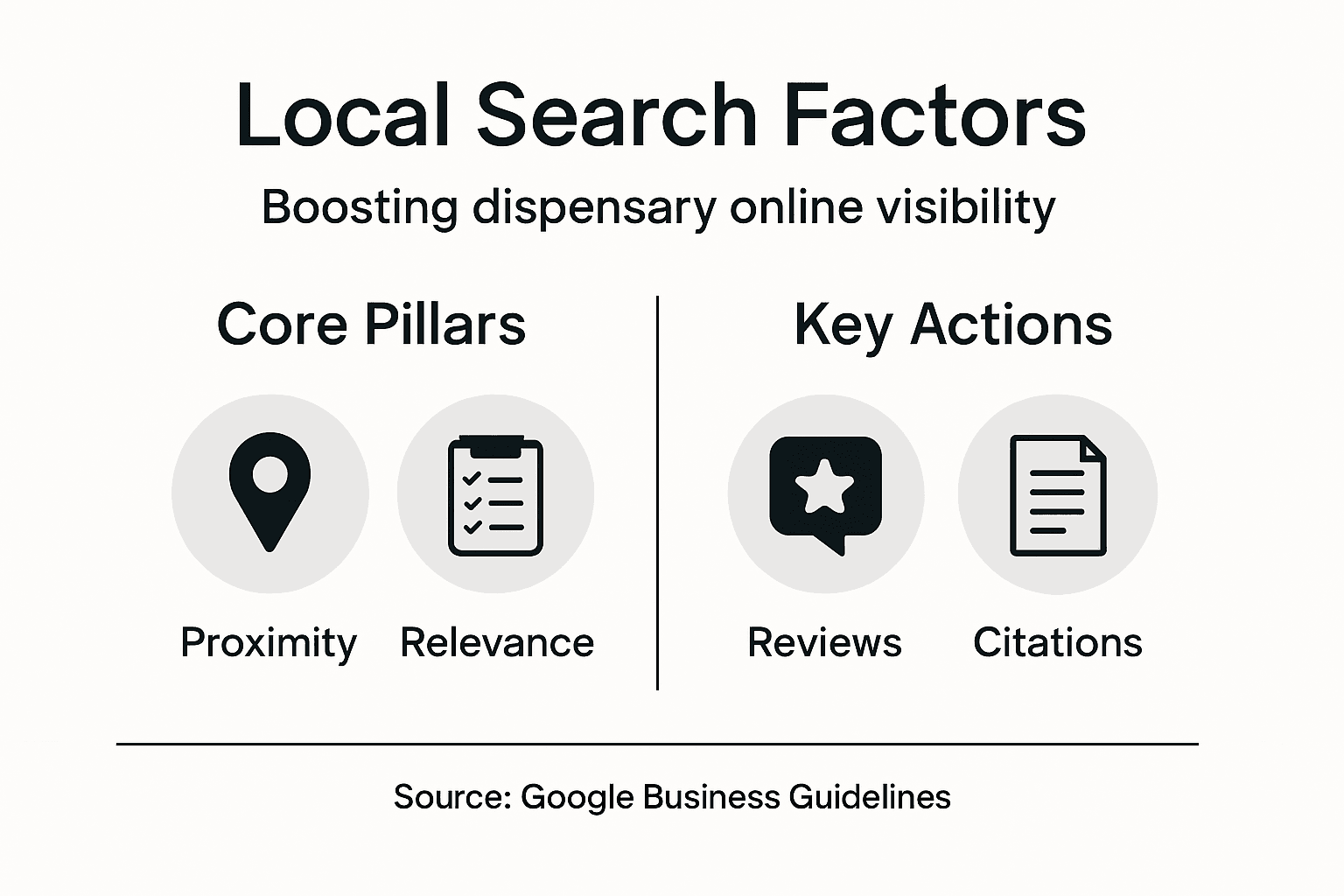
At the core, Google’s local search algorithm relies on three fundamental pillars: proximity, relevance, and prominence. Proximity measures how close your dispensary is to the person searching. A customer searching for “cannabis near me” in Denver will see dispensaries in Denver before those in Boulder. Relevance determines how well your business matches what someone is actually looking for. If you’ve optimized your Google Business Profile for specific product categories like edibles or concentrates, you’ll rank better when people search for those exact products. Prominence reflects how well-known and trusted your dispensary is, which Google measures through customer reviews, backlinks from reputable websites, and mentions across the internet.
These three pillars break down into more specific ranking signals. Google Business Profile signals include your business hours, location accuracy, photos, and the completeness of your profile information. On-page signals cover the content on your website, including keywords, headings, and internal structure. Reviews matter enormously: the quantity, recency, and quality of customer feedback directly influence rankings. Citations (mentions of your business name, address, and phone number on other websites) build authority. Backlinks from cannabis industry publications, local directories, or educational sites strengthen your prominence. Behavioral signals track how customers interact with your listing and website, while personalization factors account for the individual searcher’s location, search history, and preferences.
Understanding these factors matters because it shifts your mindset from hoping for visibility to strategically earning it. You’re not optimizing for Google. You’re optimizing for your actual customers by making sure Google can clearly understand who you are, where you are, and why you deserve their attention. Every review you encourage, every accurate detail you add to your profile, and every quality page you publish on your website sends signals to Google that you’re a legitimate, trustworthy dispensary worth recommending to local customers.
Here’s a breakdown of how key local search ranking signals support dispensary visibility:
| Ranking Signal Type | Example Component | Business Benefit |
|---|---|---|
| Proximity | Dispensary location | Attracts neighborhood traffic |
| Relevance | Accurate categories | Matches products to search intent |
| Prominence | Customer reviews | Builds trust and online reputation |
| Citations | Consistent directory NAP | Increases credibility with Google |
| On-Page SEO & UX | Fast, mobile site | Improves customer engagement |
| Behavioral/Personalization | Search history influence | Delivers tailored search results |
Pro tip: Start by auditing your Google Business Profile completeness today because a fully optimized profile accounts for approximately 20-30% of your local ranking potential and requires minimal ongoing effort.
Your Google Business Profile is your digital storefront. When someone searches for cannabis dispensaries in your area, this profile often appears before your website. If it’s incomplete, inaccurate, or poorly optimized, potential customers move on to competitors who’ve invested the time. The good news: optimizing your Google Business Profile is critical for local search rankings, and most dispensary owners can do this without hiring expensive consultants.

Start with the fundamentals that Google actually cares about. Your business name must match your legal entity exactly. Adding keywords to your business name (like “Denver Cannabis Dispensary” instead of just “Your Dispensary Name”) seems tempting, but Google penalizes this. Focus instead on selecting the correct primary category. This single decision shapes which searches trigger your profile. If you sell flower, edibles, and concentrates, choose the category that represents the majority of your revenue. You can add up to 10 additional categories, so list everything you offer across those secondary slots. Accuracy matters tremendously here because Google uses categories to determine relevance when someone searches for specific product types.
Next, ensure business name, address, phone number, and categories are regularly updated and verified. This consistency signals legitimacy to Google. Any discrepancy between your Google Business Profile, your website, and directory listings creates confusion. If you moved locations or changed your phone number, update immediately across all platforms. Add strategic keywords naturally throughout your business description. Instead of keyword stuffing, write two to three sentences describing your dispensary, what products you offer, and what makes you different. Google reads this and uses it to match your profile with relevant searches.
Photos and posts also influence rankings. Upload high quality images of your storefront, interior, products, and staff. Posts about new strains, special promotions, or educational content keep your profile fresh and give Google signals that your business is active. Encourage customers to leave reviews and respond to every review you receive, whether positive or negative. This engagement tells Google you’re a responsive business worth recommending. The quantity, quality, and recency of reviews directly impact your local search visibility.
Pro tip: Verify your Google Business Profile ownership today and check for duplicate listings under slightly different names, which can split your review authority and confuse local search rankings.
A citation is simply a mention of your dispensary’s name, address, and phone number (NAP) somewhere online. Think of it as a digital voucher for your business. When Google finds your NAP listed consistently across multiple authoritative directories, it treats your dispensary as more legitimate and trustworthy. Citation signals refer to the presence and consistency of a business’s Name, Address, and Phone Number across various online directories, helping establish both trust and authority for local search algorithms. This consistency matters because it tells Google you’re a real, verifiable business worth recommending to local customers.
The directories that matter most are Waze, Apple Maps, Yelp, and industry-specific platforms like Leafly and Weedmaps for cannabis businesses. Local directories like your city’s chamber of commerce, Better Business Bureau, and Google My Business also carry weight. Getting listed on 20 random, low-authority sites does less for you than being listed on 5 high-quality directories. Quality beats quantity here. When you submit your dispensary information to these platforms, make sure your NAP is identical everywhere. A phone number formatted as “(303) 555-0123” on one site and “303.555.0123” on another creates confusion. Google’s systems struggle to recognize these as the same business, which weakens your citation authority. Update your information consistently across all directories whenever you make changes.
The influence of citation signals has shifted over time. While citations remain foundational to local search rankings, they no longer dominate the algorithm like they once did. Local directories contribute to citation signals by providing authoritative mentions of a business’s details, supporting higher local search rankings by reinforcing the business’s prominence and trustworthiness. However, citations alone won’t get you to the top of local results anymore. You need strong reviews, accurate Google Business Profile information, relevant website content, and backlinks working together. Think of citations as table stakes: they’re necessary but not sufficient.
For cannabis dispensaries specifically, getting listed on cannabis-focused directories carries extra weight because those platforms are authoritative within your industry. Weedmaps, Leafly, and similar platforms are where customers actively search for cannabis products. Being present and maintaining accurate information on these sites sends stronger signals to Google than appearing on generic business directories. Don’t neglect these industry-specific platforms.
To help you prioritize, here’s a comparison of high-value directories for cannabis dispensaries:
| Directory Name | Industry Focus | Authority Level |
|---|---|---|
| Google Maps | General business | Highest |
| Weedmaps | Cannabis-specific | Very High |
| Leafly | Cannabis-specific | Very High |
| Yelp | General business | High |
| Apple Maps | General business | High |
| Waze | General business | Medium |
| Chamber of Commerce | Local business | Medium-High |
Pro tip: Conduct a citation audit by searching your dispensary’s name in Google and documenting where it appears online, then prioritize adding your NAP to the 10 highest-authority directories you’re currently missing.
Your website is where the conversation between Google and your customers actually happens. Google doesn’t just look at your Google Business Profile anymore. It crawls your website, reads your content, and evaluates how customers interact with it. On-page SEO factors such as keyword usage in title tags, meta descriptions, and quality content tailored to local intent significantly influence rankings. This means every page on your site should speak to local cannabis customers with specific keywords they actually search for. Instead of generic content like “We sell cannabis,” write pages about “Buy concentrates in Denver” or “Best edibles dispensary near Boulder.”
Your website’s technical foundation matters just as much as the words on it. Mobile-friendliness isn’t optional anymore. Most of your customers search for dispensaries on their phones while driving or browsing between activities. If your website takes five seconds to load or the buttons are too small to tap, they leave. Google tracks this behavior and penalizes slow, clunky websites in local search results. Page speed, easy navigation, clear calls to action, and clean design all signal to Google that your site is worth ranking. When customers land on your site, they should immediately understand your hours, location, products, and how to reach you. Confusion kills conversions.
Optimizing on-page SEO includes ensuring NAP consistency on the site, using relevant local keywords, and providing valuable, user-centric content. Your website footer should display your business name, address, and phone number exactly as they appear on your Google Business Profile and directories. Use keywords naturally throughout your content. Write about the products you sell, the neighborhoods you serve, and the problems customers solve by visiting your dispensary. Answer questions people actually ask: “Do you have delivery?” “What strains are in stock?” “Are you open on Sundays?” When you answer these questions on your website, Google matches your pages to those specific searches.
User experience metrics matter because they reveal customer satisfaction to Google. Low bounce rates, longer time on site, and repeat visitors all signal that your website delivers real value. Customers who spend time reading your content or browsing your product pages are clearly finding what they need. Google rewards this engagement by boosting your visibility in local results. Bad user experience also tanks your rankings. If customers click your local listing and immediately leave because the site is confusing or slow, Google notices and assumes you’re not worth recommending.
Pro tip: Test your website speed using Google PageSpeed Insights and prioritize fixing any issues marked as “poor” because mobile page speed is now a confirmed ranking factor for local search results.
Compliance isn’t just a legal checkbox for cannabis dispensaries. It directly impacts your local search visibility. Unlike restaurants or retail shops, dispensaries operate under strict state and local regulations that affect every aspect of how you present yourself online. One misstep in your Google Business Profile description or a claim that violates local advertising rules can trigger suspension or removal from search results entirely. You cannot afford to treat compliance as an afterthought.
The challenge starts with your business description and service listings. Dispensaries face unique challenges regarding compliance as local regulations impact how they can advertise and present information online. Many states prohibit health claims, require specific disclaimers, or restrict how you describe your products. Some jurisdictions forbid terms like “medical” or “therapeutic” without special licensing. Your dispensary might be prohibited from advertising home delivery in certain regions or offering specific product types online. When you optimize your Google Business Profile, your website, and directory listings, you must use language that complies with your specific jurisdiction’s rules. What works in Colorado may violate Massachusetts regulations. Generic SEO advice doesn’t account for these nuances.
Operating within regulatory restrictions requires dispensaries to be cautious with wording in Google Business Profiles and other listings to meet legal requirements. Review solicitation is particularly tricky. While reviews boost your local rankings significantly, some states restrict how actively you can request them. You cannot offer incentives for positive reviews or pressure customers into leaving them. Your content strategy must balance ranking potential with legal constraints. You cannot make claims about product benefits that lack scientific backing or violate advertising rules. This means your SEO content focuses on what you actually sell (flower strains, product types, brands you carry) rather than medical claims that would boost rankings but violate law.
Work closely with your compliance officer or lawyer when optimizing your online presence. Have them review your Google Business Profile description, website copy, and any marketing claims before you publish. This prevents costly suspensions and maintains your search visibility long term. Cannabis dispensaries that ignore compliance end up losing rankings, visibility, and ultimately customers. Those that build compliance into their SEO strategy from day one maintain consistent, sustainable growth. The extra effort upfront pays dividends.
Pro tip: Before making any changes to your Google Business Profile or website content, review your state and local cannabis advertising regulations or consult with your legal team to ensure your wording complies with all requirements.
Most dispensary owners make the same local SEO mistakes repeatedly. They’re not trying to sabotage themselves. They simply don’t know what Google actually values. The good news: these mistakes are entirely preventable once you understand what causes them. The bad news: every week you operate with inconsistent information or outdated content costs you customers who find competitors instead.
Inconsistent business information is the foundation of ranking problems. Your dispensary name, address, and phone number must be identical everywhere. Not similar. Not abbreviated differently. Identical. If your Google Business Profile lists your phone as “(720) 555-0123” but your website shows “720-555-0123,” Google treats these as separate businesses. This splits your review authority, weakens your citation strength, and confuses customers. Common mistakes include inconsistent business information across listings, keyword stuffing in business names, ignoring reviews, and neglecting local relevance in content. Many dispensaries try to boost rankings by adding keywords to their business name, writing something like “Denver Cannabis Flower and Edibles Dispensary” instead of their actual business name. Google penalizes this aggressively. Your business name field must contain only your legal business name. Save the keywords for your business description and website content.
Reviews are growth fuel, yet most dispensary owners ignore them completely. They don’t respond to negative reviews, don’t encourage satisfied customers to leave feedback, and don’t monitor what customers are saying. Other pitfalls include failing to respond to customer reviews, ignoring the importance of backlinks and online reputation, and poor website usability. Responding to reviews takes 15 minutes per week but signals to Google that you’re an engaged, responsive business. Negative reviews hurt less if you respond professionally and offer to resolve the issue. Google rewards active review management with higher rankings. Additionally, many dispensaries neglect their website entirely. They view their Google Business Profile as sufficient and don’t bother with quality website content, fast loading times, or mobile optimization. Your website is your long-term asset. Your Google Business Profile is temporary visibility. Build both.
Failing to update your profile regularly is another silent killer. Your hours change seasonally. Your product selection evolves. Your team grows. When you don’t update your Google Business Profile for months, Google assumes you’re inactive and deprioritizes you. Post monthly updates about new products, sales, or events. Update your hours before holidays. Keep your profile fresh and active in Google’s eyes.
Pro tip: Conduct a full audit of your business information across Google Business Profile, your website, Weedmaps, Leafly, and local directories this week to ensure complete NAP consistency across all platforms.
The article highlights the critical challenges cannabis dispensaries face in mastering local search ranking factors such as proximity, relevance, prominence, and compliance. Many dispensary owners struggle with inconsistent business information, review management, and navigating strict advertising regulations that impact visibility on Google and cannabis-specific platforms. If you want to rise above competitors and convert local searchers into loyal customers, optimizing your online presence strategically is essential.
At DopeSEO, we specialize in crafting tailored SEO solutions exclusively for cannabis businesses like yours. Our deep understanding of local search ranking signals, Google Business Profile optimization, and citation audits helps your dispensary secure higher rankings while staying fully compliant with complex regulations. From fine-tuning your website’s user experience to managing your reputation on platforms like Weedmaps and Leafly, we handle every detail so you can focus on serving your customers.
Take the first step toward dominating your local market today by partnering with a digital marketing agency that truly understands the cannabis industry. Visit DopeSEO now and discover how expert local search optimization can generate sustained organic traffic and boost your dispensary’s growth.
Local search ranking factors are criteria used by Google to determine which cannabis dispensaries appear at the top of search results when users search for cannabis products or services locally. Key factors include proximity to the searcher, relevance of the business to the search query, and prominence based on customer reviews and online reputation.
To optimize your Google Business Profile, ensure your business name, address, and phone number (NAP) are consistent across all platforms. Choose the correct primary category that reflects your business, add strategic keywords in your description, and regularly update your profile with new photos and posts to keep it fresh and engaging.
Customer reviews significantly impact local search rankings because they reflect your business’s trustworthiness and engagement. A higher quantity and quality of recent reviews can enhance your prominence in search results, helping potential customers find your dispensary more easily.
Citations, which are mentions of your dispensary’s name, address, and phone number across various online directories, help establish credibility with Google. Consistency in citation information across high-authority directories increases your dispensary’s legitimacy and trustworthiness, positively impacting local search rankings.

© 2026 Curious Monkeys Pressing Buttons LLC DBA Cannabiz Marketing Solutions AKA DopeSEO. All rights reserved.