
Paid ads aren’t the only path to customers, and for cannabis businesses, they’re often not even an option. Major platforms like Google, Meta, and Instagram restrict or outright ban cannabis advertising, leaving dispensaries and cultivators scrambling for visibility. Content marketing fills that gap, and it fills it well. Cannabis marketing builds trust and educates consumers in a regulated industry where transparency and compliance aren’t optional. This guide covers the strategies, compliance guardrails, and practical steps you need to grow organically and sustainably.
| Point | Details |
|---|---|
| Compliance-first approach | Always design content for local and federal cannabis regulations to avoid costly risks and maximize reach. |
| SEO and owned channels | Blogs, guides, and email drive higher organic traffic than paid ads, especially when social media platforms restrict cannabis advertising. |
| Education builds trust | Transparent, informative content earns customer trust, creates topical authority, and delivers ROI well above traditional advertising methods. |
| Monitor regulations | Rules change often—review state and federal updates monthly to stay ahead and prevent fines or deindexation. |
| Expert help accelerates growth | Partnering with cannabis-specialized SEO and marketing resources can streamline compliance and drive faster business results. |
The cannabis industry operates under a patchwork of restrictions that make traditional advertising a minefield. Federal rules, state-by-state variation, youth exposure risks, and platform policies all limit where and how you can promote your brand. Traditional ads are restricted across most major digital channels, which means compliance isn’t just a legal concern, it’s a marketing strategy.
Outdated paid tactics waste enormous portions of already tight budgets. When ads get pulled or accounts get banned, that spend disappears with nothing to show for it. Content marketing, by contrast, compounds over time. Every blog post, guide, or video you publish keeps working for you long after you hit publish.
Here are the key compliance challenges cannabis businesses face with paid advertising:
The payoff for shifting to content is significant. As the data shows:
“Content marketing delivers 13X ROI compared to traditional outbound marketing, making it one of the highest-return strategies available to cannabis brands.”
For cannabis businesses, the top digital marketing strategies all point toward owned channels and organic growth as the foundation of a sustainable marketing program.
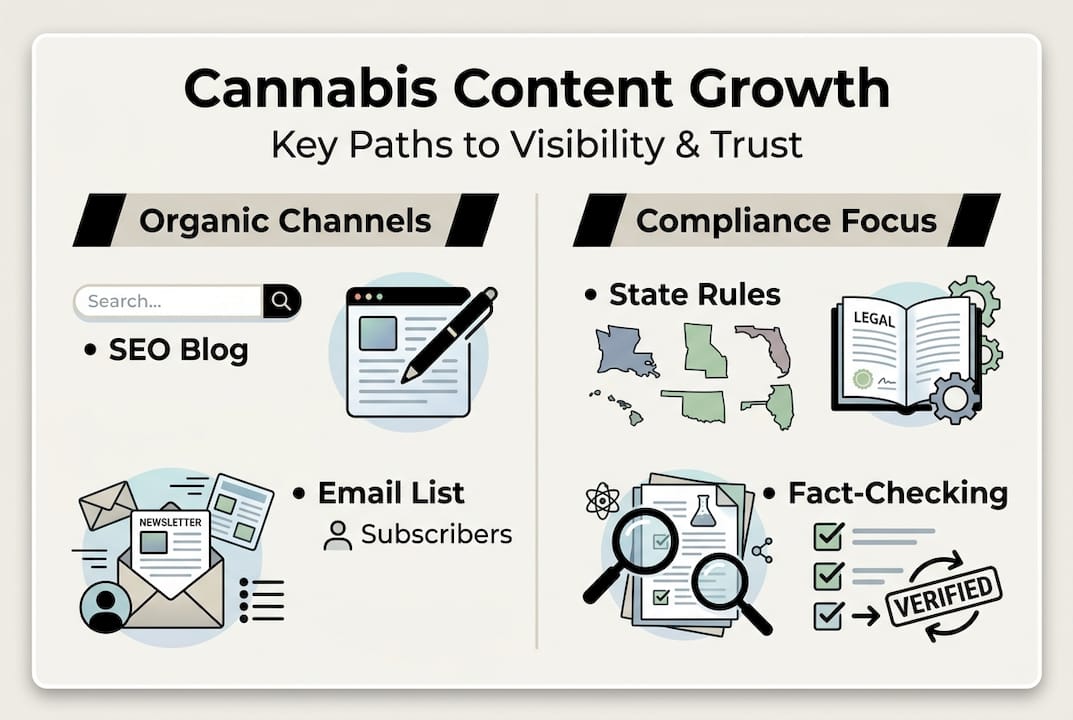
Knowing you need content is one thing. Knowing exactly what to create and where to publish it is another. The cannabis brands seeing the biggest gains are investing in SEO-optimized blogs, educational guides, and video content that answers real customer questions. These formats build authority and rank in search, which means free, targeted traffic month after month.
Owned channels consistently outperform paid media for cannabis businesses. Email newsletters, your own blog, and local SEO are not subject to platform bans. They’re yours. Question-based content converts 340% higher than product-focused content, which means writing posts like “What’s the difference between indica and sativa?” will outperform a product page almost every time.

The numbers back this up. Cannabis SEO strategies yield 121% traffic growth in 8 months, 534% in 12 months, and a 1,200% increase in keyword rankings. That’s not a rounding error. That’s a business transformation.
| Content type | Avg. traffic growth | Time to results | Best channel |
|---|---|---|---|
| SEO blog posts | 121% in 8 months | 3 to 6 months | Organic search |
| Educational guides | 534% in 12 months | 6 to 12 months | Organic + email |
| Video content | 40 to 80% lift | 1 to 3 months | YouTube + embed |
| Email newsletters | 25 to 35% open rate | Immediate | Owned list |
| Local SEO content | 200%+ local visibility | 2 to 4 months | Google Maps |
Here’s how to launch an effective cannabis content campaign:
For deeper guidance on optimizing cannabis content for search engines, the technical side matters just as much as the writing. Title tags, meta descriptions, internal linking, and page speed all affect how well your content ranks.
Pro Tip: Write content that answers the exact questions your budtenders hear every day. Those are the same questions your future customers are typing into Google. Proven cannabis SEO strategies consistently show that question-based content drives the highest conversion rates in this industry.
Don’t overlook enhancing cannabis SEO with social media either. Even if you can’t run paid ads, organic social posts drive traffic back to your owned content and signal relevance to search engines.
Every piece of content you publish carries regulatory risk if you’re not careful. State rules vary dramatically, and what’s acceptable in Colorado may be a violation in Florida. Strict state-by-state rules vary widely, with risks including fines averaging $52,000, deindexation, and youth exposure violations.
Here’s a quick comparison of compliance requirements across key states:
| State | Health claims allowed | Age gate required | Disclaimer required | Imagery restrictions |
|---|---|---|---|---|
| California | No | Yes (21+) | Yes | Strict |
| Colorado | Limited | Yes (21+) | Yes | Moderate |
| Florida (medical) | Limited | Yes (18+) | Yes | Strict |
| Illinois | No | Yes (21+) | Yes | Moderate |
| New York | No | Yes (21+) | Yes | Strict |
Avoid these common content mistakes that trigger fines or platform penalties:
Proactive state-specific reviews prevent fines and keep your content strategy intact as regulations evolve with federal rescheduling discussions in 2026.
Pro Tip: Set a monthly calendar reminder to review your state’s cannabis marketing regulations and check for federal updates. Regulations are shifting fast in 2026, and a single outdated claim can cost you tens of thousands of dollars. Review cannabis lab compliance best practices to understand how compliance extends beyond marketing into your entire operation.
For a full breakdown of how SEO intersects with regulatory requirements, SEO compliance for cannabis is an essential resource. If you’re working with legal counsel, cannabis legal marketing guidance can help align your content strategy with your legal team’s requirements.
Compliance and trust aren’t separate goals. They reinforce each other. When your content is accurate, transparent, and educational, it satisfies both Google’s E-E-A-T standards (Experience, Expertise, Authority, Trust) and your customers’ need for reliable information. That combination is what separates brands that grow from brands that stall.
The attributes that make cannabis content trusted by both consumers and search engines include:
Educational content does more than keep you compliant. It builds topical authority, which means Google starts treating your site as the go-to resource in your niche. That authority compounds into rankings, traffic, and sales. Compliance-first educational content via SEO and email delivers the best long-term visibility, especially for YMYL categories where Google scrutinizes content quality most aggressively.
The compounding effect is real:
“Cannabis brands using organic content strategies see 121% to 557% traffic growth and 1,200% keyword ranking increases within 12 months, far outpacing any paid channel in the same timeframe.”
Start now. Pick three questions your customers ask most often. Write one educational post per question. Optimize each for local search. Build your email list. Repeat monthly. That’s the entire playbook, and it works. For a complete roadmap, SEO best practices for cannabis covers every technical and strategic layer you need to compete and win.
Content marketing is one of the most powerful tools available to cannabis businesses, but executing it correctly across compliance requirements, SEO best practices, and platform restrictions takes specialized expertise. Generic marketing agencies don’t understand the nuances of this industry. You need a partner who does.
At dopeseo.com, we build content strategies specifically for cannabis dispensaries, cultivators, and ancillary businesses. From the marketing guide for cannabis industry to a full cannabis SEO strategy 2026 roadmap, our team handles the research, writing, optimization, and compliance review so you can focus on running your business. Explore our cannabis SEO strategies for dispensaries and see how we turn compliant content into compounding organic growth.
Cannabis brands rely on owned channels like blogs, SEO, and email to reach customers and build authority. SEO-optimized educational content including blogs, guides, and videos bypasses platform bans entirely while building long-term organic visibility.
Major risks include making prohibited health claims, using non-age-gated imagery, and missing mandatory disclaimers. Fines average $52,000 per violation, and repeated offenses can result in deindexation or loss of your license.
Absolutely. Question-based content converts 340% higher than product-focused content, and cannabis SEO strategies deliver 121% traffic growth in 8 months and 534% in 12 months.
State rules dictate permissible claims, imagery, and disclaimers, and they vary significantly across markets. Strict state-by-state rules mean businesses must review local laws regularly to avoid fines and content takedowns.
E-E-A-T stands for Experience, Expertise, Authority, and Trust, and it’s Google’s framework for evaluating content quality in sensitive categories. Integrating E-E-A-T for YMYL content is essential for cannabis brands that want to rank and maintain credibility with both users and search engines.

© 2026 Curious Monkeys Pressing Buttons LLC DBA Cannabiz Marketing Solutions AKA DopeSEO. All rights reserved.