
TL;DR:
- Google Maps ranking for dispensaries depends on relevance, prominence, and behavioral engagement signals.
- Building strong relevance and local authority can overcome physical proximity limitations.
- Consistent NAP data, review strategies, and geo-grid tracking are essential for local search success.
You open Google Maps, search for dispensaries nearby, and your competitor shows up first even though your shop is closer. That’s a frustrating reality for many dispensary owners, and it’s more common than you’d think. Google Maps ranking isn’t automatic, and it isn’t purely about location. Customers rely on Maps to find, evaluate, and choose dispensaries every single day, which means your position directly affects foot traffic and revenue. This guide walks you through exactly how the ranking algorithm works, how to prepare your presence, and how to execute the tactics that actually move the needle.
| Point | Details |
|---|---|
| Relevance over proximity | Dispensaries can outrank closer competitors by boosting relevance and prominence signals. |
| Optimize your foundation | Accurate business data and compliance are critical before active ranking tactics. |
| Leverage customer reviews | Keyword-rich and frequent reviews are a key differentiator in local Maps results. |
| Track and adapt | Regular ranking checks and adapting to Google’s algorithm ensure sustained visibility. |
| Expert help accelerates success | Professional cannabis SEO support can speed up and safeguard the ranking process. |
Google Maps uses three core factors to determine which businesses appear at the top of local results: relevance, distance, and prominence. Most dispensary owners assume that being physically close to a searcher is enough to rank well. That’s a costly misconception.
Proximity can be overcome by building stronger relevance and prominence than your competitors. A dispensary five miles away with hundreds of keyword-rich reviews, consistent citations, and an active Google Business Profile (GBP) will often outrank a shop that’s two blocks from the searcher.
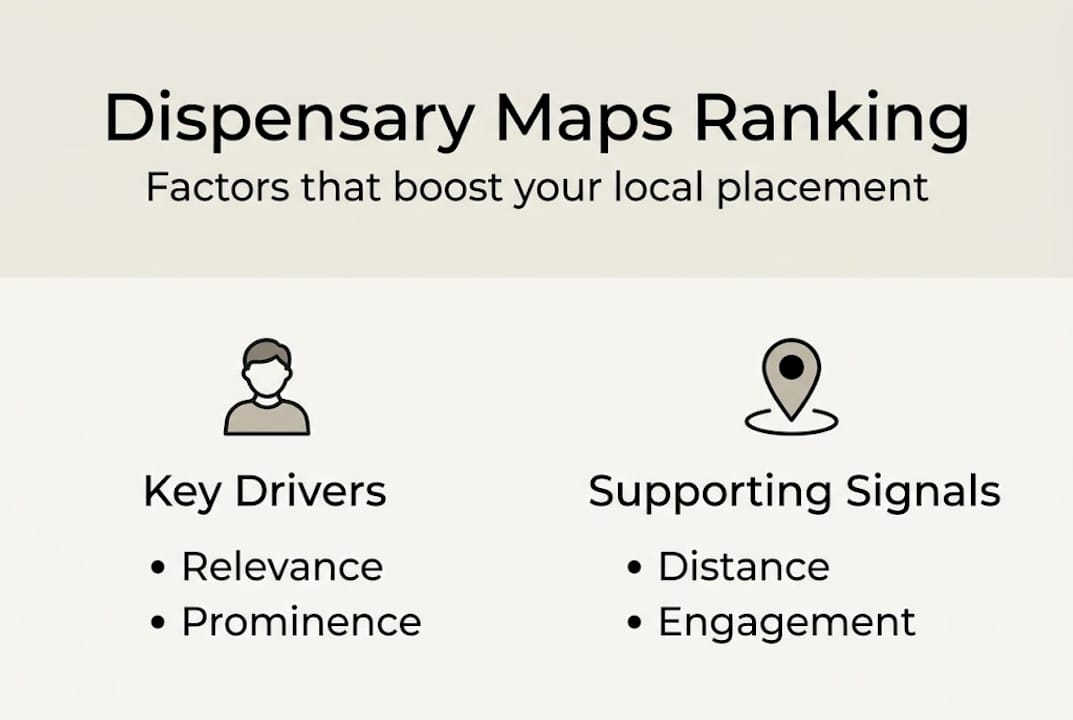
Here’s how each factor plays out for dispensaries specifically:
| Ranking factor | What it means for dispensaries | Impact level |
|---|---|---|
| Relevance | How well your profile matches the search query | Very high |
| Distance | Physical proximity to the searcher | Moderate |
| Prominence | Reviews, citations, links, and engagement signals | Very high |
| Review keywords | Keyword mentions in customer reviews | High |
| AI engagement signals | Click-through rates, calls, direction requests | Growing fast |
In 2026, AI-driven engagement signals are playing a larger role in Maps visibility. Google tracks how users interact with your listing, including how often they call, request directions, or click through to your website. These behavioral signals tell Google your listing is relevant and trustworthy.
Successful dispensaries also track geo-grid variations rather than just citywide rankings. A geo-grid tool shows you exactly where your dispensary ranks across a grid of geographic points in your area. You might rank first near your shop but drop to position eight just a mile away. That level of detail is what separates serious operators from those guessing at their visibility.
The top five ranking levers unique to dispensaries include:
For a deeper look at boosting Google Maps ranking for cannabis businesses, the tactics go well beyond what generic local SEO guides cover. Understanding the algorithm is your starting point, but execution is where rankings are actually won.
“Proximity is a fixed variable you can’t control. Relevance and prominence are the levers you can actually pull.”
Before you execute any optimization tactics, you need a solid foundation. Skipping this step is like building on sand. Your dispensary’s Google Maps presence depends on accurate, consistent, and compliant information across every platform that Google crawls.
Start with these foundational requirements:
Here’s a quick comparison of what’s essential versus what’s a bonus:
| Element | Must-have | Nice-to-have |
|---|---|---|
| Google Business Profile | Yes | |
| Consistent NAP citations | Yes | |
| Licensed address verified | Yes | |
| Customer photos | Yes | |
| Weekly Google Posts | Yes | |
| Menu integration (Weedmaps) | Yes | |
| 50+ reviews with keywords | Yes |
NAP consistency is non-negotiable. If your dispensary is listed as “Green Leaf Cannabis” on Google but “Green Leaf Dispensary” on Yelp, those inconsistencies send conflicting signals to Google. The algorithm loses confidence in your business data and your rankings suffer.

Compliance is another factor that generic SEO guides ignore entirely. Cannabis businesses operate under state licensing rules, and your GBP must reflect your legal business name and address exactly. Any mismatch can trigger a suspension.
Google reviews with relevant keywords improve your Maps relevance score, which is why building a review strategy early matters. Don’t wait until you’re already trying to rank. Start collecting reviews from day one.
Pro Tip: Run a citation audit before doing anything else. Use a tool like BrightLocal or Whitespark to find every inconsistent listing across the web. One bad citation won’t tank your rankings, but dozens of them will. Check out these Google Business Profile tips built specifically for dispensaries to make sure your profile is set up correctly from the start.
Your website also plays a supporting role. A slow, non-compliant, or poorly structured site weakens your overall local authority. Follow these website tips for visibility to make sure your site reinforces your Maps presence rather than undermining it.
With your foundations set, it’s time to execute the proven step-by-step process to actually climb the local rankings.
Optimize your Google Business Profile fully. Fill out every field: business description with local keywords, services, hours, and attributes. Choose your primary category as “Cannabis store” and add secondary categories where relevant. Upload at least 20 high-quality photos of your interior, exterior, staff, and products.
Build a consistent review acquisition system. Ask every customer for a review at checkout or via follow-up text. Train your staff to say something like, “If you loved your visit, mentioning what you picked up in your review really helps us.” That prompt naturally encourages keyword-rich responses.
Post to your GBP weekly. Google Posts are underused by most dispensaries. Share new product arrivals, promotions, or educational content. Each post signals to Google that your business is active and engaged.
Earn local backlinks and citations. Get listed on cannabis-specific directories and earn mentions from local news outlets or community blogs. These signals build the prominence factor that helps you outrank competitors.
Use geo-grid tracking tools. Tools like Local Falcon or BrightLocal’s grid tracker show you exactly where your ranking stands across your city. AI-driven engagement signals are increasingly influencing local search prominence in 2026, so tracking behavioral data alongside position data is critical.
Pro Tip: Responding to every review, positive or negative, adds a ranking signal. When you respond and include a relevant keyword naturally (“Thanks for visiting our Portland dispensary!”), you reinforce your relevance for that location and product type.
Common pitfalls to avoid:
For a complete walkthrough on ranking your dispensary on Google Maps, you’ll find tactics that go well beyond the basics. Understanding the Maps ranking advantages available to cannabis businesses helps you prioritize where to spend your time.
Once you’ve executed the ranking steps, you’ll need a reliable way to measure your success and fix issues that arise.
The best tools for tracking your Maps performance include:
| Tool | What it tracks | Best for |
|---|---|---|
| Local Falcon | Geo-grid rank positions | Hyper-local visibility |
| BrightLocal | Citations, reviews, rankings | Full local audit |
| Google Business Profile Insights | Calls, clicks, direction requests | Engagement signals |
| Semrush Local | Keyword rankings, competitor gaps | Competitive analysis |
Geo-grid tracking reveals hyper-local variations in rankings that a single citywide position check will completely miss. You might think you’re ranking well until you see that you’re invisible to searchers just a few blocks north of your shop.
Monitor your GBP Insights weekly. Watch for changes in direction requests, phone calls, and website clicks. A sudden drop in any of these metrics often signals a ranking shift before you even notice a position change.
Common ranking issues and how to fix them:
“Distance bias can be beaten. The dispensaries that win in 2026 are the ones building superior relevance and local authority, not just waiting for nearby customers to find them.”
Adapting to future Google changes means staying current on algorithm updates and adjusting your strategy accordingly. For ongoing support with boosting dispensary visibility and understanding the full Maps optimization benefits, make sure you’re working with resources built specifically for cannabis.
Most Google Maps guides are written for restaurants, retail stores, or service businesses. They give solid general advice, but they miss the nuances that make cannabis a completely different game.
Mainstream guides don’t account for the fact that cannabis businesses face platform restrictions, stricter review policies, and the constant risk of GBP suspension. A tactic that works fine for a coffee shop can get a dispensary’s listing flagged. That’s not a hypothetical risk. It happens regularly.
Proximity-first thinking is also outdated. The dispensaries winning in local search right now are not necessarily the closest ones. They’re the ones with the strongest cannabis local search strategies, the most relevant review content, and the most consistent local authority signals.
Geo-grid tactics and reputation management matter far more for dispensaries than copying what works for general retail. Your review response strategy, your citation profile, and your GBP content all need to be calibrated for a regulated industry with unique customer concerns.
Pro Tip: Invest in a geo-grid tracking tool and a review compliance process before spending money on ads. Organic Maps visibility compounds over time, and the dispensaries building that foundation now will be nearly impossible to displace in 12 months.
Ready to put these steps into practice or want hands-on support? Executing a Maps ranking strategy while running a dispensary is a lot to manage on your own.
At Dope SEO, we specialize in cannabis-specific local search optimization, which means no guesswork and no generic tactics that put your GBP at risk. Our team handles citation cleanup, geo-grid tracking, review strategy, and ongoing optimization so you can focus on your customers. Explore our cannabis SEO strategy built for 2026, review our local search workflow for cannabis businesses, or start with our local search strategy guide to see exactly how we approach Maps dominance for dispensaries.
Relevance, prominence, and distance are the three core factors, but relevance and prominence now outweigh simple proximity in most local searches. Engagement signals like calls and direction requests are also growing in importance.
Encourage customers to mention specific products or services in their reviews, since review keywords boost relevance scores in Google’s algorithm. Never incentivize reviews, but do make the ask part of your standard checkout process.
Use a geo-grid tool like Local Falcon to visualize your positions across your local area, because geo-grid tracking reveals hyper-local variations that a single keyword search will never show you.
Audit your Google Business Profile for data errors, policy violations, and recent negative reviews, then correct each issue and monitor your engagement metrics over the following two weeks.
Absolutely. By building stronger relevance and prominence through reviews, citations, and engagement, proximity bias can be overcome with a well-executed local SEO strategy.

© 2026 Curious Monkeys Pressing Buttons LLC DBA Cannabiz Marketing Solutions AKA DopeSEO. All rights reserved.