
TL;DR:
- Running a cannabis dispensary requires balancing compliance with digital growth strategies to avoid legal issues and lost sales.
- Consistently optimizing your online profiles, maintaining accurate core data, and leveraging owned customer data are crucial for sustained visibility and success.
Running a cannabis dispensary means fighting a two-front battle every single day: staying compliant while still growing your customer base. A weak online presence doesn’t just mean fewer clicks. It means lost sales, eroded trust, and real legal exposure. Dispensaries that ignore the technical and regulatory demands of digital marketing often find themselves buried in search results, flagged by platforms, or quietly losing customers to better-optimized competitors down the street. This guide gives you a clear, actionable path through compliance requirements, profile optimization, audience building, and the consistent habits that separate high-performing dispensaries from the rest.
| Point | Details |
|---|---|
| Get compliance right | Strict age gates, geo-fencing, and no medical claims are essential for any dispensary online. |
| Maximize local search | Fully optimized Google and directory profiles drive visibility and reviews that build trust. |
| Own your audience | First-party email and SMS lists let you market directly and survive future ad bans. |
| Consistency wins | Regular updates and review requests outpace competitors relying on just one big campaign. |
Before you touch a single listing or post a single photo, you need to get your foundation right. The cannabis industry has requirements that simply don’t apply to most other businesses, and skipping these steps can cost you more than a ranking drop.
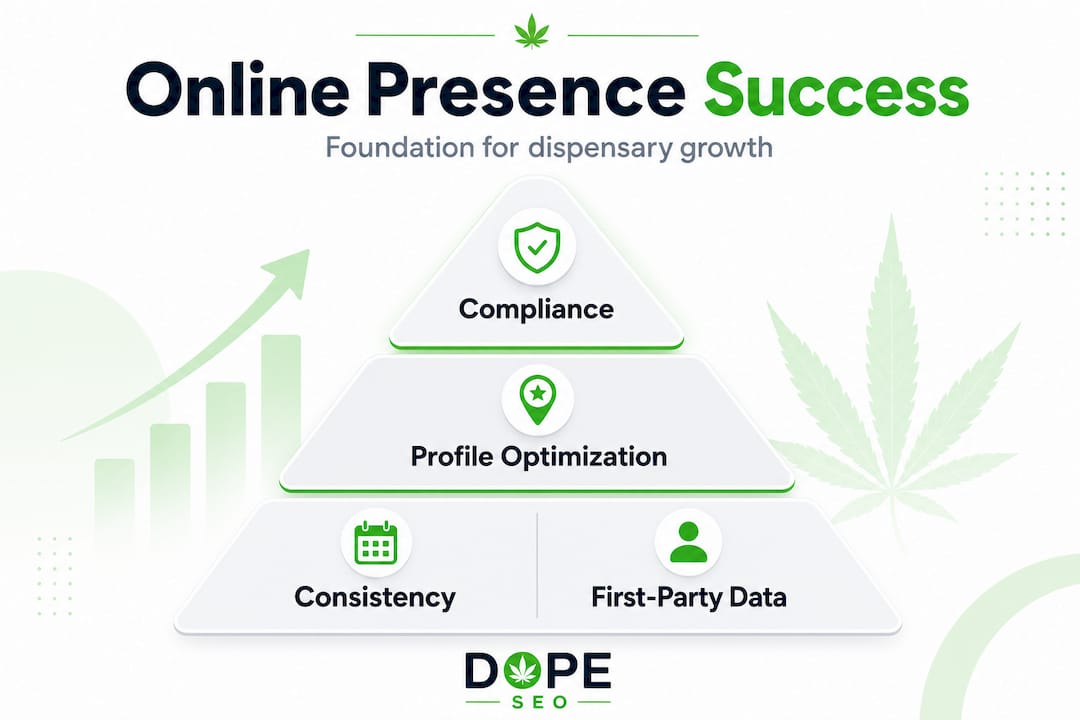
Compliance essentials for cannabis in 2026 include age-gating, geo-fencing, avoiding all medical claims, and following your state’s specific advertising rules. These are not optional. Age-gating ensures that only adults can access your site content, while geo-fencing restricts your digital ads and content to approved geographic areas. Violating either can result in fines, listing removals, or worse.
The table below breaks down the non-negotiable compliance tools versus the marketing essentials you’ll also need in place.
| Category | Requirement | Why it matters |
|---|---|---|
| Compliance | Age-gate on website | Prevents underage access; required by most state laws |
| Compliance | Geo-fencing on ads | Restricts content to legal markets |
| Compliance | No medical claims | Avoids regulatory violations and platform bans |
| Marketing | Accurate NAP data | Powers local search rankings and customer trust |
| Marketing | Updated business hours | Reduces customer frustration and bounce rate |
| Marketing | Quality photos | Improves profile engagement and click-through rates |
| Data | First-party email/SMS list | Enables direct marketing without relying on ad platforms |
| Operations | Regular content audits | Catches compliance issues before regulators do |
Your NAP data, which stands for name, address, and phone number, must be identical across every platform where your dispensary appears. Even a small inconsistency, like abbreviating “Street” to “St.” on one listing but not another, can hurt your local search rankings.
Here’s a quick checklist of what to gather before you optimize anything:
Collecting first-party customer data is especially critical now. As advertising restrictions tighten and third-party cookies phase out, your owned customer list becomes one of your most valuable marketing assets.
Pro Tip: Document every compliance decision you make and keep a running log of when you performed audits. If a platform or regulator questions your practices, that paper trail is your best defense.
The Google Business Profile is the single most powerful free tool available to dispensaries right now. Think of it as your digital storefront on Google Maps and Search. Getting this right before anything else sets you up for every other optimization effort to work more effectively.
With your compliance setup and core data ready, you can now focus on the optimization work that drives real visibility. This is where many dispensaries fall short because they treat listing setup as a one-time task rather than an ongoing process.
Follow these steps in order for the best results:
Not all dispensary profiles perform equally. Here’s a practical comparison of what separates top-ranked dispensaries from those stuck on page two or lower.
| Profile element | Underperforming dispensary | Top-ranked dispensary |
|---|---|---|
| Review count | Under 100 reviews | 1,000+ reviews |
| Average star rating | Below 4.0 | 4.7 or higher |
| Photo count | 5 or fewer | 50+ |
| Posting frequency | Rarely or never | Weekly |
| Response to reviews | Inconsistent | Responds to every review |
| NAP consistency | Varies across platforms | Identical everywhere |
| Business hours accuracy | Outdated or incomplete | Updated for every holiday |
This table makes one thing very clear: the gap between average and excellent is mostly a matter of consistency, not creativity.
Pro Tip: Use a spreadsheet to track every directory where your NAP appears. Tools that monitor listing consistency can alert you when a platform changes your information, which happens more often than you’d think.
When you’re ready to go deeper on visibility, Google Maps optimization for dispensaries is a specific discipline worth investing time in. It goes beyond your profile and into how Google ranks local businesses spatially, which is especially competitive in dense urban markets. Learning how to boost local SEO for cannabis specifically also helps you understand which directory signals carry the most weight for your market. And for the technical ranking side of things, reviewing Google Maps ranking tips designed for cannabis businesses will give you a competitive edge your neighbors are probably missing.
Optimizing your profiles once is not enough. Regulations change. Platforms update their terms. What was compliant six months ago might trigger a violation today. Building compliance monitoring into your monthly routine is what protects everything you’ve worked to build.
“Failing to audit your compliance regularly doesn’t just risk a fine, it risks your entire online presence. One platform takedown can erase months of SEO progress overnight.” This is exactly why scheduled audits are non-negotiable for any serious dispensary.
Cannabis advertising compliance in 2026 requires age-gating, geo-fencing, avoiding medical claims, and staying current with state-specific rules, with regular audits as the minimum standard.
Aim to run a full compliance audit at minimum once per quarter, with quick spot checks monthly. Your audit should cover:
If you want a structured approach to this, the local SEO steps framework designed for cannabis dispensaries includes compliance checkpoints alongside visibility tactics, which is a much smarter way to manage both at once.
Visibility brings visitors. But what converts visitors into loyal, repeat customers? The answer is direct communication through channels you own and control, not platforms that can restrict you at any time.
Third-party cookies are essentially gone. Major browsers have blocked them, and ad platforms have restricted targeting for regulated industries like cannabis even further. If your marketing strategy depends on retargeting pixels and third-party audiences, it’s already weakening. Building first-party data through loyalty programs, email capture, and SMS sign-ups is now the standard for compliant, effective dispensary marketing.
Pro Tip: Even a loyalty program with 500 active members can drive more consistent revenue than a $2,000 ad spend on a restricted platform. Own your audience before you try to rent one.
Here’s the honest truth most marketing agencies won’t tell you: the dispensaries ranking at the top of Google Maps and search results are not there because of a brilliant viral campaign. They’re there because someone on their team asked for a review every single day, updated their hours every holiday, responded to every customer comment, and fixed every broken listing the moment it went out of sync.

Flashy campaigns have their place. A well-executed seasonal promotion can spike traffic for a week. But it won’t protect your ranking when a competitor opens up two blocks away. What protects your ranking is the slow, unglamorous work of maintaining accuracy and engagement month after month.
Think about what this looks like in practice. Updating holiday hours takes five minutes. Uploading three new photos takes ten. Responding to the week’s reviews takes fifteen. None of that feels like marketing. All of it compounds into a Google Maps presence that’s nearly impossible for a new competitor to replicate quickly, because it’s built on months of consistent signals.
The real mindset shift is treating your online presence like a living storefront. A physical store gets restocked, cleaned, and updated constantly. Your digital presence deserves the same attention. Dispensaries that understand this stop asking “what campaign should we run next?” and start asking “what did we miss updating this week?” That shift in thinking is what separates the businesses that grow steadily from those that spike and stall.
You now have the blueprint. Compliance first, profile optimization second, consistent maintenance third, and owned audience growth running in the background of all of it. The question is how fast you can execute and how much of it you can sustain without letting something slip.
That’s exactly where working with a specialized team makes a measurable difference. At dopeseo.com, we work exclusively with cannabis businesses, which means we already understand the regulatory landscape, the platform restrictions, and the local market dynamics that trip up generalist agencies. Whether you need a complete cannabis SEO strategy, a refined local search workflow, or a website design built for both compliance and conversion, our team has the industry-specific experience to move fast and get it right. The dispensaries that grow fastest are the ones that stop trying to figure this out alone.
Claiming and optimizing your Google Business Profile with accurate details is the foundational step. Top dispensaries earn over 1,000 reviews at a 4.7-star rating by actively requesting feedback from every customer.
Use age-gates, geo-fencing, and avoid any language that could be interpreted as medical claims. Cannabis advertising compliance also requires regular audits and staying current with state-specific regulations.
Paid ads carry significant risk because most major platforms severely restrict cannabis advertising. Focusing on compliant listings and first-party data through loyalty and email programs is a safer and more sustainable approach.
As third-party cookies disappear from the digital advertising ecosystem, your owned email and SMS audience becomes your most reliable marketing channel. Building this database through loyalty programs protects you from platform changes that are completely outside your control.

© 2026 Curious Monkeys Pressing Buttons LLC DBA Cannabiz Marketing Solutions AKA DopeSEO. All rights reserved.