
TL;DR:
- Regular SEO audits help cannabis businesses detect technical issues, optimize content, and adapt to AI-driven search changes. Conducting quarterly audits ensures proactive management of site health, compliance, and evolving search algorithms. Prioritizing issues like crawl errors, local SEO accuracy, and AI citation readiness sustains organic growth in a regulated environment.
An SEO audit is a structured website health check that diagnoses issues across technical SEO, content quality, and AI search visibility to improve your cannabis business’s online performance. The role of SEO audits has expanded significantly in 2026, with AI Overviews appearing in over 50% of Google results and reshaping how dispensaries, cultivators, and cannabis brands get discovered. Tools like Google Search Console, Semrush, and Screaming Frog are no longer optional. They are the instruments you use to diagnose why your pages are invisible and what it takes to fix them. Cannabis businesses face a compounding challenge: standard SEO obstacles plus compliance restrictions, restricted ad platforms, and a search environment that increasingly favors AI-cited authority over keyword density.
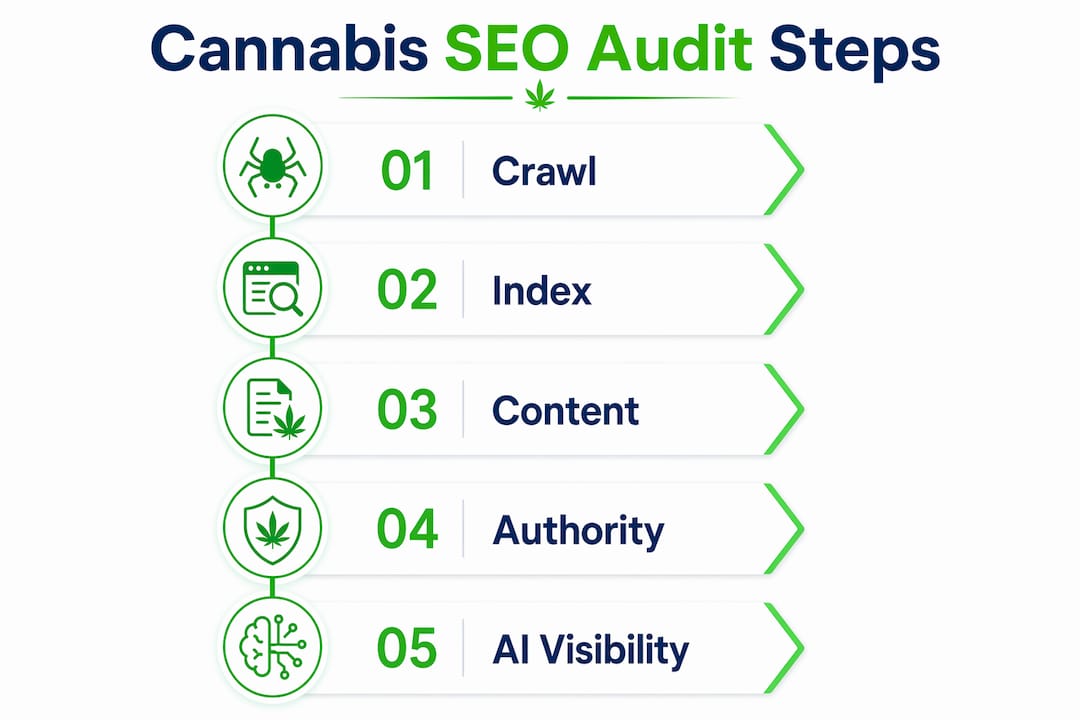
A complete SEO audit covers five distinct layers: crawlability, indexability, content quality, authority signals, and AI visibility. Each layer builds on the one before it. Skipping ahead to content fixes while crawl errors exist is like painting over a cracked wall.
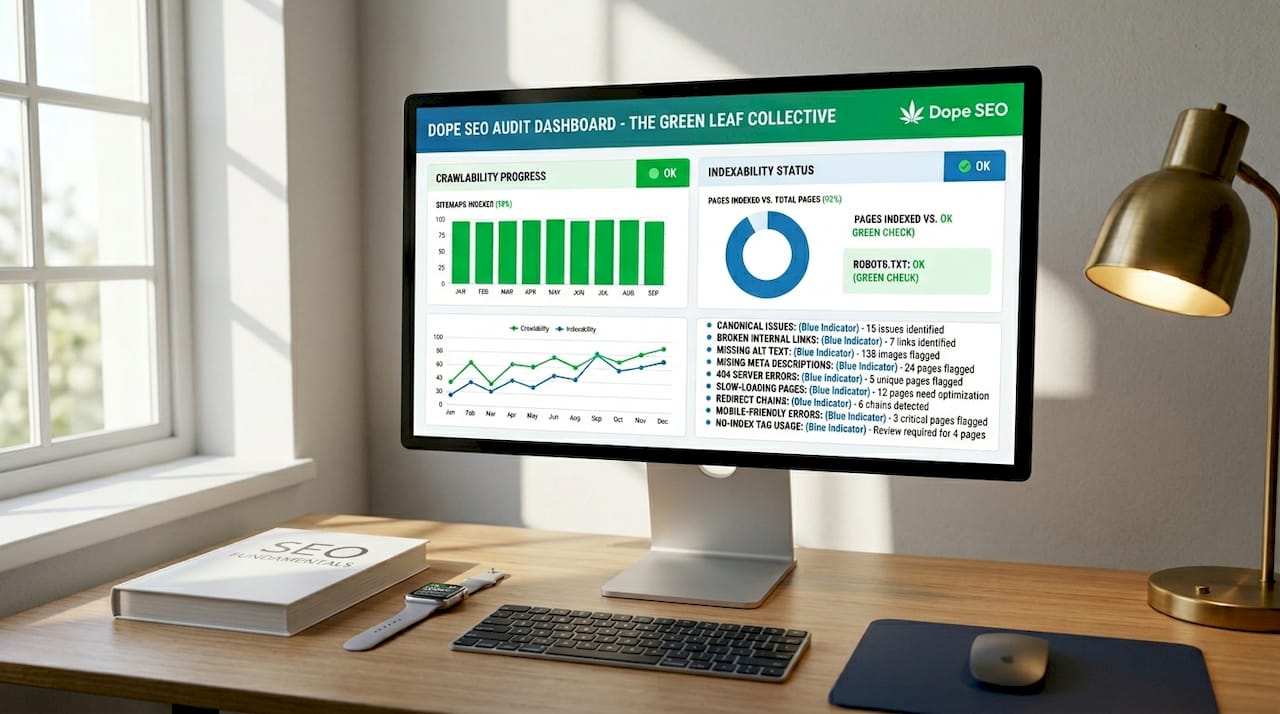
Crawlability determines whether Google’s bots can access your pages at all. Indexability determines whether those pages are eligible to appear in search results. Crawl and index validation must happen before any content or structured data work, because even exceptional content cannot rank if priority URLs are blocked or excluded. For cannabis sites, this matters more than most. Age-gate scripts, geo-restriction plugins, and compliance overlays can accidentally block Googlebot from crawling your most valuable pages.
Core Web Vitals (Largest Contentful Paint, Interaction to Next Paint, and Cumulative Layout Shift) are measured through PageSpeed Insights and Google Search Console. These scores directly affect your rankings and user experience. SSL configuration is another non-negotiable: incorrect HTTPS setup can reduce click-through rates by up to 45% and trigger browser warnings that destroy trust before a visitor even reads your content.
Content audits identify pages that no longer match user intent, have lost traffic over time (content decay), or compete with each other for the same keyword (content cannibalization). Cannabis sites are especially prone to cannibalization because product category pages, strain pages, and blog posts often target overlapping terms like “buy indica flower” or “dispensary near me.”
The Google Search Console Page indexing report shows you exactly which URLs are valid, excluded, or returning errors. Identifying priority URL status is the foundational step that enables targeted fixes with direct ranking impact. Pair this with a content inventory spreadsheet to flag pages for refresh, consolidation, or removal.
Authority audits examine your backlink profile, internal linking structure, and brand mentions. In the cannabis niche, internal linking fixes outperform backlink chasing because acquiring quality backlinks is difficult when many mainstream publishers avoid cannabis topics entirely. A well-structured internal linking audit redistributes page authority across your site without requiring a single new external link.
The newest audit layer is AI visibility, sometimes called Generative Engine Optimization (GEO) or Answer Engine Optimization (AEO). This checks whether your content immediately answers the core user question, includes E-E-A-T signals like author bylines and cited sources, and is structured in a way that AI models trust and cite. Metrics to track here include Generative Appearance, Citation Frequency, and Share of AI Voice.
Pro Tip: Run your audit in this exact sequence: crawl → index → content → authority → AI visibility. Fixing issues out of order wastes time and can mask the real root cause of ranking problems.
| Audit layer | Key tools | Primary metric |
|---|---|---|
| Crawlability | Screaming Frog, Google Search Console | Crawl errors, blocked URLs |
| Indexability | Google Search Console Page indexing | Valid vs. excluded URLs |
| Content quality | Semrush, Ahrefs | Traffic decay, cannibalization |
| Authority | Ahrefs, Semrush | Internal link equity, backlink health |
| AI visibility | Rich Results Test, manual AI query checks | Citation frequency, generative appearance |
A one-time audit is a snapshot. A quarterly audit is a system. Semrush recommends a quarterly audit cadence to stay ahead of issues rather than reacting to traffic drops after they occur. For cannabis businesses operating in a regulatory environment that shifts constantly, quarterly is the minimum. A state law change, a Google core update, or a new compliance requirement can invalidate pages that ranked well last month.
Here is why recurring audits protect your organic traffic:
Track these metrics across every audit cycle: organic sessions by page, AI citation frequency, Core Web Vitals scores, index coverage rate, and internal link equity distribution. Comparing these numbers quarter over quarter tells you whether your fixes are working or whether new problems have emerged.
Cannabis digital marketing operates under constraints that most industries never encounter. SEO compliance for cannabis websites requires auditing for age-gate implementation, geo-targeting accuracy, and restricted keyword usage that could trigger ad policy violations even on organic pages. These are not standard audit checklist items. They require cannabis-specific knowledge to identify and fix correctly.
Key cannabis audit considerations include:
Pro Tip: Prioritize your audit fixes by a simple impact-versus-effort matrix. A crawl error blocking your dispensary menu page is high impact and usually low effort to fix. Rewriting 40 blog posts for AI readiness is high effort and medium impact. Fix the crawl error first.
The right tool stack depends on your budget and audit depth. Free tools cover the fundamentals. Paid tools add competitive intelligence and bulk analysis that manual checks cannot match.
| Tool | Type | Best used for |
|---|---|---|
| Google Search Console | Free | Index coverage, Core Web Vitals, search performance |
| PageSpeed Insights | Free | LCP, INP, CLS scores by URL |
| Rich Results Test | Free | Structured data validation, schema markup |
| Semrush | Paid | Site audit, keyword gaps, backlink analysis |
| Ahrefs | Paid | Backlink profile, content gap, competitor analysis |
| Screaming Frog | Paid (free tier available) | Bulk crawl, redirect chains, internal link mapping |
Google Search Console is your starting point for every audit. The Page indexing report shows you which URLs Google has crawled, which are excluded, and why. PageSpeed Insights gives you field data and lab data for Core Web Vitals, broken down by mobile and desktop. The Rich Results Test validates your structured data markup, which is critical for earning featured snippets and AI citations.
For cannabis businesses with competitive local markets, Semrush and Ahrefs provide keyword gap analysis that reveals which terms your competitors rank for that you do not. Screaming Frog crawls your entire site in minutes and exports a spreadsheet of every internal link, redirect, broken URL, and missing meta tag.
Pro Tip: Document every audit in a shared spreadsheet with columns for issue type, affected URL, priority level, assigned owner, and resolution date. An undocumented audit produces findings that get forgotten. A documented audit produces a fix queue that drives measurable results.
Regular, structured SEO audits are the single most reliable method for cannabis businesses to protect rankings, adapt to AI-driven search changes, and fix the compliance-related technical issues that generalist agencies miss.
| Point | Details |
|---|---|
| Audit in sequence | Fix crawl and index issues before addressing content or authority problems. |
| Audit quarterly | A quarterly cadence catches issues before they become traffic losses. |
| Include AI visibility | Track Citation Frequency and Generative Appearance as standard audit metrics in 2026. |
| Prioritize cannabis-specific issues | Local SEO accuracy, compliance content, and mobile speed are high-impact starting points. |
| Document every finding | A fix queue with owners and deadlines turns audit findings into measurable improvements. |
Most cannabis marketers I see start their audits with content. They rewrite product descriptions, refresh blog posts, and add keywords to title tags. Then they wonder why rankings do not move. The answer is almost always upstream: crawl errors, excluded URLs, or a site architecture that buries the most important pages three clicks deep.
The shift to AI-driven search makes this sequencing problem even more costly. If your pages are not indexed correctly, they cannot be cited in AI Overviews. No amount of E-E-A-T signaling helps a page that Google has excluded from its index. I have seen cannabis dispensary sites with 40% of their product pages excluded from Google’s index because a compliance plugin was blocking Googlebot. The content on those pages was excellent. It did not matter.
The other mistake I see consistently is treating audits as a one-time project. You run an audit, fix the issues, and move on. Six months later, a Google core update shifts the rankings, new compliance requirements force content changes, and the site has accumulated fresh technical debt. The brands that sustain organic growth treat audits as a recurring workflow, not a remediation project. Pair your quarterly technical audit with a content refresh cycle and an AI visibility check, and you have a system that compounds over time rather than decaying between fixes. For cannabis brands trying to build online visibility in a restricted environment, that compounding effect is the closest thing to a durable competitive advantage.
— Max
Running an audit is only half the work. The other half is knowing which fixes to prioritize and how to translate technical findings into a growth strategy your whole team can execute.
Dopeseo specializes in exactly this. From cannabis SEO strategy built around your audit findings to dispensary-specific optimization that accounts for compliance restrictions and local competition, the team at Dopeseo turns audit data into organic traffic. If your cannabis business is ready to move from diagnosis to results, Dopeseo has the industry-specific expertise to get you there.
An SEO audit identifies technical, content, and authority issues that prevent your cannabis website from ranking in both traditional search results and AI-driven answers. Regular audits are the foundation of any sustainable cannabis SEO strategy.
Semrush recommends a quarterly audit cadence for proactive health monitoring. Cannabis businesses should audit at least quarterly given the frequency of Google core updates and industry-specific compliance changes.
Cannabis audits must include compliance checks for age-gate implementation, geo-targeting accuracy, and restricted keyword usage, plus local SEO validation for Google Business Profile consistency. These items do not appear on standard audit checklists.
Google Search Console, PageSpeed Insights, and the Rich Results Test cover the core technical audit requirements at no cost. Google Search Console’s Page indexing report is the single most important starting point for any cannabis site audit.
AI visibility measures whether your content earns citations in Google’s AI Overviews and other generative search answers. With AI Overviews appearing in over 50% of Google results, cannabis brands that ignore this audit layer are invisible to a growing share of search traffic.

© 2026 Curious Monkeys Pressing Buttons LLC DBA Cannabiz Marketing Solutions AKA DopeSEO. All rights reserved.