
TL;DR:
- Business categories in Google Business Profiles are the most crucial factor for local SEO, directly affecting local Pack visibility and eligibility. Choosing the most precise primary category and a limited set of relevant secondary categories significantly enhances search rankings, feature access, and AI classification. Regularly auditing and updating categories based on competitor research and Google’s evolving options ensures optimal long-term local search performance.
Business categories in Google Business Profile (GBP) are the primary signal that determines whether your listing appears in local search results for a given query. Without the right category, no amount of reviews, photos, or citations will get your business into the Local Pack. The role of business categories in local SEO is not a minor optimization detail. It is the foundational filter that either qualifies or disqualifies your listing before any other ranking factor comes into play. Understanding how to choose, structure, and maintain your categories is one of the highest-leverage moves you can make for local search visibility in 2026.
The primary category is the #1 GBP signal for Local Pack visibility in 2026, according to multiple local search ranking factor studies. That means it outweighs review count, proximity signals, and even website authority when Google decides which businesses to surface for a given local query. This single field carries more weight than most business owners realize.

Categories act as gating filters in local search. A wrong primary category excludes your listing from relevant local queries regardless of how well-optimized everything else is. Think of it this way: if you run a medical cannabis dispensary and your primary category is listed as “Health Food Store,” Google will not serve your listing to someone searching “dispensary near me.” The category mismatch blocks you before the ranking competition even starts.
Specificity is the key principle here. Google’s category system includes thousands of options, and choosing the most precise category available consistently outperforms broader alternatives. A “Cannabis Dispensary” category will outrank “Retail Store” for cannabis-related searches every time, even if the business descriptions are identical. The more precisely your primary category matches the searcher’s intent, the more eligible your listing becomes.
Your primary category also unlocks specific GBP features. A restaurant category activates menu fields and reservation integrations. A hotel category enables star ratings and check-in details. Choosing a category that does not match your actual business type means you lose access to these features, which further reduces your profile’s completeness and competitive standing.
Pro Tip: Search Google Maps for your top three local competitors and look at their primary categories before you finalize yours. The category that appears most consistently among high-ranking competitors in your area is almost always the correct choice for your market.
Here is what the primary category directly affects:
Secondary categories expand query coverage for related services but carry significantly less ranking weight than your primary category. GBP allows up to nine secondary categories, but using all nine is rarely the right move. The goal is to add legitimate categories that reflect services you genuinely offer, not to maximize the number of categories for keyword coverage.
The distinction between effective and ineffective secondary category use comes down to relevance and proof. Google cross-references your categories against your website content, photos, and reviews. If your secondary categories imply services you cannot substantiate, your profile’s trust score drops.
| Secondary category approach | Outcome |
|---|---|
| 3-5 categories matching real services | Expanded query coverage, stable profile trust |
| 6-9 loosely related categories | Diluted relevance, potential suppression risk |
| Categories implying unverified services | Profile trust issues, possible visibility reduction |
| Single secondary category only | Missed coverage for legitimate ancillary services |
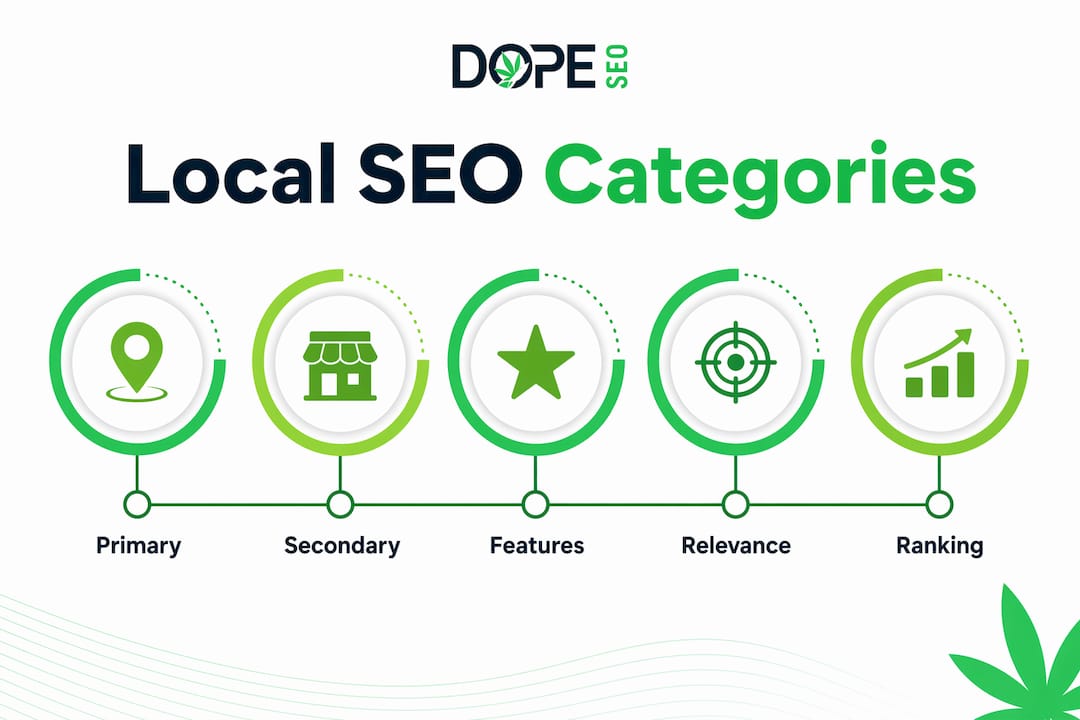
Overusing or mismatching secondary categories dilutes relevance and may trigger profile suppression or reduced visibility. Google’s systems are designed to detect when a business is trying to game category selection rather than accurately describe itself. The penalty is not always a suspension. More often, it is a quiet reduction in ranking stability that is hard to diagnose.
A dispensary that also offers delivery, cannabis accessories, and educational consultations has a clear case for three to four secondary categories. A dispensary that adds “Pharmacy,” “Health Clinic,” and “Wellness Center” as secondary categories because those terms attract search volume is taking a risk that is not worth the marginal gain.
Pro Tip: Audit your secondary categories every six months. Google periodically adds new category options, and a more precise secondary category may become available that better describes one of your services.
Choosing the right categories is a research process, not a guessing game. Follow these steps to build a category strategy grounded in data rather than assumption.
Analyze top-ranking competitors on Google Maps. Search your primary service plus your city on Google Maps. Open the top three to five listings and look at their categories. Competitor category research on Google Maps is the most reliable method for identifying which primary category Google already associates with high-ranking businesses in your niche and geography.
Use GBP’s built-in category suggestions. When you type a category into the GBP dashboard, Google auto-suggests options from its official list. Start with your most specific descriptor and work through the suggestions. Never type in a custom category that does not appear in Google’s list. Custom entries are not recognized as structured category signals.
Align categories with your actual services. Your primary category should reflect your core business identity, not your most profitable service or your aspirational positioning. Primary category defines core business identity; secondary categories cover ancillary specialties. A dispensary is a dispensary, not a “wellness brand” in Google’s category system.
Document your current rankings before making changes. Track your Local Pack positions for five to ten target queries using a tool like BrightLocal or Whitespark’s Rank Tracker. This baseline lets you measure the actual impact of any category change rather than guessing.
Change one category at a time. Treat category edits like controlled experiments. Modify one category, then monitor performance over two to four weeks before making additional changes. Bundling multiple profile edits at once makes it impossible to attribute ranking shifts to a specific change.
Monitor for volatility after edits. Changing GBP categories can cause short-term volatility or suspension risk if edits misalign with real-world business signals or are done aggressively. Watch your profile status and ranking positions closely for the first two weeks after any category change.
Repeat the audit every six months. Auditing and updating categories periodically keeps listings competitive as Google updates its category list and local markets shift. A category that was the best option in 2024 may have a more precise replacement available today.
Business categories do not operate in isolation. They work alongside every other local SEO signal to determine your overall visibility. According to the Whitespark 2026 Local Search Ranking Factors report, GBP signals as a whole constitute 32% of Local Pack ranking factors and 12% of AI search visibility factors. Categories are the most influential single element within that GBP signal group.
The relationship between categories and other signals is reinforcing. Consistent NAP, citation uniformity, and complete GBP fields maximize visibility when combined with accurate category selection. If your category says “Cannabis Dispensary” but your website never mentions dispensary services, or your citations list a different business type, Google’s confidence in your category accuracy drops. The signals need to tell the same story.
AI-powered search is now a factor you cannot ignore. Category signals improve AI local search visibility by helping AI engines classify businesses properly. Tools like Google’s AI Overviews and voice search assistants pull structured data from GBP to generate local recommendations. A precise, accurate category makes your business far more likely to appear in those AI-generated answers. You can explore how these local ranking factors interact in more detail if you want a deeper breakdown.
Here is how categories function within the broader signal ecosystem:
For cannabis businesses specifically, the importance of precise category selection is amplified by the industry’s regulatory complexity and the limited number of platforms willing to list cannabis businesses at all.
Business categories are the single most important GBP signal in local SEO, functioning as a gating filter that determines search eligibility before any other ranking factor applies.
| Point | Details |
|---|---|
| Primary category is the top signal | It determines Local Pack eligibility and outweighs reviews, proximity, and website authority. |
| Specificity beats breadth | Choose the most precise primary category available rather than a broad descriptor. |
| Secondary categories need restraint | Use three to five categories that reflect real services; avoid adding categories for keyword coverage alone. |
| Category changes carry risk | Change one category at a time and monitor rankings for two to four weeks after each edit. |
| Categories feed AI search visibility | Precise GBP categories help AI systems classify and recommend your business in local responses. |
Most business owners treat category selection as a one-time setup task. They pick something reasonable during GBP registration and never revisit it. That is the single most common local SEO mistake I see, and it costs businesses real visibility every day.
Categories are not a ranking hack. They are a declaration of what your business is. When you choose a category that is slightly off, or one that is accurate but not specific enough, you are telling Google to show your listing to the wrong audience. Every other optimization you do on top of that misaligned foundation produces diminished returns.
What I have found actually works is treating category changes the way a scientist treats an experiment. Document your baseline, change one variable, wait for the data, then decide. Businesses that approach it this way consistently see cleaner attribution and avoid the panic that comes from making five profile changes at once and watching rankings drop with no idea why.
The other thing worth saying directly: do not let competitive pressure push you into adding categories that stretch the truth about your business. If your website, photos, and reviews do not support a category, Google will figure that out. The short-term visibility gain is not worth the profile trust damage. Build your category strategy on accuracy, and then reinforce it with every other signal on your profile.
Regular audits matter more than most people expect. Google adds new categories regularly, and the right option for your business may not have existed when you first set up your profile. Checking every six months takes fifteen minutes and can meaningfully improve your search coverage without any risk.
— Max
Getting your GBP categories right is the starting point for every local SEO win that follows. Dopeseo specializes in local search optimization for cannabis dispensaries and other businesses operating in complex, regulated markets. From category research and competitor analysis to full Google Maps optimization and profile management, Dopeseo builds category strategies grounded in 2026 ranking factor data. If your dispensary is not showing up in the Local Pack for your most important searches, your categories are the first place to look. Reach out to Dopeseo for a GBP audit and find out exactly where your category strategy stands.
The primary category is the single most important field in your Google Business Profile for local search rankings. It functions as the primary eligibility signal that determines which queries your listing can appear for in the Local Pack.
Three to five secondary categories is the recommended range for most businesses. Adding more than five increases the risk of relevance dilution and profile instability without meaningful ranking gains.
Yes. Changing your primary category can cause short-term ranking volatility and, in some cases, trigger a profile suspension if the new category conflicts with your existing business signals. Always change one category at a time and monitor results over two to four weeks.
Precise GBP categories help AI systems like Google’s AI Overviews classify your business accurately, making it more likely to appear in AI-generated local recommendations and voice search responses.
Auditing your categories every six months is the standard best practice. Google regularly updates its category list, and a more precise option for your business type may become available that improves your search coverage and ranking eligibility.

© 2026 Curious Monkeys Pressing Buttons LLC DBA Cannabiz Marketing Solutions AKA DopeSEO. All rights reserved.