
TL;DR:
- A cannabis ecommerce platform integrates online ordering, inventory management, and regulatory reporting into a compliant operational system. Ensuring strict compliance, seamless POS integration, and optimized platform features is vital for success and scaling in the regulated market. Building redundancy in payment processors and maintaining operational discipline are critical to prevent early failures and sustain growth.
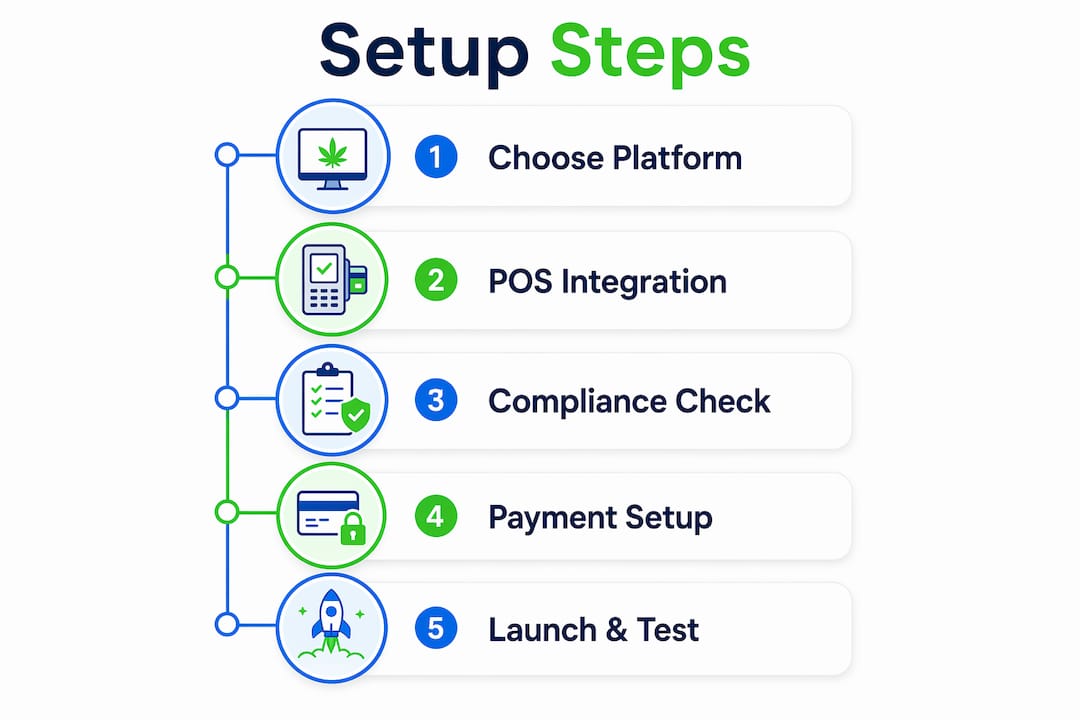
A cannabis ecommerce platform is defined as an integrated digital retail system combining compliant online ordering, real-time inventory management, and automated regulatory reporting into a single operational stack. This cannabis ecommerce setup guide covers every layer you need to build a store that sells, stays compliant, and scales. Platforms like Meadow, Carrot, and Cova have proven that dispensaries with tightly integrated systems consistently outperform those running disconnected tools. Whether you are launching your first cannabis online store or rebuilding a fragmented setup, the decisions you make at the architecture level determine your compliance exposure, your customer experience, and your revenue ceiling.
Compliance is not a feature you add after launch. It is the foundation every other decision rests on. Cannabis ecommerce operates under a dual-layer legal structure where state law permits online ordering and delivery while federal law prohibits interstate shipment of THC products. Federal prohibition blocks cross-border THC shipping, which means every storefront must be configured to serve customers within a single state’s licensed territory.
Your platform must enforce the following requirements before a single order is processed:
Subscription services add another compliance layer. The FTC’s Negative Option Rule was vacated in July 2025, meaning subscription compliance now relies on state auto-renew rules and federal ROSCA enforcement. If you plan to offer loyalty subscriptions or auto-replenishment, build state-specific consent flows into your checkout from day one.
POS and ecommerce integration is the operational core of any cannabis retail setup. POS integration connects your in-store system to your online storefront via a secure API, with the POS serving as the single source of truth for inventory counts, pricing, and compliance state. Every online order feeds back into the POS, which then pushes the transaction into your state traceability system automatically.
Here is how to execute this integration correctly:
Pro Tip: Set a recurring calendar reminder for weekly inventory reconciliation between your POS and your online menu. Even well-integrated systems drift over time, especially after product returns, damaged goods write-offs, or manual adjustments.
Real-time inventory sync prevents overselling and stops your online menu from displaying products that are unavailable or out of compliance. This is not a nice-to-have. It is the difference between a smooth customer experience and a compliance violation that costs you your license.

The right platform features turn browsers into buyers and one-time customers into regulars. Carrot clients average 22% of total revenue from online orders, with top-performing dispensaries exceeding 50%. That gap between average and top performers comes down almost entirely to platform design and feature execution.
The features that move the needle most are:
Pro Tip: Test your checkout flow on three different mobile devices before launch. What works on an iPhone 15 may break on a mid-range Android. Cannabis customers are not patient with broken checkout experiences.
You can find a deeper breakdown of cannabis ecommerce tips that cover conversion optimization specific to dispensary menus and fulfillment workflows.
Multi-state cannabis operators face a structural challenge that single-state dispensaries do not. Each state requires its own storefront configuration with jurisdiction-specific geofencing, product labeling, purchase limits, and checkout rules. A single-store mentality will create compliance violations across every state you operate in.
The table below compares the two primary approaches to multi-state ecommerce architecture:
| Approach | How it works | Best for |
|---|---|---|
| Unified platform with per-state configs | One platform (e.g., Meadow or Cova) with state-specific rule sets applied per storefront | Operators with 2 to 5 state licenses seeking centralized management |
| Separate platforms per state | Independent ecommerce instances for each state, each integrated with its own POS | Large multi-state operators with distinct brand identities per market |
Payment processing deserves its own strategy. Traditional processors will not touch cannabis transactions. Your options in 2026 include cashless ATM networks, ACH-based cannabis payment processors, and PIN debit solutions. Each carries different fee structures and customer experience trade-offs. Cashless ATMs are widely used but carry regulatory scrutiny in some states. ACH processors offer cleaner transaction records but require customer bank account authorization. You can review cannabis payment processing options to match the right solution to your state’s regulatory environment.
The federal-state legal conflict is not resolving quickly. Build your payment infrastructure with the assumption that your processor relationship could change on short notice. Maintain relationships with at least two payment solution providers so that a single processor exit does not take your store offline.
A successful cannabis ecommerce setup requires POS integration, per-state compliance configuration, and conversion-focused platform features working together from day one.
| Point | Details |
|---|---|
| Compliance is foundational | Age verification, geofencing, and Metrc integration must be built in before launch, not added later. |
| POS is the source of truth | Your online menu must pull live inventory and compliance state from your POS to prevent overselling. |
| Platform features drive revenue | Dispensaries with optimized mobile menus and loyalty programs generate over 20% of revenue online. |
| Multi-state needs per-state logic | Each state requires its own storefront rules for labeling, limits, and checkout compliance. |
| Payment infrastructure needs redundancy | Maintain at least two cannabis-approved payment processor relationships to protect against sudden exits. |
I have watched dispensaries spend months selecting the right platform, only to go live with a broken integration and no plan for what happens when the API drops. The failure is almost never the technology. It is the operational design around the technology.
The most common mistake I see is treating POS integration as a one-time setup task. Integration requires ongoing attention. Inventory adjustments, product returns, and new SKU additions all create opportunities for your online menu to drift out of sync with your actual stock. Dispensaries that assign a specific staff member to own the integration, run daily reconciliation checks, and review error logs weekly outperform those that set it and forget it.
The second mistake is underinvesting in staff training. Your budtenders and delivery drivers are part of your compliance stack. If they do not understand how online orders flow through the system, they will create manual workarounds that break your traceability reporting. Train your team on the full order lifecycle before you go live, not after your first compliance incident.
Analytics are where I see the biggest missed opportunity. Most platforms generate rich data on cart abandonment, product views, and fulfillment times. Very few operators use that data to make menu or UX decisions. If a product has high views and low add-to-cart rates, the problem is usually the product description or the price point, not the customer. Use your data to make those calls.
The cannabis ecommerce operators who will win in 2026 are the ones treating their online store as a living system that requires the same operational discipline as their physical floor.
— Max

Building a compliant, high-converting cannabis online store is only half the equation. The other half is making sure customers can find it. Dopeseo specializes in cannabis SEO strategy and compliant web design built specifically for dispensaries, cultivators, and multi-state operators. Every service Dopeseo delivers is designed around the regulatory constraints and platform restrictions that generalist agencies do not understand. If your ecommerce store is live but not generating organic traffic, or if you are building from scratch and need a compliance-ready design, Dopeseo has the industry-specific expertise to close that gap.
Ecommerce integration for dispensaries connects your online storefront to your POS system via API, syncing inventory, pricing, and compliance data in real time. This prevents overselling and automates traceability reporting to state systems like Metrc.
No. Federal law prohibits interstate shipment of THC products regardless of state legalization status. Every cannabis ecommerce storefront must be configured to serve customers within a single licensed state territory.
Meadow, Carrot, and Cova are among the most widely used platforms for cannabis ecommerce. Each offers POS integration, real-time inventory sync, and compliance-ready checkout features designed for licensed dispensaries.
Cannabis dispensaries use cashless ATM networks, ACH-based processors, or PIN debit solutions because traditional processors like Stripe do not support cannabis transactions due to federal banking restrictions. Maintaining relationships with two processors protects against service interruptions.
Setup time depends on POS readiness and inventory data quality. Platforms like Carrot report onboarding within days when POS and inventory data are already organized. Compliance configuration and staff training typically add two to four weeks to the full launch timeline.

© 2026 Curious Monkeys Pressing Buttons LLC DBA Cannabiz Marketing Solutions AKA DopeSEO. All rights reserved.