
TL;DR:
- Effective dispensary reputation management involves continuously monitoring, responding, and improving perception across digital platforms through operational consistency and strategic review practices. Building documented procedures, staff training, and compliance into daily operations are essential foundations for long-term reputation growth and search visibility. In 2026, focusing on review velocity, profile completeness, and local SEO signals is vital, but technology complements rather than replaces disciplined human-led operational efforts.
Dispensary owners often assume reputation management means responding to a few bad Google reviews and calling it done. That framing costs real money. Defining dispensary reputation management correctly means understanding it as a structured system that connects how your operation runs internally to how customers talk about you publicly. Your star rating, review velocity, and search visibility all trace back to decisions made on the floor, not in a marketing meeting. This article breaks down what reputation management actually involves for cannabis retailers, how operational discipline feeds it, and which tools and tactics work in the current market.
| Point | Details |
|---|---|
| Reputation is operational first | Consistent staff training and standardized procedures create the conditions for positive reviews. |
| Review velocity beats total count | Regular fresh reviews outrank sheer volume in local search rankings. |
| Compliance protects reputation | Incentivizing reviews violates Google policies and FTC rules, risking permanent damage. |
| Profile completeness drives rankings | A fully optimized Google Business Profile outperforms incomplete listings even with similar review counts. |
| Match tools to your stage | Choose reputation tools based on dispensary size, market competition, and whether you need crisis response or growth. |
Reputation management for a cannabis dispensary is the ongoing process of monitoring, shaping, and recovering how your business is perceived across every digital and in-person touchpoint. It is not a campaign. It does not start and stop. It runs continuously, because your competition is always collecting reviews while you sleep.
The core elements break down into four operational phases:
Beyond those four phases, there is a broader arc to understand. Dispensaries move through three reputation stages: building, maintaining, and recovering. A new location focuses on building a baseline of trust and review volume. An established dispensary maintains it by keeping quality consistent and review flow steady. A dispensary that has taken reputational damage, whether from a public complaint, a compliance issue, or a viral negative experience, must recover deliberately and patiently.
One thing that separates dispensary reputation management from generic marketing is the regulatory layer. Cannabis businesses cannot run the same ads, promotions, or review campaigns that restaurants or retail shops use freely. Your reputation strategy must stay within platform terms of service, FTC guidelines, and state cannabis regulations simultaneously. Ignoring any one of those creates exposure that no marketing budget can fix.
Most dispensary owners want to fix their reputation by getting more reviews. That is the wrong starting point. Operational inconsistency leads directly to service variability, and service variability is what generates the one-star reviews in the first place.
Think about what happens when you open a second location without documented procedures. Budtender product knowledge varies. Wait times differ. The checkout experience feels different. Customers who love your first location walk into the second expecting the same experience and leave disappointed. That disappointment shows up on Google by the weekend.
Standardized operating procedures are not just an HR formality. They are a reputation management tool. When every staff member knows how to greet a first-time customer, explain product categories, and handle a complaint, you eliminate the randomness that produces negative reviews. Reputation management is a byproduct of how consistently you operate, not just a function of how actively you market.
Staff training also directly affects review generation. Budtenders who feel confident in their knowledge are more likely to ask for a review at checkout, and more likely to do it in a way that feels natural rather than awkward. A nervous or under-trained employee asking for a review is less effective than a confident one who has had that conversation dozens of times.
Pro Tip: Run a monthly “shadow session” where a manager observes the checkout process specifically to assess how naturally review requests are being made. Adjust training based on what you hear, not what you assume.
Centralized compliance management also protects reputation at the operational level. A single compliance failure, a labeling error, a failed inspection, or a regulatory violation, can generate negative press coverage that no SEO tactic can bury quickly. Building compliance into daily operations is a reputation strategy, whether or not it looks like one.

Once your operations are consistent, digital reputation management becomes about amplifying the positive experiences you are already creating. The mechanics have gotten more specific in 2026, and understanding the benchmarks matters.
Here is how the local search ranking picture looks for dispensaries right now:
The compliance piece on the digital side is non-negotiable. Incentivizing reviews with discounts, loyalty points, or free products violates both Google’s policies and FTC regulations. The risk is account suspension and long-term reputational harm, not a slap on the wrist. Do not do it.
Pro Tip: Post new photos to your Google Business Profile at least twice a month. Google’s algorithm reads regular profile activity as a signal of business health, and it costs nothing.
For dispensaries ready to treat local SEO as a core reputation channel, Dopeseo’s local search ranking factors resource is a strong reference for understanding which signals move the needle most in cannabis-specific markets.
| Digital factor | Why it matters | 2026 priority level |
|---|---|---|
| Review velocity | Fresh reviews outrank total volume in local rankings | High |
| Google Business Profile completeness | Full profiles beat incomplete ones regardless of review count | High |
| LocalBusiness schema | Underused tactic that improves search engine clarity | Medium |
| Geo-targeted content pages | Extends reach beyond map pack radius | Medium |
| Authentic review generation | Builds trust signals without compliance risk | High |
Treating community trust, authority signals, and AI discoverability as a unified system, rather than separate tactics, is the direction the industry is moving. Dispensaries that integrate these elements see more sustained local search growth than those running them as isolated campaigns.
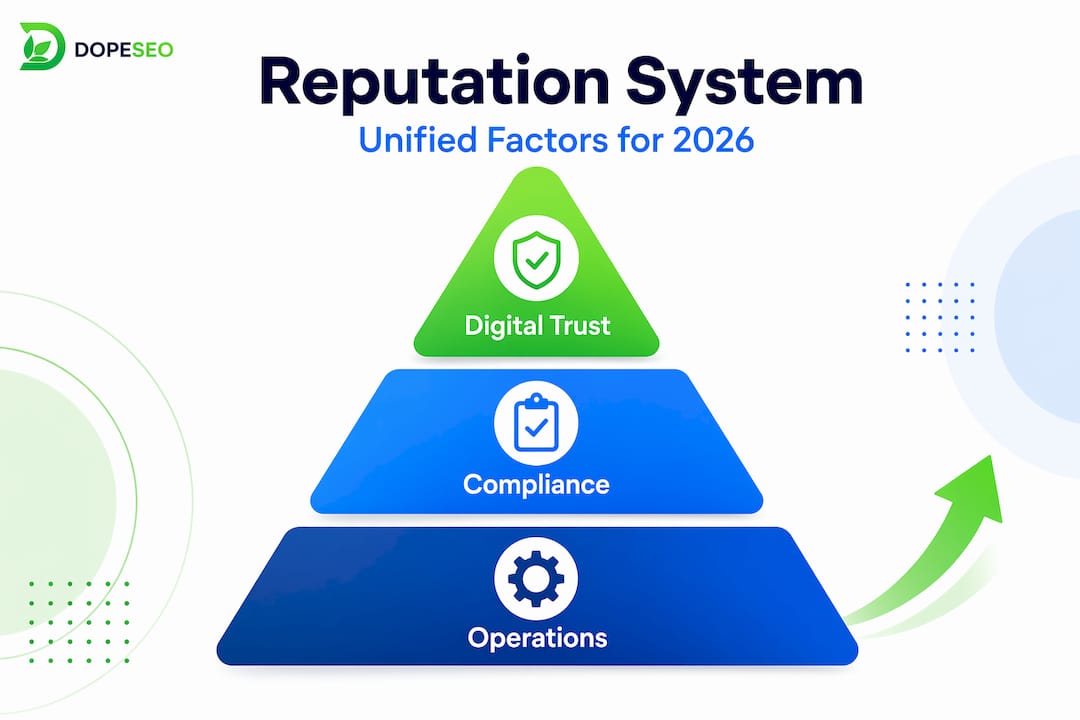
Understanding the theory is one thing. Putting it into practice requires a repeatable process your team can actually run without you supervising every step.
Here are the concrete steps that work:
Pro Tip: When responding to a negative review, never mention specific products or make medical claims. Keep it professional, acknowledge the concern, and invite the customer to contact you directly. This protects your compliance standing while demonstrating good faith.
The pitfalls to avoid are just as important as the steps to follow. Discount incentives for reviews, purchased reviews, and generic review-request blasts sent to your entire loyalty list all carry risks that outweigh any short-term gain. Build slowly, build authentically, and the compounding effect takes over within a few months.
Choosing the right tools depends entirely on where your dispensary sits right now. Tailored strategies outperform one-size-fits-all solutions, and that applies to software just as much as strategy.
| Tool type | Best for | Key strength | Potential limitation |
|---|---|---|---|
| Cannabis-specific platforms (e.g., Leafly, Weedmaps built-in tools) | Single-location dispensaries | Audience relevance, no setup needed | Limited cross-platform monitoring |
| General review management software | Multi-location operators | Centralized dashboard, automation | May lack cannabis compliance features |
| AI-powered local SEO systems | Growth-focused dispensaries | Predictive insights, content automation | Higher cost, learning curve |
| Crisis management agencies | Dispensaries under reputational threat | Fast response, PR expertise | Expensive for ongoing use |
For a dispensary just getting started, the priority is a tool that monitors Google and Leafly reviews in one place and sends alerts when new reviews come in. For a multi-location operator, you need something with centralized dashboards so you can see which location is underperforming before it becomes a problem. Dispensary owners at the growth stage are increasingly turning to AI-powered systems that integrate reputation data with local search signals to identify opportunities in real time.
The key compliance criteria to look for in any tool: it should not automate review requests in ways that violate Google’s terms, it should flag fake review risks, and it should integrate with your Google Business Profile rather than work around it.
I’ve seen dispensary owners spend significant money on marketing agencies to clean up a reputation problem that was caused entirely by a training failure inside their own store. The reviews were bad because the experience was inconsistent. No amount of SEO or review management fixes that root problem.
What I’ve learned from working with multi-location cannabis retailers is that the dispensaries with the strongest reputations in competitive markets are almost always the ones with the most disciplined internal operations. They have documented procedures for every customer-facing interaction. They review their Google ratings weekly. They treat a drop in their star average the same way they treat a drop in sales.
My honest advice: before you invest in any reputation management tool or agency, audit your in-store experience first. Send mystery shoppers. Review your last 20 one-star reviews for patterns. If you see the same complaint appearing repeatedly, that is an operational problem wearing a reputation problem’s face.
The AI tools coming into the cannabis space are genuinely useful for monitoring and response automation. But they work best on top of a solid operational foundation. A dispensary with inconsistent service and an AI chatbot responding to reviews is still a dispensary with inconsistent service.
Balance technology with human judgment. Automation handles volume. Human judgment handles nuance. You need both to manage a dispensary reputation well in 2026.
— Max
Reputation management and local search visibility are two sides of the same coin for cannabis dispensaries. If your Google Business Profile is incomplete, your review velocity is flat, or your local SEO foundation is missing, your reputation efforts will always fight uphill.
Dopeseo works exclusively with cannabis businesses, which means the strategies we apply are built around the regulatory realities and platform restrictions your dispensary faces every day. From ethical digital marketing practices that keep you compliant, to proven cannabis SEO strategies for 2026 that build lasting local visibility, Dopeseo’s services are designed specifically for operators like you. Whether you need a full reputation audit, local SEO buildout, or content strategy, the team is ready to help you compete in your market.
Dispensary reputation management is the ongoing process of monitoring, responding to, improving, and sustaining how your cannabis business is perceived online and in your community. It combines operational consistency with digital tactics like review generation and Google Business Profile optimization.
Competitive metropolitan dispensaries need 100 or more reviews averaging at least 4.4 stars to hold top local map pack positions. Smaller markets require around 50 reviews with a 4.5-star average.
No. Incentivizing reviews with discounts or loyalty points violates Google’s policies and FTC regulations and can result in account suspension or permanent reputational damage.
Review velocity refers to how frequently your dispensary receives new reviews. Regular fresh reviews are a stronger local ranking signal than total review count, because they indicate an active, trustworthy business to search algorithms.
Look for tools that monitor reviews across Google, Leafly, and Weedmaps from a single dashboard, comply with platform terms of service on automated outreach, and integrate with your Google Business Profile. Tailored solutions that match your dispensary size and goals consistently outperform generic platforms.

© 2026 Curious Monkeys Pressing Buttons LLC DBA Cannabiz Marketing Solutions AKA DopeSEO. All rights reserved.