
TL;DR:
- Ecommerce SEO involves optimizing large-scale product and category pages to improve organic search rankings and attract buyers. It requires managing crawl architecture, structured data, internal linking, and content mapped to buyer intent to build a sustainable revenue system. Fixing technical issues like faceted navigation and implementing structured data are crucial before content improvements can effectively boost rankings.
If you run an online store and you’ve heard the phrase “explaining ecommerce SEO” tossed around in marketing meetings, you might assume it means adding keywords to product titles and calling it a day. It doesn’t. Ecommerce SEO, the practice of optimizing an online store to rank in organic search results and attract buyers, is far more layered than standard website SEO. It involves crawl architecture, product schema, faceted navigation control, and content mapped to purchase intent. This guide covers all of it, so you understand exactly what moves the needle and why.
| Point | Details |
|---|---|
| Product and category pages are the priority | Highest-leverage pages for rankings are product and category pages, not blog posts. |
| Technical SEO is non-negotiable | Faceted navigation and poor crawl architecture silently block Google from indexing your best pages. |
| Structured data drives AI visibility | Product schema with pricing, availability, and reviews qualifies your listings for rich results and AI shopping citations. |
| Reviews and first-party data create a moat | Original customer data and Q&A content differentiate your store in ways competitors cannot copy quickly. |
| Content maps to buyer intent | Buying guides, comparisons, and FAQs support each stage of the purchase decision and build topical authority. |
Ecommerce SEO is the process of making your online store visible to people searching for the products you sell. The industry term you’ll see in technical discussions is “organic search optimization for ecommerce,” but in practice most practitioners just call it ecommerce SEO. What sets it apart from a blog or service site is the scale and complexity. A store with 5,000 products has thousands of pages to optimize, each with unique data requirements, and the platform structure controls what Google can actually access and rank.
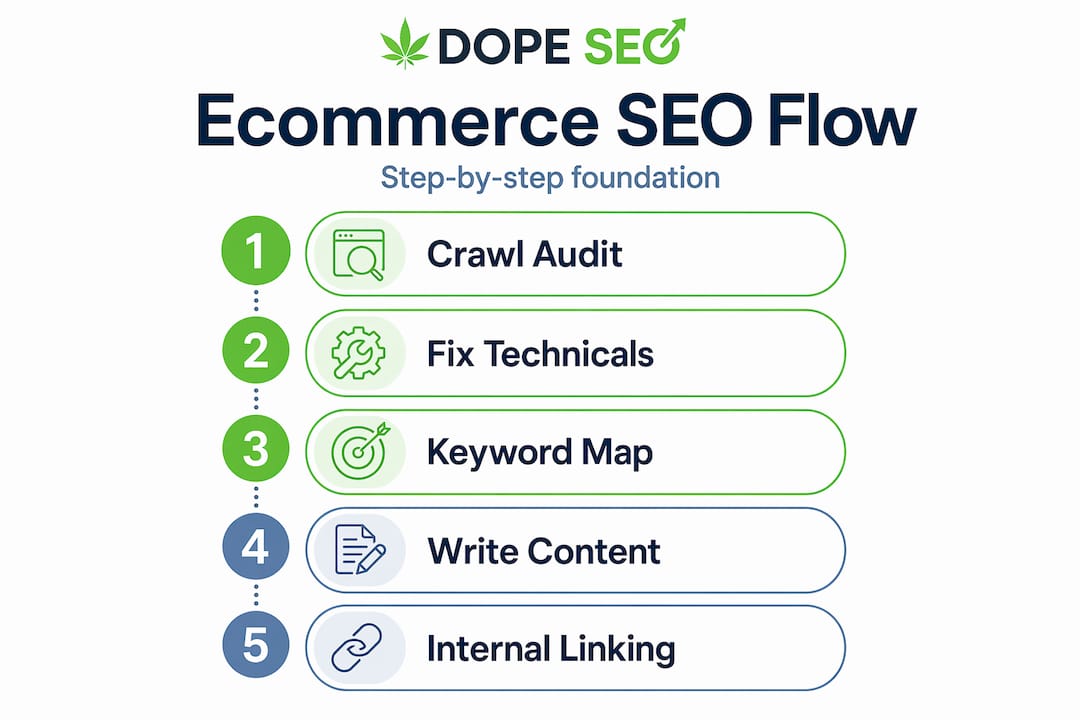
The core pillars work together as a system. No single pillar compensates for a broken one.
Pro Tip: Map every content asset to a specific stage of the buying journey before you write it. Informational content (guides, FAQs) belongs at the top of the funnel. Product and category pages close the sale. Build both layers and link them together.
When these six elements align to one revenue goal, your store earns organic traffic that compounds over time without paying for every click.
Technical SEO for ecommerce is where most stores lose ground quietly. The problems are invisible to shoppers but very visible to Google’s crawlers.
Here are the most common technical issues and how to address them:
Faceted navigation URL explosion. A store with 5,000 products and 10 filters can generate 500,000 faceted URLs if left unmanaged. Google wastes its crawl budget on these low-value pages instead of your actual product listings. The fix is a combination of canonical tags pointing filter URLs to the canonical category page, noindex directives on non-SEO-worthy filter combinations, and robots.txt rules to block crawler access to the worst offenders.
Core Web Vitals, especially INP. Interaction to Next Paint replaced First Input Delay as a ranking signal, and INP thresholds require scores below 200ms for a “good” rating. One Shopify store reduced INP from 612ms to 178ms in five days and saw ranking improvements as a direct result. Third-party scripts are almost always the culprit on ecommerce platforms.
JavaScript rendering blocking product data. If your product prices, descriptions, or availability are loaded via client-side JavaScript, Google may not index that data correctly. Server-side or hybrid rendering is required for reliable indexation of critical product information.
International SEO and hreflang. Stores selling across multiple markets need hreflang tags implemented correctly on every page variant. Errors here cause the wrong language or regional version to rank in the wrong country, splitting ranking signals.
Here’s a quick comparison of the most common technical issues and their fixes:
| Technical issue | Primary fix | Secondary consideration |
|---|---|---|
| Faceted navigation URL sprawl | Canonical tags plus noindex | Robots.txt disallow for worst patterns |
| Slow INP scores | Audit and defer third-party scripts | Server-side rendering for key elements |
| JavaScript-rendered product data | Move to server-side rendering | Validate with Google’s URL Inspection tool |
| Hreflang errors for international stores | Validate tags with dedicated tools | Align with geo-targeted domain structure |
Pro Tip: Large ecommerce catalogs fail from inefficient crawl architecture before content quality becomes a factor. Fix your crawl and indexation first. Content improvements have nowhere to land if Google can’t reach your pages.

Reviews are not just trust signals for shoppers. They are semantic content that Google and AI systems read to understand what a product does, who it’s for, and how it performs. Advanced ecommerce SEO tactics in 2026 treat reviews and Q&A as structured content that helps AI shopping tools understand your catalog, not just rank it.
Here’s what actually matters when building this layer of your SEO:
Pro Tip: Collect first-party data systematically. Send a short post-purchase survey at the 30-day mark asking about sizing accuracy, durability, and product expectations. Publish aggregated findings on the relevant category or product pages. This content cannot be replicated by competitors.
Content marketing and internal linking are not separate activities in ecommerce SEO. They work as a system. Content attracts searchers at every stage of the buying journey, and internal links transfer authority from those content pages to your product and category pages where conversions happen.
Here is a repeatable process for building this system:
Map keywords by purchase intent. Group your keyword list into three tiers: informational (how-to, what-is queries), comparative (best X for Y, X vs Z), and transactional (buy X, X price, X near me). Each tier maps to a specific page type.
Assign page types to each tier. Informational keywords go to blog posts and guides. Comparative keywords go to buying guide pages or category pages with editorial content. Transactional keywords go directly to product and category pages.
Write with specificity. A buying guide for “best topical CBD for joint pain” should reference specific product attributes, dosing ranges, and ingredients. Vague guides don’t rank and don’t convert.
Link from content to commercial pages with descriptive anchor text. Linking from a blog post about “how to choose a CBD tincture” to your tinctures category page using anchor text like “full-spectrum CBD tinctures” passes authority and context. Strong internal linking boosts rankings for category pages far beyond what navigational links alone can achieve.
Audit for orphan pages. Any product or category page with no internal links pointing to it is invisible to Google’s crawl in practice. Manual internal linking audits are necessary because automated tools frequently miss whether Google is effectively guided to priority pages.
Build topical clusters. Group related content into hubs with one pillar page and several supporting posts, all linked together. This structure signals category authority to Google and helps your store rank for the full range of queries in a product niche.
The timeline on this work is longer than most owners expect. Technical and schema fixes typically take four to six months to visibly impact rankings. Topical content clusters compound over six to twelve months. Plan accordingly and measure progress by organic sessions to commercial pages, not just overall traffic.
I’ve worked with enough online stores to say this clearly: the biggest SEO mistakes I see are never about keyword density or meta descriptions. They are about broken crawl architecture, ignored faceted navigation, and internal linking that guides no one.
What I’ve found is that store owners chase content upgrades while Google literally cannot find half their product pages. Fix the technical foundation first, every time. Content improvements only compound when the index is healthy.
The other thing I’ll say plainly: AI visibility has changed the priority order. Structured data and first-party product information now matter as much as traditional ranking signals because Google’s AI shopping features pull from structured, extractable content, not just ranked pages. Stores that optimize only for classical SEO will get left behind in shopping experiences powered by AI.
The stores that win are the ones treating SEO as a revenue system, not a checklist. Catalog structure, product data quality, technical health, content, and conversion rate optimization all have to point toward the same goal. Isolate any one of them and you lose the compounding effect that makes organic traffic genuinely profitable.
— Max
If this article clarified what your store is missing, the next step is getting expert eyes on your specific situation. Dopeseo works with ecommerce businesses to diagnose crawl issues, implement structured data, build content strategies, and fix the technical problems that quietly suppress rankings.
Whether your store needs a full SEO strategy overhaul or targeted fixes in specific areas, Dopeseo has the experience to move from diagnosis to results. Explore the full range of ecommerce SEO services and see how a structured approach translates into organic traffic that actually drives revenue.
Ecommerce SEO is the process of optimizing an online store’s product and category pages to rank in organic search results. It differs from standard SEO because it requires managing large-scale catalogs, faceted navigation, product schema, and crawl architecture that typical content sites don’t have.
Technical and schema improvements typically take four to six months to impact visibility, while topical content clusters compound over six to twelve months. AI citation visibility can appear within four to eight weeks of implementing structured data correctly.
Faceted navigation generates thousands of low-value URL combinations that waste Google’s crawl budget. A store with 5,000 products and 10 filters can create 500,000 faceted URLs without proper canonical tags and noindex directives in place.
Product schema with fields like price, availability, and AggregateRating qualifies your listings for rich results in Google Search and makes your product data readable by AI shopping tools. This directly increases click-through rates and positions your store for AI-driven shopping citations.
First-party data is original information you collect directly from your customers, such as return rates, sizing feedback, or product durability surveys. Publishing this data on your product and category pages creates content no competitor can replicate, which is a significant advantage for AI shopping citations that favor unique, extractable sources.

© 2026 Curious Monkeys Pressing Buttons LLC DBA Cannabiz Marketing Solutions AKA DopeSEO. All rights reserved.