
TL;DR:
- Mobile-first indexing priority makes mobile site performance crucial for Google rankings.
- Responsive design with content parity ensures better user experience and search visibility.
- Optimizing Core Web Vitals improves site speed, stability, and user engagement on mobile devices.
If you still think your desktop site is the main driver of Google rankings, it’s time to update that assumption. Mobile-first indexing is now Google’s standard, meaning the mobile version of your site is what Google primarily crawls, indexes, and ranks. For cannabis and hemp businesses competing in local search, this shift is not a minor technical footnote. It determines whether customers find you or your competitor when they search for a dispensary nearby. This guide breaks down exactly what mobile optimization means for your brand, what Google requires, and the specific mistakes that cost cannabis businesses rankings and revenue.
| Point | Details |
|---|---|
| Google’s mobile-first rule | Google crawls and ranks your site based on its mobile version, making mobile optimization essential. |
| Responsive design wins | A single responsive site is easier to maintain and meets both user and search engine needs. |
| Meet Core Web Vitals | Improving LCP, INP, and CLS helps boost search visibility and keep mobile users happy. |
| Match mobile and desktop content | Ensure all important content is available on both mobile and desktop for better indexing. |
| Avoid common pitfalls | Biggest mistakes include too small tap targets, intrusive popups, and slow load times. |
Your customers are almost certainly searching on their phones. Think about the typical buying journey: someone is out, they want to find a nearby dispensary, and they pull out their phone and type “dispensary near me.” That moment is where your mobile site either wins the click or loses it to a competitor.
Local cannabis searches are overwhelmingly mobile-driven. When your site loads slowly, displays poorly, or frustrates users on a small screen, those visitors leave fast. Google tracks that behavior. High bounce rates and short session times send negative signals that can drag down your local rankings over time.
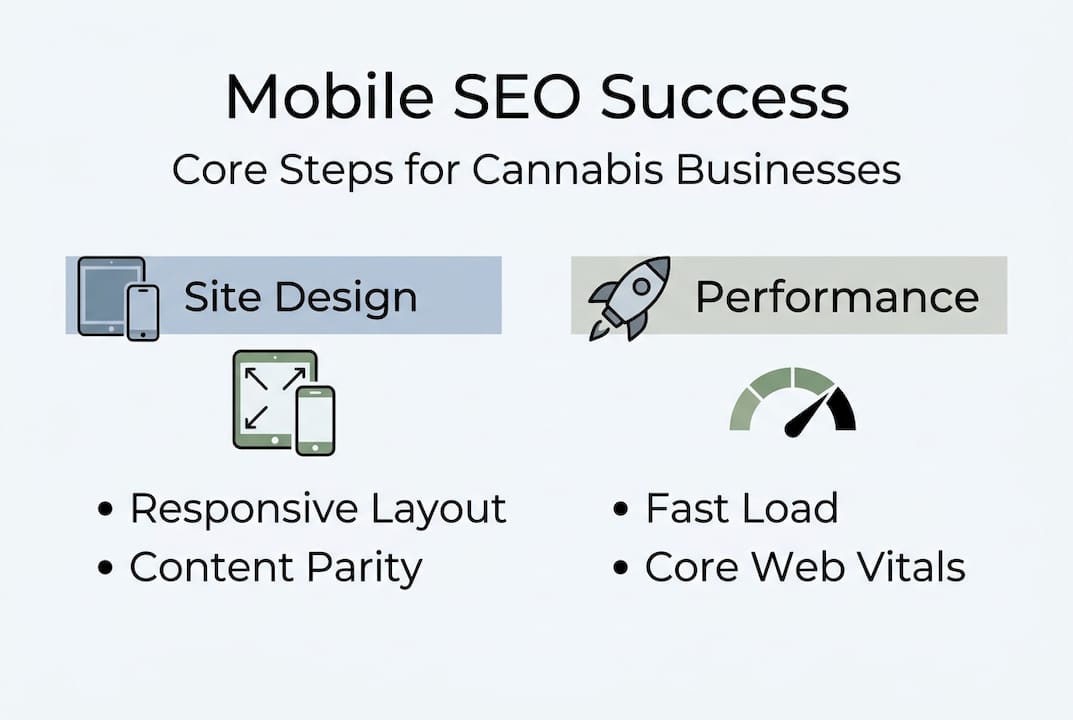
Beyond user behavior, there is a structural reason to prioritize mobile. Mobile-first indexing means Google uses your mobile version to determine your overall search ranking, not your desktop version. Even if your desktop site is beautifully designed and technically sound, a weak mobile experience will suppress your rankings across all devices.
Here is what that means in practice for cannabis businesses:
“A flawless desktop site means nothing if Google’s crawler sees a broken mobile version. Your rankings reflect your mobile experience first.”
For cannabis brands navigating a competitive local market, investing in mobile SEO for cannabis is not optional. It is the baseline for being found at all.
Now that you understand why mobile performance matters, let’s get into what it actually requires. There are three foundational pillars: responsive design, content parity, and technical health.

Responsive design means your website uses a single URL and a single codebase that adapts its layout to fit any screen size. This is different from an “m-dot” site, which is a separate mobile site hosted at something like m.yoursite.com. Responsive design is Google’s recommended method for mobile optimization because it avoids duplicate content issues, simplifies link equity, and reduces maintenance overhead.
Content parity is equally critical. Key content should not differ between your mobile and desktop versions. If your desktop site has detailed product descriptions, strain information, and structured data (also called schema markup) but your mobile version strips those out for simplicity, Google only sees the stripped version. That means your rankings suffer for all the content you worked hard to create.
Here is a quick comparison of the two main mobile approaches:
| Approach | URL structure | Maintenance | SEO risk |
|---|---|---|---|
| Responsive design | Single URL | Low | Minimal |
| Separate m-dot site | Two URLs | High | Duplicate content risk |
| Dynamic serving | Single URL | Medium | Misconfiguration risk |
For most cannabis businesses, responsive design is the clear winner.
Technical health covers the details that can quietly undermine your mobile performance:
Pro Tip: Use Google Search Console’s URL Inspection tool to see exactly how Googlebot renders your mobile pages. If the rendered version looks broken or incomplete, that is what Google is indexing.
Responsive design and content parity get your foundation right. But Google also measures how fast and stable your site feels to real users. That is where Core Web Vitals (CWV) come in.
Core Web Vitals are three specific performance metrics Google uses to evaluate page experience:
These CWV thresholds for mobile are the benchmarks Google uses to classify your site as “good,” “needs improvement,” or “poor.” Falling into the poor category is a ranking disadvantage you cannot afford in a competitive cannabis market.
According to mobile performance data, a significant portion of mobile sites still fail to meet these thresholds. Cannabis sites with large product catalogs, video content, and compliance overlays are especially vulnerable to CWV failures.
Here are the most impactful fixes you can make:
| Metric | Common cause of failure | Fix |
|---|---|---|
| LCP | Unoptimized hero images | Compress images, use a CDN, implement lazy loading |
| INP | Heavy JavaScript | Defer non-critical scripts, reduce third-party code |
| CLS | Images without dimensions | Always specify width and height attributes |
For cannabis content optimization, use the "srcset` attribute on images so browsers load the right image size for each screen. Avoid loading full-resolution product photos on mobile when a smaller version works just as well.
“Passing Core Web Vitals is not just a technical checkbox. It directly affects how users feel when they visit your site, and that feeling drives conversions.”
Run your site through Google PageSpeed Insights regularly. It gives you specific, actionable recommendations tied directly to your CWV scores.
Even cannabis businesses that invest in mobile design often make avoidable mistakes that undermine their rankings and user experience. Knowing what to watch for saves you time and money.
Here are the most common mobile pitfalls we see:
user-scalable=no or maximum-scale=1 in your viewport meta tag prevents users from zooming in. This is an accessibility violation and a confirmed ranking signal Google watches for.One thing that is often misunderstood: using accordions and tabs to organize content on mobile is perfectly fine. Google can index content inside these elements. The issue arises only if the content is intentionally hidden from crawlers using CSS or JavaScript in a way that prevents indexing.
Pro Tip: Run your site through Google’s Mobile Usability report in Search Console monthly. It flags specific pages with tap target issues, viewport errors, and content-wider-than-screen problems so you can fix them before they hurt rankings.
For a complete checklist of what to fix, our on-page SEO tips for cannabis brands cover both technical and content-level improvements you can act on immediately.
Here is the honest truth: most cannabis businesses treat mobile optimization as a one-time task rather than an ongoing practice. They launch a responsive site, run one speed test, and consider it done. That is where the gap forms.
We also see a pattern of designing purely to pass Google’s tests. Owners optimize for scores, not for the actual person standing in a parking lot trying to find your menu on a 4G connection. Those are two different goals, and only one of them builds a loyal customer base.
The cannabis brands that consistently win in local search treat mobile UX (user experience) as a living part of their business. They run quarterly audits, test on real devices across different network speeds, and pay attention to where users drop off in their analytics.
Building genuine mobile SEO expertise means understanding that Google’s standards and your customers’ needs mostly overlap, but not perfectly. Fill both gaps and you will outperform competitors who only chase one.
You now have a clear picture of what mobile optimization requires and where most cannabis businesses fall short. The next step is making sure your site actually meets these standards in a way that drives real local visibility and revenue.

At Dope SEO, we specialize in building and optimizing mobile-friendly, compliant cannabis websites that are built to rank. Whether you are starting from scratch or auditing an existing site, our team understands the unique technical and regulatory demands of the cannabis space. Explore our cannabis SEO 2026 guide to see the full picture, or review our SEO strategies for cannabis to map out your next move. For site-level work, our cannabis web design service builds mobile-first from the ground up.
Mobile-first indexing means Google uses your site’s mobile version as the primary basis for ranking and indexing, so a poor mobile experience directly lowers your search visibility across all devices.
Use Search Console and PageSpeed Insights to identify mobile usability errors, Core Web Vitals failures, and specific pages that need attention.
Core Web Vitals thresholds include LCP under 2.5 seconds, INP under 200 milliseconds, and CLS under 0.1, and hitting all three puts your site in Google’s “good” performance category.
No. Content parity between mobile and desktop is required for Google to fully index your site, so stripping content from your mobile version will hurt your rankings.
Avoid user-scalable=no, tiny tap targets, and intrusive interstitials on mobile, and always use a minimum 16px font size to keep your site accessible and ranking well.
