
TL;DR:
- Backlinks now support content and user experience, accounting for about 13% of SEO weight.
- Quality, relevance, and compliance are crucial for backlinks, not just volume or quantity.
- Organic link building from authoritative, compliant publishers strengthens trust and sustains rankings.
If you’ve been chasing backlink volume to rank your cannabis business higher, you’re likely working against yourself. The SEO landscape has shifted dramatically, and cannabis brands face a uniquely difficult environment where mass link building doesn’t just fail, it can actively suppress your visibility. Backlinks still matter, but their role has evolved. They now account for roughly 13% of algorithmic weight, sitting third behind content and user experience. This guide breaks down what backlinks actually do for cannabis SEO in 2026, how AI and regulations have changed the rules, and what strategies will genuinely move the needle for your business.
| Point | Details |
|---|---|
| Backlinks support authority | Contextual, quality backlinks build trust and visibility for cannabis websites. |
| Relevance matters most | AI and search algorithms favor backlinks from related, authoritative sources over volume. |
| Avoid risky tactics | Massive link-building can result in suppression; prioritize compliance and safe outreach. |
| Balance strategy in 2026 | Backlinks are important but must be balanced with content excellence and user experience. |
A backlink is simply a link from one website to yours. When another site links to your dispensary or cannabis brand, search engines interpret that as a vote of confidence. The more credible and relevant that linking site is, the more weight that vote carries.
For years, SEO professionals treated backlinks as the dominant ranking factor. Build enough of them, the thinking went, and your rankings would climb. That approach is outdated. Today, backlinks and cannabis SEO work together with content quality, user experience, and E-E-A-T signals (experience, expertise, authoritativeness, and trustworthiness) to determine where you rank.
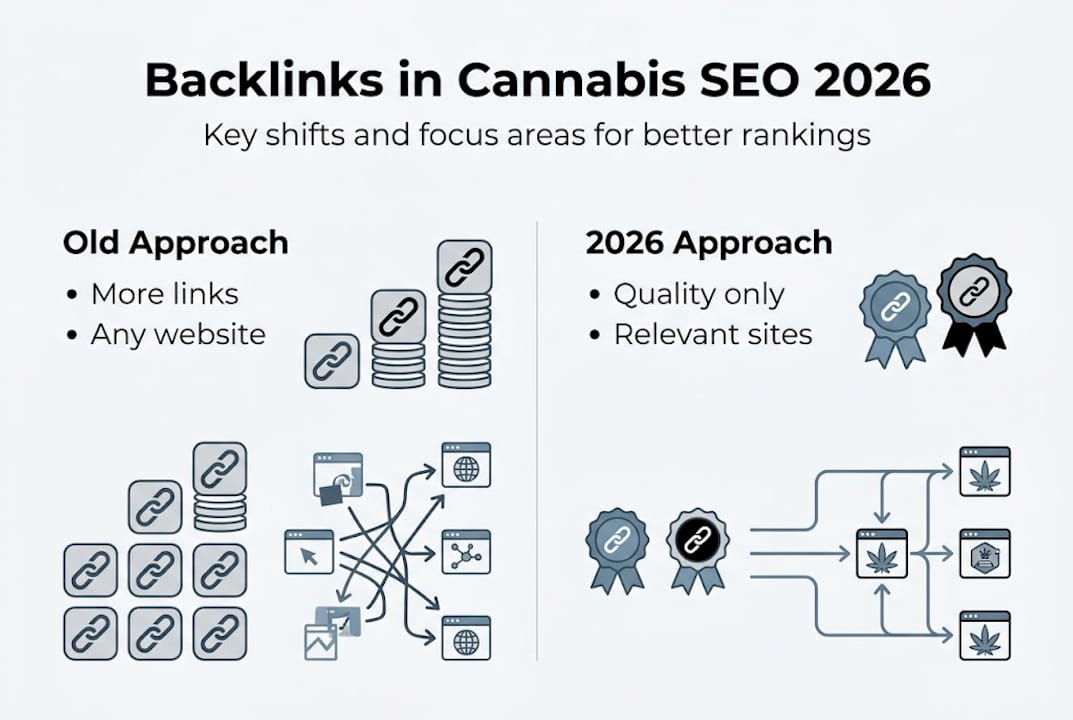
Search engines, especially those powered by AI, now evaluate the full picture of your site’s credibility. A single backlink from a respected cannabis publication or a well-known health and wellness outlet can do more for your rankings than 50 links from low-quality directories. Relevance and context matter more than raw numbers.
Here’s why backlinks still matter for cannabis businesses specifically:
The key shift is this: backlinks are now a supportive factor, not the primary driver. They amplify the strength of your content and UX rather than replace it. Understanding link building strategies tailored to cannabis means accepting that fewer, better links will always outperform a flood of irrelevant ones.
The SEO world changed significantly when AI-driven algorithms became the norm. These systems don’t just count links; they analyze context, relevance, and the relationship between linking sites. That changes everything for cannabis businesses.
One of the most important nuances is how AI treats different link types. Nofollow and image links now carry partial equity and relevance signals in AI-powered ranking systems. This matters because many compliant publishers in adjacent industries, like health, wellness, and lifestyle, use nofollow attributes by default. Previously, those links were considered worthless. Now, they contribute to your authority in meaningful ways.
For cannabis brands specifically, the regulatory environment creates a layer of complexity that doesn’t exist in most other industries. You can’t advertise on Google Ads or Facebook the same way a retail store can. That restriction pushes more of your growth strategy toward organic search, making your backlink profile even more critical.
But here’s the risk: cannabis sites face suppression over direct penalties when their backlink profiles look spammy or unnatural. Suppression means your rankings quietly drop without a formal manual action. It’s harder to detect and harder to recover from. Private blog networks (PBNs), rapid velocity spikes, and irrelevant links are the main triggers.
“In regulated markets, a quality backlink profile builds trust faster than volume ever could. Custom outreach to compliant publishers is the only sustainable path.” Cannabis SEO backlinks
The scarcity of quality backlink opportunities in cannabis actually works in your favor if you approach it correctly. Because most publishers won’t touch cannabis content, the ones that do carry significant weight. Improving backlink authority in this environment means identifying those rare, compliant publishers and building real relationships with them.
| Factor | Old approach | New approach |
|---|---|---|
| Volume | Hundreds of links per month | Fewer, highly relevant links |
| Link type | Dofollow only | Dofollow and nofollow both valued |
| Source quality | Any DA score | Relevance and compliance matter most |
| Strategy | Automated outreach | Custom, relationship-based outreach |
| Risk | Penalties | Suppression (harder to recover from) |
| Outcome | Short-term ranking spikes | Sustained authority and trust |
Understanding the strategic benefits of backlinks in this context helps you build a profile that holds up over time rather than one that collapses after the next algorithm update.
The 2026 shift in backlink strategy is clear: AI and large language models value authority and contextual relevance over sheer link count. For cannabis brands, this means your outreach needs to be surgical, not scattered.
Contextual links from relevant publishers are the gold standard. A dispensary that earns a mention in a cannabis industry publication, a local lifestyle blog, or a health-focused outlet gets far more value than one that buys links from generic directories. The link needs to make sense to a human reader, and AI can tell the difference.

| Strategy | Ranking impact | Risk level | Sustainability |
|---|---|---|---|
| Quality contextual outreach | High | Low | Long-term |
| Mass directory submissions | Low | Medium | Short-term |
| PBN links | Temporary spike | Very high | None |
| Guest posting on relevant sites | Medium-High | Low | Long-term |
| Paid link schemes | Unpredictable | Very high | None |
The link building power in cannabis comes from earning trust, not buying it. Here’s a practical framework for building a high-impact, low-risk backlink campaign:
Pro Tip: Before reaching out to any publisher, check whether they accept cannabis-related content and whether their site is monetized through AdSense. AdSense-compliant publishers are generally safer partners because they already operate within content guidelines that align with your compliance needs.
Avoiding the wrong tactics is just as important as executing the right ones. Learn about protecting against negative SEO so competitors can’t damage your profile by pointing spammy links at your domain.
Cannabis SEO carries risks that most industries don’t face. Understanding the difference between suppression and a manual penalty is critical for protecting your rankings.
A manual penalty is a formal action from Google, usually visible in Google Search Console. It’s serious but transparent. You know it happened, and there’s a clear process to resolve it. Suppression is subtler. Your rankings quietly decline because AI algorithms have flagged your backlink profile as low-quality or manipulative. There’s no notification. Many cannabis businesses experience this and assume their content is the problem when the real issue is their link profile.
Spammy links, PBNs, and velocity spikes are the primary suppression triggers for cannabis sites. Because cannabis is already a sensitive category, algorithms apply additional scrutiny. Relevance matters more than raw domain authority in this context.
Here are the warning signs and quick checks you should run regularly:
Review your backlink profile monthly using a reputable SEO tool. Disavow links that look manipulative or irrelevant. Staying proactive about cannabis SEO compliance keeps your profile clean and your rankings stable.
If you suspect a competitor is pointing bad links at your site, that’s a real threat called negative SEO. Knowing how to respond quickly is part of running a serious cannabis marketing operation.
Here’s the uncomfortable truth: most cannabis marketers still treat backlinks like it’s 2015. They chase volume, use automated outreach tools, and measure success by the number of links acquired rather than the quality of relationships built.
That approach doesn’t just underperform. In a regulated industry, it actively works against you. We’ve seen cannabis brands with hundreds of low-quality links get quietly suppressed while a competitor with 30 well-placed, relevant links climbs steadily to page one.
The scarcity of compliant publishers in cannabis is not a disadvantage. It’s a filter. It removes lazy competitors from the equation and rewards brands willing to do the real work of relationship-based outreach.
One cannabis retailer we observed shifted from a volume-based approach to targeting just 10 to 15 highly relevant publishers per quarter. Within six months, their organic traffic increased significantly, not because they had more links, but because the links they had carried genuine authority and contextual relevance.
The brands winning in cannabis SEO right now understand that a backlink is not just a ranking signal. It’s a trust signal. And in a market where consumers are making decisions about products they put in their bodies, trust is everything. Explore the strategic benefits of backlinks to see how a focused approach translates into real business growth.
Building a strong backlink profile in cannabis takes more than good intentions. It takes industry-specific knowledge, compliant outreach, and a strategy built around how AI actually evaluates authority today.
At Dope SEO, we specialize in exactly this. Our team understands the regulatory landscape, the platform restrictions, and the publisher relationships that make cannabis link building work. Whether you’re a dispensary looking to dominate local search or a brand trying to build national authority, we have the tools and expertise to help. Explore our cannabis SEO best practices, review our dispensary SEO strategies, or visit Dope SEO to learn how we can build a backlink strategy that actually moves your rankings.
Yes. AI algorithms now consider nofollow and image links as partial equity and relevance signals, making them especially useful in regulated industries where compliant publishers often apply nofollow attributes by default.
Cannabis websites are more likely to experience suppression from spammy links or PBNs than a formal penalty, so prioritizing relevance and compliance over volume is essential for protecting your rankings.
Backlinks now represent roughly 13% of algorithmic weight, making them a supportive ranking factor that works best when combined with strong content quality and positive user experience rather than as a standalone tactic.
Focus on custom outreach to compliant publishers and create genuinely useful content that earns contextual links from authoritative sources, since a quality-focused profile builds trust faster than volume ever will in regulated markets.

© 2026 Curious Monkeys Pressing Buttons LLC DBA Cannabiz Marketing Solutions AKA DopeSEO. All rights reserved.