
TL;DR:
- Semantic search interprets user intent and meaning, transforming retrieval with models like BERT. It outperforms keyword search by 25-35% in accuracy and is rapidly adopted by enterprises, especially in regulated industries. Successful implementation depends on high-quality metadata, hybrid architectures, and content structured around topical clusters and clear entity signals.
Semantic search is defined as a method of information retrieval that interprets the meaning and intent behind a query rather than matching its exact words. The role of semantic search has shifted from a technical curiosity to a core ranking mechanism inside Google’s algorithms, powered by models like BERT and OpenAI’s embedding systems. Enterprises that adopt semantic knowledge platforms report up to 320% ROI over three years. For digital marketers and SEO specialists, understanding how this technology works is no longer optional. It directly determines whether your content surfaces or disappears.
Semantic search engines convert both queries and documents into dense vector embeddings using pretrained language models such as BERT. Each embedding is a numerical representation of meaning. Results are retrieved by measuring the distance between the query vector and document vectors using cosine similarity.

The process involves two distinct stages in production systems. A bi-encoder handles fast initial retrieval across millions of documents. A cross-encoder then re-ranks the top candidates with higher accuracy, comparing the query and each result together rather than independently.
Hybrid architectures add a third layer by combining semantic retrieval with traditional keyword search methods like BM25. Reciprocal Rank Fusion balances the unbounded scores from keyword search with the bounded similarity scores from semantic models, producing rankings that handle both exact-match and intent-based queries.
One critical and often overlooked factor is metadata quality. Semantic search requires high-quality descriptive metadata to avoid confident but incorrect matches. When documents lack clear labels or descriptions, the model finds the closest vector match regardless of actual relevance. This produces results that look plausible but are factually wrong.
Pro Tip: Before deploying any semantic search system, audit your content library for missing or vague metadata. Descriptive titles, clear category labels, and accurate summaries are the foundation of accurate retrieval.
Semantic search and keyword search solve different problems. Knowing which to deploy, and when, separates effective SEO strategies from wasted effort.
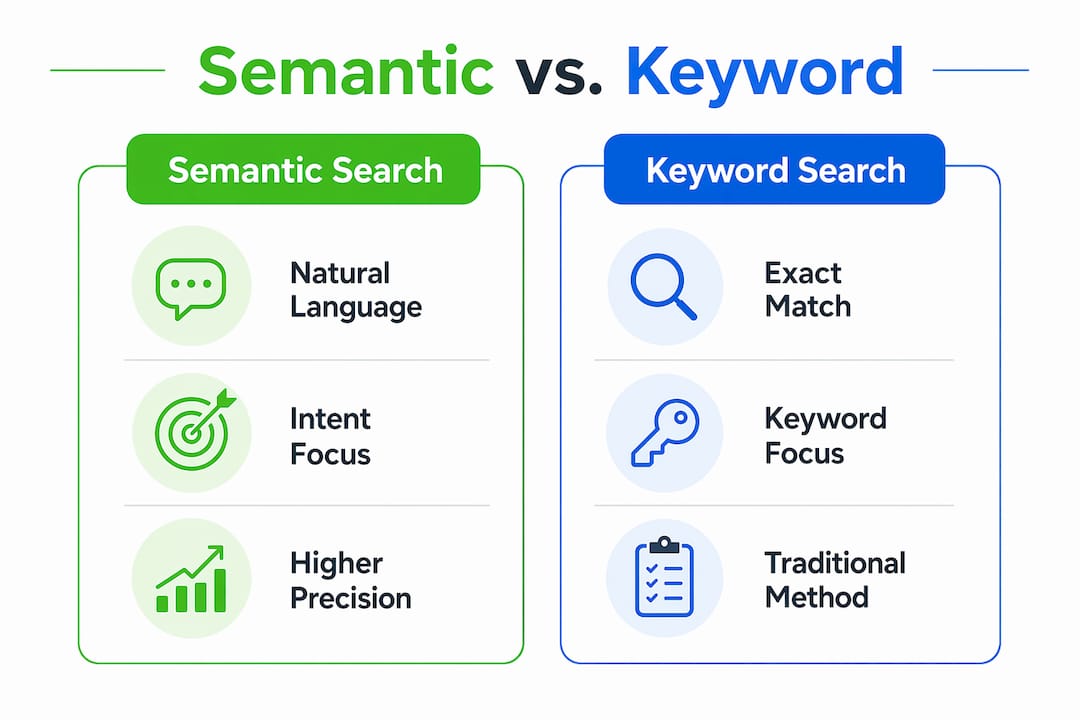
Semantic search excels when users express intent in natural language, use synonyms, or ask ambiguous questions. A query like “something to help me sleep” returns relevant results even though it contains no medical terminology. Keyword search is better suited for exact-match queries such as product SKUs, error codes, or legal citations where precision matters more than interpretation.
The performance gap is measurable. Semantic search improves retrieval precision by 25–35% over keyword-based methods and reduces irrelevant results by up to 40%. That improvement translates directly into lower bounce rates and higher user satisfaction scores.
| Feature | Semantic search | Keyword search |
|---|---|---|
| Query type | Natural language, intent-based | Exact match, code-based |
| Synonym handling | Strong | Weak |
| Ambiguous queries | Handles well | Often fails |
| Exact product codes | Less reliable | Highly accurate |
| Best use case | Content discovery, FAQs, research | Catalog lookup, error codes |
| Architecture fit | Vector databases, embedding models | Inverted index systems |
The industry standard for production systems is a hybrid approach that combines both methods. Neither semantic nor keyword search alone handles the full range of real-world queries. A hybrid model gives you the intent-reading power of semantic retrieval and the precision of keyword matching in one architecture.
The benefits of semantic search extend well beyond better rankings. The technology closes the intent gap, the distance between what a user types and what they actually need. Semantic search helps close this gap by interpreting natural language expressions, which directly improves customer service resolution speed and satisfaction.
For SEO professionals, the practical gains show up in several areas:
Industries like healthcare, legal services, and e-commerce see the sharpest gains. A legal firm using semantic search for document retrieval finds relevant case law even when the query uses different terminology than the source document. An e-commerce site surfaces products when users describe what they want rather than naming a specific item.
By 2026, 75% of large enterprises will have implemented semantic search technologies that surpass keyword-only systems. That adoption rate signals a market shift, not a trend. Waiting to adapt means ceding ground to competitors who already understand semantic indexing techniques.
The biggest failure point in semantic search deployments is not the model. It is the data fed into it. Dumping unstructured or unlabeled data into a vector database produces confident but incorrect matches. These errors are harder to diagnose than keyword search failures because the system does not return zero results. It returns wrong results with high confidence scores.
Solving this requires upstream investment in data quality before you touch any model configuration.
Pro Tip: Treat metadata cleanup as infrastructure work, not a content task. Assign it to a dedicated sprint before any semantic search implementation. The payoff in retrieval accuracy is immediate and measurable.
Applying semantic search strategies in practice means rethinking how you structure content, not just how you select keywords. The shift is from targeting individual phrases to building topical clusters that cover a subject from multiple angles.
Here is a practical framework for integrating semantic search into your SEO workflow:
Map your topic clusters. Identify the core subject you want to rank for, then list every related question, synonym, and subtopic your audience might search. Tools like Google’s People Also Ask and related searches reveal the semantic neighborhood around your primary keyword.
Align content with search intent. Each piece of content should serve one clear intent: informational, navigational, or transactional. Mixing intents within a single page confuses both users and algorithms.
Use structured data markup. Schema.org markup gives search engines explicit signals about your content’s entities, relationships, and context. This directly supports semantic indexing by reducing ambiguity.
Track semantic visibility, not just rankings. Monitor impressions across query clusters, not just your primary keyword. A rise in impressions for related queries signals that Google recognizes your topical authority.
Apply industry-specific semantic strategies. Cannabis marketing, for example, operates under platform restrictions that limit paid advertising. Optimizing cannabis content for semantic relevance becomes the primary driver of organic visibility when paid channels are restricted. The same logic applies to legal SEO, healthcare content, and other regulated industries.
Monitor 2026 SEO trends continuously. AI-powered ranking systems update frequently. What works today may need adjustment as embedding models evolve. Build a quarterly review into your content calendar.
A semantic SEO guide for marketers can help you build the vocabulary and framework to communicate these strategies to clients and stakeholders who are still thinking in keyword-only terms.
Semantic search delivers measurable gains in retrieval precision, user satisfaction, and organic visibility, but only when content quality and metadata management are treated as non-negotiable foundations.
| Point | Details |
|---|---|
| Semantic search improves precision | Retrieval accuracy improves by 25–35% and irrelevant results drop by up to 40% over keyword methods. |
| Hybrid architecture is the standard | Combining semantic models with BM25 keyword search handles the full range of real-world query types. |
| Metadata quality drives accuracy | Poor or missing metadata produces confident but wrong matches, the hardest failure mode to diagnose. |
| Topic clusters outperform single keywords | Content covering a subject from multiple angles ranks better than pages targeting one repeated phrase. |
| Enterprise adoption is accelerating | 75% of large enterprises will implement semantic search technologies by 2026, making adaptation urgent. |
I have watched SEO professionals treat semantic search as a magic fix for stagnant rankings. It is not. The technology is genuinely powerful, but it amplifies what is already in your content library. If your existing pages are thin, vague, or stuffed with repetitive phrases, a semantic model will surface that weakness faster than a keyword algorithm ever did.
What I find most interesting is the metadata problem. Most teams skip straight to model selection and vector database configuration. They spend weeks on infrastructure and then wonder why results are inaccurate. The answer is almost always upstream. The content descriptions are too vague, the category tags are inconsistent, or the page titles do not reflect what the content actually covers. Fixing that takes discipline, not technology.
The other misconception I see constantly is that semantic search replaces keyword research. It does not. Semantic search is a complement to keyword search, not a replacement. Your keyword research tells you what people search for. Semantic analysis tells you what they mean. You need both signals to build content that ranks and converts.
For cannabis and hemp businesses specifically, this matters more than in most industries. Platform restrictions limit your paid reach, which means organic search carries more weight. A content strategy built on semantic topic clusters, clear entity signals, and well-structured metadata gives you a durable advantage that paid competitors cannot easily replicate. The brands that invest in this now will be significantly harder to displace in 2027 and beyond.
— Max
Dopeseo specializes in SEO for cannabis and hemp businesses, where organic search is often the only reliable channel for customer acquisition. The team applies semantic search strategies directly to content architecture, local search optimization, and on-page structure to improve how Google interprets your pages.
Whether you operate a dispensary, cultivation facility, or ancillary cannabis business, Dopeseo’s approach starts with a full audit of your content library and metadata quality before any optimization work begins. From there, the team builds topic clusters, applies structured data markup, and tracks semantic visibility across query groups. If you want to understand how your current site performs against semantic ranking signals, the local search strategy guide is a strong starting point. For a direct conversation about your specific situation, the discovery form connects you with the Dopeseo team.
Keyword search matches exact words in a query to words in a document. Semantic search interprets the meaning and intent behind the query, returning relevant results even when the exact words do not appear in the source content.
Semantic search rewards content that covers a topic thoroughly using varied synonyms, related entities, and clear entity signals. Google’s algorithms use embedding-based signals to assess topical depth, which means repetitive keyword use no longer drives rankings the way it once did.
A hybrid search architecture combines semantic vector retrieval with traditional keyword search methods like BM25. Hybrid search is the industry standard because it handles both intent-based queries and exact-match queries within a single system.
Semantic models match queries to the nearest vector in a database. When metadata is vague or missing, the model returns the closest match regardless of actual relevance, producing confident but incorrect results that are difficult to diagnose.
Cannabis businesses face platform restrictions that limit paid advertising, making organic search the primary acquisition channel. Semantic SEO strategies built around topic clusters and search intent generate durable organic visibility that paid restrictions cannot undercut.

© 2026 Curious Monkeys Pressing Buttons LLC DBA Cannabiz Marketing Solutions AKA DopeSEO. All rights reserved.