
TL;DR:
- Focusing on local customers reduces acquisition costs and builds trust through community engagement. Local marketing creates lasting credibility and generates more loyal, repeat clients. Effective strategies include optimizing Google profiles, local SEO, geo-targeted ads, and managing reviews consistently.
Most businesses assume that reaching more people means reaching better people. That assumption gets expensive fast. Understanding why target local customers is the right move reveals a counterintuitive truth: a smaller, geographically focused audience almost always outperforms a broad, unfocused one. Local customers convert at higher rates, refer more often, and stick around longer. The benefits of local marketing go well beyond saving money on ads. When you build real visibility in your community, you create a reputation that compounds over time and drives growth that broad national campaigns simply cannot replicate.
| Point | Details |
|---|---|
| Local targeting cuts costs | Focusing on nearby buyers reduces acquisition costs and increases customer retention through trust. |
| Consumers actively prefer local | 57% of American shoppers will pay more to support local businesses over national chains. |
| Reviews make or break local trust | Fresh, high-volume positive reviews are non-negotiable for converting local search traffic. |
| Geo-targeting multiplies ad relevance | Location-based ads aligned to local intent drive immediate in-store visits and conversions. |
| Local SEO is your foundation | A fully optimized Google Business Profile is the single most important digital storefront you own. |
The clearest business case for local customer focus comes down to two numbers: how much it costs to acquire a customer, and how long that customer stays. Local marketing lowers both by building the kind of trust that broad campaigns cannot manufacture. When your business shows up consistently in local search results, local news, and community conversations, you stop paying to interrupt strangers and start attracting people already primed to buy.
Word-of-mouth referrals are worth understanding here because they behave differently in local markets. A satisfied customer in your neighborhood talks to other people in that same neighborhood. One referral in a tight community can produce five more customers who live within driving distance. That chain does not happen the same way when your customer base is scattered across multiple cities.
The importance of local customers also shows up in your reputation. Local marketing builds credibility that extends beyond individual transactions. Businesses that engage with local issues, sponsor local events, and show up in community spaces become recognized authorities. That recognition is an asset that takes years to build and cannot be bought with an ad budget.
Marketing as “local” positions a business for loyalty and word-of-mouth that extend well beyond individual transactions, generating long-term growth that broad campaigns rarely achieve.
Key business outcomes you can expect from a consistent local focus:
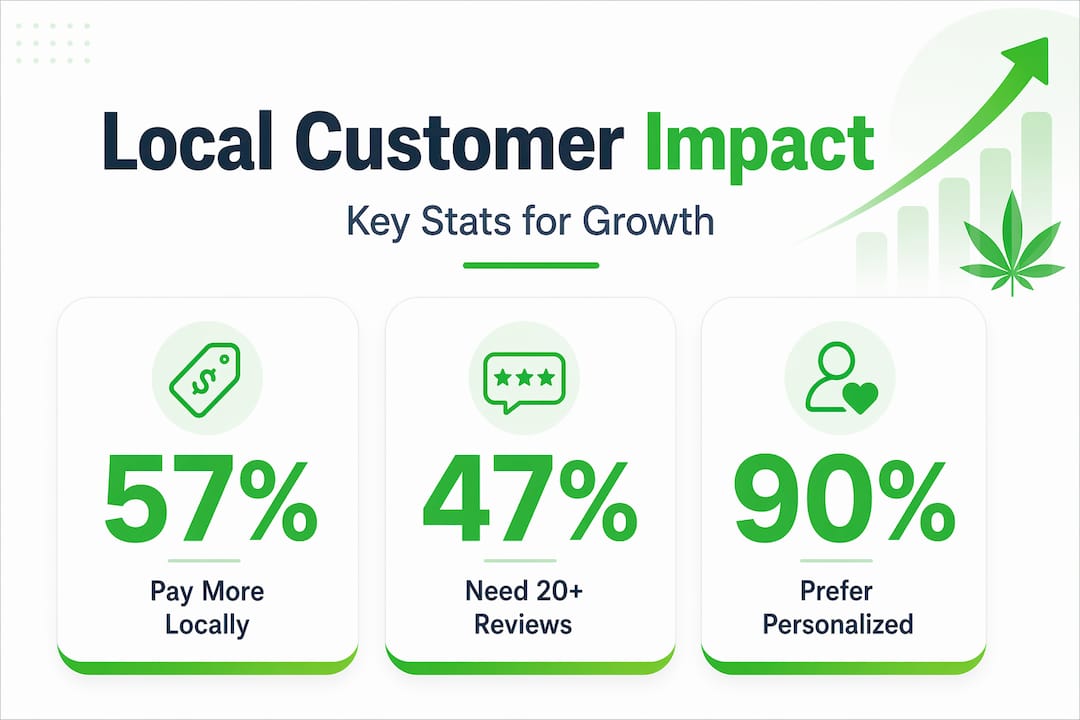
The numbers behind local consumer behavior in 2026 make the strongest argument for why you should focus on local audiences. 57% of American shoppers say they are willing to pay more to support local retailers. That is not a small preference. That is a measurable pricing advantage you hold over national competitors simply because of where you operate.
Reviews are the other critical variable. 47% of consumers will not use a business with fewer than 20 reviews. More specifically, 74% only care about reviews from the past three months, and 31% will only consider businesses with a 4.5-star rating or higher. If your review profile is thin or stale, you are losing local customers before they ever visit your page.
| Consumer Behavior | Data Point | Source |
|---|---|---|
| Willing to pay more locally | 57% of US shoppers | Shopify, 2026 |
| Won’t use business with under 20 reviews | 47% of consumers | BrightLocal, 2026 |
| Only care about reviews from last 3 months | 74% of consumers | BrightLocal, 2026 |
| Require 4.5+ star rating | 31% of consumers | BrightLocal, 2026 |
| Prefer personalized ads | Nearly 90% of consumers | Harvard Business Review, 2026 |
Personalization is the third pillar of local consumer behavior. Nearly 90% of consumers prefer personalized ads over generic ones. Location-based targeting delivers exactly that. When someone sees an ad for your dispensary at 6 PM on a Friday that includes your address and current hours, the ad feels relevant. It does not feel like noise.
Pro Tip: Ask every satisfied customer for a Google review within 24 hours of their visit. Recency matters as much as volume. A steady stream of fresh reviews beats a large batch that went stale six months ago.
Knowing why local targeting works is only half the job. Knowing how to execute it is where the growth actually happens. The following steps reflect what consistently produces results for local businesses, including cannabis dispensaries operating in competitive local markets.
Optimize your Google Business Profile. This is your digital storefront. Complete every field: hours, services, photos, and your service area. Post updates weekly. Respond to every review, positive or negative. Businesses with fully completed profiles rank significantly higher in local pack results.
Build your local SEO foundation. Use location-specific keywords across your website, title tags, and meta descriptions. Create separate pages for each neighborhood or city you serve if you have multiple locations. Understanding local search ranking factors is the difference between appearing in local pack results and being invisible.
Use geo-targeting in paid campaigns. Location-based marketing improves ad relevance by matching your message to local needs and showing your nearest location details automatically. Geofencing takes this further by triggering ads when a user physically enters a defined geographic boundary around your store or a competitor’s.
Activate social media for your local audience. Tag your location in posts. Partner with local micro-influencers who have engaged followings in your city. Comment on and share local news and events to signal genuine community investment.
Build a referral program with local incentives. Structure rewards around local experiences: gift cards to nearby businesses, discounts tied to local events, or partner offers from businesses your customers already use. This creates a web of community relationships that a national chain cannot replicate.
Encourage and manage reviews continuously. Local search optimization requires a steady pipeline of fresh reviews. Automate review requests through your point-of-sale system or post-purchase email flows.
Pro Tip: Geofencing works especially well for cannabis dispensaries near recreational areas or event venues. Set a geofence around a local concert hall or farmers market and serve ads that include a time-sensitive offer. The proximity plus the urgency drives foot traffic that standard display ads rarely achieve.
A lot of businesses treat local marketing as just a targeting filter. They narrow their ad audience by ZIP code, call it local, and expect results. That approach misses the deeper mechanics of how local trust actually forms.
The mistakes that most consistently undermine local customer targeting include:
The businesses that win local search and local loyalty over time are the ones that treat local as an ongoing commitment, not a campaign switch to flip.

I’ve worked with enough local businesses to see the same pattern play out repeatedly. The ones that chase broad visibility first almost always spend more and grow slower than the ones that own their local market before expanding.
What I’ve learned is that local authority compounds in a way that paid reach simply does not. When you show up consistently in local search results, get mentioned in local community groups, and collect a steady stream of fresh reviews, your cost to acquire each new customer quietly drops over time. Meanwhile, businesses spending heavily on broad campaigns are running on a treadmill.
The piece most businesses miss is that local marketing is not about limiting yourself. It’s about choosing where to be undeniable first. A cannabis dispensary that fully owns its local search presence, maintains a strong review profile, and runs well-targeted geo-campaigns is nearly impossible to displace. The community knows them. Google trusts them. That position took time to build, and no competitor can buy it overnight.
The uncomfortable truth is that many businesses skip this step because local feels small. It is not. It is the foundation that every sustainable growth strategy has to be built on.
— Max
If this article clarified why local customer targeting matters, the next step is putting a real strategy behind it. Dopeseo specializes in exactly this, with a particular focus on cannabis businesses navigating competitive local markets and complex platform restrictions.
Whether you need to build your Google Business Profile from scratch, generate consistent review volume, or launch geo-targeted campaigns that actually convert, Dopeseo has the tools and industry knowledge to move the needle. Start with the cannabis SEO strategy guide to see how local optimization fits into a full growth plan. Or explore the 2026 cannabis SEO guide to understand how search visibility translates into real revenue for local operators. Your community is already searching. Make sure they find you first.
Local customers convert at higher rates, refer more often, and are cheaper to retain than broadly acquired customers. Local marketing builds trust through community engagement, which reduces acquisition costs and improves long-term retention.
47% of consumers will not consider a business with fewer than 20 reviews, and most require those reviews to be from the past three months. Prioritize volume and recency equally.
Combining a fully optimized Google Business Profile with consistent local SEO and geo-targeted ad campaigns produces the strongest results. Businesses that add active review management to this mix outperform those relying on any single tactic alone.
Yes. 57% of US shoppers say they will pay more to support a local business over a national retailer, giving local businesses a genuine pricing advantage when they market their community connection clearly.
Geo-targeting improves ad relevance by delivering messages tailored to local needs and including the nearest location details. This shifts ad creative from broad awareness to proximity-driven calls to action, which drives measurably higher foot traffic and conversions.

© 2026 Curious Monkeys Pressing Buttons LLC DBA Cannabiz Marketing Solutions AKA DopeSEO. All rights reserved.