
TL;DR:
- Cannabis websites require specialized design to ensure legal compliance and effective SEO.
- Ongoing monitoring and updates are essential as regulations, platform policies, and market conditions change.
- Strategic community education and local SEO are key to building long-term online success.
A generic website template might seem like a fast, affordable solution for your dispensary, but it can quietly expose you to regulatory fines, payment processor shutdowns, and search rankings that never move. Most web designers build for e-commerce retailers or service businesses, not for an industry where a missing age gate or an unintentional advertising claim can trigger serious consequences. Cannabis website design is its own discipline, shaped by legal requirements, platform restrictions, and a local search landscape that demands a specialized approach. This article breaks down exactly what you need to know, from compliance essentials to SEO tactics that actually work for dispensaries.
| Point | Details |
|---|---|
| Specialization is essential | A generic website won’t meet the compliance or marketing needs of dispensaries. |
| Compliance affects design | Legal requirements shape everything from navigation to checkout and content strategy. |
| SEO drives dispensary growth | Effective cannabis websites use industry-tailored SEO to compete and increase visibility. |
| Avoid critical mistakes | Missing age gates and poorly structured content can result in site takedowns and penalties. |
If you’ve ever tried to run a Google Ads campaign for your dispensary and watched it get rejected within hours, you already understand the core problem. Cannabis businesses operate under a set of rules that most web designers, marketers, and platform policies were never built to accommodate. That gap creates real risk.
Cannabis websites face strict regulations that vary by state, county, and even municipality. What’s acceptable in Colorado may violate rules in California. Federal law adds another layer of complexity, since cannabis remains a Schedule I substance at the federal level. This means your website must be built with compliance baked in from day one, not added as an afterthought.
The consequences of getting it wrong are not abstract. Dispensaries have faced:
These aren’t rare edge cases. They happen to real dispensaries every month.
“Compliance is not a checkbox. It’s an ongoing operational function that touches every page of your website.”
Beyond legal risk, there’s a practical SEO challenge. Advertising platforms like Google and Meta restrict cannabis-related paid promotion, which means organic search is your primary traffic channel. That makes SEO compliance for cannabis both a legal issue and a business growth issue simultaneously. You need a website that ranks well without triggering platform flags, and that requires understanding keyword restrictions, content framing, and technical signals that most generalist agencies simply don’t know.
Age-gating is a foundational requirement. Your site must verify that visitors are of legal age before they access product information. Privacy policies must disclose data collection practices clearly. Disclaimers about the legal status of cannabis in specific jurisdictions are often required. Each of these elements must be positioned correctly, written in plain language, and updated as regulations evolve.
Understanding why specialization is vital sets the stage for a deep dive into the actual building blocks every cannabis site needs. Think of these not as optional upgrades, but as the baseline for operating legally and competitively.
Mobile-first design. More than 60% of dispensary website traffic comes from mobile devices. Clear navigation and mobile-first design directly impact whether a customer finds your menu, calls your store, or places an order. A site that loads slowly or breaks on a phone loses customers before they ever see your products.
Age verification gates. Your age gate must appear before any product or brand content is visible. It should be prominently placed, require affirmative action from the user, and log consent where required by law.
Secure ecommerce and payment integrations. Cannabis-friendly payment processors are limited, but they exist. Your site needs to integrate with compliant platforms that won’t terminate your account when they see what you sell.
ADA accessibility compliance. The Americans with Disabilities Act applies to websites. Alt text on images, keyboard navigation support, and proper color contrast ratios are not optional. Accessibility lawsuits targeting dispensaries have increased in recent years.
Legal disclaimers and compliance content. Every product page should include appropriate disclaimers. Educational content should be framed carefully to avoid unverified medical claims.
“Your website is your digital storefront. If it’s not built to handle the unique demands of cannabis retail, you’re leaving both revenue and legal protection on the table.”
Transparent product information also builds customer trust. Customers want to see cannabinoid profiles, lab test results, and sourcing details. Displaying this information clearly, while staying within content guidelines, is a competitive advantage. For more on how content structure supports both trust and rankings, explore optimizing cannabis content for search performance.
Pro Tip: Run your site through Google’s PageSpeed Insights and an accessibility checker like WAVE every quarter. Small technical issues compound over time and quietly hurt both compliance and rankings.

With the foundation of a strong, compliant design in place, dispensaries need to focus on maximizing their site’s reach and discoverability. SEO for cannabis is not the same as SEO for a restaurant or a law firm.
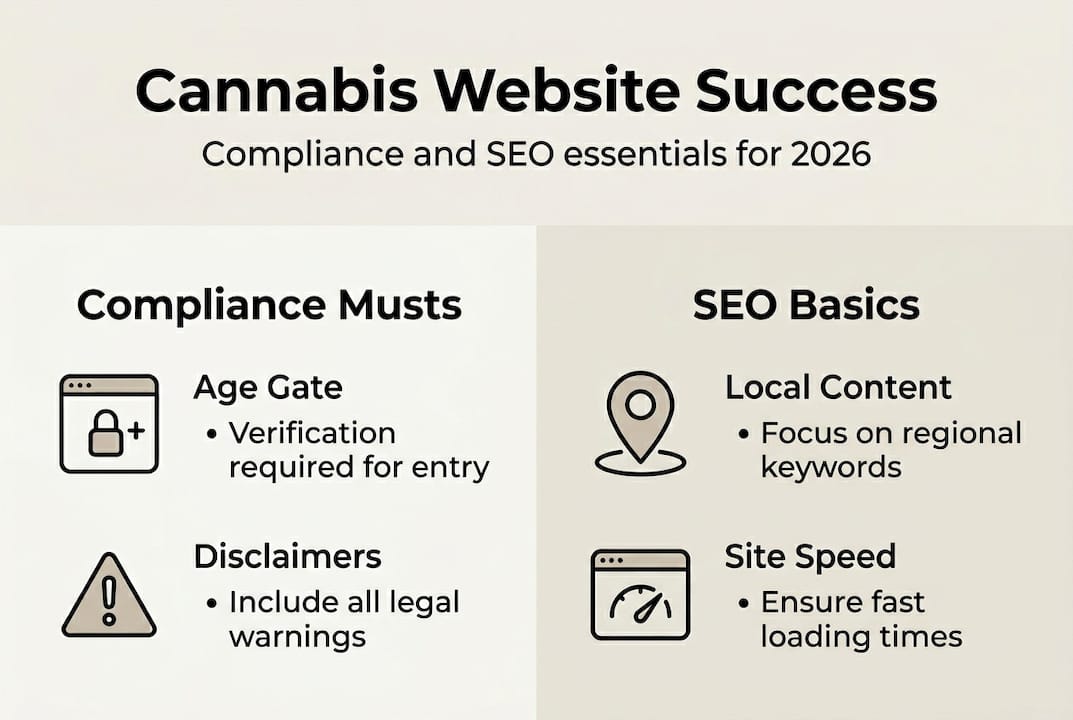
Cannabis SEO differs significantly because of keyword restrictions and local search intent. People searching for dispensaries are almost always looking for something nearby. That means local SEO is your highest-leverage investment.
Here’s what local optimization looks like in practice:
| SEO tactic | Cannabis-specific consideration |
|---|---|
| Paid search ads | Heavily restricted; organic is primary channel |
| Keyword targeting | Avoid terms that trigger platform flags |
| Backlink building | Focus on cannabis directories and local press |
| Content marketing | Educational content outperforms promotional copy |
| Core web vitals | Page speed directly impacts mobile rankings |
Site speed deserves special attention. Google’s Core Web Vitals are ranking signals, and slow-loading dispensary sites with heavy image galleries consistently underperform. Compress product images, use lazy loading, and choose a hosting provider with strong uptime records.
For a deeper look at building a complete SEO strategy for dispensaries, the approach needs to account for both technical performance and content depth. Product pages with detailed descriptions, FAQ markup, and structured data help search engines understand what you sell and where you sell it.
As cannabis businesses expand online, even small compliance oversights can lead to major setbacks. Here’s how to protect your company.
The most common issues we see fall into predictable patterns. Knowing them in advance puts you ahead of most dispensary operators.
| Compliance issue | Potential consequence |
|---|---|
| Missing age gate | State regulatory fine, hosting suspension |
| Unsubstantiated health claims | FTC complaint, state penalty |
| No cookie consent banner | CCPA or GDPR violation |
| Outdated privacy policy | Data breach liability |
| Inaccessible design | ADA lawsuit |
Missteps in site content or lacking proper disclaimers frequently lead to punitive action. The fix is not complicated, but it requires consistent attention.
Here’s a step-by-step process for staying compliant:
Critical reminder: Cookie consent banners are not optional if you serve customers in California, Colorado, or any state with active privacy legislation.
Pro Tip: Hire a cannabis attorney to review your website content at least once per year. The cost of a legal review is a fraction of the cost of a regulatory fine or payment processor termination.
For ongoing cannabis SEO compliance guidance, treat your website like a living document. Regulations change, platforms update their policies, and your site needs to keep pace.
Having covered the practical actions, let’s zoom out and share the bigger lessons learned from working with dispensary websites.
Most web designers approach cannabis sites like a checklist problem. Build the age gate, add a disclaimer, call it done. That thinking gets dispensaries into trouble because compliance is not static and neither is SEO. The cannabis market moves fast. State laws change. Google updates its local algorithm. A competitor opens two blocks away and starts outranking you within weeks.
The dispensaries that win online treat their website as an ongoing investment, not a one-time project. They publish educational content that builds community trust. They monitor their local rankings weekly. They test new product page formats and measure the results.
There’s also a hidden opportunity most operators miss: community education. When your site answers real questions about cannabis consumption, local laws, and product safety, you become a trusted resource in your market. That trust translates directly into cannabis marketing strategies that build long-term brand authority, not just short-term traffic spikes. Checklist thinking gets you compliant. Strategic thinking gets you customers.
If you’re serious about setting your cannabis business apart online, specialized support makes all the difference. Building a compliant, high-performing dispensary website requires more than a good template. It requires deep knowledge of cannabis regulations, local SEO mechanics, and platform-specific restrictions.

At DOPE SEO, we specialize in professional cannabis web design built specifically for dispensaries and cannabis retailers. From age-gating and ADA compliance to ecommerce integration and local search optimization, we handle the details that generic agencies miss. Explore our cannabis SEO services or dive into our dispensary local search guide to start building a stronger online presence today.
Specialized cannabis websites must balance strict regulations and compliance hurdles including age-gating and unique marketing restrictions that most other businesses never encounter. A generalist web designer rarely has the knowledge to navigate these requirements correctly.
Yes, dispensaries should include age gates, disclaimers, and privacy policies to remain compliant with industry requirements. Skipping any of these pages creates both legal exposure and potential payment processor risk.
By using local SEO techniques like location-specific content, review management, and local business listings, dispensary websites can increase both foot traffic and online orders. Consistent NAP data across directories is especially important for local ranking signals.
Missing legal disclaimers, inadequate age verification, and using restricted advertising terms are the most common errors leading to penalties. Regular site audits catch these issues before regulators or platform policies do.

© 2026 Curious Monkeys Pressing Buttons LLC DBA Cannabiz Marketing Solutions AKA DopeSEO. All rights reserved.