
TL;DR:
- In 2026, hemp cultivation SEO focuses on AI citations, technical compliance, and authoritative content to ensure visibility. Organic search remains critical as paid ads face restrictions, making a strategic, ecosystem-level approach essential for growth. Success depends on optimizing for AI Overviews, Core Web Vitals, and targeted keyword architectures to build long-term brand authority.
If you believe ranking on page one of Google is still the finish line for your hemp cultivation business, 2026 has already moved the goalposts on you. The SEO trends in 2026 for cultivation point clearly toward AI-driven search experiences, tighter technical standards, and the reality that your site must earn trust from both search engines and AI answer systems simultaneously. Hemp cultivators face an extra layer of difficulty: ad platforms often reject your campaigns outright, making organic search not just a tactic but your primary growth engine. This guide breaks down exactly what is changing and what you should do about it.
The biggest structural shift in search right now is not a Google algorithm update. It is the rise of AI Overviews, the AI-generated answer blocks that now sit above traditional blue links. Google AI Overviews appear on about 47% of queries as of Q1 2026, fundamentally changing how users interact with results. Many searchers read the AI answer and never scroll further. If your hemp cultivation content is not being cited inside those answers, you are invisible to nearly half the search audience, regardless of your ranking position.
What does this mean practically? Your content needs to be written in a way that AI systems recognize as credible and quotable. Think of it less like chasing a keyword position and more like becoming a reference that an expert would cite. Google’s AI pulls from pages that demonstrate depth, clarity, and consistent topical authority.
Here is what positions hemp cultivation content to be cited by AI Overviews:
“Being cited in an AI Overview is the new first-page ranking. For hemp cultivators navigating ad restrictions, earning that citation spot is not optional, it is survival.”
Understanding AI cultivation SEO success requires accepting that the old metric of “ranking number three for hemp flower strains” matters far less when an AI block answers the question before any user clicks. The cannabis SEO market trends confirm that brands investing in entity-level authority are winning the AI citation game. AI’s role in search rankings continues to expand, meaning this is not a temporary test from Google.
Hemp cultivation websites commonly display age verification gates the moment a visitor arrives. That is understandable from a compliance standpoint. The problem is that Google specifically penalizes mobile pages with intrusive interstitials that block access to primary content on arrival from search results. If your age gate covers the full screen and forces a multi-step interaction before showing any content, your mobile rankings are taking a hit right now.
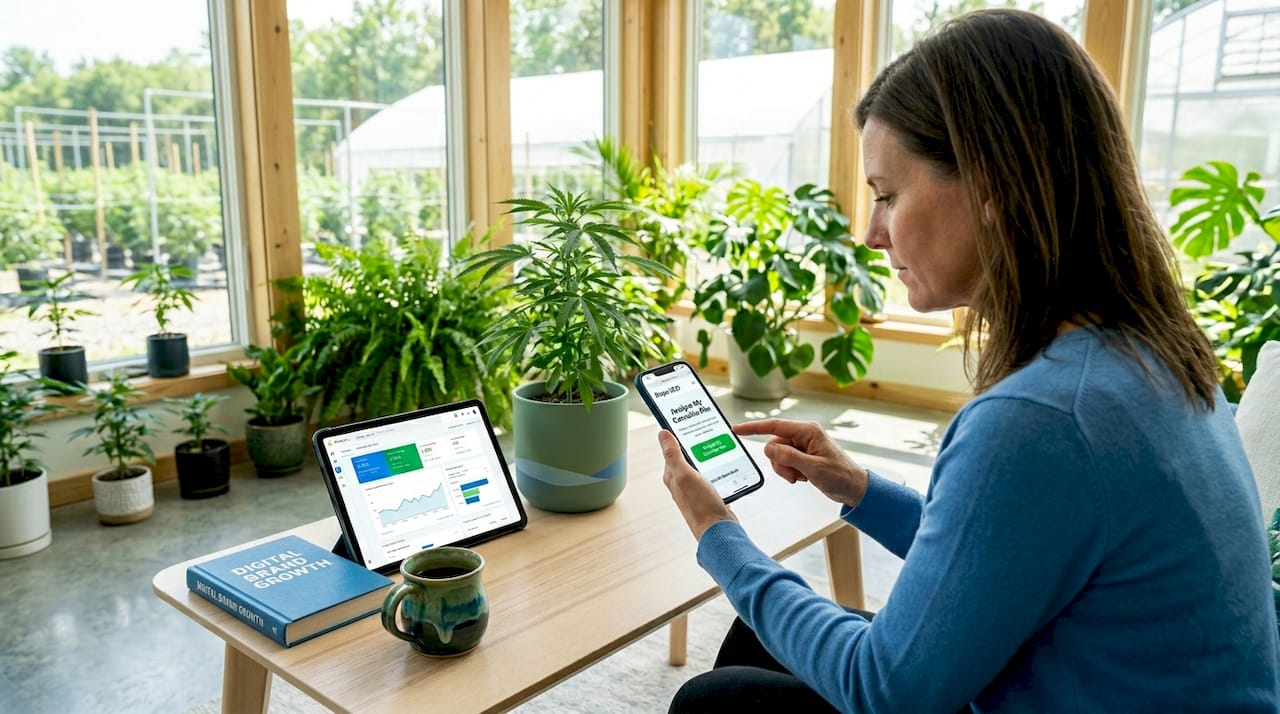
The fix is not to remove age verification. It is to redesign it so it passes Google’s criteria while still meeting your compliance obligations.
Best practices for compliant interstitials on hemp cultivation sites:
Pro Tip: Run your most trafficked cultivation pages through Google Search Console’s Mobile Usability report and cross-reference with PageSpeed Insights. If pages with interstitials are flagged, that is your first priority to fix before any content update.
Staying current on SEO compliance for cannabis sites means treating age verification as a UX design problem, not just a legal checkbox. The sites that get this right protect their organic rankings while remaining fully compliant.
Think of Core Web Vitals as the entry fee to compete in hemp cultivation SEO in 2026. You can have the most authoritative content on CBD flower cultivation in the country, but if your pages load slowly or shift around as they render, Google will not rank them as confidently, and AI systems will not cite them as readily. Core Web Vitals thresholds (LCP ~2.5s, INP ~200ms, CLS ~0.1) remain critical ranking signals in 2026, with an especially strong emphasis on mobile performance.
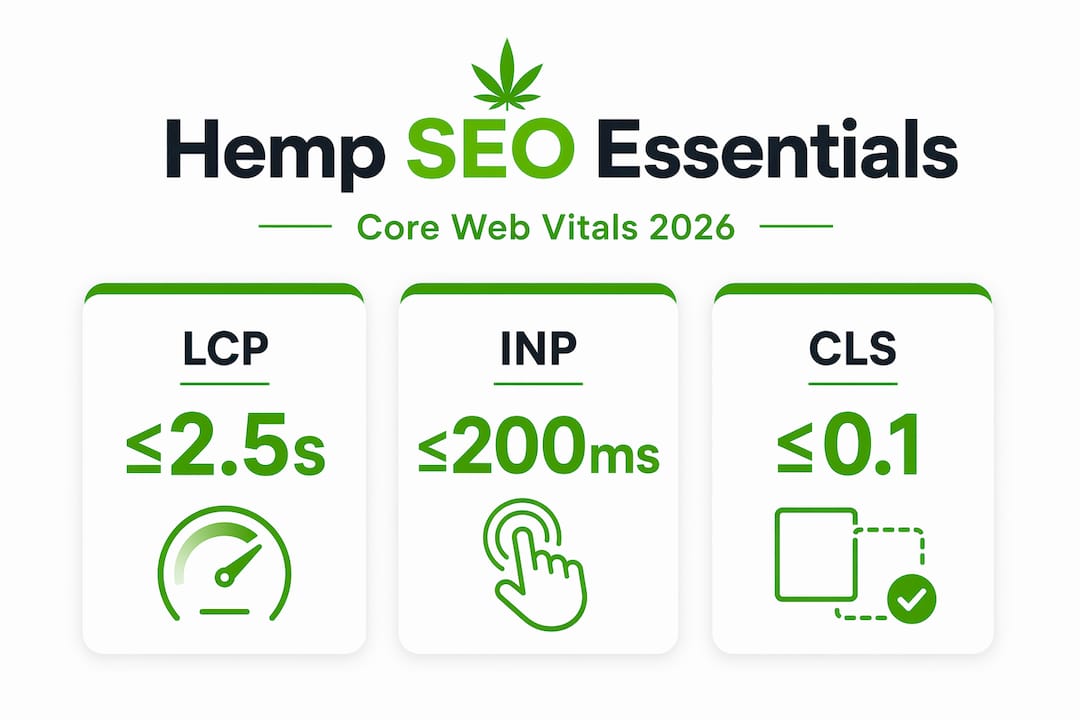
Here is what each metric means for your hemp site specifically:
| Metric | What it measures | Hemp site risk area |
|---|---|---|
| LCP (Largest Contentful Paint) | How fast the main content loads | High-res product or crop photography |
| INP (Interaction to Next Paint) | How fast the page responds to clicks | Filter-heavy product catalog pages |
| CLS (Cumulative Layout Shift) | Visual stability during load | Ad slots and dynamic pricing widgets |
Hemp cultivation sites tend to be image-heavy by nature. Showcasing flower quality, grow operations, and processing facilities matters for brand credibility. But unoptimized images are the single most common reason cultivation sites fail LCP targets.
Key actions to protect your Core Web Vitals:
Pro Tip: A score of 75 or above on Google’s PageSpeed Insights for mobile is a solid baseline. Below 50, your site is likely losing ranking ground to competitors who made the technical investment. Check your cannabis SEO challenges in this area before touching your content strategy.
Good Core Web Vitals also directly correlate with AI citation rates. AI systems prefer pages that load fast, stay stable, and present structured content clearly. Performance and credibility are now intertwined.
Keyword research for cultivation has grown more sophisticated than finding high-volume terms and writing content around them. Successful cultivation SEO uses a three-tier keyword approach, dedicating 60 to 70 percent to specificity keywords and 15 to 20 percent to long-tail problem solvers. Here is how to apply that framework to hemp cultivation specifically.
The three tiers explained:
Foundation keywords (15 to 20% of your portfolio): These are broad terms like “hemp cultivation” or “CBD hemp farming.” They establish what your site is about to Google but rarely convert directly. Use them on core pillar pages and your homepage.
Specificity keywords (60 to 70% of your portfolio): These are the workhorse terms. Examples include “indoor hemp cultivation lighting schedule,” “hemp biomass buyers,” or “hemp seed germination rates.” They have clear intent and drive the bulk of your qualified traffic. Build dedicated content pages or blog posts for clusters of related specificity terms.
Long-tail problem solvers (15 to 20% of your portfolio): These capture searchers asking very specific questions, such as “why are my hemp plants turning yellow in late veg” or “how to pass a hemp THC compliance test.” These convert at higher rates because the searcher has a precise need. FAQ sections, detailed how-to guides, and troubleshooting content are ideal formats here.
Additional keyword strategy principles for hemp cultivation:
Review the latest cannabis market SEO trends and the cannabis SEO guide 2026 for deeper context on how this keyword architecture applies beyond cultivation into related product categories.
Paid digital advertising for hemp and cannabis businesses remains a minefield in 2026. Meta, Google Ads, and most programmatic platforms still restrict or outright reject campaigns for hemp products, even where cultivation is fully legal. SEO is emphasized as a scalable, regulation-resistant acquisition channel for cannabis businesses precisely because it operates outside those platform gatekeepers.
What this means for your marketing budget allocation:
“For hemp cultivators, SEO is not a luxury or a long-term project. It is the only scalable digital acquisition channel available to you right now. Treat it with the same seriousness you give your grow operation.”
Understanding why SEO matters for cannabis brands helps frame realistic expectations. SEO has longer lead times than paid ads, typically three to six months before significant organic traffic materializes. But the digital marketing strategies for cannabis that perform best in 2026 treat SEO as infrastructure, not a campaign.
Here is a perspective most SEO guides will not tell you directly: chasing keyword rankings in 2026 is the hemp cultivation equivalent of counting how many people drive past your farm without stopping. The real measure of digital success has shifted. SEO in 2026 requires ecosystem-level authority signals and visibility across AI assistants, not just traditional SERP positions.
We work with hemp cultivators who get frustrated when their rankings look solid but their organic traffic is flat or declining. The explanation is almost always the same: AI Overviews and featured snippets are answering user questions before any click happens. The win is no longer the click. The win is being the source the AI chose to cite.
What does measurement look like in this new environment? You need to track branded search volume (are people searching for your cultivation brand by name?), AI citation frequency (is your content appearing in AI Overview answers?), and direct traffic trends alongside traditional organic metrics. SEO ranking factors in the AI era confirm that structured data markup, E-E-A-T signals (Experience, Expertise, Authoritativeness, Trustworthiness), and content completeness are the factors AI systems weigh most heavily.
Addressing cannabis SEO challenges specific to hemp cultivation means accepting that you are building brand authority alongside a technical and content foundation. The cultivators who will dominate organic search and AI visibility in 2027 are the ones planting those seeds now, with patience and precision.
Implementing everything covered in this guide, from AI-ready content to Core Web Vitals optimization to a three-tier keyword architecture, requires both industry knowledge and technical execution. Most hemp cultivation businesses do not have that combination in-house.
At Dope SEO, we specialize exclusively in cannabis and hemp businesses, which means we understand your regulatory constraints, platform restrictions, and competitive landscape without a learning curve. Our team aligns with every 2026 SEO trend covered here, including AI visibility strategies, compliant mobile UX, and content development built for topical authority. Whether you are starting from zero or refining an existing strategy, the cannabis SEO 2026 guide gives you a foundation, and our services take you further. Explore how we help cultivators boost cannabis SEO visibility and build durable organic growth, or review our cannabis marketing strategies tailored for the hemp sector.
AI Overviews appear on about 47% of queries as of Q1 2026, so hemp cultivation sites must create content that AI systems recognize as authoritative enough to cite, rather than relying solely on traditional keyword rankings for visibility.
Google penalizes intrusive interstitials that block primary content on mobile devices; age verification banners must be slim, easily dismissible overlays that do not cover the main page content immediately on load.
Core Web Vitals thresholds (LCP ~2.5s, INP ~200ms, CLS ~0.1) are active ranking signals in 2026, and poor performance on media-heavy cultivation pages reduces both traditional search rankings and the likelihood of being cited in AI Overviews.
The three-tier keyword approach allocates 60 to 70 percent of content to specificity keywords targeting clear intent, with foundation terms and long-tail problem solvers filling out the remainder to address diverse searcher needs and improve conversions.
Advertising restrictions on cannabis products make paid channels unreliable for hemp businesses; SEO builds compliant, compounding organic traffic that does not depend on ad platform approvals or policy reviews to keep working.

© 2026 Curious Monkeys Pressing Buttons LLC DBA Cannabiz Marketing Solutions AKA DopeSEO. All rights reserved.