
TL;DR:
- AI significantly accelerates SEO adaptation for hemp businesses amidst frequent regulatory and algorithm changes.
- Proper site preparation and compliance are essential before implementing AI tools for effective results.
- Combining AI automation with human oversight is key to building sustainable, compliant search visibility.
Standing out online as a hemp business is genuinely hard. Advertising restrictions limit your paid options, search engines apply extra scrutiny to regulated industries, and well-funded competitors are fighting for the same local and national keywords. Organic search is often your most reliable channel, yet traditional SEO tactics move too slowly to keep pace with shifting regulations and algorithm updates. AI-driven SEO changes that equation. This guide walks you through every practical step, from site preparation to ongoing performance tracking, so your hemp brand can build sustainable search visibility without running into compliance landmines.
| Point | Details |
|---|---|
| AI accelerates compliance | AI helps hemp brands quickly adapt to evolving regulations and avoid costly penalties. |
| Streamlined SEO workflow | AI-driven tools automate keyword research, content strategy, and site audits for hemp businesses. |
| Continuous improvement | Real-time AI analytics let you fix SEO issues and refine campaigns for better results over time. |
Hemp businesses operate in a space where the rules change fast. Federal guidelines, state-level restrictions, and platform policies all shape what you can and cannot say online. That regulatory pressure creates a unique SEO environment that most generalist agencies simply are not equipped to navigate.
Hemp websites face unique SEO compliance and legal issues compared to other industries, which means the standard playbook rarely applies. You need a strategy built around what hemp brands are actually allowed to publish, promote, and link to.
The core challenges break down into a few recurring patterns:
This is exactly where AI earns its place in your workflow. AI tools can scan your existing content for compliance red flags, cluster keywords by intent and risk level, and identify content gaps your competitors have not filled yet. The importance of SEO for hemp brands is not just about rankings. It is about building a durable digital presence that survives both algorithm updates and regulatory shifts.
“AI-powered SEO tools give hemp businesses the ability to adapt their content strategy in real time, something that manual processes simply cannot match at scale.”
Brands that rely on manual keyword research and static content calendars tend to fall behind quickly. They miss emerging search trends, publish content that inadvertently crosses compliance lines, and struggle to recover when rankings drop. AI removes much of that guesswork by processing large data sets and flagging issues before they become costly problems.
Before you deploy any AI SEO tool, your website needs a solid foundation. Skipping this step means you are feeding flawed data into your AI platforms, which produces flawed recommendations.
Staying compliant is critical in hemp SEO, or your site risks being penalized or delisted entirely. Start with this compliance checklist:
Once compliance is addressed, focus on structured data. Implementing Schema.org markup, especially for products, reviews, and local business information, helps AI tools interpret your site accurately and improves how search engines display your content. A compliant site design that incorporates structured data gives AI platforms cleaner signals to work with.
Comparing popular AI SEO platforms for hemp businesses:
| Platform | Best for | Compliance features | Hemp-friendly? |
|---|---|---|---|
| Surfer SEO | On-page optimization | Content score alerts | Yes, with custom rules |
| Clearscope | Content relevance | Keyword flagging | Yes |
| MarketMuse | Content gap analysis | Topic modeling | Yes |
| Semrush AI | Full-funnel research | Site audit tools | Yes, with manual review |
Each platform has strengths, but none of them replace human judgment on compliance. Use them to accelerate research and optimization, not to make final calls on what is legally safe to publish.
Pro Tip: Before connecting any AI tool to your site, run a manual compliance audit first. AI platforms are excellent at spotting SEO patterns, but they are not lawyers. A clean starting point means better outputs and fewer surprises.
Integrating these tools does not have to disrupt your current workflow. Start with one platform for keyword research, get comfortable with its outputs, then layer in additional tools for content optimization and technical audits.
With your site prepared and your tools selected, here is a practical workflow for rolling out AI-driven SEO across your hemp business.
Manual vs. AI-driven SEO tasks for hemp businesses:
| Task | Manual approach | AI-driven approach |
|---|---|---|
| Keyword research | 4 to 6 hours per cycle | 30 to 60 minutes |
| Content gap analysis | Inconsistent, time-intensive | Automated, ongoing |
| Compliance monitoring | Reactive, easy to miss | Proactive, real-time alerts |
| On-page optimization | Page by page | Site-wide, scalable |
| Rank tracking | Weekly manual checks | Daily automated reports |
Pro Tip: Always keep a human reviewer in the loop for any content that makes product claims or references health outcomes. AI tools are powerful accelerators, but your brand’s legal exposure is a human responsibility.
The AI advantages for hemp SEO are most visible when you combine automation with strategic human oversight. That balance is what separates brands that scale from those that stall.
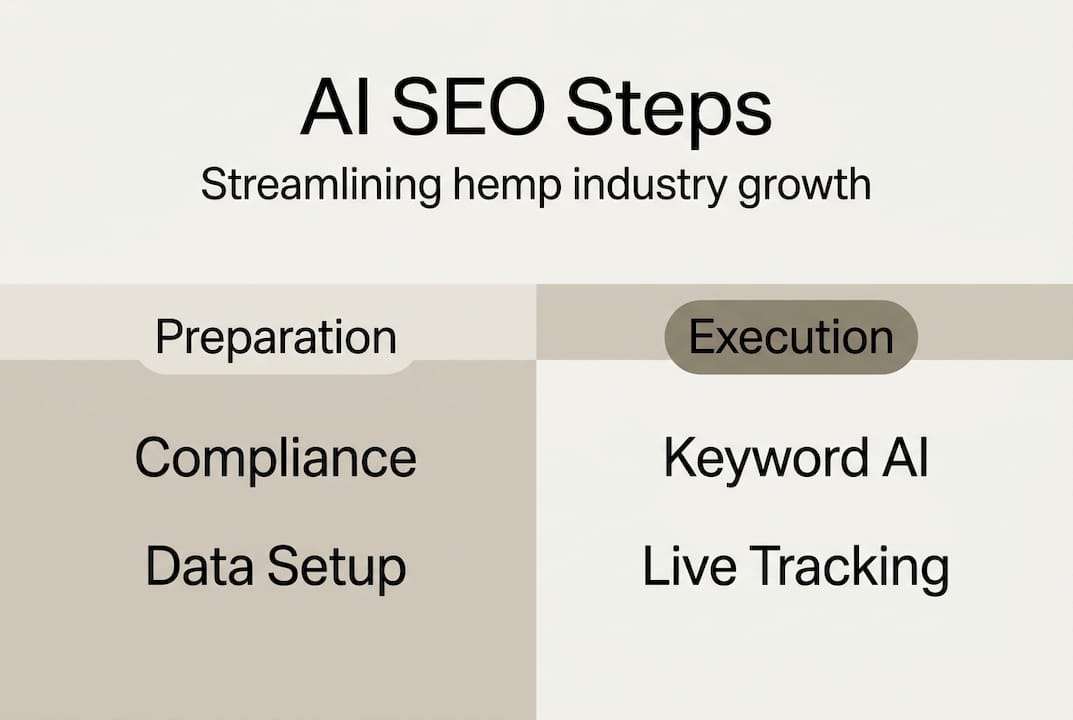
Once your AI SEO system is running, the work does not stop. Hemp is a fast-moving industry, and your SEO strategy needs to move with it.

AI-powered analytics give real-time alerts for compliance or SEO ranking shifts, which means you can catch problems before they compound. Set up automated alerts for sudden drops in organic traffic, changes in keyword positions, or new compliance flags triggered by content updates.
Here are the signals you should be watching:
Green flags (things are working):
Red flags (action needed):
When you spot a red flag, act quickly. Use your AI platform to diagnose whether the issue is technical, content-related, or compliance-driven. Each category requires a different fix, and AI tools can help you prioritize based on impact.
For ongoing improvement, feed your performance data back into your AI tools regularly. Machine learning models improve with more data, and platforms like MarketMuse or Semrush refine their recommendations as they learn more about your site’s history and competitive landscape. The AI SEO analytics tips that matter most for hemp businesses center on combining compliance monitoring with standard performance metrics in a single dashboard view.
Iterate every 30 to 60 days. Review what is working, cut what is not, and use AI insights to guide your next content priorities.
Here is the uncomfortable truth: most hemp SEO projects do not fail because of bad keywords or weak content. They fail because the team behind them cannot keep up with the pace of change. Regulations shift. Algorithms update. Competitors publish more content. And the manual processes holding everything together simply buckle under the pressure.
We have seen this pattern repeatedly across the industry SEO challenges that hemp and cannabis brands face. The businesses that grow are not necessarily the ones with the biggest budgets. They are the ones that build systems capable of adapting quickly. AI is that system.
What sets successful hemp brands apart is not just using AI tools. It is using them early and building institutional knowledge around them. When your team understands how to interpret AI outputs, challenge its recommendations, and apply human judgment where it counts, you create a compounding advantage that competitors playing catch-up cannot easily replicate. The window to build that lead is open right now.
Applying AI-driven SEO to a regulated industry like hemp is genuinely complex. Even with the right tools, knowing which levers to pull and when to pull them requires experience that most in-house teams are still developing.
At Dope SEO, we specialize in exactly this kind of work. Our team builds cannabis SEO strategy frameworks that combine AI efficiency with compliance expertise, so your hemp brand grows without unnecessary risk. Whether you need a full audit, a local search strategy guide tailored to your market, or hands-on support implementing the steps covered here, we are ready to help. Reach out to our team and let us build a strategy that actually fits your business.
Hemp SEO requires regulatory awareness for compliance and visibility, which means standard SEO approaches must be adapted to account for advertising restrictions, content limitations, and platform-specific rules that do not apply to most other industries.
Platforms like Surfer SEO, Clearscope, and MarketMuse are strong starting points because they analyze content relevance, keyword trends, and on-page signals at scale, but always layer in human compliance review before publishing anything in a regulated category.
AI enables ongoing compliance monitoring for cannabis and hemp websites by scanning content for risky language, tracking regulatory updates, and flagging pages that may need revision before they attract penalties.
AI-driven SEO strategies are scalable for hemp businesses of all sizes, making it a practical investment even for smaller brands that need to compete efficiently without large marketing teams or budgets.

© 2026 Curious Monkeys Pressing Buttons LLC DBA Cannabiz Marketing Solutions AKA DopeSEO. All rights reserved.