
TL;DR:
- Organic cannabis traffic is earned through unpaid search engine results, making it the primary growth channel in an industry blocked from most paid ads. Building a sustainable SEO strategy involves content aligned with customer intent, technical optimizations, and authoritative backlinks, which take time but provide long-term benefits. Measuring traffic quality with detailed analytics is crucial for optimizing efforts and achieving scalable, lasting growth.
Defining organic cannabis traffic is one of those concepts that sounds simple until you realize most cannabis businesses are measuring it wrong, chasing the wrong metrics, or worse, believing they can shortcut their way to rankings with ad spend. Organic traffic is the visitors who land on your website through unpaid search results on Google, Bing, or similar engines. No sponsorship tag. No paid placement. Just earned visibility. For cannabis businesses operating in an industry where paid ads are largely blocked, understanding organic traffic is not optional. It is your primary growth channel.
| Point | Details |
|---|---|
| Organic traffic is earned, not bought | Google ranks sites based on content quality and authority, not ad spend. |
| Cannabis businesses depend on organic search | Platform ad restrictions make SEO the most reliable acquisition channel in this industry. |
| Intent makes organic traffic more valuable | Organic visitors are actively searching for solutions, which drives higher conversion rates. |
| Analytics go deeper than pageviews | Tracking product-level behavior and browse-to-cart rates reveals true traffic quality. |
| SEO results take time but compound | Expect 3 to 6 months for significant results, with traffic building sustainably over time. |
Organic cannabis traffic refers to website visitors who arrive through unpaid search engine results. When someone types “best CBD tinctures near me” or “what is a live resin cartridge” into Google, clicks a result, and lands on your site, that is organic traffic. Google does not accept payment to rank sites higher in those organic results. Your position is earned through content relevance, site authority, and technical performance.
This is where many cannabis business owners get confused. Running Google Ads does not boost your organic rankings. Ad spend and organic rankings are completely separate systems. A paid ad appears with a “Sponsored” label and disappears the moment your budget runs out. Organic rankings stay and grow over time.
Here is a clear breakdown of how organic traffic differs from other sources:
| Traffic Source | How It Works | Cost | Intent Level |
|---|---|---|---|
| Organic search | Earned through SEO; unpaid results on Google/Bing | No direct cost | High |
| Paid search | Purchased ad placements via Google Ads | Per click | Medium |
| Direct | Visitor types your URL directly | None | Very high |
| Referral | Arrives via a link on another website | None | Medium |
| Social | Clicks from social media posts or profiles | None | Low to medium |
Organic visitors stand out because of intent. They searched for something specific, found your page, and clicked. That is a customer who is already looking for what you offer. Organic visitors show higher trust and purchase intent compared to someone who saw a display ad while scrolling through an unrelated feed.
Cannabis businesses face a marketing reality that most industries do not. Major platforms including Google Ads, Meta, and most programmatic networks either outright block cannabis advertising or restrict it so heavily that paid acquisition at scale is not realistic. That leaves organic search as the most scalable and reliable channel available.
The stakes are real. A focused SEO effort produced a 108% increase in monthly organic visitors for a cannabis client in just 90 days. That kind of growth is not built on ad spend. It is built on content, authority, and technical execution.
Here are the core challenges and opportunities that make organic traffic so critical in this space:
Education-driven content paired with a trusted website experience is the primary growth engine in cannabis marketing. That is not a theory. That is the consistent pattern across successful cannabis brands.
Pro Tip: Do not think of SEO as a cost center. Think of it as a long-term asset. Every piece of content that earns a ranking is a permanent sales rep working for you around the clock, without a salary.
Most cannabis businesses are underinvesting in analytics, and it is costing them. Understanding organic traffic is not just about knowing how many people visited your site. It is about understanding what those visitors did and whether they moved closer to a purchase.

The most common mistake is relying on basic pageview counts. Cannabis operators using isolated eCommerce or iframe setups often miss product-level behavioral data entirely. You can have 50,000 monthly organic visitors and still have no idea which product pages are converting or where users are dropping off.
Here are the key metrics you should monitor for measuring cannabis website traffic accurately:
Tracking product-level behavior and cart actions from organic traffic gives you a real picture of quality, not just quantity. Google Analytics 4 combined with Google Search Console gives you most of this data without additional cost.
Pro Tip: Set up organic traffic segments in GA4 so you can isolate organic visitor behavior from all other traffic. Then compare conversion rates between organic and paid or social sources. The difference will tell you exactly where to focus your investment.
Getting serious about organic traffic means building your site and content with a clear strategic framework. Here is what actually moves rankings for cannabis businesses in 2026.
Start with how your customers search, not how you describe your products internally. Someone searching “how does delta-8 make you feel” wants a content answer. Someone searching “buy delta-8 gummies near me” wants a product page. Both are valuable. Mixing up which type of page serves which query is one of the fastest ways to lose ranking potential. Use tools like Google Search Console and Semrush to identify the actual queries sending traffic to your site, then build pages that match intent precisely.
Building a semantic architecture with less than 3 clicks from the homepage improves SEO performance more than raw content volume. Keyword cannibalization, where multiple pages compete for the same query, is one of the most common and damaging SEO mistakes cannabis sites make. Group your content into clear topic clusters. For example, build a central “CBD Oil” hub page, then support it with related posts covering dosage guides, product comparisons, and user questions. This structure tells Google you own a topic area rather than just touching on it occasionally.
Guest posts on cannabis and wellness sites with domain ratings between 40 and 70, combined with contextual backlinks, have shown measurable ranking improvements within three months. Not all backlinks are equal. A link from a reputable cannabis news outlet or a wellness publication carries far more weight than generic directory links.
Cannabis customers search on mobile. Your site needs to load fast, render correctly on every screen size, and avoid technical errors that prevent Google from crawling key pages. Core Web Vitals scores, structured data markup, and clean internal linking are the foundation of cannabis content optimization that search engines reward.
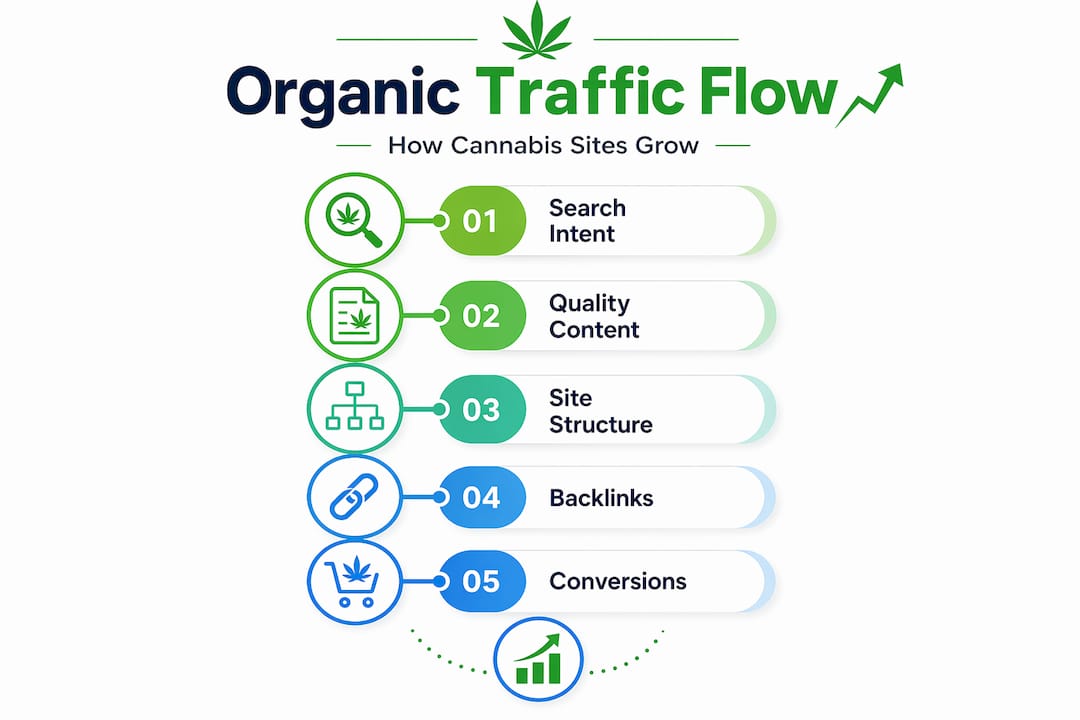
Here is a summary of strategy elements and their expected impact:
| Strategy | Difficulty | Time to Impact | Expected Benefit |
|---|---|---|---|
| Keyword research and mapping | Low | 1 to 2 months | Better-targeted content, reduced cannibalization |
| Semantic site architecture | Medium | 2 to 4 months | Stronger topical authority and crawl efficiency |
| Educational content creation | Medium | 3 to 6 months | Increased organic sessions and brand trust |
| Authoritative backlink building | High | 3 to 6 months | Improved domain authority and rankings |
| Technical SEO fixes | Low to Medium | 1 to 3 months | Better indexation and page experience scores |
Understanding organic cannabis SEO is one thing. Building a realistic plan around it is another. Professional cannabis SEO services typically run $2,000 to $5,000 per month, with meaningful results taking 3 to 6 months to materialize. That timeline is not a flaw in SEO. It reflects how Google works. Trust and authority are built over time, not overnight.
Paid ads provide temporary, rented visibility, while organic SEO builds compounding traffic that grows month over month. For cannabis businesses blocked from most paid channels, that compound effect is not just preferable. It is the strategy.
Here are the most practical next steps to put this into action:
Check out Dopeseo’s practical guidance on how to drive organic traffic for cannabis businesses in 2026 for a more detailed tactical breakdown.
Pro Tip: Avoid any agency or consultant promising fast rankings through mass link schemes or AI-generated content at scale. These tactics produce short-term spikes and long-term penalties. Sustainable organic traffic is built on consistent, quality work.
I have worked with enough cannabis businesses to see a clear pattern. The ones that struggle are usually the ones waiting for advertising platforms to loosen their restrictions so they can just run paid ads like everyone else. The ones that grow are the ones who accepted early on that organic search mirrors real customer demand and built their marketing around that reality.
The uncomfortable truth is that most cannabis businesses underestimate how much their website is leaving on the table. They have decent products, credible brands, and real customer demand. But their site architecture is a mess, their content does not match search intent, and their analytics are not tracking anything that actually connects to revenue.
What I have found consistently is that cannabis brands who commit to SEO for 6 to 12 months, with real content, real links, and proper technical foundations, end up with a traffic asset that no competitor and no platform policy change can take away from them. That is worth far more than any campaign you could run.
Organic SEO is not a marketing tactic. For cannabis businesses, it is the business itself. Treat it like one.
— Max
If this article clarified what organic cannabis traffic actually means and how to build it, the next step is putting that knowledge into practice with specialists who understand the industry’s unique rules.
Dopeseo works exclusively with cannabis and hemp businesses, building organic visibility strategies that account for platform restrictions, local market competition, and the compliance requirements most generalist agencies get wrong. From technical audits and content strategy to backlink acquisition and Google Business Profile optimization, Dopeseo delivers SEO built specifically for cannabis brands. Explore proven approaches for dispensaries through the cannabis SEO strategies Dopeseo has refined across real client results.
Organic cannabis traffic refers to website visitors who arrive through unpaid search engine results on platforms like Google or Bing, earned through SEO practices rather than paid ads or direct visits.
No. Google’s paid and organic systems are completely separate. Ad spend has no effect on organic rankings, which are determined by content quality, relevance, and site authority.
Most cannabis businesses see significant organic traffic growth within 3 to 6 months of consistent SEO investment, though competitive markets may take longer to show measurable ranking improvements.
Track organic sessions by landing page, browse-to-cart rates, keyword ranking trends, and goal completions from organic sources. Pageviews alone do not give you meaningful data about traffic quality.
Most major ad platforms restrict or prohibit cannabis advertising entirely. This makes organic search through SEO the primary scalable acquisition channel available to cannabis businesses in 2026.

© 2026 Curious Monkeys Pressing Buttons LLC DBA Cannabiz Marketing Solutions AKA DopeSEO. All rights reserved.