
TL;DR:
- Most cannabis marketing funnels must be tailored to comply with platform restrictions and legal regulations.
- Organic channels like local SEO and community-focused social content are key at the top and middle funnel stages.
- Retention efforts, including loyalty programs and targeted outreach, generate higher customer lifetime value than new customer acquisition.
Most cannabis dispensaries are quietly burning their marketing budget on tactics built for industries where the rules are completely different. You can’t run a straightforward Google Shopping campaign, boost posts freely on Instagram, or use affiliate networks the way a supplement brand can. The result is wasted spend, inconsistent messaging, and a customer journey that falls apart before it even starts. A purpose-built cannabis marketing funnel accounts for platform restrictions, compliance requirements, and the specific way your customers research and buy. This guide breaks down every stage so you can build a funnel that actually converts.
| Point | Details |
|---|---|
| Compliance shapes funnels | Cannabis marketing funnels must be built for strict regulatory environments, making channel and content choices essential. |
| Education drives engagement | Educational content and community engagement nurture prospects through the funnel more effectively than direct promotion. |
| SEO is a top performer | SEO drives the majority of dispensary web traffic and is a critical investment for funnel performance. |
| Retention outpaces acquisition | Loyalty programs and authentic engagement boost spend and long-term value more than constant customer hunting. |
Every business uses some version of a marketing funnel. But most funnel frameworks assume open access to paid advertising, unrestricted product promotion, and a clean attribution path. Cannabis marketing has none of that. If you apply a generic funnel model to your dispensary, you’re setting yourself up for account bans, shadow-banning, and missed revenue.
The standard funnel breaks into three phases: Top-of-Funnel (TOFU), Middle-of-Funnel (MOFU), and Bottom-of-Funnel (BOFU). In cannabis, each phase comes with non-negotiable guardrails.
Here’s what shapes a cannabis-specific funnel:
“TOFU tactics include compliant social ads, local SEO, Google Business Profile optimization to build visibility without direct product promotion.”
This means your funnel architecture has to be built around what you can do, not what works for a general e-commerce brand. Compliant social media strategies must lead with education, lifestyle, and community rather than direct product calls-to-action. Your channel selection is the foundation. Get it wrong, and the rest of the funnel breaks down.
Understanding what makes cannabis funnels unique, let’s break down each stage and its best practices.
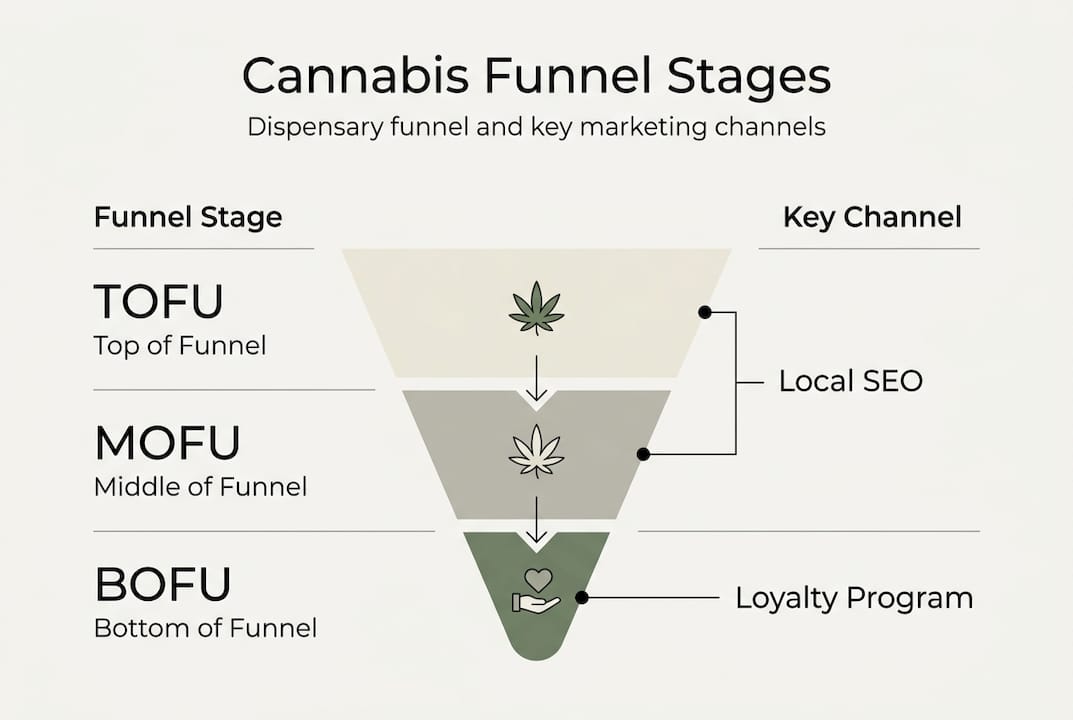
Your goal here is awareness. A potential customer searches “dispensary near me” or sees your Instagram page for the first time. They don’t know your brand yet. TOFU tactics that work in cannabis include:
Now the consumer is curious. They’re comparing options, reading reviews, and looking for information about strains, effects, or products. This is the research phase. MOFU content focuses on education, including blogs on strains and FAQs, as well as competitor analysis and review platforms to nurture interest.
High-impact MOFU tactics:
The customer is ready to buy or has already purchased. BOFU is about conversion and retention. Loyalty programs, SMS promotions, and POS integrations are your strongest tools here. Social content tactics like member-exclusive offers posted on Instagram Stories drive repeat visits effectively.
| Funnel stage | Primary goal | Key channel |
|---|---|---|
| TOFU | Awareness | Local SEO, GBP, programmatic |
| MOFU | Education and trust | Content, review platforms, email |
| BOFU | Conversion and retention | Loyalty programs, SMS, POS |
Pro Tip: Map a real customer journey. Start at “first Google search” and trace every touchpoint to “post-purchase email.” You’ll quickly spot the gaps where customers drop off.
We’ve seen the funnel structure. Now let’s quantify success and the integration tools you need.
Numbers give you something to manage against. Without benchmarks, you’re guessing whether your funnel is performing or bleeding money. Here are the figures that matter for cannabis marketers in 2026:
| Metric | Cannabis benchmark |
|---|---|
| Email open rate | 18 to 22% |
| Email CTR | 2.3 to 4.1% |
| Conversion rate | 1.5 to 2.8% |
| SEO traffic share | 60% of total dispensary traffic |
| Programmatic ROI | 3x vs. print |
Email open rates between 18 and 22% and SEO accounting for 60% of dispensary traffic confirm that organic and owned channels are your highest-leverage plays. Paid print and billboards still exist in cannabis, but the data shows programmatic advertising delivers three times the return.
Key integration tools worth prioritizing:
SEO compliance for cannabis is also a critical integration point. Your on-page content, metadata, and technical structure must work together to boost SEO visibility without triggering platform flags. SEO is not just a traffic source. It’s the connective tissue between every funnel stage.
Funnel ROI tip: Dispensaries that integrate POS with CRM see measurably higher customer lifetime value because they can identify high-value segments and market to them specifically, rather than blasting the whole list.
After core tactics and benchmarks, it’s time to tackle the advanced challenges that often trip up expanding dispensaries.

Once you operate across multiple states, your funnel complexity scales fast. Each jurisdiction has its own advertising rules, disclosure requirements, and restricted platforms. What works in a single-location operation needs a structural rethink when you add markets.
Multi-state operations need geo-fencing and jurisdiction-specific creative, while over-produced social content underperforms compared to raw, authentic video. That last point surprises most operators. A quick iPhone video shot in-store often outperforms a polished, studio-produced ad because it feels real. Audiences in the cannabis space are skeptical of corporate aesthetics.
Advanced tactics worth implementing:
Retention deserves special attention here. Loyalty members spend 3.5x more than non-members, which makes your BOFU investment directly tied to revenue growth. Spending your entire budget on acquisition while ignoring retention is one of the most common and costly mistakes in dispensary marketing.
Advanced SEO tactics for multi-state operations include building out market-specific content clusters and improving local SEO signals for each individual location. Google treats each physical location as a separate entity. You need to treat it that way too.
Pro Tip: Build a compliance checklist for each state where you operate. Before launching any campaign, run it through that checklist. This prevents one creative asset from creating legal exposure across an entire market.
Most funnel guides in the cannabis space start with channels. Which platform. Which keyword. Which ad format. That’s backwards.
The real growth lever is understanding exactly who your ideal customer is before you build a single funnel stage. Starting with customer ICP over keywords drives revenue-generating SEO, while retention consistently outperforms acquisition at 3.5x spend from loyalty members. That insight changes your entire resource allocation strategy.
When you know your customer deeply, whether they are a medical patient managing chronic pain or a recreational user who shops on Friday evenings, your content hits differently. Your email subject lines resonate. Your Google Business Profile posts get clicks. Your authentic social engagement builds a community instead of just a follower count.
Tactics without ICP are just noise. The dispensaries that outperform their local competitors aren’t always the ones with the biggest ad budgets. They’re the ones who know their customers well enough to speak directly to their needs at every funnel stage. Build that foundation first. The tactics become exponentially more effective when they’re aimed at the right person.
If you’re ready to put these strategies into action and see tangible results, here’s how we can help.
At Dope SEO, we work exclusively with cannabis businesses navigating the exact challenges covered in this guide. From cannabis SEO strategy to local search optimization and compliant content creation, our approach is built around what actually works in this industry.
We help dispensaries optimize local search workflow at every funnel stage, from Google Business Profile setup to POS-integrated retention campaigns. Our team understands platform restrictions, jurisdiction differences, and what it takes to build organic visibility without triggering ad policy flags. If you want to see the benefits of local optimization working in your market, we’re ready to build that plan with you.
Local SEO and Google Business Profile optimization are the most effective, driving compliant visibility without direct product promotion. They work within platform restrictions while capturing high-intent local searches.
Track against established benchmarks: email open rates of 18 to 22%, CTR between 2.3 and 4.1%, conversion rates of 1.5 to 2.8%, and SEO-attributed traffic accounting for around 60% of total visits.
Loyalty members spend 3.5x more than first-time buyers, making retention programs significantly more cost-effective than continuously funding top-of-funnel acquisition campaigns.
Use geo-fencing and jurisdiction-specific creative for each market, prioritize authentic over polished social content, and integrate POS data for precise campaign tracking across locations.

© 2026 Curious Monkeys Pressing Buttons LLC DBA Cannabiz Marketing Solutions AKA DopeSEO. All rights reserved.