
TL;DR:
- Reviews are a crucial factor in local SEO, especially for cannabis dispensaries competing in dense markets. Building a strong, authentic review profile through deliberate strategies like personalized requests, timely responses, and relevance-focused feedback can significantly boost your map pack rankings. Active review management, emphasizing recency and relevance, is essential to dominating local search results and gaining visibility.
Customer proximity to your dispensary matters, but it’s only one piece of the local ranking puzzle. Many cannabis businesses pour resources into location optimization while ignoring the factor that often makes the real difference in crowded markets: reviews. Prominence is based in part on how many reviews and positive ratings a business has, according to Google itself. This article breaks down exactly how reviews function as a local SEO signal, what review elements Google actually measures, and how you can build a review strategy that moves your dispensary up the map pack rankings.
| Point | Details |
|---|---|
| Reviews drive prominence | Google uses review count and quality to determine how visible your cannabis business is in local search. |
| Content and recency matter | Reviews that mention specific products or services and recent responses help secure top rankings. |
| Ongoing engagement wins | Active review management—requesting, responding, and updating—keeps your business ahead of competitors. |
| Strategic review requests | Asking for authentic, detailed reviews after positive interactions yields the best ranking impact. |
Before you can use reviews strategically, you need to understand how Google scores local businesses in the first place. Google’s local search algorithm evaluates three core factors when deciding which businesses show up in the map pack: relevance, distance, and prominence.
Here is what each factor actually means in practice:
| Factor | What it measures | Role of reviews |
|---|---|---|
| Relevance | How well your listing matches a search query | Indirect: keywords in reviews can signal relevance |
| Distance | How close your business is to the searcher or specified location | No direct role |
| Prominence | How well-known and well-regarded your business is online | Direct: review count, rating, and content all factor in |
Relevance and distance are fairly static. You set your categories, optimize your Google Business Profile, and your physical location is what it is. Prominence is different. It’s dynamic, and reviews are one of the most actionable levers you have to influence it.
Google groups local ranking into relevance, distance, and prominence, with prominence explicitly tied to review quantity and quality. This means that even if a competitor is physically closer to a searcher than your dispensary, a stronger review profile can push your listing higher. That’s a major insight for cannabis businesses operating in dense urban markets where proximity alone isn’t enough to stand out.
Understanding the full picture of ranking factors for dispensaries is the first step to building a strategy that actually performs. Reviews sit at the center of prominence, which is the most variable and most improvable of the three ranking signals.
“Prominence is based in part on how many reviews and positive ratings a business has.” — Google Business Profile Help
A high average rating alone won’t get you there. Google considers the totality of your review profile, including how many reviews you have, how recent they are, and what customers actually say in the text of those reviews.
Now that you understand Google’s three-factor ranking model, let’s look at what happens when you zoom in on the reviews themselves. Not all review signals carry equal weight, and the competitive level of your market determines which signals matter most at any given stage.
At the most basic level, review count is the entry ticket. Getting your dispensary into the top 20 local results often comes down to having enough reviews to signal that your business is active and credible. But once you’re in contention for the top 10 positions, the game shifts. Review signals, especially review count and review-text relevance, can become the decisive differentiators at the very top of Google local rankings.
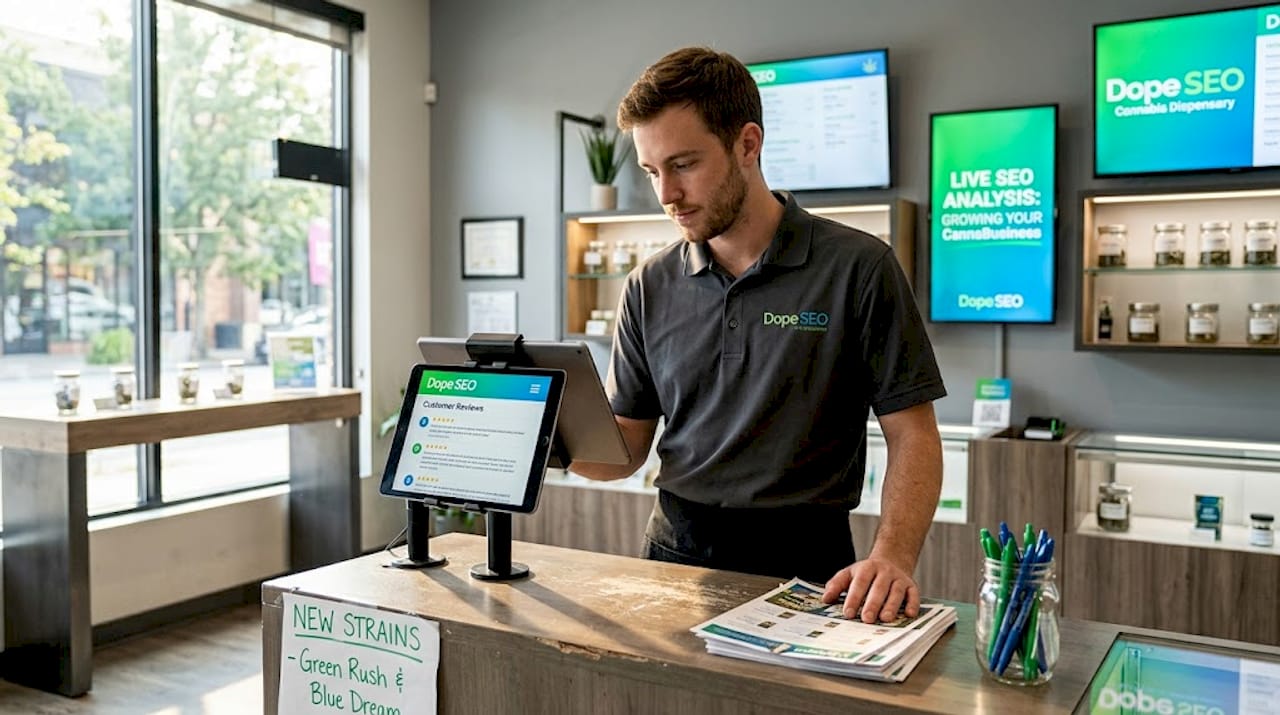
Here’s why that matters for cannabis specifically. Dispensaries in major markets often compete in areas with dozens of nearby businesses all vying for the same three map pack spots. Many of those competitors will have comparable review counts. That’s exactly the moment when what your reviews say becomes just as important as how many you have.
Consider two dispensaries with identical ratings and similar review counts. One has reviews that say “great place” and “love it here.” The other has reviews mentioning “sativa edibles,” “CBD tinctures,” “knowledgeable budtenders,” and “fast pickup orders.” The second dispensary is giving Google something to work with. Those keywords inside review text help Google understand your offerings and reinforce your relevance for specific searches.
Key review signals Google evaluates:
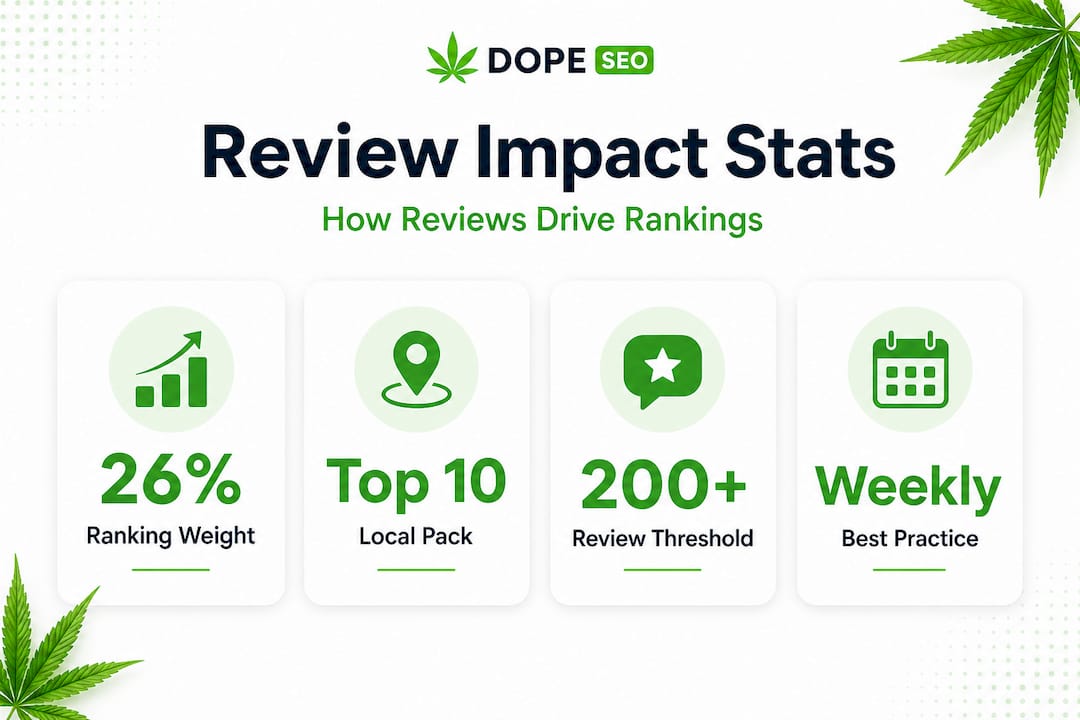
The data backs this up. Review count accounts for 26% of ranking decisions among the top 10 in local packs, making it one of the highest-weighted individual factors at that tier. That’s not a marginal signal. It’s a core driver.
You can learn more about how reviews and SEO for dispensaries interact to create real search visibility gains, especially in markets where the map pack is fiercely contested.
Pro Tip: When training your staff or creating signage that encourages reviews, ask customers to mention the specific product they purchased or the service they appreciated. A review that says “the Blue Dream recommendation from the budtender was spot on” does more for your local SEO than a generic five-star rating with no text.
Let’s say you have 200 reviews and a 4.6 average rating. You feel good about your profile. But here’s the thing: if those reviews mostly came in 18 months ago and you haven’t had a new one in three weeks, your profile is stagnating. Google treats freshness as a signal of ongoing relevance, and so do potential customers.
Recency and velocity are practical levers for local prominence. A business that consistently earns new reviews signals to Google that it is active, serving customers, and worth surfacing. A business with a flat review profile, even a good one, gradually loses that freshness edge over competitors who are generating reviews regularly.
Here’s a step-by-step framework for maintaining review momentum and engagement:
Build a review request into your post-purchase routine. Whether you send an SMS receipt, an email confirmation, or simply train your budtenders to ask at the register, make asking for a review a standard part of every transaction.
Use a short, direct review link. Generate a Google review link from your Google Business Profile dashboard and use it in every post-purchase touchpoint. Fewer clicks mean more completions.
Respond to every review, positive or negative, within 48 hours. Google recommends replying to reviews and notes that this activity can support your local ranking. A prompt, personalized response also builds trust with future customers who read your reviews before visiting.
Personalize your responses. Avoid copy-paste replies. When you reference the specific product or experience a customer mentioned, you signal both to Google and future readers that your business is attentive and genuine.
Address negative reviews constructively. A well-handled negative review can actually reassure potential customers more than silence. Acknowledge the issue, offer a resolution, and keep your tone calm and professional.
Set a weekly review goal. Even a modest target of 3 to 5 new reviews per week adds up to 150 to 260 new reviews over a year. Consistency matters more than occasional spikes.
For more on boosting local cannabis rankings through active profile management, the strategy goes well beyond just reviews. But reviews are often the fastest-moving signal you can control right now.
“Respond to reviews to build your business’s reputation and show customers that you value their feedback.” — Google Business Profile Help
Pro Tip: When a customer leaves a one or two-star review, respond quickly with empathy and a clear next step (like a phone number or email to resolve the issue). Many customers update their reviews after a positive resolution, and that change is visible to everyone researching your dispensary.
Understanding the theory is valuable. But in competitive cannabis markets, you need tactics that actually generate better reviews, more consistently. Here’s how top-performing dispensaries approach review generation beyond just asking for five stars.
What to do:
What to avoid:
The nuance here matters. Review quantity alone may not be enough in top-tier competitive markets. You need quality and relevance, which means guiding customers naturally toward meaningful, specific reviews without scripting them.
Understanding how to rank your dispensary on Google Maps puts reviews in the larger context of local SEO, alongside citations, on-page optimization, and link building. And for a broader view of what’s working right now, our local SEO for cannabis dispensaries guide covers all the foundational pillars. You might also find this breakdown of getting more client reviews useful as a framework for building consistent review volume, even if it’s written for a different industry.
Here’s the honest truth we’ve observed working with cannabis businesses across different markets: most dispensaries treat reviews as a passive metric. They wait for customers to leave them, celebrate when the rating goes up, and move on. That’s not a strategy. That’s wishful thinking dressed up as reputation management.
The businesses that actually dominate their local map packs treat reviews as an active channel. They guide the narrative, not by telling customers what to say, but by creating the kind of experiences and service interactions that naturally produce specific, relevant feedback. When a budtender gives an exceptional recommendation for a particular strain, that customer is far more likely to mention the strain by name in a review without being asked.
What we’ve consistently seen across well-ranked dispensaries is this: deliberate review content beats random high volume in competitive map packs. A dispensary with 120 reviews that frequently mention specific products, staff names, and service experiences will often outrank a competitor with 300 generic five-star ratings. Google’s algorithm is reading that text. It rewards specificity and authenticity.
The hard-won lesson is this: authentic, relevant mentions of services and strains in reviews outperform sheer volume in tight competitive windows. A dispensary that coaches staff to create memorable, specific moments for customers, and then politely asks those customers to share the experience, is building a review profile that functions as genuine content marketing.
Real “review care” for top-ranking dispensaries includes weekly response routines, monthly review audits to spot trends in customer language, and staff training that ties service quality directly to online reputation. It’s not glamorous. But it works, and it works consistently. For context on the full range of ranking factors for cannabis dispensaries, reviews are only one part of the equation, but they’re often the most neglected and the most improvable.
If this article made one thing clear, it’s that reviews aren’t a passive outcome of running a good dispensary. They’re an active ranking signal you can shape, grow, and optimize.
At Dope SEO, we specialize exclusively in cannabis and hemp businesses, which means we understand the platform restrictions, regulatory nuances, and competitive dynamics that generic marketing agencies simply don’t. We help dispensaries build structured review programs, respond strategically to customer feedback, and integrate reputation management into a broader local SEO strategy. Whether you’re starting from scratch or looking to break into the top three map pack positions, our cannabis SEO guide is a strong starting point. From there, our cannabis dispensary search strategies and optimizing local search workflow resources give you a clear path forward.
There’s no fixed number, but review count rises to 26% of ranking weight among top 10 local results, making it a major signal at the most competitive positions. Focus on consistent growth rather than hitting a specific target.
Yes, review keyword relevance contributes significantly in the top ten map results, especially when competing dispensaries have similar review counts. Specific product and service mentions in review text give Google more to work with.
Google advises replying to reviews as a best practice, noting that active engagement supports local ranking and signals that your business values customer feedback.
Aim to generate new reviews weekly, not in occasional bursts. Consistent velocity signals ongoing activity to Google and keeps your profile fresh and relevant to potential customers.
No. Offering discounts, gifts, or any reward in exchange for a review violates Google’s guidelines and can result in review removal or listing penalties that damage your rankings significantly.

© 2026 Curious Monkeys Pressing Buttons LLC DBA Cannabiz Marketing Solutions AKA DopeSEO. All rights reserved.