
Even experienced hemp marketers with solid websites and quality products struggle to attract consistent, qualified web traffic. The reason is rarely the product itself. It almost always comes back to one overlooked factor: search intent. Because hemp businesses face strict advertising bans on platforms like Google Ads and Meta, intent-driven organic SEO becomes the primary engine for customer acquisition. Understanding what your potential customers are actually searching for, and why, is the foundation of every high-performing, compliant hemp marketing strategy.
| Point | Details |
|---|---|
| Search intent is crucial | Tailoring your content to match what users want is key for hemp marketing success and compliance. |
| Organic SEO drives growth | Focusing on intent beats paid channels, especially where advertising is restricted in the hemp industry. |
| Practical keyword strategy | Use long-tail, compliant keywords and local terms for greater search visibility and higher conversion rates. |
| Actionable process matters | A step-by-step search intent workflow prevents costly mistakes and gives your hemp business a clear edge. |
Search intent is the underlying reason a person types a query into a search engine. It answers the question: what does this person actually want right now? Google’s algorithm is built to match results to intent, not just keywords. If your content doesn’t align with what users expect to find, you won’t rank, regardless of how well-written your page is.
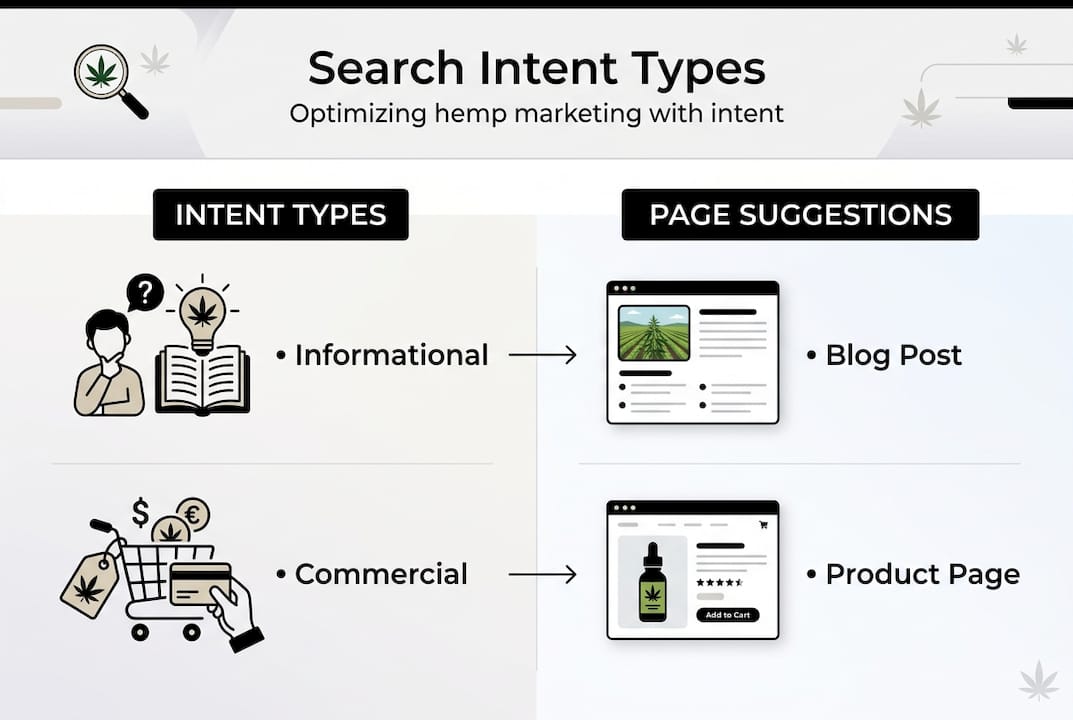
As search intent explained in cannabis SEO, there are four primary types of intent that shape how you should build and optimize content for hemp businesses:
Here’s a quick reference for how these intent types map to hemp business content:
| Intent type | User goal | Best content format |
|---|---|---|
| Informational | Learn about hemp/CBD | Blog posts, guides, FAQs |
| Navigational | Find your brand | Homepage, About page |
| Commercial investigation | Compare products | Review pages, comparison articles |
| Transactional | Buy now | Product pages, landing pages |
“Defining search intent and its role in legal marketing strategies for hemp businesses is the starting point for any SEO campaign that actually converts.”
Ignoring intent means you might rank for a keyword but attract visitors who have no interest in buying. That wastes your content budget and inflates your bounce rate. Applying hemp marketing compliance tips alongside intent research keeps your strategy both effective and legally sound.
With a clear definition in hand, let’s explore the four primary types of search intent and how each shapes winning hemp marketing.
Each intent type demands a different content approach. Matching the wrong format to the wrong intent is one of the most common reasons hemp pages fail to rank. Here’s how to think about each one:
| Intent type | Example hemp query | Recommended page type |
|---|---|---|
| Informational | “How does CBD work?” | Blog post or guide |
| Navigational | “[Brand] hemp store” | Homepage or brand page |
| Commercial | “Best CBD gummies for pain” | Comparison or review article |
| Transactional | “Buy CBD tincture 1000mg” | Product or category page |
Pro Tip: Open Google and type your target keyword. Scan the “People also ask” section and the top-ranking results. The format and tone of those results tell you exactly what intent Google has assigned to that query. Match it, and your chances of ranking improve significantly.
Misaligning content with intent is costly. A product page targeting “What is hemp?” will almost never rank because Google knows that query is informational. Intent-driven organic SEO removes the guesswork and replaces it with evidence-based content decisions. Always check SEO compliance for cannabis requirements before publishing any new content.

Next, understand exactly why intent-first thinking isn’t just smart, it’s necessary in today’s hemp marketing environment.
Google Ads, Facebook Ads, and most major paid platforms restrict or outright ban hemp and CBD advertising. This isn’t a temporary inconvenience. It’s a structural reality that forces hemp businesses to rely on organic search as their primary acquisition channel. That makes search intent not just useful but essential.
When you align your content with real user intent, the results are measurable:
Compliant, intent-focused organic content can deliver over 40% higher engagement compared to generic keyword targeting. That’s a significant lift when paid channels are off the table.
Pro Tip: Prioritize long-tail keywords like “organic CBD oil for joint pain in Denver” over broad terms like “CBD oil.” Long-tail queries have clearer intent, less competition, and higher conversion rates. They also align naturally with cannabis SEO compliance requirements because they’re specific and informational rather than promotional. Explore cannabis marketing strategies to see how this fits into a broader plan.
Now, let’s make this actionable with a clear step-by-step process any hemp industry marketer can apply.
Pro Tip: Never build a landing page or blog post without first confirming the search intent behind your target keyword. Intent-driven organic SEO is the difference between a page that ranks on page one and one that gets buried on page five.
As you put all this into play, watch out for the biggest issues that stall or derail hemp intent-driven marketing.
Even marketers who understand search intent in theory make avoidable errors in practice. Here are the most common ones:
“Most hemp marketing failures start with guessing what the customer wants. You need evidence.”
The fix for every mistake above is the same: go back to the data. Use search intent research as your starting point for every piece of content, every page update, and every keyword decision. Evidence beats assumptions every time.
Ready to get more from every site visitor and searcher? Here’s how to put these lessons into action with guidance from proven experts.
At Dope SEO, we specialize in building intent-driven SEO strategies for hemp and cannabis businesses that can’t rely on paid advertising. Our team understands the regulatory landscape, the platform restrictions, and the local market dynamics that make hemp marketing uniquely challenging. From advanced cannabis SEO strategies to full-service content planning and competitor analysis, we build campaigns around what your customers are actually searching for. If you’re ready to stop guessing and start ranking, explore our cannabis marketing strategies or schedule a free consultation with our team today.
Strict advertising restrictions make organic, intent-focused SEO the most reliable way for hemp brands to reach qualified customers. Without paid channels, organic search is your primary growth engine.
Analyze the search results page for each keyword and review the “People Also Ask” section. The search intent signals in those results tell you exactly what format and tone Google expects.
Yes. Content that matches user intent consistently outperforms generic efforts. Intent-driven organic SEO leads to higher engagement, better lead quality, and stronger conversions without relying on paid ads.
Avoid broad or outdated keywords, and always ensure your content is compliant with current regulations. Aligning every page to a specific search intent and local customer needs is the most reliable path to consistent rankings.

© 2026 Curious Monkeys Pressing Buttons LLC DBA Cannabiz Marketing Solutions AKA DopeSEO. All rights reserved.