
TL;DR:
- Proper cannabis eCommerce integration is essential to maintain compliance, prevent penalties, and ensure inventory accuracy across all platforms. It requires thoroughly understanding jurisdictional regulations, mapping system requirements, and implementing server-side gating and SKU-level compliance flags. Ongoing testing and monitoring create a reliable, audit-ready workflow that minimizes costly errors and strengthens operational efficiency.
Getting cannabis eCommerce integration wrong doesn’t just mean a buggy checkout experience. It can mean regulatory penalties, license suspension, or inventory discrepancies that take weeks to unravel. Your online sales channel must connect seamlessly with your point-of-sale system, seed-to-sale traceability platform, age verification tools, and tax calculation logic from day one. This guide walks you through a proven, compliance-first integration process so your dispensary can sell online with confidence, operational efficiency, and a clean audit trail at every stage.
| Point | Details |
|---|---|
| Check compliance first | Know your jurisdiction’s rules and platform prerequisites before starting integration. |
| Synchronize inventory automatically | Integrate your POS and regulatory systems to avoid manual errors and stay audit-ready. |
| Gate and verify every sale | Use integrated age/ID verification and cart/checkout restrictions to prevent illegal transactions. |
| Use secure payment and tax APIs | Process payments and calculate taxes server-side to meet regulatory requirements. |
| Test and monitor continuously | Run compliance checks and monitor all systems regularly to maintain legal operations. |
To solve compliance challenges, your first step is proper preparation. Before you configure a single plugin or API connection, you need a clear picture of what your jurisdiction requires and what your existing systems can actually support.
Jurisdictional rules vary more than most operators expect. Some states allow direct-to-consumer cannabis delivery; others prohibit it entirely. Product type restrictions, purchase limits per transaction, and medical versus recreational distinctions all affect how your eCommerce system must behave. As a step-by-step integration pattern confirms, confirming jurisdiction and compliance requirements is the critical first action before any technical setup begins.
Here are the core compliance areas you must audit before integration:
On the technical side, your integration prerequisites include checking whether your POS system supports API connections to your eCommerce platform, whether your products are already tagged with the right SKU-level data for traceability, and whether your eCommerce platform allows custom checkout logic. Review your website compliance essentials and cannabis integration basics to make sure your foundation is solid before moving forward.
| Prerequisite | Why it matters |
|---|---|
| POS with API access | Enables real-time inventory and sales sync |
| Seed-to-sale platform connection | Required for regulatory reporting |
| Compliant eCommerce platform | Must support age gating and cart restrictions |
| Tagged product catalog | Needed for SKU-level compliance flags |
Pro Tip: Build a compliance checklist document that lists every state and local requirement with a column for “how this is enforced technically.” Review it with your legal counsel before you begin integration. This single step can prevent costly re-builds later.
With compliance prerequisites in hand, the next step is visualizing how your entire tech stack will route orders, inventory updates, and regulatory triggers. Most operators underestimate how many systems need to talk to each other.
Your core integration architecture includes four connected layers:
The difference between running these systems manually versus integrating them is enormous. Here’s a direct comparison:
| Factor | Manual flow | Integrated flow |
|---|---|---|
| Inventory accuracy | Updated manually after each sale | Updated automatically at transaction |
| Compliance reporting | Entered by staff, error-prone | Synced directly to Metrc or state system |
| Age verification | Checked at counter only | Enforced at online checkout and POS |
| Audit readiness | Requires manual record reconciliation | Automated logs available in real time |
| Operational effort | High, requires multiple staff touchpoints | Low, system handles routine compliance steps |
“For cannabis and higher-risk retail, many teams implement eCommerce-to-POS integration so online ordering data and inventory stay synchronized, reducing manual error and maintaining regulatory accuracy across channels.”
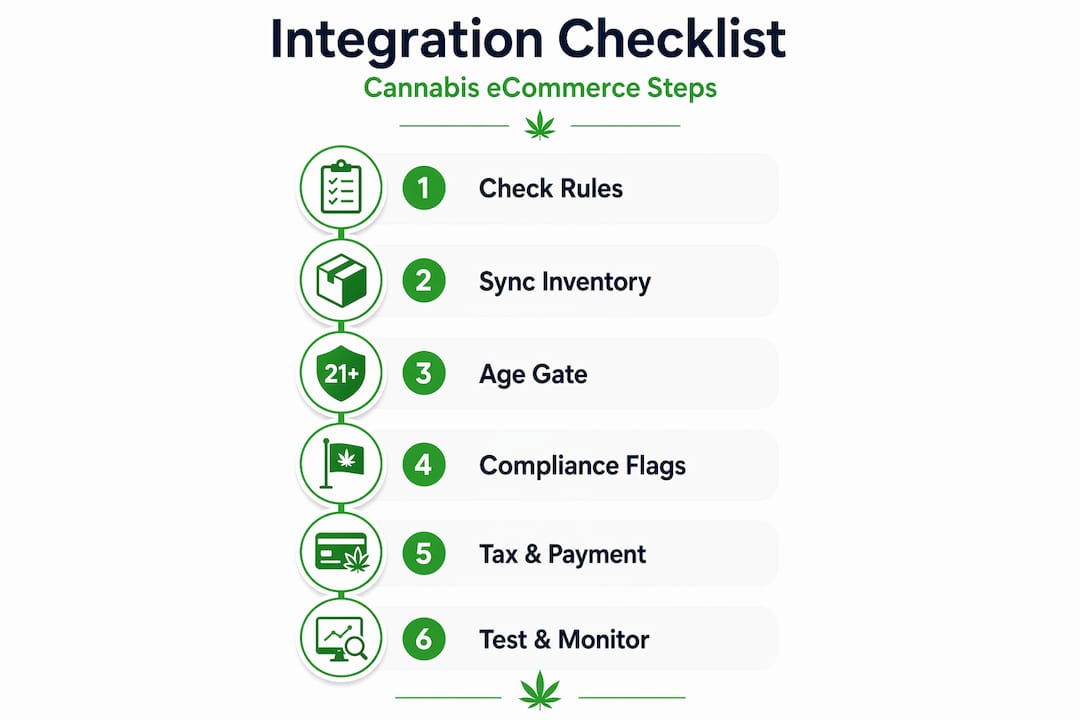
The numbered integration steps you’ll work through are:
Strong eCommerce for dispensaries relies on getting this architecture right from the start. Poor web design decisions at the system-mapping stage often create technical debt that’s far more expensive to fix later.

With a mapped process, move step by step through setup, keeping compliance triggers front and center at every stage. This is where most dispensaries either get it right or create gaps that surface during an audit.
Step-by-step execution:
Configure age and ID gates. Set up age verification at account creation and again at checkout. The gate should block users who don’t confirm age eligibility. For pickup or delivery orders, link your online verification to your POS-based ID check so there’s a consistent customer record.
Enable cart and checkout restrictions. Program your cart logic to enforce purchase limits by product category, total weight, or THC content. If a customer’s cart exceeds the legal limit for your state, the checkout should block the transaction with a clear message rather than allowing an illegal sale.
Link eCommerce to your POS. This connection ensures every online order flows into your POS as a pending transaction, reducing double-entry and keeping inventory counts accurate. When a product sells online, the POS reflects it immediately.
Sync sales data with your traceability platform. Each completed transaction should trigger an automatic update to Metrc or your state’s equivalent system. Age verification and POS-linked ID checks can be operationally integrated so customers are verified before purchase or queuing, reducing underage sale risk significantly.
Test all compliance triggers before launch. Simulate edge cases intentionally: try an underage entry, attempt a cart above purchase limits, use a zip code from a non-delivery zone. Every trigger should fire correctly.
Edge cases you must plan for:
The step-by-step integration pattern confirms this sequence: gate checkout first, then connect and sync data to your POS and traceability system, and finally test with audit-ready workflows.
Pro Tip: Set up SKU-level compliance flags in your eCommerce product catalog. Each SKU should carry metadata for product category, THC content, and applicable state restrictions. Your checkout logic reads these flags server-side so restrictions fire automatically, even if a staff member accidentally lists a non-compliant product. Use these flags to boost eCommerce sales through better catalog management as well.
Each checkout action should trigger server-side checks for age, zip code, and SKU eligibility. Never rely on client-side JavaScript alone for these restrictions. Client-side checks can be bypassed. Server-side enforcement cannot.
After setting up basic compliance and order sync, connect your payments and tax calculations for a complete, audit-ready workflow. This step is where many cannabis operators make costly technical shortcuts.
Cannabis retail faces unique payment challenges. Many traditional processors decline cannabis merchants. You need a processor who explicitly supports regulated cannabis businesses, with clear terms around chargebacks, settlement timelines, and compliance documentation. Review your options for cannabis payment processing to find processors suited to your license type.
For tax calculation, the rule is simple: always server-side, never client-side. Trigger tax calculation via platform extension or webhook mechanisms or API-based tax services rather than relying on manual or ad-hoc client-side logic. Cannabis tax rates vary by state, county, municipality, and product type. A server-side tax API pulls the correct rate based on the customer’s delivery address and product category in real time.
Direct API integration vs. platform plugin: key considerations
Manual tax calculation is a genuine liability. Reconciliation errors from manual entry can compound across hundreds of daily transactions, leading to under-reporting or over-collection. Both create problems during state audits.
When selecting a platform approach, also review your options for choosing eCommerce platforms. The right platform choice directly affects how cleanly you can implement payment and tax integration.
Pro Tip: Before going live, run your payment and tax integrations through a full sandbox test cycle. Process at least 20 to 30 test transactions across different product categories, delivery zones, and tax scenarios. Verify that your audit logs capture each calculation and payment event correctly. Catching discrepancies in sandbox costs nothing. Catching them during a state audit is a different story.
With all integrations installed, close the loop by validating and maintaining your system in real-world operations. Testing before launch is obvious. Ongoing monitoring is often neglected.
Tests to run before go-live:
Ongoing monitoring practices:
Pro Tip: Document every integration component, including API endpoints, webhook triggers, and compliance flags, in a single internal reference document. When a regulator asks how your system enforces purchase limits, you want to pull up a clear answer in seconds, not spend hours reconstructing logic from memory.
A well-maintained dispensary website optimization practice extends beyond SEO. System performance, uptime, and integration health all affect customer experience and compliance posture. Treat monitoring as a core operational responsibility, not an afterthought.
Here’s the honest reality after working with cannabis operators at various stages of their eCommerce build-out: the failures we see most often aren’t from missing major steps. They come from underestimating the edge cases.
A dispensary can get age gating right, connect their POS, and even link to Metrc successfully. But they leave checkout open to prohibited product combinations because no one mapped those restrictions at the SKU level. Or they sync their product catalog but not their live inventory, meaning customers can order products that are physically out of stock or flagged in their traceability system. Regulators don’t grade on effort. They check outcomes.
The mindset shift that separates operators who sail through compliance audits from those who don’t is treating server-side gating, SKU-level flags, and audit logging as requirements, not enhancements. These elements aren’t expensive nice-to-haves you add after launch. They’re the foundation. Rushing to go live without them doesn’t save time. It creates remediation work that’s far more disruptive than building it correctly the first time.
There’s also a pattern worth noting around SEO compliance for cannabis: operators who build their websites with compliance baked into the architecture tend to rank better too. Search engines reward well-structured, technically sound sites. Compliance and discoverability aren’t opposing priorities. They reinforce each other when your foundation is solid.
Navigating eCommerce integration correctly is a major operational win. But once your system is running, the next challenge is getting qualified buyers to your store and converting them into loyal customers.

At Dope SEO, we specialize in helping cannabis dispensaries build organic visibility alongside their operational infrastructure. Our team understands both the regulatory environment and the technical requirements that make cannabis eCommerce work. Whether you’re refining your cannabis SEO strategy to attract local buyers, building out your cannabis marketing solutions, or starting from scratch with a cannabis SEO guide, we bring industry-specific expertise that generalist agencies simply can’t match. Reach out to our team and let’s map a growth plan built for your market.
Failing to sync POS data with regulatory systems is the most common error, leading to mismatched inventory records and potential compliance penalties. A linked POS sends transaction details to Metrc at the time of sale, eliminating the manual reconciliation gap.
Integrate age verification at both the storefront and checkout stages, with ID scanning linked directly to your POS for pickup and delivery fulfillment. Age verification and POS-linked ID checks can be operationally integrated to reduce underage sale risk before any queue or purchase is finalized.
Metrc-connected POS systems and eCommerce platforms with custom API extensions are best suited for automating compliance updates and checkout triggers. Metrc-integrated POS systems update inventory records automatically at each transaction, keeping your regulatory reporting current without manual input.
Always calculate taxes server-side using a trusted API or platform-supported extension. Triggering tax calculation via API or webhook mechanisms prevents errors that arise from manual or client-side tax logic.
Use sandbox environments to process test transactions across age verification failures, over-limit cart attempts, out-of-zone delivery addresses, and tax scenarios, then verify that audit trails in all connected systems reflect each event correctly.

© 2026 Curious Monkeys Pressing Buttons LLC DBA Cannabiz Marketing Solutions AKA DopeSEO. All rights reserved.