
TL;DR:
- Long-tail keywords attract highly targeted, purchase-ready cannabis customers with 25% higher conversion rates.
- They improve search rankings by matching specific search intent and reducing competition.
- Building content clusters around related long-tail phrases enhances long-term topical authority and organic growth.
Most cannabis businesses pour their budget into ranking for terms like “dispensary” or “buy weed online,” only to find themselves buried under national brands and well-funded competitors. The smarter play? Long-tail keywords, specific phrases that attract buyers who already know what they want. Long-tail keywords yield 25% higher conversions than broad terms in cannabis SEO, making them one of the highest-return strategies available to dispensaries and manufacturers. This guide breaks down what long-tail keywords are, how they work in a regulated industry, and exactly how to find and use them to grow your organic traffic.
| Point | Details |
|---|---|
| Long-tail keywords boost conversions | Cannabis businesses benefit from 25 percent higher conversion rates using long-tail keywords over broad terms. |
| Reach the right audience | Focusing on specific phrases attracts motivated buyers looking for exactly what you offer. |
| Avoid compliance pitfalls | Tailoring keywords helps cannabis brands stay compliant with strict advertising regulations. |
| Continuous research wins | Regularly updating your keyword strategies keeps you ahead in the competitive cannabis market. |
A long-tail keyword is a search phrase, typically three or more words, that targets a narrow, specific topic. Instead of “cannabis oil,” a long-tail phrase might be “best CBD oil for anxiety in Denver.” That extra specificity is not a weakness. It is a targeting advantage.
Understanding keyword research importance is the foundation of any effective cannabis SEO plan. Short-tail keywords get searched more often, but they also attract enormous competition and vague intent. Someone searching “cannabis” could be a researcher, a journalist, or a curious teenager. Someone searching “organic sativa flower delivery Portland Oregon” is almost certainly a buyer.
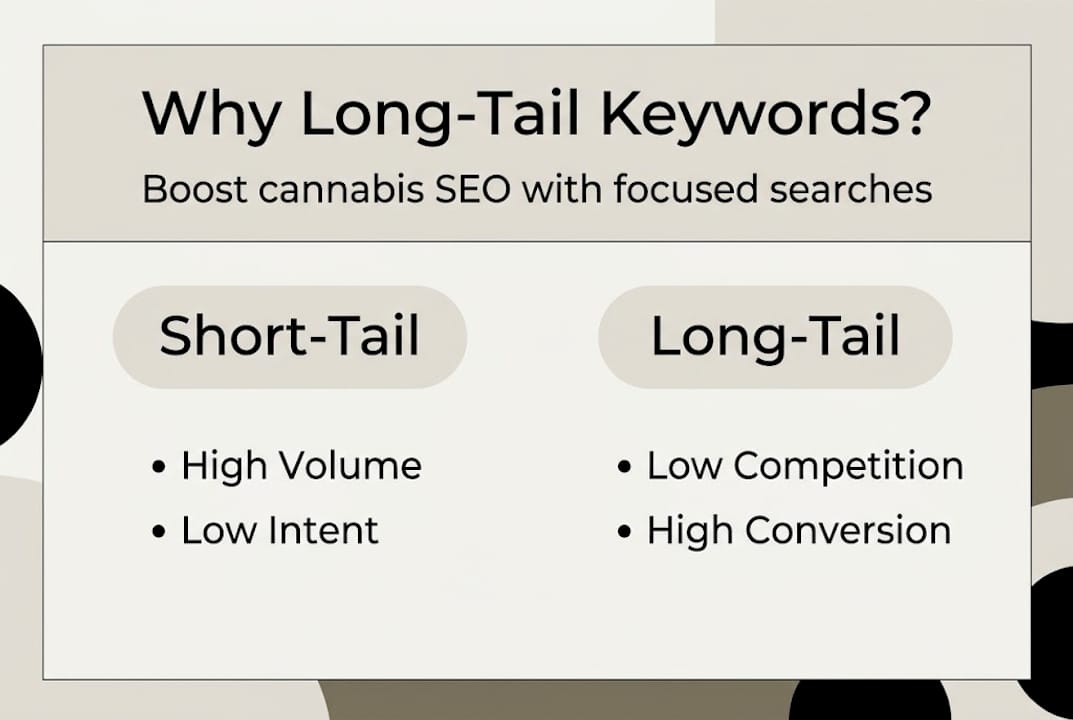
Here is a direct comparison:
| Factor | Short-tail keyword | Long-tail keyword |
|---|---|---|
| Example | “dispensary” | “cannabis delivery near downtown Austin” |
| Monthly search volume | Very high | Low to moderate |
| Competition level | Extremely high | Low to moderate |
| Conversion potential | Low | High |
| Audience intent | Unclear | Purchase-ready |
For cannabis businesses specifically, the case for long-tail keywords is even stronger. Advertising restrictions on platforms like Google and Meta mean you cannot rely on paid ads the way other industries can. Organic search becomes your primary channel, and cannabis SEO terminology like “search intent” and “keyword specificity” directly shape how well your pages perform.
Here is why long-tail keywords outperform in regulated markets:
“Long-tail keywords yield 25% higher conversions than broad terms in cannabis SEO, making them a critical asset for any dispensary or manufacturer investing in organic growth.”
That conversion advantage is not a coincidence. It reflects the reality that specific searches come from specific buyers.
Understanding what long-tail keywords are is just the start. Here is how they actively work to put your cannabis business in front of the right audience.
Google’s ranking algorithm rewards relevance above almost everything else. When a page’s content closely matches a user’s search phrase, Google sees it as a strong answer to that query. A dispensary page optimized for “low-dose THC edibles for beginners in Chicago” is far more likely to rank for that exact search than a generic “edibles” page, even if the generic page has more backlinks.
Consider this visibility comparison:
| Keyword | Estimated competition | Realistic ranking position for a new site |
|---|---|---|
| “cannabis” | Extremely high | Page 5 or beyond |
| “dispensary near me” | High | Page 2 to 3 |
| “CBD gummies for sleep in Tucson” | Low | Page 1 possible |
The math is straightforward. A page 1 ranking for a low-competition long-tail phrase sends more qualified traffic than a page 5 ranking for a popular term.
Here is a step-by-step look at how targeting specific search intent draws more qualified buyers to your site:
Pro Tip: Geo-specific phrases like “recreational dispensary open late in Boulder” or product-specific phrases like “live resin cartridge under $40 Phoenix” combine location and product detail in ways that attract buyers who are ready to act. These are the searches that turn into same-day sales.
The cannabis keyword research process is where this visibility advantage starts. The more precisely you understand what your ideal customer is searching for, the more precisely you can put your business in front of them.

Now that you know the value of long-tail keywords, the next step is figuring out how to find and use these terms strategically.
Start with the tools and sources already available to you:
When evaluating any keyword, look for these four factors:
Once you have a list, follow this workflow:
For advanced keyword research in cannabis, customer questions are one of the most underused sources. Read your reviews, listen to in-store questions, and check your email inquiries. Real customer language converts better than anything a keyword tool generates.
Pro Tip: Build a simple spreadsheet to track each keyword, its assigned page, current ranking, and monthly traffic. This single habit separates businesses that see steady SEO growth from those that guess and hope.
Being proactive is key, but what you avoid is just as critical as what you do. Here are pitfalls to sidestep for a more effective SEO campaign.
Keyword stuffing: Repeating a phrase five or six times in a short paragraph does not help rankings. It hurts them. Google penalizes unnatural repetition, and readers leave pages that read like a robot wrote them. Use your target phrase once in the title, once in the opening paragraph, and naturally throughout the rest of the content.
Ignoring user intent: A long-tail keyword that sounds specific can still attract the wrong audience if the intent does not match your page. “How to grow cannabis at home” targets a grower, not a buyer. Make sure the intent behind each phrase aligns with your business goal for that page.
Skipping compliance review: Cannabis SEO operates in a regulated space. Phrases that reference specific medical claims, dosage recommendations, or restricted product types can create legal exposure or get your content flagged. Review SEO best practices for cannabis before publishing any health-adjacent content.
Ignoring analytics: If you are not tracking which keywords drive traffic and conversions, you are flying blind. Set up Google Analytics and Search Console from day one and review them monthly.
Targeting irrelevant phrases: A keyword with low competition is only valuable if it attracts your actual customer. A dispensary in Miami targeting “cannabis laws in Canada” will get traffic with zero conversion potential. Stay focused on phrases your local or product-specific audience actually searches.
“Quality and relevance always beat quantity. Ten well-chosen long-tail keywords outperform a hundred poorly matched ones every time.”
Staying current with 2026 SEO trends in cannabis markets is also essential. Search behavior shifts, regulations change, and new competitors enter your market. A keyword strategy that worked last year may need updates today.
Most guides stop at “find the right keywords and use them on your pages.” That advice is not wrong, but it misses the bigger picture.
The real ROI from long-tail keywords comes from building topical authority, not chasing dozens of isolated phrases. When you create a cluster of related content around a theme, such as CBD education, local delivery, or strain selection, Google begins to recognize your site as a trusted resource on that topic. That recognition lifts all your pages, not just the ones you optimized.
Rather than publishing 30 disconnected blog posts, build educational resource hubs. Group related long-tail topics together, link them internally, and go deep on each subject. This approach builds reader trust alongside search visibility.
The marketing strategies for cannabis that produce lasting results are built on answering customer questions thoroughly, not gaming an algorithm. When your content genuinely helps someone make a better purchase decision, they return, share, and convert. That is the kind of growth that compounds over time.
Long-tail keywords are one of the most practical and cost-effective tools available to cannabis businesses right now. But knowing the strategy and executing it consistently are two different things.
At Dope SEO, we specialize in helping dispensaries and cannabis manufacturers build SEO strategies that actually work within the unique constraints of this industry. Whether you are starting from scratch or refining an existing approach, our resources give you a clear path forward. Start with our what is cannabis SEO guide to build your foundation, then move into our cannabis SEO strategy playbook for 2026 to put everything into action. Your next qualified customer is already searching. Make sure they find you.
Phrases like “organic cannabis delivery in Seattle” or “best CBD oil for sleep Arizona” are long-tail keywords that target highly specific search intent, and they convert at 25% higher rates than broad terms.
They attract visitors with highly specific needs, which is why they produce 25% higher conversions compared to general search terms that draw mixed-intent traffic.
Review and update your keyword list every quarter to stay ahead of trends and compliance changes in cannabis search behavior.
Yes, using city- or neighborhood-specific search phrases enhances local rankings and attracts nearby customers, and geo-targeted long-tail terms are among the highest-converting options available to dispensaries.

© 2026 Curious Monkeys Pressing Buttons LLC DBA Cannabiz Marketing Solutions AKA DopeSEO. All rights reserved.